

The Ferrari 308 GT4 wears a sharp Bertone wedge where many buyers expect the curves of a Pininfarina Ferrari. Introduced as the Dino 308 GT4, it also occupies a pivotal place in the company’s history: Ferrari identifies it as its first series-production road V8 and its first mid-engine 2+2. Its shape may divide opinion, but its significance does not depend on looking like a two-seat 308.
The rear seats and its reputation for being comparatively accessible can make the GT4 seem like a practical way into classic Ferrari ownership. Neither protects a buyer from costly engine work, difficult service access, or the consequences of long storage. The soundest approach is to judge the GT4 as a distinctive car in its own right, then judge each example by its records and mechanical condition.
- Why Bertone’s GT4 mattered to Ferrari
- A transverse V8, not a rebodied two-seat 308
- European and US 308 GT4 specifications at a glance
- What the 2+2 layout really gives you
- The maintenance bill behind an accessible classic
- Inspect the car beneath the fresh paint
- The GT4’s place in the Ferrari story
- Frequently asked questions
- What is the average price of a Ferrari 308 GT4?
- Why is the 308 GT4 sometimes called a “poor man’s Ferrari”?
- How can I check whether a GT4’s Dino or Ferrari badging is original?
- How can I reduce problems when storing a 308 GT4?
Why Bertone’s GT4 mattered to Ferrari
Bertone designed the Dino 308 GT4 as an original mid-engine 2+2, rather than restyling an existing two-seat car. Its straight edges, angular glasshouse, and wedge profile marked a conspicuous departure from the Pininfarina shapes familiar to Ferrari buyers. Whether that makes it compelling or awkward remains a matter of taste, and it is worth deciding in person rather than through photographs alone.
The Dino name was part of the car’s identity at introduction. That can make the GT4 look like an outsider in a Ferrari collection, yet the engineering milestone is firmly within Ferrari’s road-car story. Ferrari identifies it as its first series-production road V8 and its first mid-engine 2+2.
That V8 claim has a precise boundary. It does not mean Ferrari had never built a V8 before: earlier racing and experimental engines fall outside the series-production road-car distinction. For a buyer, the distinction explains why the GT4 matters without asking the badge or the styling to carry its historical case alone.
A transverse V8, not a rebodied two-seat 308
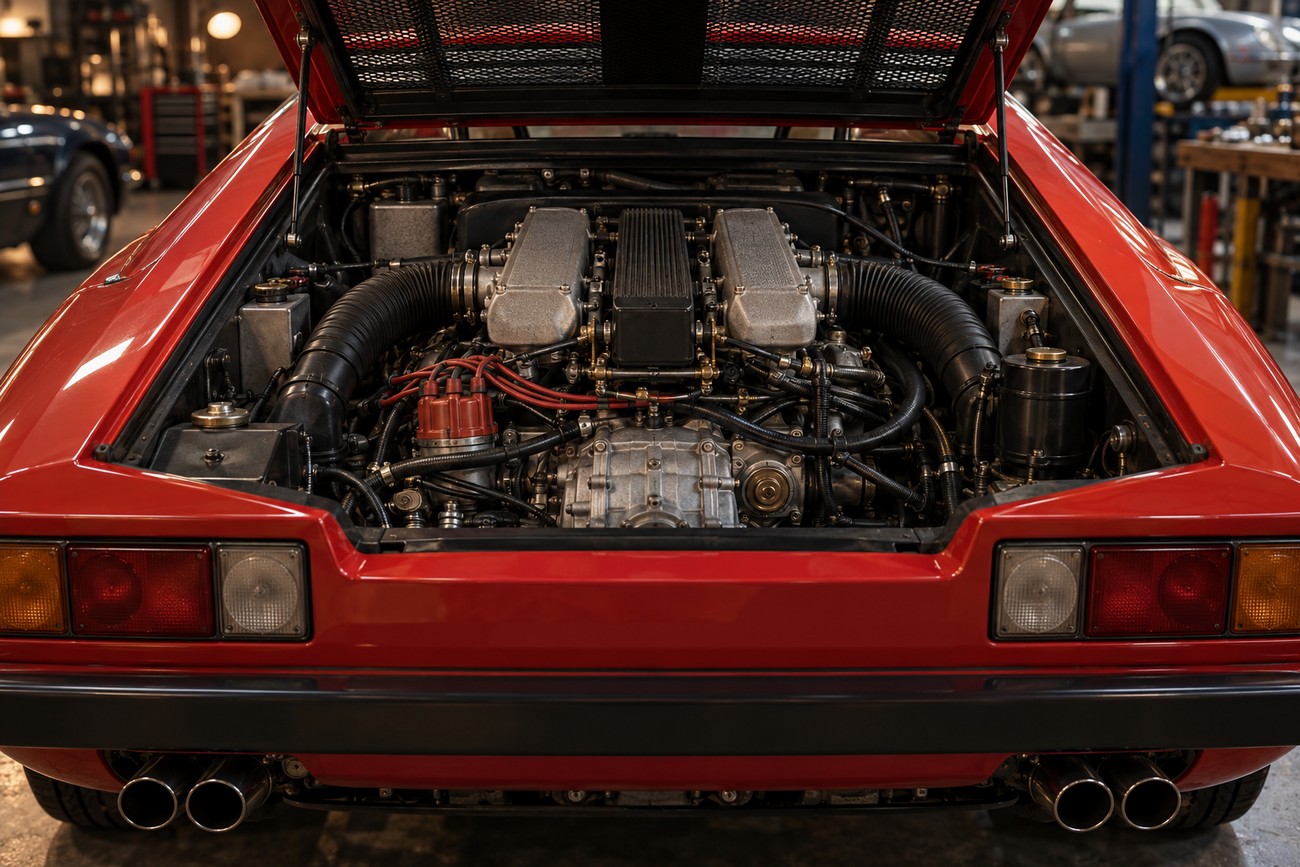
The GT4’s naturally aspirated 90-degree V8 has four camshafts and belt-driven timing. Mounted transversely behind the cabin, it works with a five-speed manual gearbox to drive the rear wheels. This arrangement helps explain how Ferrari fitted a mid-engine drivetrain and a second row of seats within the same car.
Packaging is central to the GT4’s character. The rear seats required space that a two-seat design could devote to other priorities, while the transverse engine made use of the room available behind the cabin. The result deserves to be understood on its own terms, rather than treated as a two-seat 308 with a longer roof.
That compact installation has a service consequence: access around the engine can be labor-intensive. Four Weber carburetors also require careful adjustment if the engine is to run as intended. Neither feature makes the car inherently troublesome, but both reward evidence of work done by someone familiar with this particular installation.
European and US 308 GT4 specifications at a glance
Quoted output depends on the market and specification, so identify the car before comparing performance claims.
| Specification | Commonly quoted power | How to compare it |
|---|---|---|
| European 308 GT4 | Approximately 255 hp | Confirm the year and series before applying a published figure to an individual car. |
| US-specification 308 GT4 | Approximately 230–240 hp, depending on source and specification | Do not use European output or performance claims as a direct expectation for a US car. |
Published engine capacity figures differ: Ferrari’s historical figure is 2996 cm³, while technical references commonly give 2926–2927 cm³. Attribute the figure you use and check the car’s market and series. The separately produced Italian-market 208 GT4 should not be folded into 308 GT4 comparisons.
What the 2+2 layout really gives you
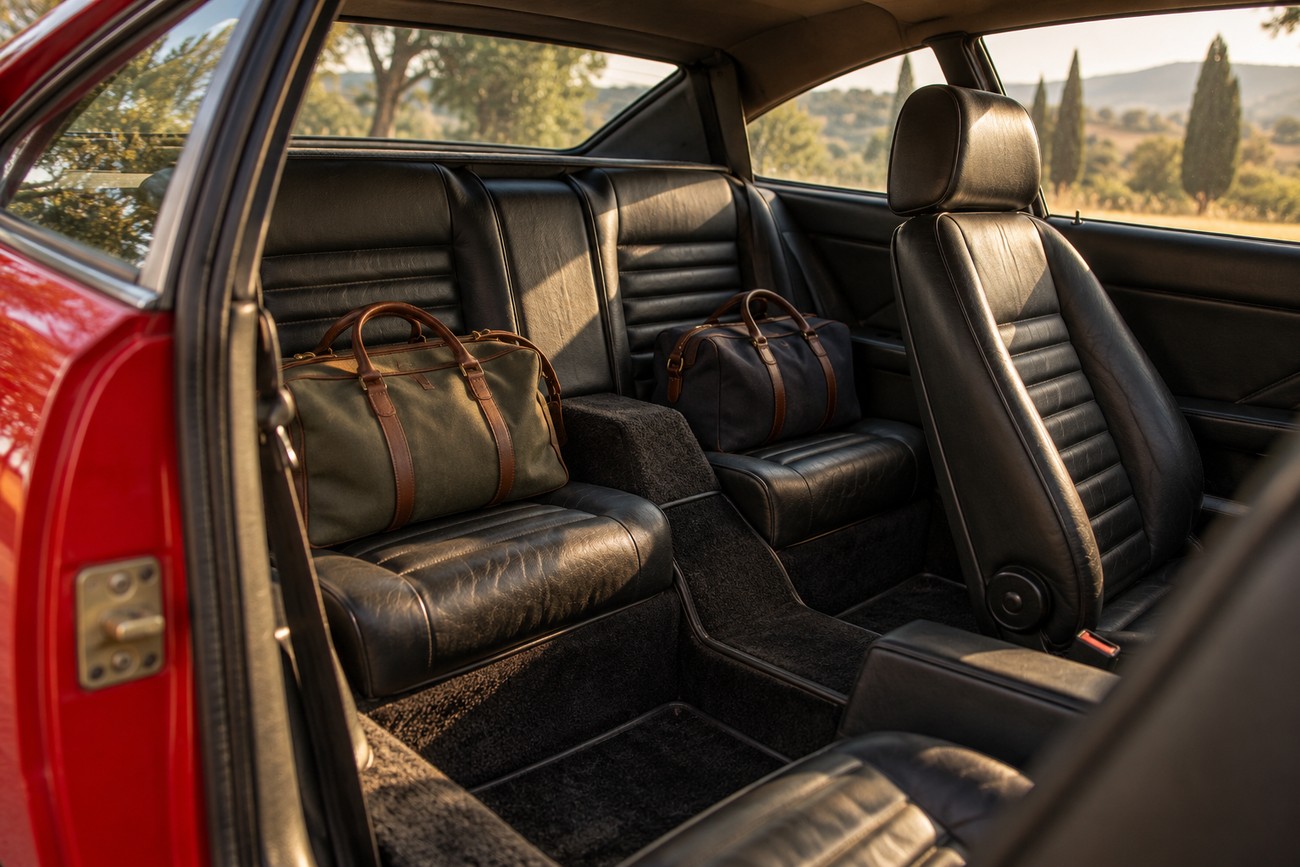
Ferrari describes the 308 GT4 as a mid-engine 2+2, a useful distinction from calling it a four-seater. Its rear seats are generally better suited to children or luggage than to regular adult travel. A prospective owner who needs to carry adults should test that expectation with the people concerned before treating the extra seats as a buying advantage.
For someone who usually travels alone or with one passenger, the second row can still make the car easier to live with. It offers a place for bags inside the cabin without suggesting the flexibility of a conventional four-seat car. That modest benefit is more credible than the promise of full-time family transport.
The transverse engine is part of how this unusual cabin arrangement was achieved. Around it sits a steel body, with aluminum covers for the front luggage compartment and engine compartment. Those materials matter at inspection time: tidy-looking aluminum covers say little about the condition of the aging steel structure beneath the paint.
Interior and exterior design will settle differently with different buyers. Some prefer the intimacy and curves of Ferrari’s Pininfarina-designed two-seaters; others value the GT4’s angular shape and unusual cabin. Neither preference changes the physical limits of the rear seats, so appeal and utility deserve separate judgments.
The maintenance bill behind an accessible classic
Timing-belt service is a defining ownership expense because access is labor-intensive. A price quoted for the belts alone may leave out tensioners, seals, and work prompted by leaks or cooling-system faults found along the way. Before accepting an estimate, ask what has been included and what would trigger additional work.
Service timing also calls for care. Guidance cited by owners and specialists ranges from approximately three years to a quoted five years or 15,000 miles. Rather than adopting one interval for every GT4, establish the guidance applicable to the car and examine dated records of what was actually replaced.
Original sodium-filled exhaust valves on early engines can pose a serious risk. If a seller says they have been replaced, seek documentation that identifies the work; an assurance without a record leaves the engine’s history uncertain. A compression check and a review by a GT4-aware specialist help put that claim in context, although neither replaces evidence of the repair.
The four Weber carburetors introduce a different kind of expense if they have been neglected or poorly adjusted. Uneven running can be mistaken for an ignition fault, leading to work that does not address the cause. Careful diagnosis matters more than replacing parts in the order they appear suspect.
Inspect the car beneath the fresh paint
Begin with the engine history, not the finish. Look for dated evidence of belt work, any documented exhaust-valve replacement, and attention to the cooling system, then arrange a compression check and specialist inspection. A low asking price can lose its appeal quickly if major work is due or the records cannot support the seller’s account.
Next, establish how the car has been used and stored. Long periods without use can leave aged belts and seals, carburetor problems, seized brake calipers, and rusty discs to emerge together. The GT4 has disc brakes on all four wheels, so a recommissioning assessment should cover the complete braking system rather than assume that a short drive proves it sound.
Fresh paint deserves a close look at the steel beneath it. Age and damp storage can conceal corrosion, while an attractive exterior offers no evidence that the engine or brakes have been maintained. Assess the body and mechanical systems separately, even on a car presented as recently restored.
Parts planning is another reason to use someone who knows the model. Components that look interchangeable with those of other 308 models may need fitment verification before they can be ordered or priced into a repair. With a comparatively small production run, a mistaken assumption can turn an apparently straightforward job into a longer, costlier one.
The GT4’s place in the Ferrari story
The 308 GT4 established a series-production road-car V8 and mid-engine 2+2 layout at Ferrari. In that sense, it forms a bridge toward the company’s later mid-engine V8 road cars, without implying that those cars share identical mechanical layouts. Its historical value lies in what it introduced, as well as in the Bertone design that gave it a distinct identity.
Production ran approximately from 1973/1974 to 1980, with 2,826 examples of the 308 GT4 built. The 208 GT4 was a separately produced Italian-market variant, not part of that total. The Mondial 8 succeeded the 308 GT4.
Those facts can make the car appealing to a collector who wants more than a familiar Ferrari silhouette. They do not reduce the cost of overdue service on a particular example. The right GT4 is one whose Bertone shape you want to own and whose documented condition gives you a realistic basis for maintaining it.
Frequently asked questions
The answers below address common buying and ownership questions that cannot be settled by the model’s specification alone. For any individual GT4, dated evidence is more useful than a general claim about the model.
What is the average price of a Ferrari 308 GT4?
A defensible current average requires recent, dated completed sales from the relevant market; an asking price is not proof of a sale. Compare cars of similar condition and specification, then account for documented major engine work, service history, corrosion, and recommissioning needs. A single unsupported average can conceal the difference between a maintained car and one facing a substantial bill.
Why is the 308 GT4 sometimes called a “poor man’s Ferrari”?
The label reflects perceptions of its divisive Bertone styling and its relative appeal beside more familiar Ferrari shapes. It says little about what it costs to keep one properly maintained. Buy on the strength of the design and the individual car’s condition, rather than treating the nickname as a promise of inexpensive ownership.
How can I check whether a GT4’s Dino or Ferrari badging is original?
Start with the car’s documentation and evidence appropriate to its production period, then compare those records with the badges fitted today. The model originated as the Dino 308 GT4, but a badge by itself cannot establish how a particular car left the factory or whether it was changed later. Resolve uncertainty through the car’s history rather than assuming its current appearance proves originality.
How can I reduce problems when storing a 308 GT4?
Plan storage so the car remains dry, the fluids and brakes receive appropriate attention, and seals are not left to deteriorate unnoticed. Before returning it to the road, have the brakes checked, review the age and condition of fluids and rubber components, and assess the carburetors if running quality has changed. A specialist can tailor that work to the length and conditions of storage; starting and driving the car without checks is a poor substitute for recommissioning.







