
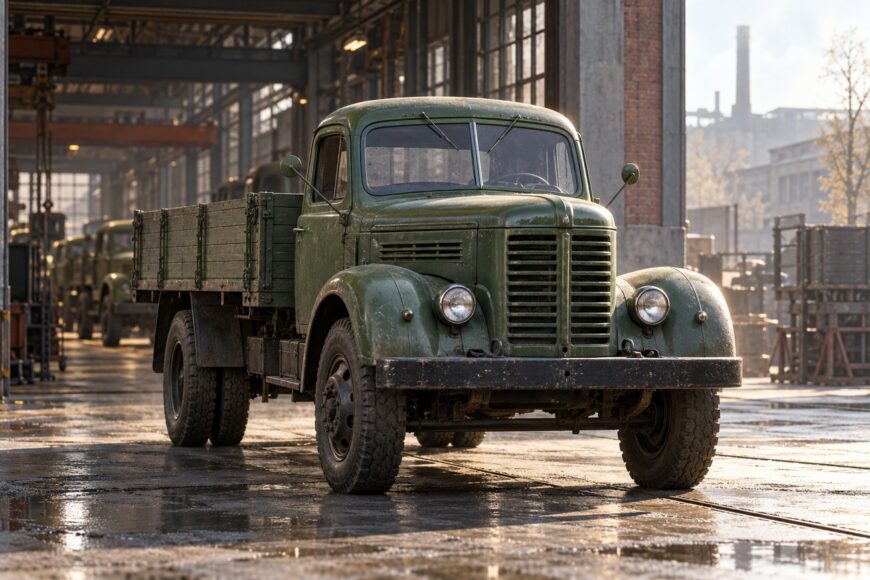
The FAW Jiefang CA10 is remembered as the People’s Republic of China’s first series-produced truck, yet its design came from the Soviet ZIS-150. Both facts matter. The first describes what China’s new automotive industry achieved; the second explains much of the truck’s engineering and helps identify a surviving example.
A familiar design still had to be manufactured repeatedly, assembled, and put to work. That is the distinction behind the CA10’s place in history. It also guards against treating an industrial symbol as a flawless vehicle: the same straightforward construction that made the truck serviceable left drivers with modest performance and little comfort. Its story begins at FAW’s plant in Changchun.
- Why the CA10 counts as the PRC’s first series-produced truck
- From the ZIS-150 to the Changchun assembly line
- Payload, engine, and the reality of driving a CA10
- CA10, CA30, and CA15: why the end date is disputed
- The weaknesses behind the national icon
- Identifying and preserving a surviving CA10
- Frequently asked questions
- What was the first Chinese car ever made?
- What does Jiefang mean on a CA10 badge?
- How should an unrestored CA10 be stored?
Why the CA10 counts as the PRC’s first series-produced truck
FAW’s Changchun plant put the Jiefang CA10 into series production in 1956. The first truck is reported to have rolled out on 13 July of that year. The date marks a manufacturing milestone, although the broader claim rests on sustained production rather than on one vehicle leaving the assembly line.
“First” needs that qualification. The CA10 is recognized as the PRC’s first series-produced truck; the claim does not establish that no motor vehicle had previously been built in China. Nor does it identify the country’s first passenger car. Readers comparing automotive firsts need to keep the vehicle category and the meaning of “production” in view.
The CA10 mattered because a domestic plant could turn an established design into working trucks. That made it a visible symbol of Chinese industrialization as well as a means of moving goods. Its historical importance does not depend on presenting every component as a new invention.
For a surviving truck, this distinction changes the question from whether it looks wholly Chinese to how it was made and used. A Soviet-derived layout is part of the CA10’s history, while Chinese production marks the achievement for which it is remembered.
From the ZIS-150 to the Changchun assembly line
The CA10 was based on Soviet ZIS-150 design and documentation. Its frame layout, cab, and major assemblies closely followed that truck, while its gasoline engine followed the ZIS-120 pattern. Calling the CA10 a wholly original Chinese design obscures its origins; specifying legal license terms, however, requires evidence beyond the shared engineering.
Adopting a design shortened the path to a production truck, but it did not make production automatic. A plant still needed equipment, trained workers, and a reliable supply of materials and components. Those demands help explain why the Changchun achievement was industrial as well as automotive.
The close resemblance has also shaped how the CA10 is described. Chinese accounts often emphasize the start of domestic manufacturing, while accounts centered on the ZIS-150 emphasize the Soviet connection. Each perspective captures something real, though neither alone tells the full story.
Early manufacturing faced reported difficulties, but broad claims that CA10 quality was uniformly inferior to the Soviet prototype are insufficiently established. Condition, production period, and later repairs matter more when judging an individual truck than a blanket verdict about every example.
Payload, engine, and the reality of driving a CA10
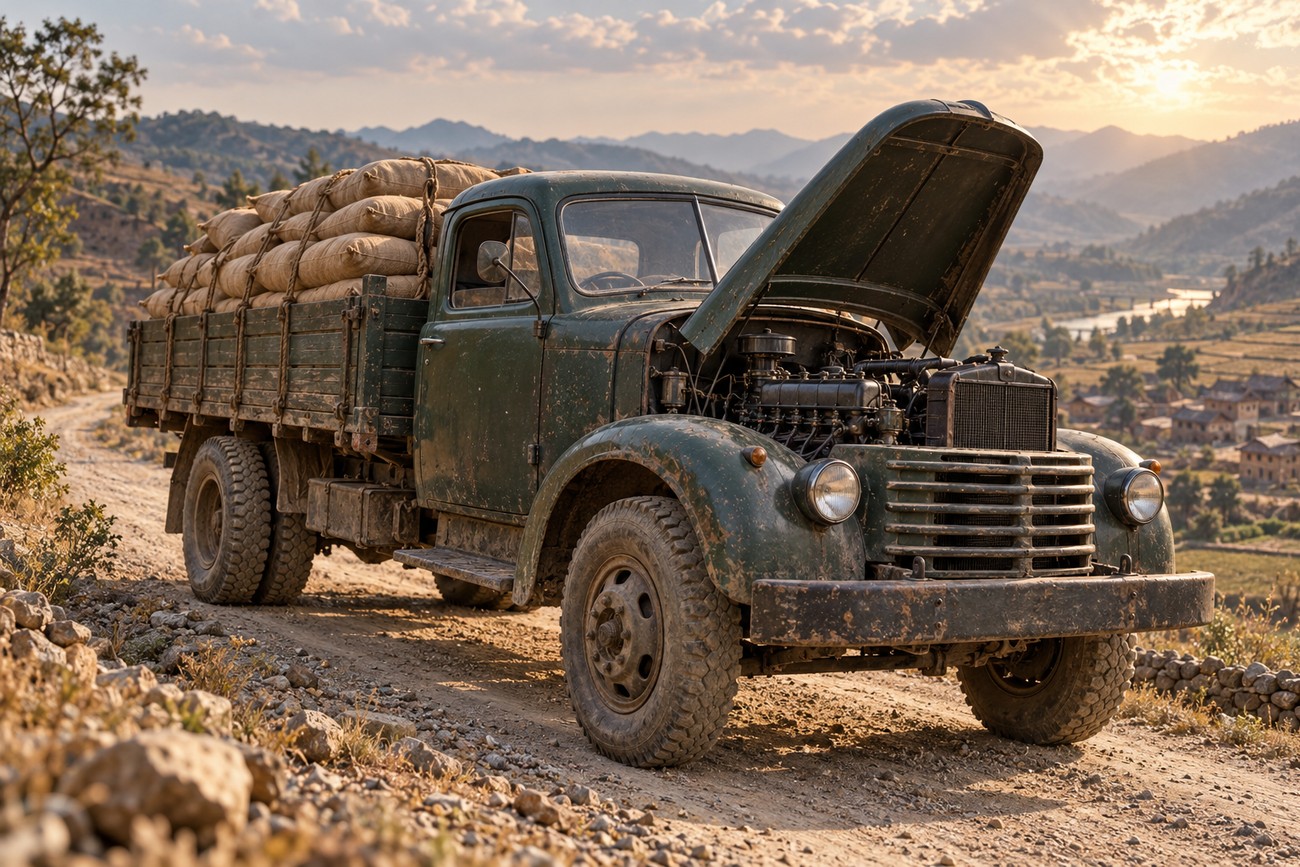
The ZIS-120-pattern engine was an approximately 5.5-liter inline-six gasoline unit producing about 90–95 hp. The CA10 was rear-wheel drive, with an unladen mass reported at about 3.9 tonnes. Sources give its payload as approximately 3.5–4 tonnes, a range worth retaining when comparing versions or historical specifications.
Those figures describe a working truck with limited power in reserve. Acceleration with a load was slow by modern traffic standards, and a driver had to plan speed and gear changes accordingly. Quoting a single payload figure without checking the particular vehicle can also encourage loads beyond its intended rating.
Simple mechanical construction offered a practical advantage: major parts were accessible, and repairs did not depend on complex electronics. That benefit came with substantial driver effort. The cab offered little isolation from engine noise and vibration, steering was heavy, and the ride could be harsh on poor surfaces.
The gasoline engine’s appetite also looks considerable beside that of a later diesel truck doing comparable work, though a defensible consumption figure depends on route and load. The CA10 makes most sense on its own period terms: maintainable transport, rather than effortless or economical travel by current expectations.
CA10, CA30, and CA15: why the end date is disputed
CA10 production began in 1956, but its final year is less clear-cut than its launch. Some accounts limit the original CA10 index to an early period around 1960. Others use the CA10 name for related Jiefang trucks built into the early 1980s, extending the apparent production run.
The difference matters because a family of similar trucks is not necessarily one unchanged model. A late vehicle described broadly as a CA10 may need closer checking against its markings, equipment, and documentation before it is dated or identified. A long family history should not be assigned wholesale to the original specification.
The three-axle CA30 is a related model reported for 1958–1979. The later CA15 is reported for 1983–1986. Their dates show how the Jiefang line developed, but neither proves that the first CA10 continued unchanged through those years.
For historical comparisons, the safest wording separates the CA10’s 1956 launch from the longer life of related designs. For restoration, the distinction is more than editorial: a model name used loosely in a listing may lead to the wrong reference material or replacement part.
The weaknesses behind the national icon
A truck producing about 90–95 hp while carrying a rated payload of roughly 3.5–4 tonnes demanded patience when loaded. Slow acceleration becomes especially consequential where traffic moves much faster than the CA10 can comfortably keep pace. Its historical status does not remove that practical limitation.
Inside the cab, noise, vibration, heavy steering, and a harsh ride added to fatigue. The CA10 also predates modern passive-safety expectations and power-assisted steering. Anyone considering road use should assess the vehicle’s actual mechanical condition and the demands of the intended route, rather than relying on its original working reputation.
Loading beyond the rated payload adds stress to an old frame, suspension, and running gear. Brake and clutch fatigue under sustained overload or mountain use appears in driver recollections, but those accounts do not establish a universal failure rate. They do reinforce a sound precaution: inspect these systems before asking an aged truck to carry a load.
A preserved CA10 can therefore be impressive without being idealized. Its basic equipment suited the work and circumstances for which it was built, while its limitations remain plain to a present-day driver. Keeping both views in focus gives the truck a more useful history than unqualified praise.
Identifying and preserving a surviving CA10
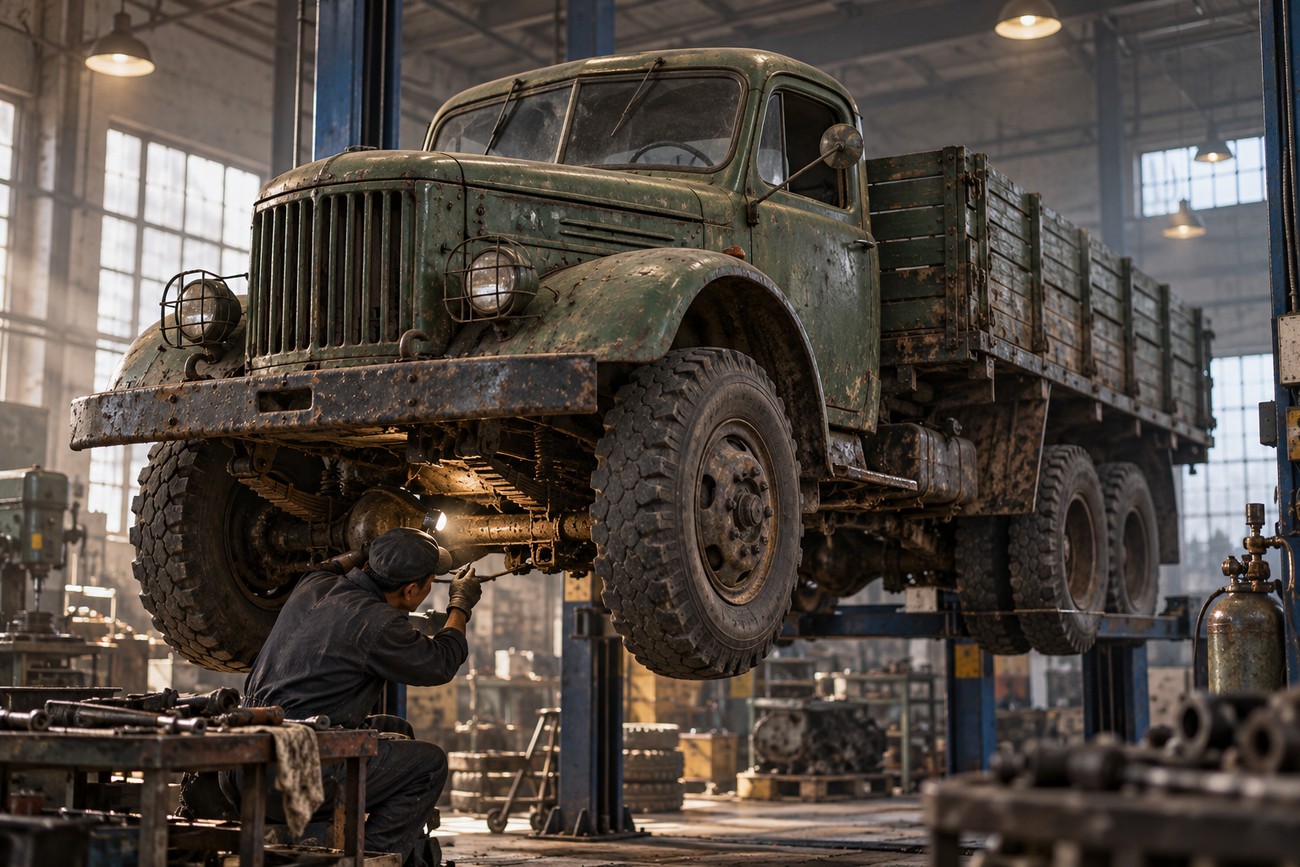
Start with the structure. Examine the frame, cab, and body for corrosion and previous repairs before assessing paint or trim. Extensive metal loss can turn an apparently complete truck into a major fabrication project, and scarce original parts make the decision to restore rather than conserve more consequential.
Next, compare badges, body details, and component markings with the vehicle’s claimed identity. A CA10 can look much like a ZIS-150 at a glance, while small differences may matter to an authentic restoration. Establish which assemblies appear original and which are documented replacements; some survivors may contain both Chinese and Soviet parts.
Before ordering a ZIS-150 replacement, match the CA10’s existing part markings and measurements to the specific assembly. Visual similarity alone does not establish fit.
Record those findings before dismantling anything. Photographs of fasteners, markings, and the position of components preserve evidence that casual repairs can erase. A Soviet service procedure may be a useful reference, but it should not automatically override the details found on the truck itself.
Engine conversions need similar restraint. A modern unit should be assessed against the frame, transmission, axles, and braking system, rather than assumed safe because it can be fitted in the engine bay. If road use is planned, registration, inspection, insurance, and emissions requirements also depend on the jurisdiction.
Frequently asked questions
The CA10’s name and “first” claim are easy to read too broadly. For an owner, the more immediate issue may be preserving evidence on a truck that has spent decades out of service. These distinctions help keep both the history and the vehicle intact.
What was the first Chinese car ever made?
The CA10 does not establish the identity of the first Chinese passenger car. “Car” may mean a passenger vehicle or be used loosely for any motor vehicle, while the supported CA10 claim is narrower: it was the PRC’s first series-produced truck. To compare firsts, specify the vehicle type and whether “made” means a prototype or a production model.
What does Jiefang mean on a CA10 badge?
Jiefang means “Liberation.” The name became a FAW truck marque, so a Jiefang badge identifies more than a single model. When checking a surviving vehicle, read the badge alongside its model markings and components; the name alone cannot establish that it is an original CA10.
How should an unrestored CA10 be stored?
Keep it sheltered and dry to limit further corrosion, particularly where water can remain against the frame or body. Before cleaning, replacing parts, or making casual repairs, photograph markings and original fittings and keep a record of anything removed. That documentation may be difficult to recreate once the truck has been altered.







