
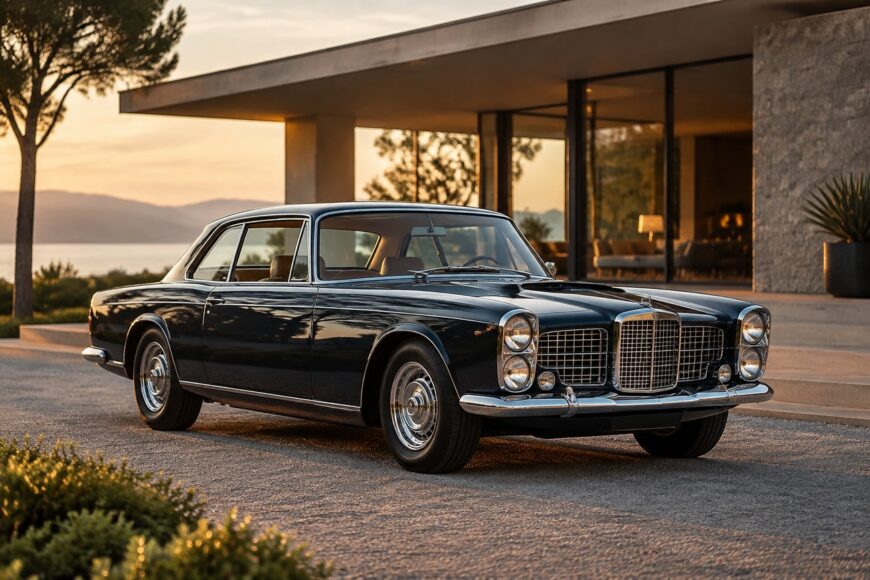
The Facel Vega Facel II embodies a difficult contradiction: bespoke French luxury, the force of an American V8, and unusually high ownership risk. Its polished cabin and restrained bodywork suggest a formal grand tourer, while the Chrysler engine delivers the kind of torque associated with large American cars.
Period figures add another layer of confusion. Power is quoted at approximately 355 hp with the automatic and 390 hp with the manual, while published top speeds range from approximately 214 km/h to 240–242 km/h. Those numbers describe different configurations and sources, rather than one universal specification. The Facel II is best understood as a rare 2+2 grand tourer with serious historical importance, not as a modern supercar or an ordinary Chrysler-powered coupe.
- What the Facel Vega Facel II Really Was
- French Design, Chrysler Muscle and Old-School Engineering
- Facel II Specifications at a Glance
- Fast on Paper, Demanding in the Real World
- Buying and Maintaining an Authentic Facel II
- Myths, Marketing and the Facel II Legacy
- Frequently asked questions
- Why is the Facel II sometimes described as the world’s fastest four-seater?
- Why can a replacement engine reduce the value of a Facel II?
- Was the Facel II a sedan or a coupe?
What the Facel Vega Facel II Really Was
Facel Vega produced the Facel II from 1962 to 1964, during the company’s final period of ambitious luxury-car production. Approximately 182–184 examples were built, including the prototype. That tiny total places every surviving car in a different category from an expensive used coupe: its identity depends as much on provenance and configuration as on condition.
The body was a four-seat 2+2 luxury coupe. The rear seats were part of the car’s grand-touring brief, giving the Facel II more carrying ability than a strict two-seater, although access and space followed the proportions of a large coupe. It was not a full-size four-door sedan, and descriptions that present it as one obscure the model’s actual layout.
Technically, the Facel II developed the established Facel Vega formula rather than abandoning it for an unrelated design. Facel supplied the body, cabin, and much of the visual character, while Chrysler provided the V8 powertrain. This division made the car distinctive: European presentation surrounded an American engine chosen for torque, availability, and performance.
That hybrid identity also explains the car’s modern fascination. A buyer is dealing with two engineering traditions in one vehicle, along with a production run too small to support the parts ecosystem of a mainstream luxury model. The Facel II’s rarity is therefore a source of prestige and a practical complication at the same time.
French Design, Chrysler Muscle and Old-School Engineering
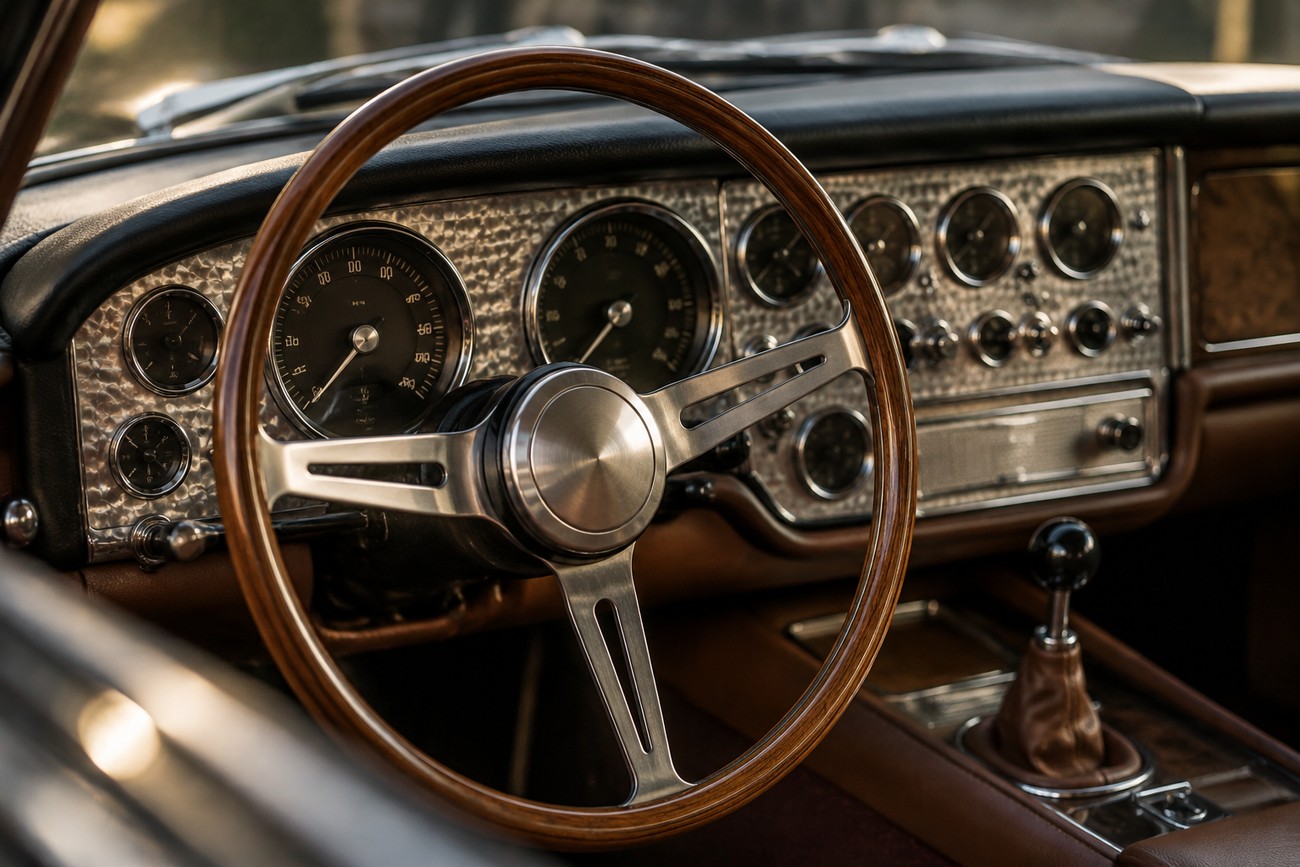
The Facel II’s appearance relies on proportion and detail rather than decorative excess. Notable trim used polished stainless steel in place of conventional chrome, giving the car a distinct surface treatment that is easy to overlook in photographs. Inside, the emphasis remained on carefully finished materials and a formal driving environment.
Underneath, the engineering was more conventional than the cabin suggested. The chassis used steel-framed construction, and the rear suspension retained leaf springs. That arrangement suited a heavy grand tourer of the period and could provide useful load-carrying durability, yet it places the Facel II firmly in its era when compared with later independent-suspension performance cars.
Dunlop disc brakes were fitted on all four wheels, an important feature for a large, powerful car. Their presence gives the specification genuine technical substance, although braking performance in a surviving example depends on correct maintenance, hydraulic condition, pad choice, and tire quality. A period specification sheet cannot certify the condition of a car six decades later.
The Chrysler V8 displaced approximately 6.3 liters, with published figures of approximately 6276–6286 cm³. Its character was torque-led and muscular, complementing the Facel II’s long-distance mission. The result was a car that could gather speed with authority while retaining the substantial feel of a steel-bodied luxury coupe.
Facel II Specifications at a Glance
Period specifications vary by transmission, measurement method, and source. The figures below describe the main configurations rather than one universal factory profile.
| Item | Facel II specification |
|---|---|
| Engine | Chrysler V8 |
| Displacement | Approximately 6276–6286 cm³ |
| Transmission | Four-speed manual or three-speed Chrysler automatic |
| Power | Approximately 355 hp with automatic; approximately 390 hp with manual |
| Published top speed | Approximately 214 km/h to 240–242 km/h |
| Weight | Approximately 1650 kg |
| Wheelbase | 2660 mm |
| Length | 4750 mm |
| Brakes | Dunlop disc brakes on all four wheels |
Fast on Paper, Demanding in the Real World
The difference between approximately 355 hp and approximately 390 hp is tied to transmission-specific configurations and varying measurement methods. The automatic version used a three-speed Chrysler transmission, while the manual car had four speeds and is commonly associated with the higher figure. Treating every Facel II as a 390 hp car produces a misleading picture of both performance and originality.
Top-speed claims require similar caution. Published figures range from approximately 214 km/h to 240–242 km/h, depending on the version and source. A period test result, a factory claim, and a later summary may describe different conditions, so the highest number should not be treated as a guaranteed cruising speed.
Weight also shapes the experience. At approximately 1650 kg, the Facel II has the mass and momentum of a substantial grand tourer, even though its length and wheelbase remain manageable by luxury-car standards. In city traffic, narrow streets, and tight parking areas, that mass can make the car feel cumbersome. The engine’s torque helps it move decisively, while the chassis encourages a measured pace rather than constant attack.
Some owner accounts describe very light steering at high speed, with a nervous sensation under those conditions. That observation is source-dependent rather than a universal consensus, and the condition of the steering system, tires, and suspension matters greatly. It remains a useful inspection point because a car that feels effortless at low speed can demand more attention on a fast road.
Fuel use is another unavoidable part of ownership. Reported consumption is around 21 l/100 km or higher, depending on traffic, tuning, and driving style. Michelin also did not guarantee the tires for prolonged running above approximately 193 km/h, which makes the headline maximum speed a historical performance statement rather than a practical invitation to sustain that pace.
Buying and Maintaining an Authentic Facel II
Inspection should begin with identity and provenance, then move to cosmetics. With only approximately 182–184 examples including the prototype, a correctly documented engine, transmission, and body structure can matter more to long-term significance than a freshly polished exterior. Records, previous identities, and period documentation help establish whether the car still represents the specification in which it was built.
The Chrysler connection simplifies some mechanical questions, yet it does not turn the Facel II into a parts-bin restoration project. The American V8 and transmission require appropriate Chrysler knowledge, while the French body, trim, instrumentation, and interior demand a different kind of research. Correct body components can be difficult to source, and a visually convincing replacement may still be historically wrong.
A replacement engine or gearbox can affect collector value even when the substitute works well. The same applies to significant body components, especially when their shape, materials, or construction differ from the original specification. A sympathetic repair may preserve usability, while undocumented substitution leaves a permanent question over the car’s history.
Maintenance therefore requires more than access to a specialist who understands large American V8s. The owner needs reliable body and trim information, accurate records of mechanical work, and a realistic plan for locating rare components. The cost of correcting a previous repair can be substantial because fabrication, research, and verification often accompany the mechanical labor.
Myths, Marketing and the Facel II Legacy
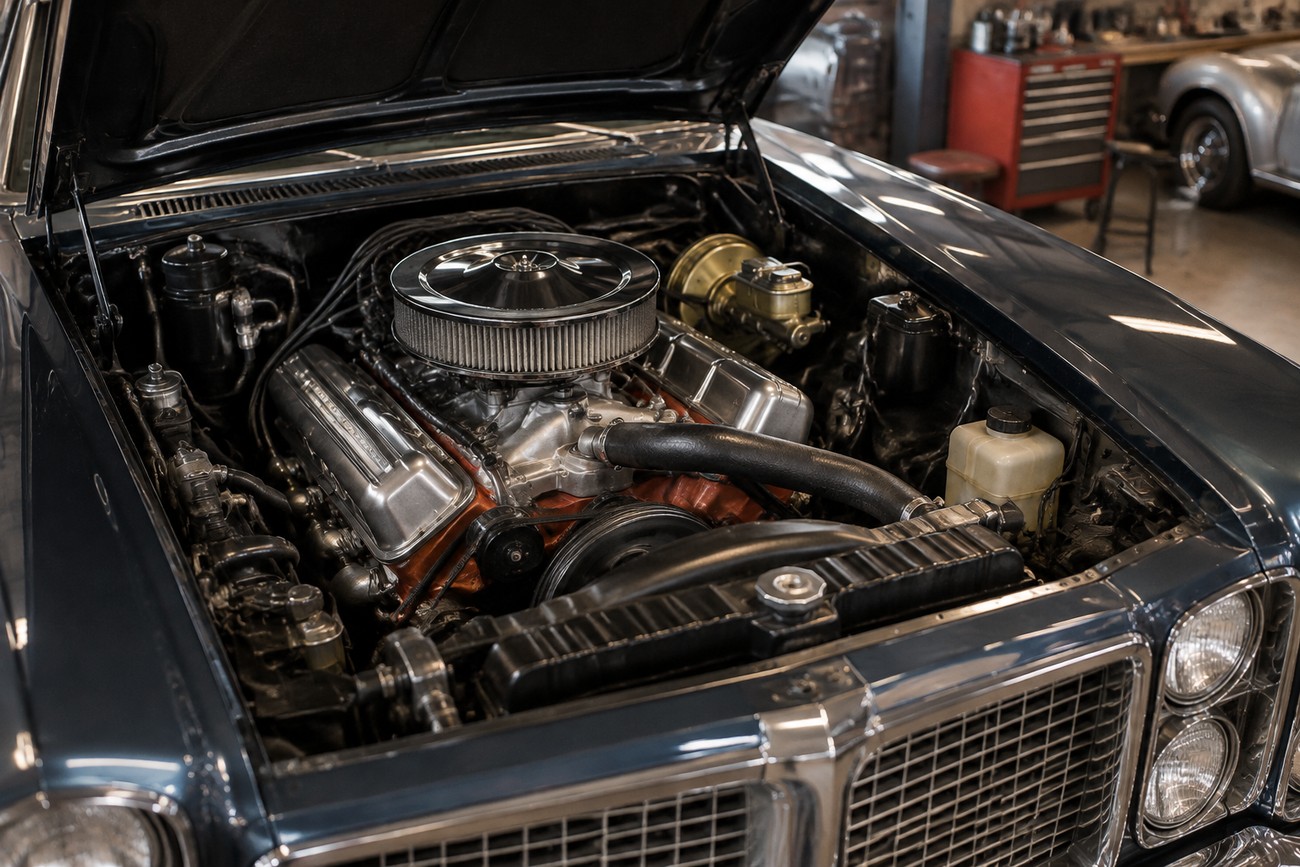
The Facel II did not have one uniform 390 hp specification. Approximately 355 hp is associated with the automatic version, while approximately 390 hp is associated with the manual, with differences also reflecting period measurement methods. Configuration matters whenever a car is assessed for originality or compared with period performance claims.
The same discipline applies to speed. Published maximum figures span approximately 214–242 km/h, so 240 km/h was not a universal real-world speed for every car. Tire limitations, road conditions, transmission choice, and the mechanical state of an individual example all shaped what could be used safely and repeatedly.
The Facel II was also not a wholly French powertrain design. Its French body and interior were combined with an American Chrysler V8, creating a French-American hybrid with a character distinct from both a conventional European luxury car and a typical American coupe. That mixture is central to its appeal rather than an embarrassing technical footnote.
Period descriptions sometimes called the Facel II the “fastest four-seater.” The phrase belongs to advertising and magazine culture of its time, not to a universally verified modern standard. The car’s lasting importance rests on the rarer combination of elegant French coachwork, torque-rich Chrysler power, and extreme scarcity: each authentic example carries historical weight that its specification sheet alone cannot explain.
Frequently asked questions
Three points often need clarification: the period “fastest four-seater” claim, the effect of an engine replacement on value, and the Facel II’s body style. Performance figures varied by version and source. Its four seats did not make it a sedan.
Why is the Facel II sometimes described as the world’s fastest four-seater?
The phrase came from period advertising and journalistic descriptions of the car’s blend of four-seat practicality and high claimed performance. It reflected the competitive language of early-1960s motoring, when manufacturers and magazines often compared headline figures across different classes of car.
It should be read as a historical claim rather than a universally verified specification. Published top speeds for the Facel II vary from approximately 214 km/h to 240–242 km/h, and those figures depended on version, measurement method, tires, and road conditions.
Why can a replacement engine reduce the value of a Facel II?
Collectors assess a rare car as a historical object as well as a functioning machine. A replacement engine may provide equal or better performance, yet it can weaken the documented link between the surviving car and its original production specification.
The effect depends on the quality of the records and the status of the replacement. A correctly documented period-correct unit is easier to evaluate than an undocumented substitute, because provenance allows future owners to understand what changed, when it changed, and why.
Was the Facel II a sedan or a coupe?
The Facel II was a four-seat 2+2 luxury coupe. “2+2” describes two primary front seats and two smaller rear seats within a coupe body; it does not describe a four-door layout.
The distinction matters when assessing space, access, and historical identity. Calling the Facel II a sedan suggests a different body structure and intended use, while its long doors, formal cabin, and rear seats belong to the grand-touring coupe tradition.







