
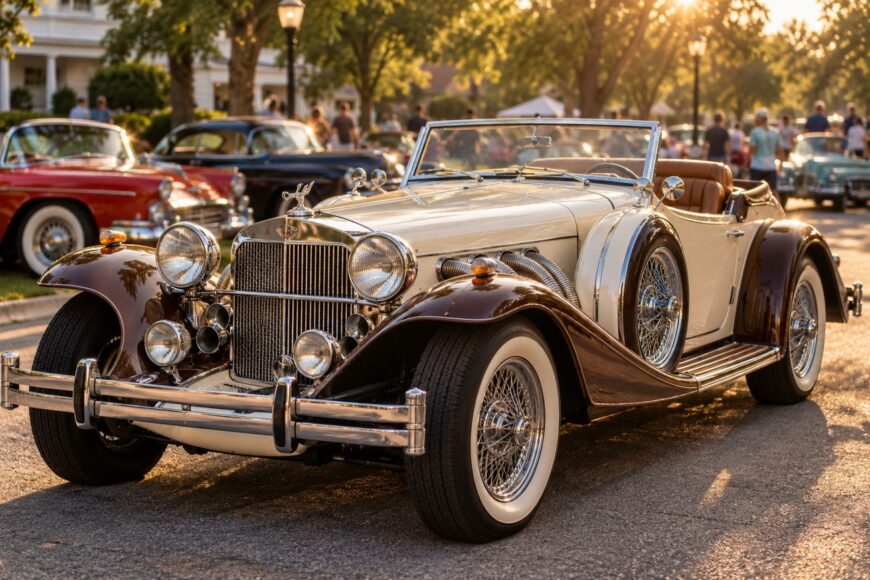
The Excalibur Series II looks back to the era of long hoods, exposed wheels, and upright grilles. Beneath that prewar-inspired shape sits a later American car built around Chevrolet/GM mechanical components. Its appearance tells you little about the parts fitted to a surviving example or the work needed to keep it on the road.
That distinction matters to a buyer. A familiar V8 may be straightforward to service, while damaged trim or tired chrome can require specialist work. Before the specification figures mean much, you need to establish what the particular car is, how it was built, and what has changed since.
- What the Series II was—and what it was not
- Under the vintage body: chassis and layout
- Series II specifications: what the figures can—and cannot—tell you
- How it drives versus what the period claims promise
- The ownership catch: common parts, uncommon work
- How to verify a Series II before buying
- Frequently asked questions
- What makes the Excalibur Series II a neo-classic rather than an antique?
- What should you confirm about a roadster or phaeton before planning to use it?
- What should you ask a repair shop before leaving it with a Series II?
What the Series II was—and what it was not
Produced approximately from 1970 to 1974, the Excalibur Series II succeeded the Series I in a line of American neo-classics. Its design borrowed visual cues from earlier motoring without claiming to be a car built in that era. The long hood, external exhaust treatment, and formal front end were intended to be seen as much as driven.
That show-car character is central to its appeal. A Series II makes an immediate visual statement at an event, yet its design also reflects the tastes and engineering choices of its own production period. Calling it a prewar classic obscures both its history and the practical questions a buyer should ask.
Roadster and phaeton are the body styles associated with the Series II. Those labels help describe a car, but they do not establish its exact equipment, engine, or current configuration. Low-volume construction and decades of repairs make the individual example more informative than a generic model description.
Under the vintage body: chassis and layout
The Series II developed the Series I with a longer wheelbase and a revised frame, commonly described as box-section construction. Its wheelbase is usually listed as 111 inches, about 2,819 mm, although some references give 2,845 mm. The difference should remain visible in any comparison of records; neither figure, on its own, verifies a particular chassis.
Rear-wheel drive and independent suspension at both ends are commonly listed for the Series II. Four-wheel disc brakes are also reported. These features place the engineering well beyond the prewar appearance, though their presence says nothing about the condition or adjustment of components on a car offered for sale.
Chevrolet/GM hardware can give a workshop a useful starting point for mechanical repairs. It does not turn the whole vehicle into a parts-bin car: the frame installation, body panels, fittings, and trim present different sourcing problems. A replacement mechanical part should be matched to the component actually installed, especially on a restored example.
Series II specifications: what the figures can—and cannot—tell you
Published specifications describe reported configurations rather than a guaranteed build sheet for every Series II. Year, body style, source, and subsequent changes all matter when matching a figure to a car.
| Item | Commonly reported specification | Qualification |
|---|---|---|
| Early engine | Chevrolet 350-ci (5.7-litre) V8; about 300 hp | Frequently cited early figure, not proof of an individual car’s output. |
| Later-reported engine | 454-ci (7.4-litre) V8; 250 hp cited in historical accounts | Reported on some later examples; confirm the fitted engine. |
| Power in catalogs | 218–330 hp across Series II and related versions | Sources and specifications differ; figures should not be merged. |
| Transmissions | Four-speed Muncie manual or three-speed Turbo-Hydramatic automatic | Common listings; descriptions vary by year and source. |
| Wheelbase | 111 inches (about 2,819 mm); also listed as 2,845 mm | Conflicting references require checking against the car and its records. |
How it drives versus what the period claims promise
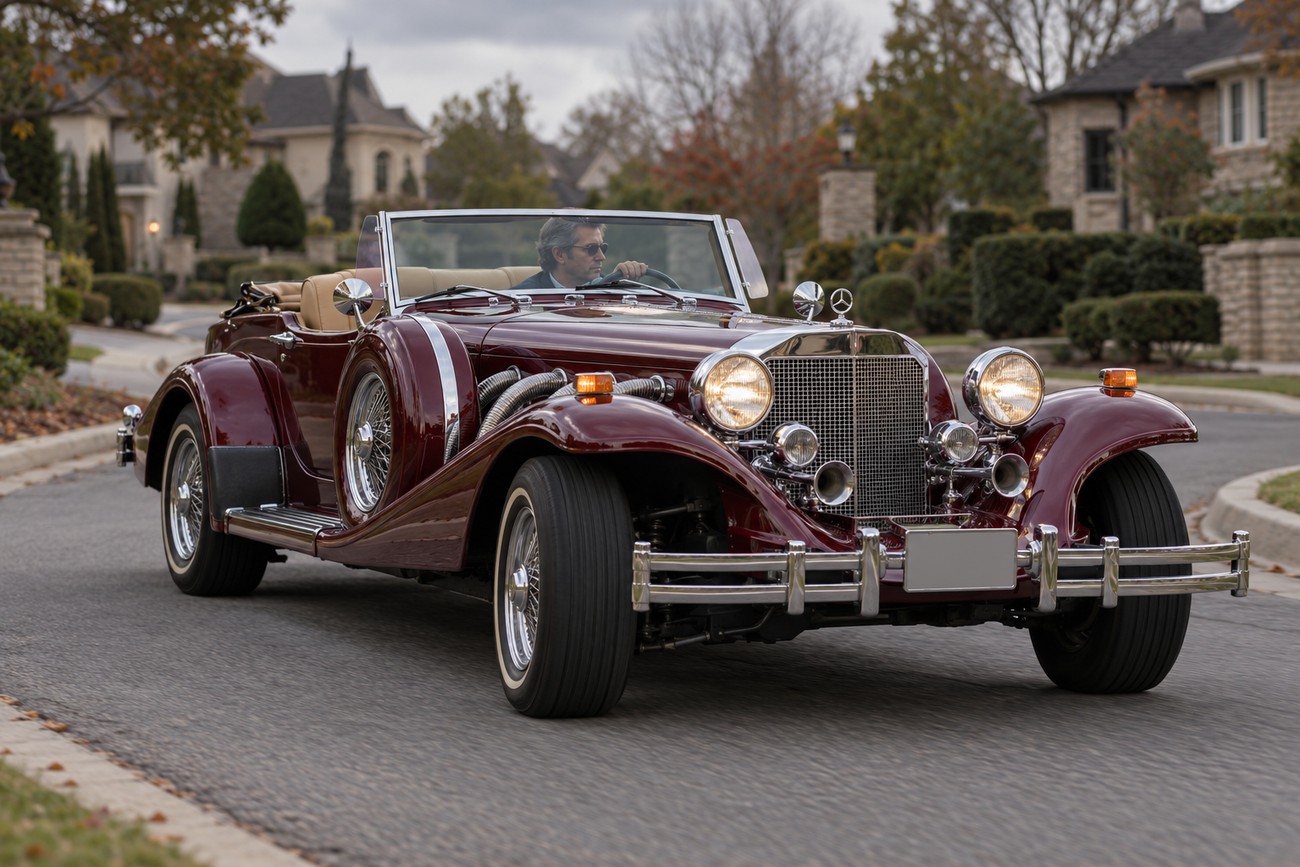
A historical brand account claims 0–60 mph in under seven seconds and a top speed around 149 mph for the Series II. Those are period claims, not independently comparable test results. Without a consistent test method and a clearly identified car, they are a poor basis for judging an example on the market.
The Series II is a substantial V8 neo-classic rather than a lightweight sports roadster. Its engine can supply strong acceleration, while its size and weight are likely to be more apparent on tight streets and during low-speed maneuvering. A buyer attracted by the open body should allow for that difference in character.
Engine choice, body style, gearing, and mechanical condition can alter how an individual car feels. Noise, weather exposure, and period ergonomics also shape a longer drive; modern expectations of passive safety are best set aside. A careful road test tells you more about steering, braking, cooling, and comfort than an isolated period speed claim.
The ownership catch: common parts, uncommon work
Chevrolet/GM mechanical components are a genuine advantage when a service item can be identified and matched. A familiar engine or transmission gives a capable shop established repair routes. The surrounding car is less predictable, and assuming that every part can be ordered from a GM catalog can stall a repair.
Series II-specific bodywork, chrome, interior pieces, and fittings may be difficult to source. Restoring a damaged panel or worn decorative part can involve fabrication or specialist finishing rather than a direct replacement. The condition of these items deserves attention before purchase because cosmetic work can become a substantial part of the ownership budget.
Low-volume assembly also makes workmanship an individual-car issue. Old repairs, altered components, and uneven restoration quality can matter more than a model-wide reputation for reliability. Rarity may increase interest among collectors, but it also narrows the pool of specialists and potential buyers; an expensive restoration is no assurance of equally strong resale value.
How to verify a Series II before buying
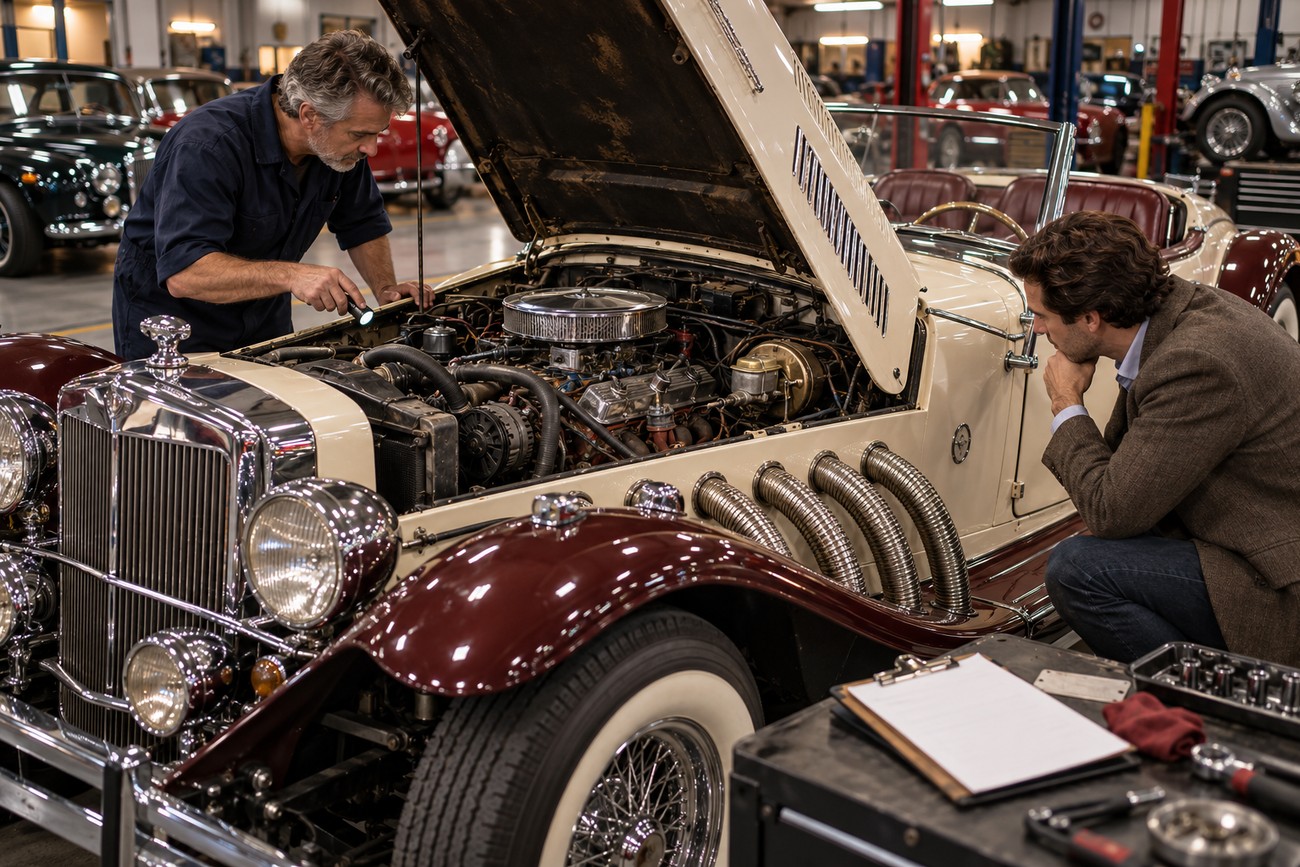
Start with identity rather than appearance. Compare the vehicle’s identification and registration records with its claimed year and roadster or phaeton body style, then check supporting photographs and restoration records. Later Excalibur series and altered cars can resemble the description in an advertisement more closely than their documents suggest.
Next, reconcile the paperwork with the engine and transmission actually fitted. The commonly cited early 350-ci V8 and later-reported 454-ci examples are useful reference points, not substitutes for inspecting the car. One source reports 37 Series II cars—11 roadsters and 26 phaetons—but that unverified total cannot establish an individual car’s identity or value.
Record component identifiers and photograph earlier repairs before ordering GM parts. A restored car may carry hardware that no longer matches a year-based catalog.
Finally, inspect the frame for corrosion and past repair work, assess suspension condition, and look closely at chrome, body fit, and interior finishing. Obtain a specialist assessment where access or construction makes a defect hard to judge. A car with a coherent history and well-documented work is easier to evaluate than one supported only by an attractive specification sheet.
Frequently asked questions
The distinction between a Series II’s appearance and its construction also shapes everyday decisions. These checks help when describing the car accurately, preparing it for use, or arranging work with a shop.
What makes the Excalibur Series II a neo-classic rather than an antique?
A neo-classic is a car newly built to evoke an earlier design period; an antique is an original vehicle from that earlier period. A restoration repairs or recreates the condition of an existing car without changing when it was made. The Series II, produced approximately from 1970 to 1974, remains a neo-classic even if its styling looks older or it has since been restored.
What should you confirm about a roadster or phaeton before planning to use it?
Check the individual car’s seating arrangement, weather equipment, and fitted accessories in person. The roadster or phaeton label alone does not tell you whether its top, side protection, storage, or passenger space will suit a planned journey. Make sure any equipment supplied with the car fits, works, and is included in the sale.
What should you ask a repair shop before leaving it with a Series II?
Ask how the shop will identify the installed mechanical components before ordering parts and whether it can handle bespoke trim and chrome or uses outside specialists. Agree on photographs and written approval for unexpected work, particularly where disassembly may expose previous repairs. That process helps you control scope before a service job grows into restoration work.







