
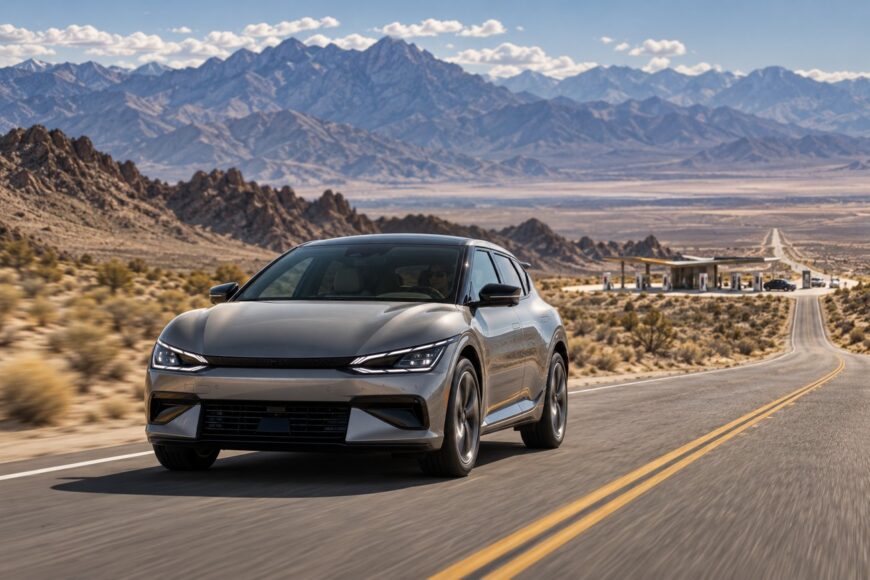
The Kia EV6 combines excellent fast-charging capability with Nevada’s long, exposed highway gaps. Its E-GMP platform and 800/400-volt architecture can keep charging stops short, but only when the station, battery temperature, state of charge, and vehicle specification cooperate.
A successful Nevada trip therefore depends on managing speed, wind, heat, elevation, charger reliability, and the exact US-market EV6. The advertised range and 18-minute charging claim are useful reference points, not route guarantees. Plan each leg with a margin, confirm a backup charger, and treat the trip as a series of manageable charging decisions.
- Is the Kia EV6 a Good Fit for a Nevada Road Trip?
- Choose the Right EV6 Version Before You Leave
- Plan Nevada Charging Around Reality, Not the Brochure
- Build a Route With Battery Margins and Backup Stops
- What Highway Driving Really Does to EV6 Range
- Common EV6 Road-Trip Mistakes and Hidden Limitations
- Frequently asked questions
- What should I do if the planned DC charger is occupied or not working?
- Why is the Kia EV6 not selling as strongly as some competing EVs?
- What is the realistic highway range of the Kia EV6?
- What are the common problems with the Kia EV6?
Is the Kia EV6 a Good Fit for a Nevada Road Trip?
The EV6 has been produced since 2021 and is built on the E-GMP platform, which was designed around electric power and fast DC charging. Its 800/400-volt architecture can accept high charging power at suitable equipment, reducing the time lost during a long journey. That is a genuine advantage over an EV that needs a much longer stop for the same energy.
Nevada exposes the limits of any range estimate. High-speed highways, headwinds, mountain grades, heat, and long distances between charging hubs can turn a comfortable leg into a cautious one. A station that appears close on a map may also be occupied, derated, offline, or inconvenient for a long wait.
The EV6 makes sense when you can verify the route, use dependable DC hubs, and accept that conditions may require an extra stop. It is especially well suited to drivers who prefer several short charging breaks over occasional long sessions. It is a weaker fit for anyone who expects to drive every leg at high speed with no backup planning.
Choose the Right EV6 Version Before You Leave
EV6 batteries are available in approximately 58 kWh and 77.4 kWh versions, depending on the vehicle. The larger battery generally creates a wider planning window, while RWD versions can be more efficient than AWD models. AWD and GT-related versions also differ substantially in performance, efficiency, and practical range, so trim names alone are not enough for route planning.
Long-range versions are often reported at approximately 280–300 miles or more in favorable warm conditions. That figure should not be treated as guaranteed highway range. Driving around 120–130 km/h, climbing through mountains, or using climate control heavily can reduce the distance between stops, while cold weather can affect both range and charging speed.
Before departure, check the vehicle identification number, battery size, drivetrain, market specification, charging port, and onboard charging capability. The US-market EV6 generally uses J1772 for AC charging and CCS1 for DC fast charging. This matters if a route app displays stations using a different connector or if the vehicle was imported from another market.
Plan Nevada Charging Around Reality, Not the Brochure
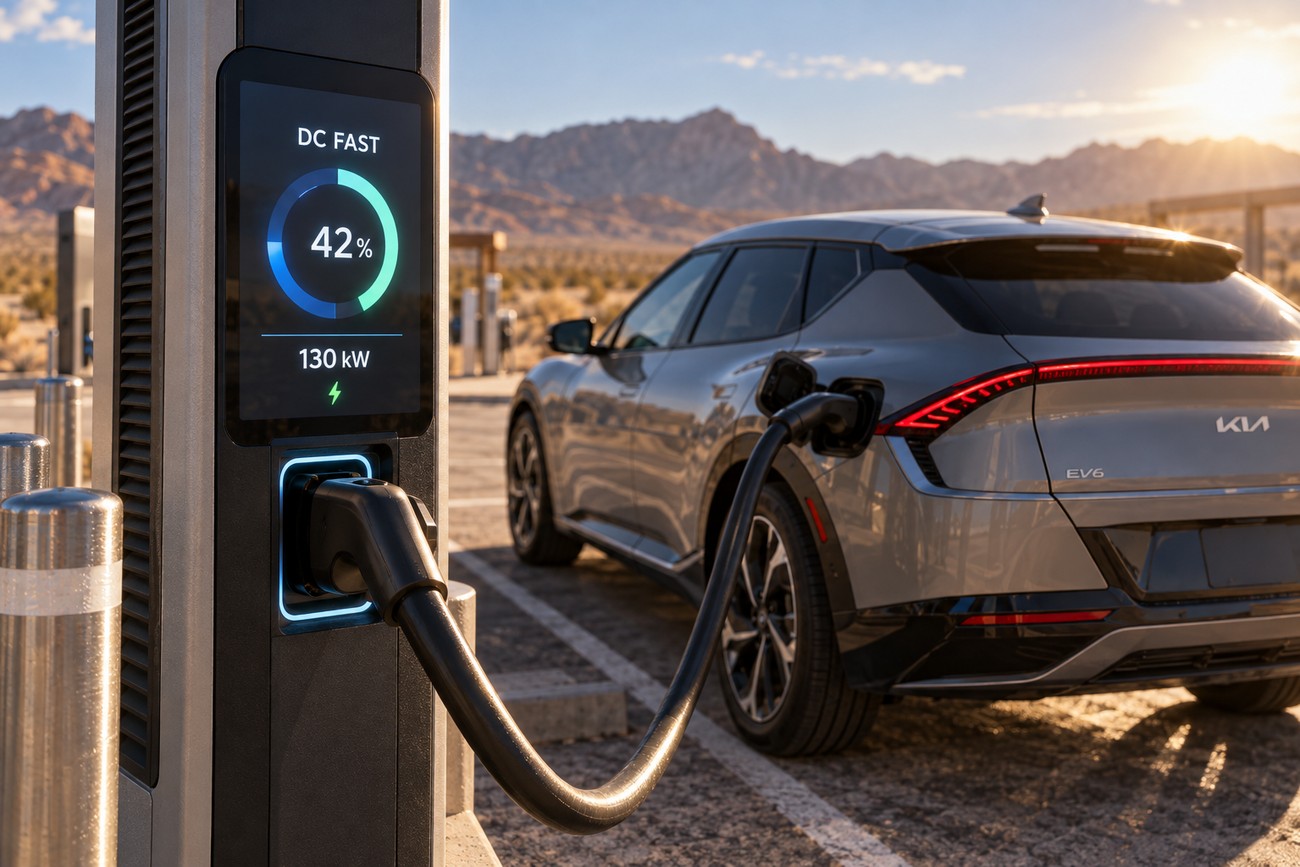
Kia’s official EV6 claim is 10–80% in 18 minutes under suitable high-power DC conditions. That is a best-case charging statement, not a promise from every public charger. Station power, battery temperature, state of charge, charger condition, and network reliability all affect the result.
One cold-weather mountain test reached about 130 kW at peak and took approximately 26 minutes to reach 80%. The difference illustrates why the charger’s advertised maximum is less useful than the actual charging curve. Speed commonly declines after approximately 35–50% state of charge, so the full 10–80% interval is not equally fast.
Where route spacing allows, 10–20 minute DC top-ups are often more efficient than repeatedly charging to 100%. Select a station with food, restrooms, lighting, and a usable fallback nearby. Also confirm that the car has the US-compatible CCS1 DC connector and J1772 AC connector before relying on a station map.
A reliable charger with usable amenities and a nearby fallback is often a better stop than a nominally faster location that may be occupied or deliver unstable power.
Build a Route With Battery Margins and Backup Stops
Divide the trip into charging legs rather than treating the whole journey as one calculation. For each leg, check distance, elevation, exposed highway sections, weather, and the likely arrival state of charge. Nevada’s long gaps between hubs leave less room to improvise after a windy climb or an unexpectedly busy station.
Mark a second charging option near every important stop before leaving. If the primary site is offline or full, the backup should be reachable without draining the battery to an uncomfortable level. Recheck live availability during the trip, since a route that worked earlier in the day can change with queues, outages, or reduced station power.
Location quality also affects the real duration of a stop. A well-lit site with restrooms and food can make a slower session manageable, while an isolated location can turn a short technical charge into an unpleasant wait. Plan the place as carefully as the kilowatt rating.
What Highway Driving Really Does to EV6 Range
Highway consumption rises noticeably at approximately 120–130 km/h compared with slower driving. Air resistance grows quickly with speed, and Nevada’s open roads can add a persistent headwind. Mountain climbs require additional energy, although some of it can be recovered during descents.
Cold weather can reduce effective range and slow charging by keeping the battery outside its preferred temperature range. Nevada heat may be less damaging to range than winter cold, yet air conditioning and sustained highway speed still consume energy. A hot afternoon can therefore shorten the comfortable planning window even when the battery is charging normally.
The cold mountain test that reached about 130 kW and approximately 26 minutes to 80% is a useful warning, not universal proof of EV6 performance. Plan around a buffer instead of stretching each leg to the vehicle’s displayed limit. If consumption rises during the first part of a leg, reduce speed early or use the backup stop before the margin disappears.
Common EV6 Road-Trip Mistakes and Hidden Limitations
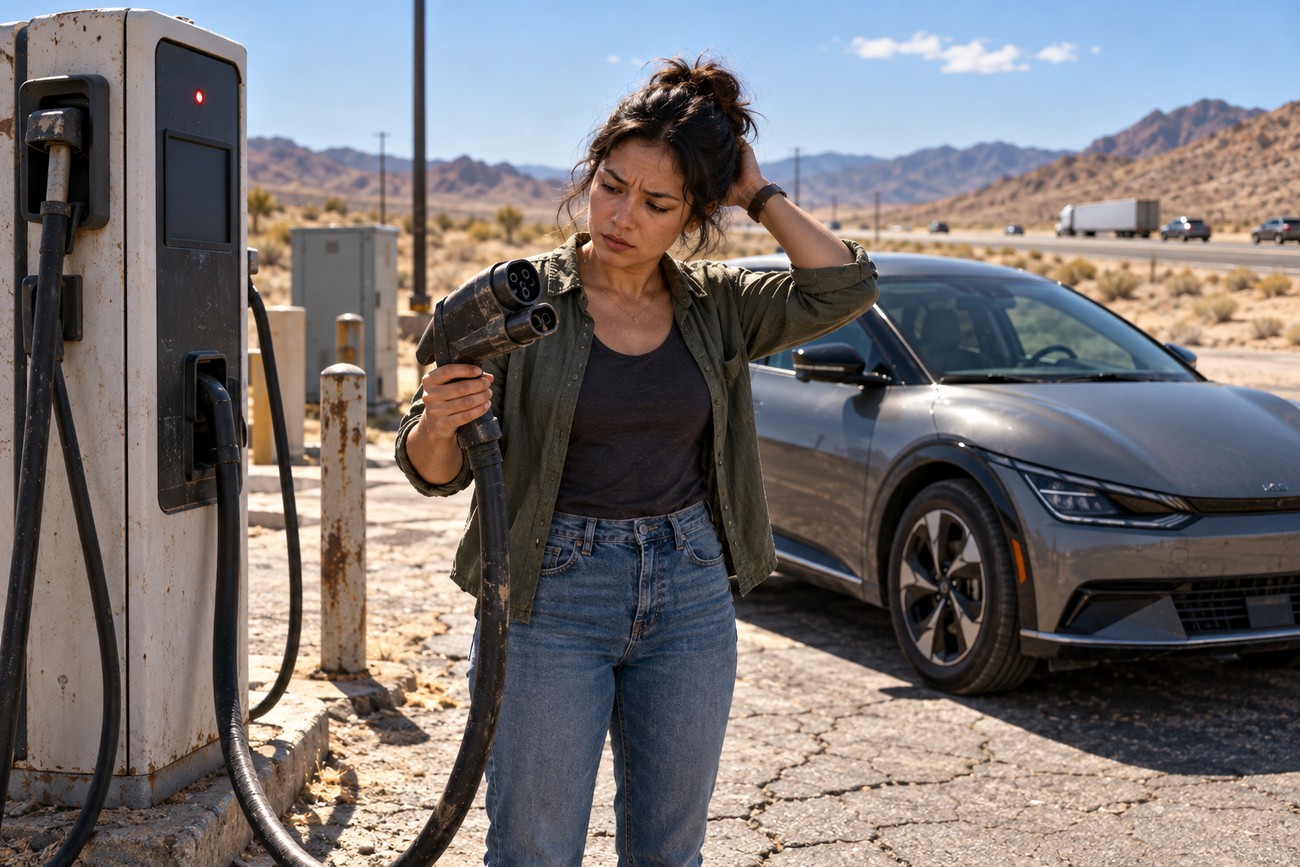
The most common error is using brochure range as a fixed highway distance. Another is confusing AC and DC: AC charging is useful at lodging or during a long stay, while DC fast charging is the tool for a short highway break. An 800-volt architecture improves the car’s potential, but it cannot overcome a low-power station, a cold battery, a high state of charge, or a faulty stall.
Drivers also assume every charging session follows the same curve. Charging commonly slows after approximately 35–50% state of charge, so staying connected for a high percentage may add less useful range per minute. Some third-party sources cite 7.4 kW AC charging, while other specifications report a more powerful onboard charger depending on market or configuration; verify the exact VIN and US specification.
Before departure, confirm the battery and drivetrain, identify the J1772 AC and CCS1 DC ports, check the charging capability, download the relevant network applications, and save backup locations. During the trip, monitor consumption, station status, and arrival margin rather than following the original plan blindly.
Frequently asked questions
Planning a Nevada road trip in an EV6 requires attention to charging conditions, route spacing, and the vehicle’s exact specification. The following answers address common concerns about backup charging, highway range, market demand, and practical limitations. Use them alongside live route and station information.
What should I do if the planned DC charger is occupied or not working?
Check the next reachable charging hub before spending time troubleshooting the first site. Preserve a battery margin, reduce speed if necessary, and treat the backup location as part of the route rather than an emergency surprise. If the next hub is beyond the current margin, look for a slower compatible charger or adjust the route before the battery becomes critical.
Why is the Kia EV6 not selling as strongly as some competing EVs?
Market demand reflects more than road-trip capability. Charging access, price positioning, brand familiarity, and the complexity of battery, drivetrain, and trim choices can affect purchase decisions. Those factors may reduce its sales visibility without making the EV6 unsuitable for long-distance travel.
What is the realistic highway range of the Kia EV6?
There is no single highway figure for every EV6. Long-range versions are often reported at approximately 280–300 miles or more in favorable warm conditions, but speeds around 120–130 km/h, wind, elevation, temperature, drivetrain, and climate control can reduce that distance. Use the car’s live consumption and route margin to decide when to charge.
What are the common problems with the Kia EV6?
For road trips, the recurring difficulties are variable DC speed, charging taper, reduced range in cold or demanding terrain, unreliable or occupied stations, and connector or market-specification confusion. These issues may come from the charger or conditions rather than a mechanical fault in the car. Verifying the exact vehicle and keeping a backup stop addresses much of the practical risk.







