
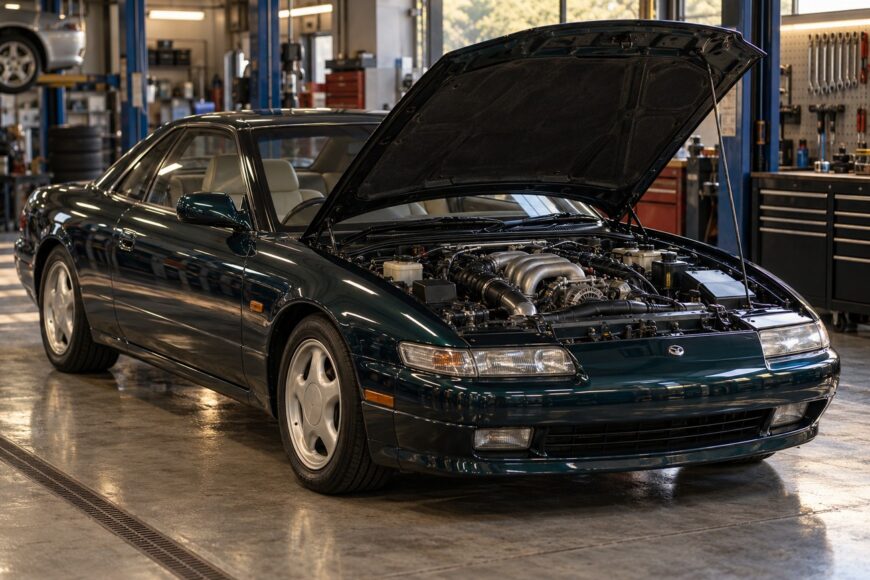
The Eunos Cosmo is a landmark triple-rotor grand tourer, but it is also a heavy, thirsty, complex old car that can be difficult to keep on the road. Its appeal rests partly on the Mazda 20B-REW, an engine no other mass-produced road car received from the factory. That precise distinction matters more than the sweeping claim that no other triple-rotor vehicle has ever existed.
Built from 1990 to 1996, the Cosmo paired its unusual powertrain with the comfort and electronic ambitions of an early-1990s Japanese flagship. Those features make a complete example compelling to collectors. They also leave a prospective owner facing scarce parts, aging electronics, and maintenance that calls for specific knowledge rather than general enthusiasm for rotary engines.
- Why the Eunos Cosmo Is Genuinely Unique
- The 20B-REW: Three Rotors and Sequential Turbocharging
- Eunos Cosmo 20B-REW at a Glance
- A Grand Tourer, Not a Lightweight Sports Car
- The Ownership Reality: Fuel, Heat, Electronics, and Parts
- What Buyers Get Wrong Before Purchasing One
- The Myths That Distort the Cosmo’s Value
- Frequently asked questions
- How many Eunos Cosmo 20B cars were made?
- Why was the Mazda 787B banned?
- What car came with a three-rotor engine?
Why the Eunos Cosmo Is Genuinely Unique
The Eunos Cosmo was a Mazda grand tourer sold through the Eunos marque from 1990 to 1996. Its defining version was the only mass-produced road car factory-equipped with the Mazda 20B-REW. That is a narrow, defensible claim about a production road car and its original engine, rather than a claim about every triple-rotor machine ever built.
Mazda gave the Cosmo a role beyond showcasing an engine. It was a technologically advanced Japanese grand tourer of the early 1990s, with top versions offering electronic navigation and early multimedia equipment. The combination of powertrain and cabin technology explains why originality matters to its identity.
The 20B’s production scale was small, generally estimated in the several-thousand-engine range rather than tens of thousands. An engine-production estimate should not be mistaken for an exact count of 20B-powered cars, much less a count of survivors. For a buyer, that limited scale chiefly means checking the availability of components before committing to repairs.
The 20B-REW: Three Rotors and Sequential Turbocharging
The Mazda 20B-REW uses three rotors and displaces 1,962 cm³ by the rotary measurement convention. Each rotor contributes to combustion within its own housing, giving the engine more capacity to produce torque than a smaller rotary layout. The extra hardware also brings more components to cool, seal, and service.
Its two turbochargers operate sequentially. The system is designed to bring in boost across different operating conditions, rather than treating both turbos as a simple pair working identically at all times. A change in the way power arrives as the system transitions can therefore be relevant to diagnosis; an obvious hesitation still deserves investigation rather than being dismissed as normal behavior.
Factory-rated output was approximately 280 PS and 402 N·m. The power figure reflects Japan’s period gentleman’s agreement on advertised output, so it is best read as the contemporary factory rating. Owner-reported and modified outputs can be substantially higher, but they are not factory specifications.
Three rotors and sequential twin-turbocharging make the 20B distinctive without making its upkeep simple. Stable cooling, correct mixture, correct ignition, and disciplined maintenance are central to keeping it healthy. A car that runs strongly during a brief drive can still have faults that emerge when it is fully hot or asked to restart.
Eunos Cosmo 20B-REW at a Glance
These factory-era specifications identify the 20B-powered Cosmo; the final rows describe its intended role rather than its mechanical output. They do not establish the condition or performance of an individual car.
| Item | Specification or positioning |
|---|---|
| Production period | 1990–1996 |
| Engine | Mazda 20B-REW, three rotors |
| Rotary-measured displacement | 1,962 cm³ |
| Turbocharger layout | Sequential twin-turbocharging |
| Factory-rated power | Approximately 280 PS, reflecting Japan’s period gentleman’s agreement |
| Factory-rated torque | 402 N·m |
| Vehicle character | Heavy, long-wheelbase grand tourer focused on comfort and technology rather than lightweight track performance |
| Market positioning | Technologically advanced Japanese grand tourer; top versions offered electronic navigation and early multimedia equipment |
A Grand Tourer, Not a Lightweight Sports Car
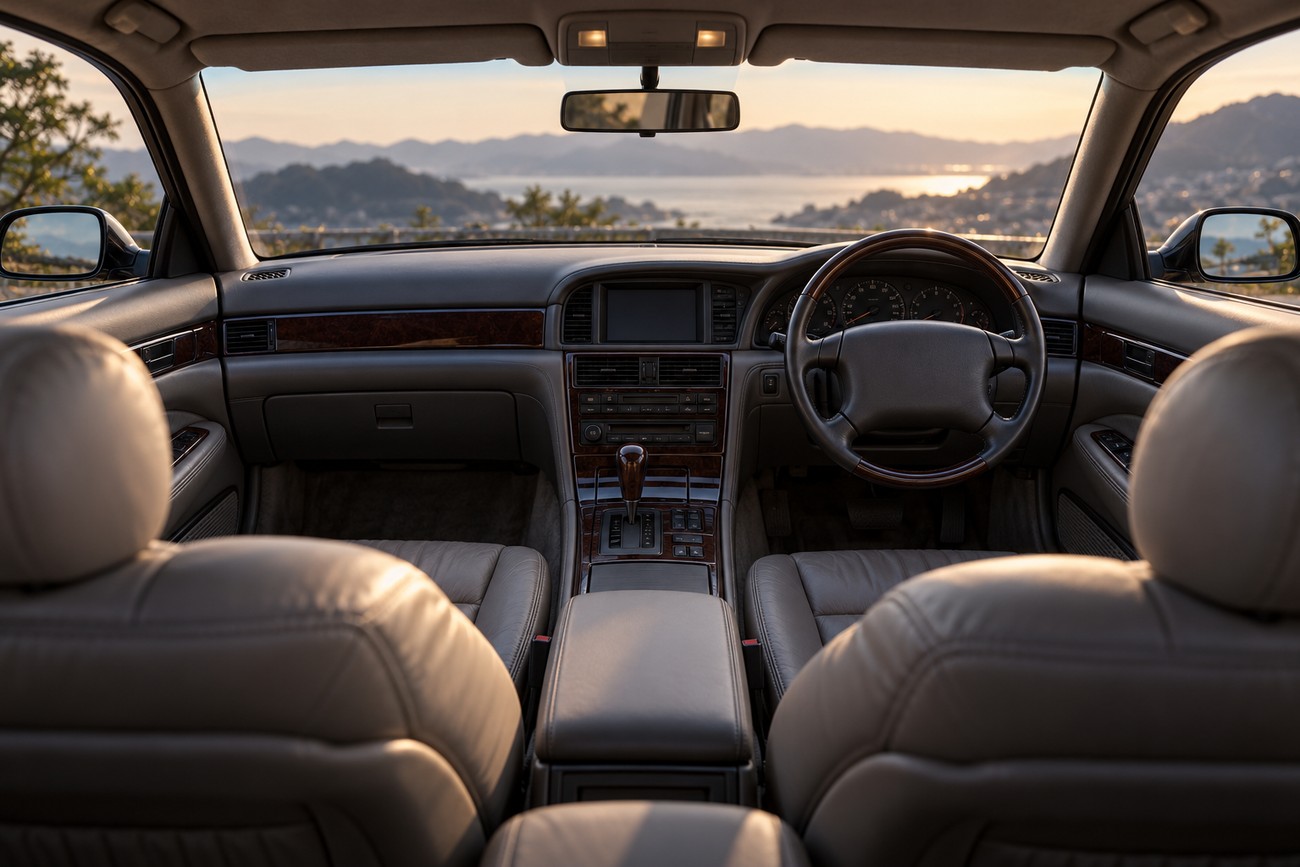
The Cosmo’s weight and long wheelbase shape how its power is used. It was conceived for comfortable, sustained travel, with equipment and refinement taking priority over minimal mass. Expecting the responses of a stripped-down sports car misses the purpose of the chassis.
Top-version electronic navigation and early multimedia equipment made the cabin part of the flagship statement. These systems add historical interest, particularly when complete and working. They also give buyers more original equipment to inspect and potentially repair.
This distinction matters when comparing a Cosmo with a lighter rotary Mazda. Strong engine output does not erase the demands that weight places on acceleration, braking, and changes of direction. The Cosmo makes more sense as a powerful grand tourer than as a starting point for inexpensive track performance.
The Ownership Reality: Fuel, Heat, Electronics, and Parts
High fuel consumption in urban and mixed driving is a recurring owner complaint, and it affects how readily the Cosmo can be used rather than merely what it costs to fill. Thermal condition deserves closer attention still. Cooling-system faults and poor maintenance can turn a running 20B-REW into an expensive repair.
Hard starts or unstable idle after storage do not identify a failed rotor by themselves. Aging seals, fuel delivery, and ignition components can all contribute, as can faults elsewhere in an old car. Diagnosis needs to distinguish an engine problem from the systems that allow it to run correctly.
The sequential turbo system adds another layer to fault-finding. Worn turbochargers, sensors, or related controls may be difficult to replace with original parts, while aging wiring and relays can imitate mechanical trouble. A technician needs to establish what the car is actually commanding and delivering before attributing a loss of power to the engine itself.
Scarcity extends beyond the powertrain to original electronics, body pieces, and interior trim. Even a sound engine does not make an incomplete car easy to finish. Specialist support is limited, too: experience with a more common rotary Mazda does not automatically translate into willingness or ability to diagnose a 20B-REW Cosmo.
What Buyers Get Wrong Before Purchasing One
Rarity is a reason to inspect more carefully, not to overlook faults. A car without a credible maintenance history may need broad preventive work on cooling, fuel, ignition, turbocharging, and aged components. The purchase decision should account for the time and specialist access that work could require.
A pre-purchase assessment should include rotor compression, a cold start, a fully warm restart, smoke, and symptoms consistent with seal trouble. Each observation answers a different question: a smooth cold start alone cannot establish hot-start health, and a short drive cannot establish compression. The aim is to narrow expensive uncertainty before money changes hands.
Undocumented swaps and modifications increase that uncertainty. If the installed components, calibration, or previous engine work cannot be identified, the next technician must first reconstruct what was done before diagnosing a fault. Originality is not mandatory for a usable car, but documentation makes a modified one far easier to support.
An RX-7 specialist may be a useful contact, yet familiarity with a two-rotor Mazda is not proof of access to 20B-specific parts or experience with the Cosmo’s systems. Confirm who will inspect and service the car before buying it. A rare engine is a poor place to discover that the nearest willing workshop is unavailable.
The Myths That Distort the Cosmo’s Value
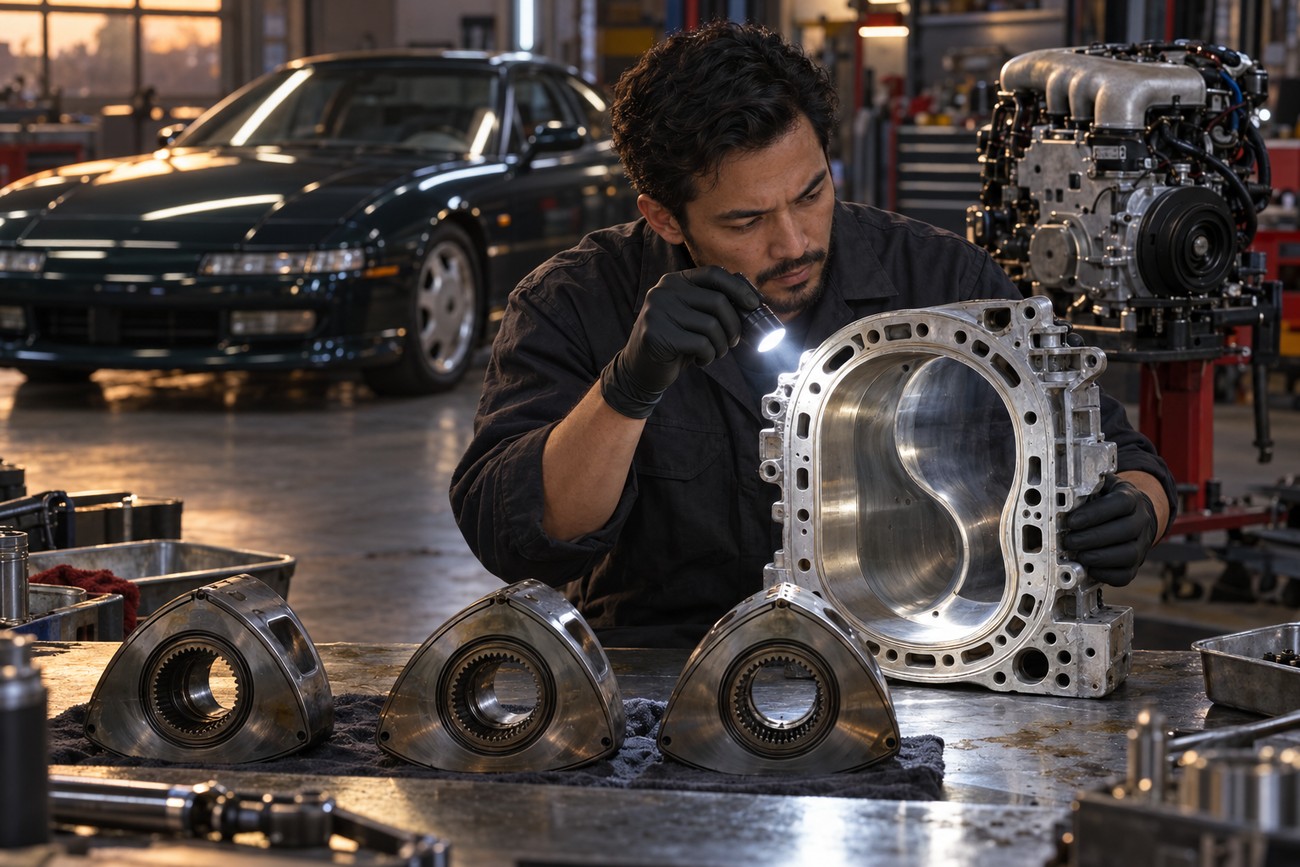
Calling the Cosmo “the only triple-rotor production car” compresses several different ideas into one phrase. The precise claim is that it was the only mass-produced road car factory-equipped with the Mazda 20B-REW. That wording preserves what is remarkable about the car without making an unnecessary claim about race cars, prototypes, or later conversions.
Approximately 280 PS is the period Japanese factory rating, not a promise about every surviving engine. Wear, faults, and modifications can all change present-day output. A claimed higher figure needs evidence, and even a documented result says little on its own about cooling or long-term reliability.
Mazda rotary parts should not be assumed interchangeable across models. Many 20B-REW and Cosmo-specific items are rarer and more expensive to source than parts for more common RX-7 rotary applications. The third rotor also brings additional complexity, thermal load, maintenance cost, and fuel demand alongside its performance potential.
Rarity, condition, completeness, and documented history are separate qualities. A scarce Cosmo with missing electronics or uncertain engine work can be harder to own than a less dramatic example with a clear service record. Its historical importance does not remove the need to judge the individual car.
Frequently asked questions
These questions cover three distinct subjects: uncertain production totals, a racing rule change, and the road car that received Mazda’s factory three-rotor engine. Keeping them separate prevents a memorable claim from becoming a misleading fact.
How many Eunos Cosmo 20B cars were made?
There is no single definitive public figure to use here as an exact total of 20B-powered Cosmo cars. Widely repeated counts are estimates; production of 20B engines is generally placed in the several-thousand range, not the tens of thousands. Engine production, completed-car production, and the number of cars surviving today are different measures and should not be presented as interchangeable.
Why was the Mazda 787B banned?
The 787B could not return under the same top-class Le Mans rules because racing regulations changed, not because of a road-car ban or a penalty imposed on the Cosmo’s 20B-REW. The 787B was a racing car with a different rotary-engine program. Its regulatory history does not explain or restrict production of the roadgoing Eunos Cosmo.
What car came with a three-rotor engine?
For a factory-equipped, mass-produced Mazda road car, the answer is the 1990–1996 Eunos Cosmo fitted with the 20B-REW. The engine was offered within the Cosmo range, so finding a Cosmo badge alone is not enough to identify a three-rotor car. Check the individual vehicle’s original specification and current engine before treating it as a 20B example.







