
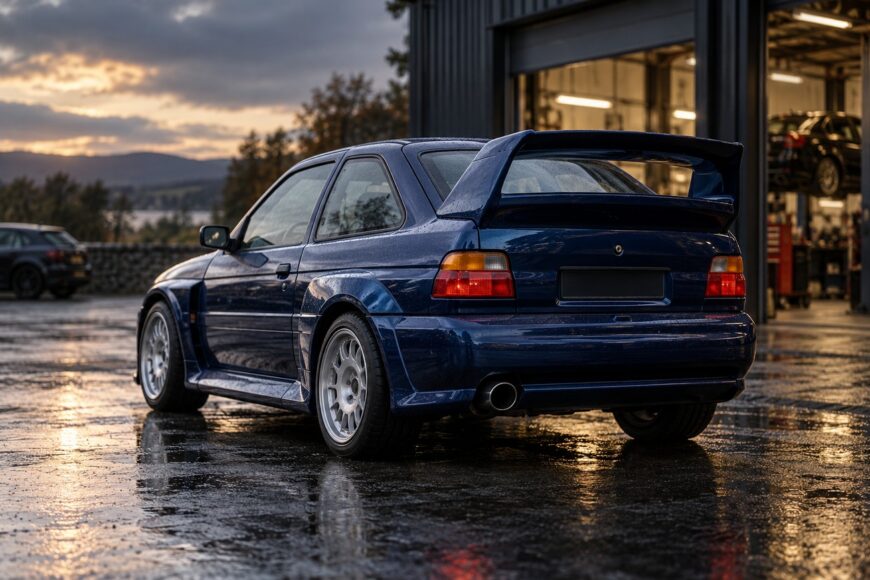
The Escort RS Cosworth’s whale tail is unmistakable. Less visible are the questions that determine whether a particular car is worth owning: Is it a genuine RS Cosworth, how sound is its shell, and what will it take to keep its turbocharged engine and all-wheel drive working properly? A striking repaint can answer none of them.
Ford built this road-going car to support a Group A rally program, and that purpose shaped far more than its appearance. Its rarity and competition connection explain the fascination, but they also make incorrect parts, undocumented modifications, and neglected maintenance consequential. The Escort RS Cosworth deserves to be understood as an engineered car, with the costs and compromises that implies, rather than admired only as an image.
- A homologation car, not an Escort with a spoiler
- Why the whale tail mattered beyond appearances
- Turbo power and all-wheel drive: the appeal and the compromise
- Big-turbo and later cars are not interchangeable
- Inspect the shell before trusting the shine
- The mechanical bills hidden behind 227 hp
- Why provenance can matter more than peak power
- Frequently asked questions
- How much is an Escort RS Cosworth worth today?
- What is the rarest Cosworth?
- Which documents help verify an Escort RS Cosworth’s originality?
A homologation car, not an Escort with a spoiler
The road-going Escort RS Cosworth was a Group A homologation special: Ford needed a production car connected to its rally contender. Approximately 7,145 road cars were built. That total establishes the model’s limited production without implying that every surviving example has a competition history.
Its Escort Mk5 origins are real, but an ordinary Escort conversion does not become an RS Cosworth by gaining wider bodywork and a wing. The homologation project involved substantial reworking to accommodate its turbocharged drivetrain, all-wheel drive, and distinctive body. Those differences matter when judging both authenticity and the feasibility of a restoration.
The resulting car had an identity separate from the mainstream Escort range. Its road-car specification carried engineering choices made in the context of rallying, though a road car should not be mistaken for a rally-prepared machine. That distinction helps explain why a genuine, correctly documented example commands attention in a way a convincing replica may not.
Why the whale tail mattered beyond appearances
The large rear wing became the Escort RS Cosworth’s defining feature, but it was part of a broader aerodynamic concept aimed at high-speed and rally stability. Its shape made the car instantly recognizable even among the prominent performance hatchbacks of its era. Calling it decoration alone misses the purpose behind the bodywork.
That purpose should not be stretched into an unverified performance claim. Without a specified test condition or aerodynamic measurement, a precise downforce figure would say little about what a road driver actually feels. The sound conclusion is that the wing was designed as part of the stability package, not that it delivers a particular force at an unspecified speed.
The same exterior pieces that establish the car’s identity complicate ownership. Original spoilers, panels, bumpers, and other trim can be scarce and costly to replace after damage. A minor-looking impact can therefore become a prolonged search for the correct part, especially when the goal is a factory-correct repair.
Turbo power and all-wheel drive: the appeal and the compromise
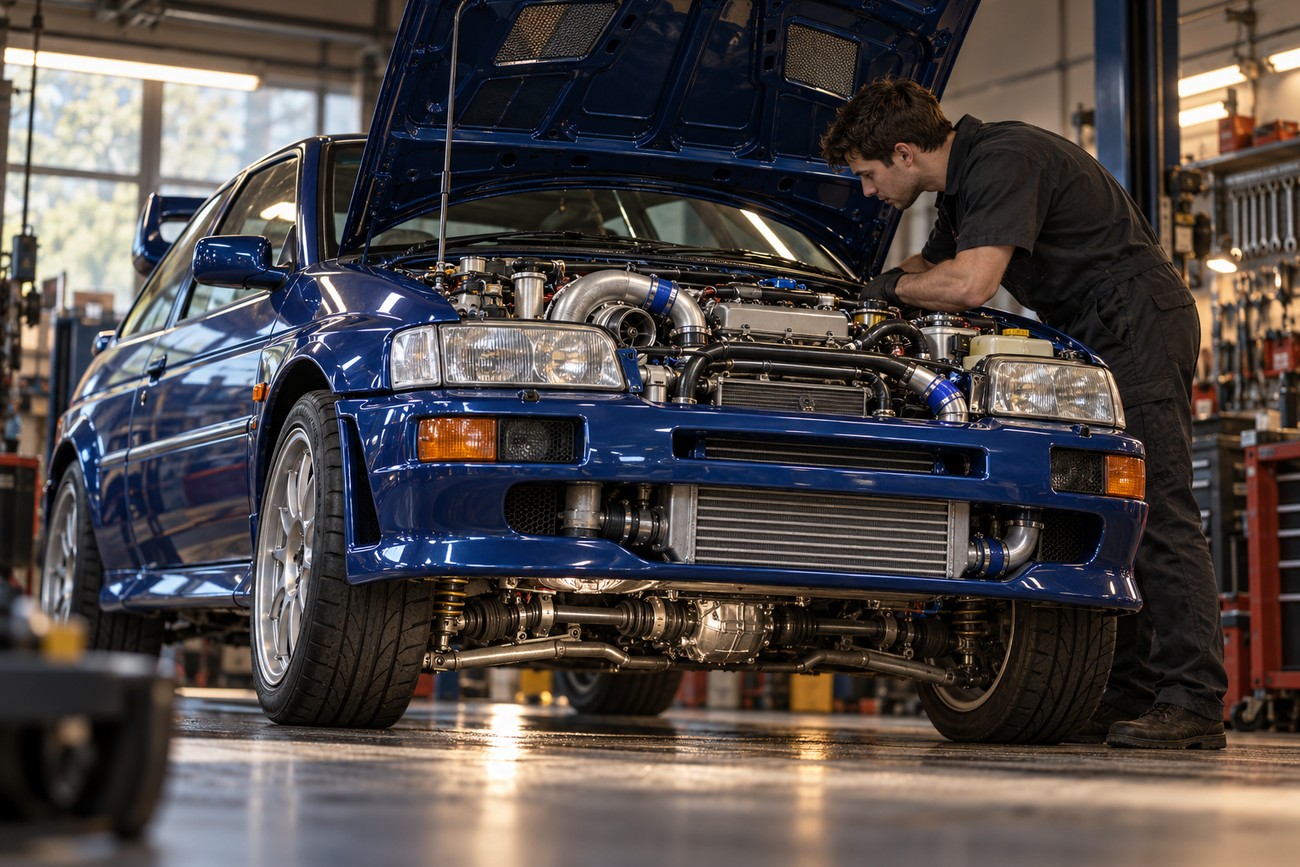
The road car uses a turbocharged, 16-valve, 2.0-liter inline-four from the YBT/YBP family. Published output is approximately 224–227 hp, with figures varying by source, year, and market. Approximately 227 hp is often quoted, but it should be read as a reported specification rather than a guarantee of what an individual car produces now.
Period performance figures commonly place 0–100 km/h at approximately 5.7–6.0 seconds and top speed at approximately 225–230 km/h. These ranges convey the car’s pace without pretending that every version was tested in identical conditions. Maintenance and modification can make an individual example feel quite different from the published numbers.
Drivers often describe a pause before the turbo delivers a pronounced surge. Gentle, low-rev driving may feel less satisfying than the headline output suggests, while a healthy engine becomes much more forceful once boost arrives. That uneven delivery is part of the experience, though excessive hesitation warrants investigation rather than being dismissed as character.
A viscous-coupling all-wheel-drive system helps put that power to use and reflects the car’s performance and handling priorities. It was not conceived chiefly for quiet, unobtrusive daily travel. The firm, noisy ride and the engine’s delivery can make long stretches on poor roads tiring, even for someone who enjoys the car’s grip and pace.
Big-turbo and later cars are not interchangeable
Early Escort RS Cosworths are commonly described as big-turbo cars. Later specifications differ, and equipment can vary by year and market. A seller’s label is therefore a starting point for checking the car, not a complete description of its factory specification.
Engine hardware deserves particular attention because decades of modifications can blur the distinction between original and altered cars. Check the claimed specification against available factory evidence and the parts actually fitted. A changed turbo, injectors, or engine-management setup may transform the way a car drives without changing its underlying identity.
Published road-car output of approximately 224–227 hp and quoted 0–100 km/h times of approximately 5.7–6.0 seconds do not, by themselves, settle a comparison between versions. Claims that every early car feels markedly fiercer or is automatically worth more are too broad. Condition, documented specification, and the quality of any changes have to be judged on the individual example.
Inspect the shell before trusting the shine
Begin by establishing that the car is a genuine RS Cosworth, rather than an ordinary Escort converted to resemble one. Reconcile its vehicle identity with registration and available factory-specification records before treating its bodywork as evidence. Correct-looking exterior parts are useful clues, but they cannot establish authenticity on their own.
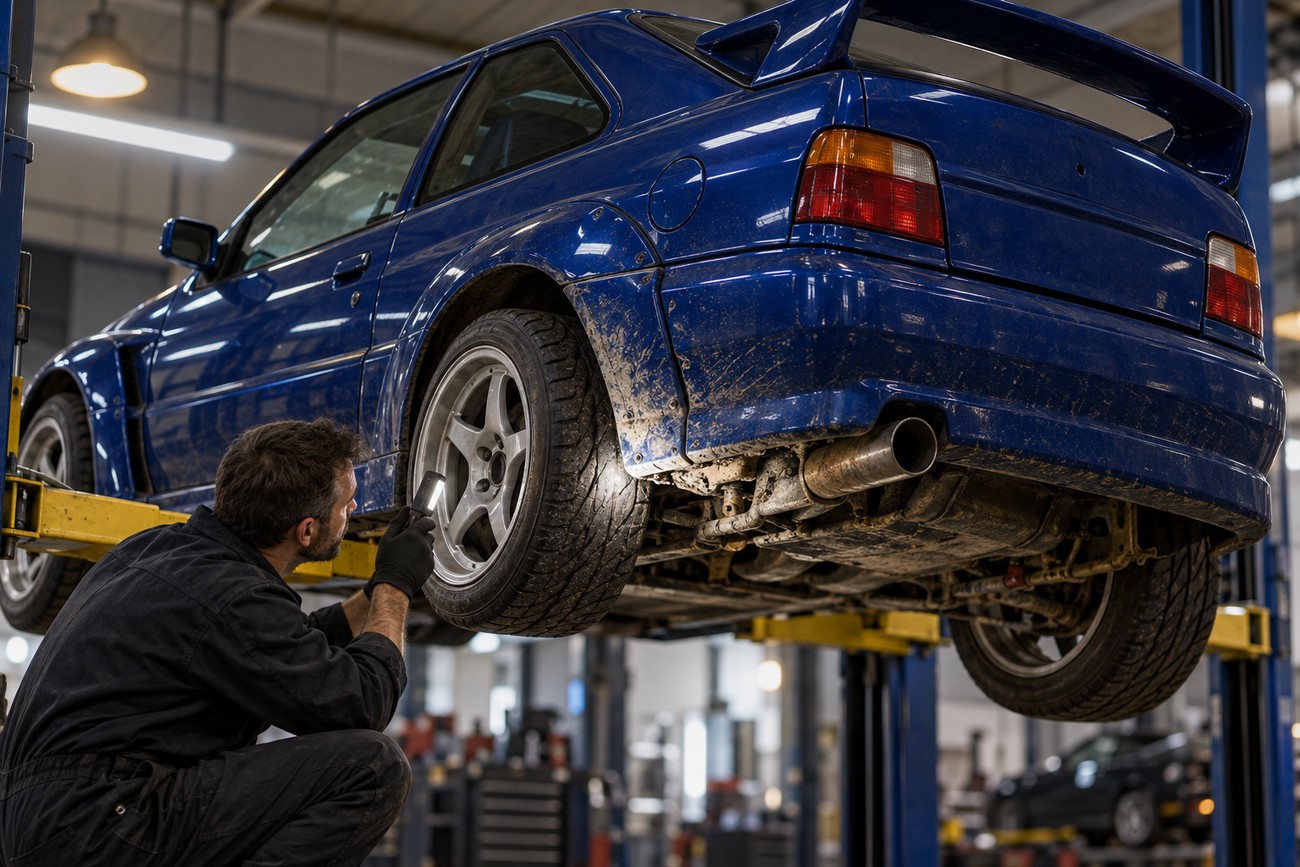
Next, inspect the shell closely for corrosion around the arches, sills, suspension mounting areas, and body-kit attachment points. Look for repairs as well as visible rust: a freshly finished surface can conceal work that needs closer examination. Evidence of past rally or track use also calls for careful assessment of the shell rather than an assumption that such use was necessarily damaging.
Restoration records should explain what was replaced and where the parts came from. Donor components and non-original panels may be apparent in a well-documented build, yet much harder to identify once everything has been painted to match. Because correct panels and exterior trim can be scarce and costly, an incomplete account of body repairs is a meaningful financial risk.
A less glossy car with consistent identifiers and clear repair photographs may be easier to assess than a flawless-looking one with gaps in its history. Cosmetic condition matters, but it cannot prove structural integrity. If access for a thorough inspection is limited, uncertainty belongs in the purchase decision rather than being wished away.
The mechanical bills hidden behind 227 hp
Approximately 224–227 hp is the commonly reported road-car output, not a diagnosis of a surviving engine. A tired turbo, compromised intercooler, or aging fuel system can blunt performance well before a car becomes undrivable. A test drive that feels flat should prompt mechanical checks, not an assumption that all Escort RS Cosworths simply drive that way.
Age affects the supporting systems too. Hoses, wiring, seals, and rubber components can create intermittent faults or leaks even on a car with an immaculate cabin. Collector status offers no protection against deterioration, and tracing a small fault may take longer when previous repairs are poorly documented.
The viscous-coupling all-wheel-drive system adds another set of components to assess. Bearing and differential wear can be difficult to pin down from a short drive, while repairs may be costly and parts availability deserves checking in advance. A specialist inspection is particularly useful when noises or drivetrain behavior have no convincing explanation in the service history.
Undocumented tuning makes that work harder. A substituted turbo, injectors, exhaust, or engine-management setup may increase output, but it also changes the questions a mechanic must ask about fueling, reliability, and compatibility. Budget for diagnosis and the availability of replacement parts before purchase; returning a heavily altered car to factory specification may cost more than its tidy appearance suggests.
Why provenance can matter more than peak power
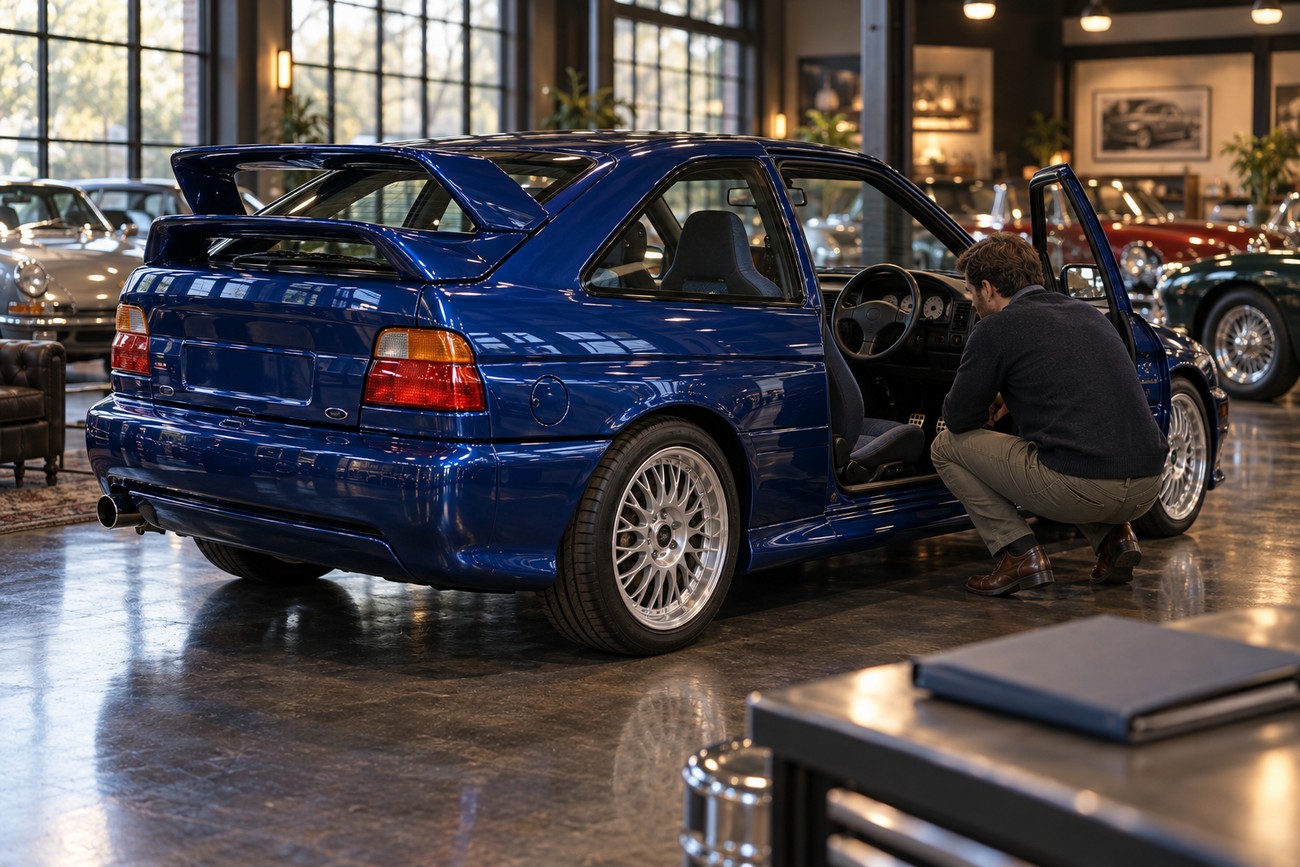
Approximately 7,145 road-going Escort RS Cosworths were built, and finding one that is both sound and correctly represented takes patience. Limited production and unmistakable design support demand, but neither establishes the value of a particular car. Original identity, documented history, condition, and market-correct factory details carry more weight than a power claim alone.
Collectors will examine details that a casual glance misses: wheels, spoiler, badges, seats, and instruments should make sense for the car’s claimed specification. A mismatch is a reason to investigate, not automatic proof of deception; parts can be replaced during ordinary ownership. Records showing when and why a change happened make the car easier to judge.
A heavily modified engine can be appealing to someone who intends to drive it, while complicating a claim of originality. Likewise, a polished restoration with little evidence of the work may leave more unanswered questions than a less glossy car with consistent records. Specification, condition, and history must be assessed together before either example can be called the better buy.
Frequently asked questions
The answers depend on what is being compared and how well an individual car is documented. Market value requires dated sales evidence, while rarity claims require clear variant definitions. Identity and factory specification need to be checked against records and the car itself.
How much is an Escort RS Cosworth worth today?
No defensible current price can be quoted without dated market evidence. Start with recent completed sales in the same market, rather than advertised asking prices, and compare cars with similar factory specifications. Then adjust for documented history, structural and mechanical condition, originality, and the extent of any restoration or modifications. A car with missing records or unresolved faults should not be valued as though those uncertainties were already settled.
What is the rarest Cosworth?
“Cosworth” can refer to different models as well as different specifications within a model, so there is no meaningful rarest-car answer without defining the group being compared. Approximately 7,145 road-going Escort RS Cosworths were built, but that overall figure does not provide documented totals for every variant. A rarity claim needs clear variant definitions and supporting production records.
Which documents help verify an Escort RS Cosworth’s originality?
Request vehicle identity and registration records, factory-specification evidence where available, dated service invoices, and photographs taken during any restoration. Compare the identifiers and claimed specification across those records, then check whether the fitted parts and visible repairs agree with them. If something differs, establish when it changed and why; a documented replacement is easier to evaluate than an unexplained mismatch, however convincing the finished car looks.







