
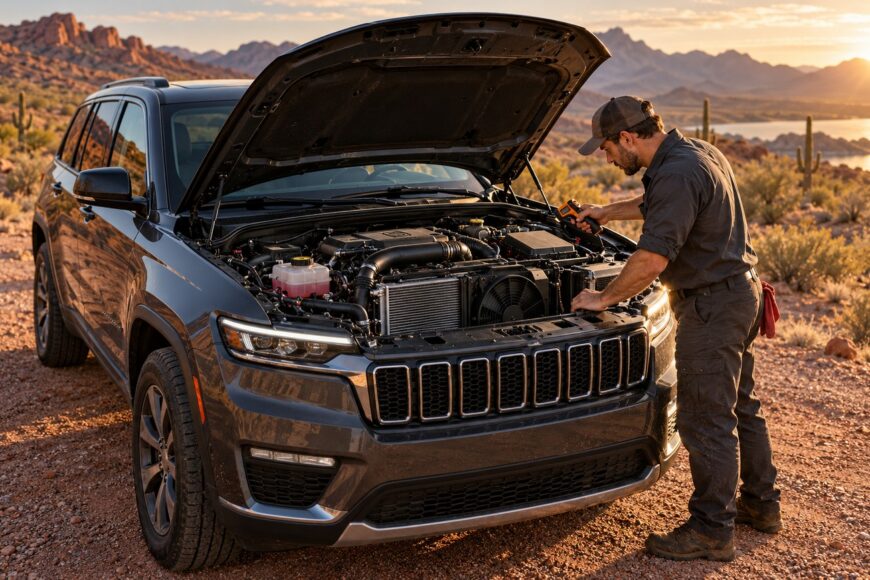
A Jeep Grand Cherokee that runs normally on the highway but spikes in traffic, after a long idle, on a grade, or while towing is showing a pattern worth diagnosing. The temperature may fall again as soon as the vehicle moves, which often points toward limited airflow or a cooling system that is close to its capacity in Arizona conditions.
Do not replace the thermostat by guesswork. First establish whether coolant temperature is genuinely rising or the dashboard gauge is simply displaying a damped reading. OBD-II data, fan operation, coolant level, pressure, airflow, and the engine-specific temperature specification provide a safer basis for repair decisions.
- What a Temperature Spike Means on a Jeep Grand Cherokee
- Why Arizona Heat Exposes Cooling-System Weaknesses
- Match the Temperature Pattern to the Most Likely Cooling-System Check
- The Parts That Commonly Cause a Jeep Temperature Spike
- A Better Diagnostic Sequence Than Replacing the Thermostat First
- What to Do When the Temperature Rises in Traffic, on a Grade, or After Shutdown
- Frequently asked questions
- What is the most common problem behind a Jeep Grand Cherokee temperature spike?
- What are the symptoms of a bad thermostat in a Jeep Grand Cherokee?
- Why can the engine temperature rise after I turn the Jeep off?
What a Temperature Spike Means on a Jeep Grand Cherokee
Many modern Jeep and SUV engines commonly operate at about 90–105°C coolant temperature, although the exact specification depends on the engine and model year. A brief change under load may deserve observation, while recurring or sharp spikes require investigation. The important point is the pattern, not one isolated needle position.
The dashboard gauge is often damped or broad in its normal range. It may remain nearly steady while coolant temperature changes quickly, because the instrument is designed to avoid constant movement during normal operating fluctuations. That makes the gauge useful as a warning, but less useful for identifying the start of a problem.
Live OBD-II data can show actual coolant temperature and reveal short spikes that the dashboard hides. Around 110–115°C can appear on a scanner while the gauge still looks nearly normal. That reading is a meaningful diagnostic clue, not proof by itself of engine damage, and it should be compared with the engine-specific specification and operating conditions.
Record the temperature during the same event that causes the complaint. A steady rise at idle, a rise only with the air conditioner operating, and a rise after shutdown suggest different testing priorities. The outside-air or intake temperature and the commanded operation of the electric fan add useful context.
Why Arizona Heat Exposes Cooling-System Weaknesses
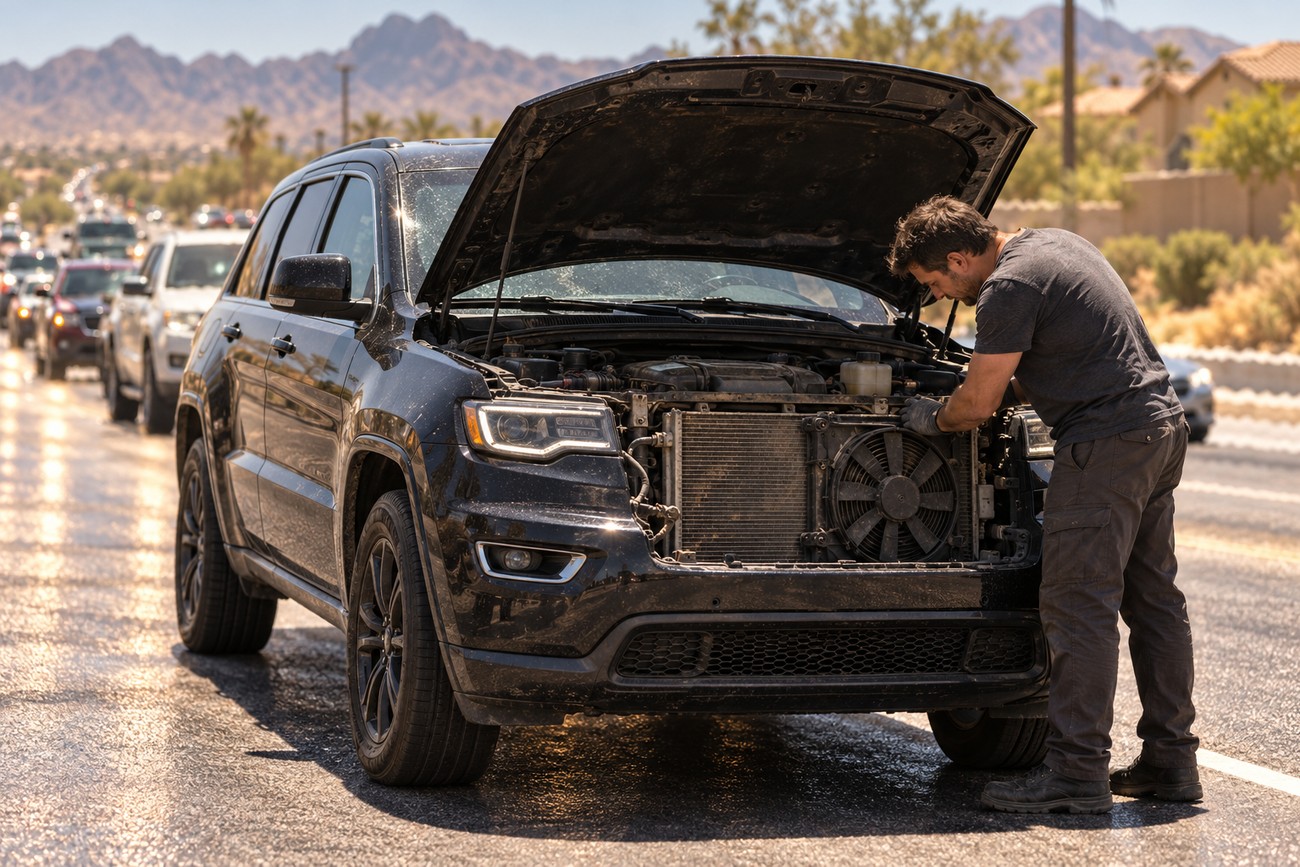
High ambient heat reduces the radiator’s heat-rejection margin. The cooling system has less temperature difference available to transfer heat from the coolant to the air, so a weakness that remains hidden in mild weather can appear during an Arizona summer.
Low vehicle speed removes much of the natural airflow through the front of the vehicle. Traffic, a long idle, air conditioning, a climb, and towing can combine into a much heavier thermal load than steady highway cruising. A marginal fan, restricted airflow path, or weak coolant circulation may cope with one condition and fail when several occur together.
The radiator and A/C condenser can collect insects, dust, and road debris. The restriction may be between the condenser and radiator, where a casual look from the front will not reveal it. A generally clean exterior also does not prove that the radiator has adequate internal coolant flow.
Arizona driving can therefore produce occasional spikes rather than constant overheating. That intermittent pattern is easy to dismiss, especially if the temperature falls once the Jeep is moving. Repeated events still matter because each one can indicate reduced cooling capacity or rising system pressure.
Match the Temperature Pattern to the Most Likely Cooling-System Check
Use the pattern to choose the first test, rather than treating it as a confirmed diagnosis. Several faults can coexist, and the same symptom can result from different components on different Grand Cherokee engines.
| Observed pattern | First checks | Diagnostic meaning |
|---|---|---|
| Temperature rises in traffic, at idle, or with the A/C on | Electric fan operation, fan control, condenser and radiator airflow | Limited low-speed airflow is possible, particularly if highway temperature remains normal. |
| Temperature rises on hills or while towing | Coolant level and mixture, radiator capacity, water-pump circulation, thermostat behavior | Increased cooling-system load may expose a restriction or weak circulation. |
| Temperature fluctuates after coolant service | Correct fill procedure, trapped air, coolant level when cold, pressure testing | Air in the system or an incorrect fill can interrupt stable circulation. |
| Temperature remains high under most conditions | Fan, thermostat, pressure cap, radiator restriction, coolant condition, and water pump | A broader loss of cooling capacity is possible; testing should be systematic. |
The Parts That Commonly Cause a Jeep Temperature Spike
The thermostat, electric fan or fan control, radiator, A/C condenser airflow, pressure cap, coolant, water pump, and air-free circulation all affect temperature. Their symptoms overlap, so a part should be replaced after a test supports it rather than because it is a familiar suspect.
A thermostat stuck closed can restrict coolant flow and cause a rapid temperature rise, particularly under load. A thermostat stuck open usually causes slow warm-up, reduced cabin heat, or a temperature that stays below its intended operating range. Thermostat behavior should be assessed alongside hose temperature, scan data, and the engine-specific service procedure.
A weak electric fan can appear functional during a brief cold check and fail after the engine warms up or when the A/C adds load. Testing fan operation under those conditions is more informative than confirming that the blades move once.
A fan or fan-control fault commonly becomes most visible at low vehicle speed. The Jeep may cool adequately on the highway because ram air compensates for the missing fan performance, then rise in temperature at a light or during a long idle. A restricted condenser or radiator face can create a similar pattern by limiting the air available to both heat exchangers.
The pressure cap is part of the cooling system, not a minor accessory. A closed pressurized system depends on the correct cap and coolant mixture; pressure loss reduces the boiling margin. Old, incorrect, mixed, or poorly serviced coolant can also contribute to recurring temperature problems, especially when the system is working close to its limit.
Weak cabin heat during an overheating event can indicate poor coolant circulation or air trapped in the system. A water pump with inadequate flow, an internal radiator restriction, or an air pocket may allow the temperature to rise even when the coolant level appears acceptable. Rising system pressure, repeated coolant loss, or bubbling should prompt proper testing rather than repeated topping off.
A Better Diagnostic Sequence Than Replacing the Thermostat First
Begin by reproducing the condition safely and recording what happens. Note outside or intake-air temperature, vehicle speed, engine load, A/C use, grade, towing status, and the OBD-II coolant temperature. Compare those readings with fan operation instead of relying only on the dashboard gauge.
When the engine is fully cold, verify the coolant level and the specified mixture. Inspect for leaks, damaged hoses, contamination, and signs that the wrong coolant or an unsuitable mixture has been used. Do not remove a cap from a hot pressurized system.
Check whether the electric fan operates at the required temperature and when the A/C is switched on. Inspect the condenser and radiator for insects, dust, and road debris, including material trapped between the heat exchangers. External washing does not rule out internal radiator restriction or poor coolant flow, and high-pressure water can damage fins if used carelessly.
Pressure-test the cooling system and the cap using equipment appropriate for the vehicle. A pressure loss can lower the coolant mixture’s boiling margin even when no large puddle is visible. After coolant service, confirm that the correct bleeding or fill procedure was completed and that trapped air is not interrupting circulation.
Only then assess thermostat behavior, radiator restriction, and water-pump circulation in detail. Replacing parts at random can leave the original fault in place and introduce a second problem. Repeated brief overheating events should not be dismissed as harmless, because short duration does not prove that the temperature stayed within a safe range.
What to Do When the Temperature Rises in Traffic, on a Grade, or After Shutdown

A Grand Cherokee can run normally on the highway because forward motion supplies strong airflow through the condenser and radiator. That does not prove the system is healthy. Traffic, low speed, air conditioning, grades, and towing remove that reserve and can reveal a fault that cruising hides.
If the temperature continues rising, warning messages appear, power drops, the cabin heater turns unexpectedly cool, or coolant escapes, reduce the load and stop in a safe location as soon as practical. Turn off the A/C, avoid continued towing or hill climbing, and allow the vehicle to cool. Do not open a hot pressurized cooling system.
A short rise after shutdown can be heat soak: stored engine heat continues moving into the coolant after airflow and coolant circulation change. If the electric fan fails to run, circulation is marginal, or the system cannot maintain pressure, that rise may become more pronounced. The timing matters: a post-shutdown increase points to a different test sequence from a rise that begins while cruising.
Once the vehicle is cool, check for obvious coolant loss without placing hands near moving fans or hot components. If the temperature repeatedly climbs, the safest choice is inspection or transport to a repair facility rather than continuing to drive and waiting for the gauge to reach the red zone.
Frequently asked questions
The answers below connect common temperature patterns with the checks that help distinguish among possible causes. No single symptom identifies one failed part across every Grand Cherokee engine and model year. Live temperature data, fan behavior, and cooling-system tests provide the clearest direction.
What is the most common problem behind a Jeep Grand Cherokee temperature spike?
There is no single most common cause across every Grand Cherokee engine and model year. A spike at idle or with the A/C on ranks electric-fan operation and airflow higher; a rise after coolant service raises concern about trapped air; a rise under load directs attention toward the thermostat, radiator capacity, coolant circulation, or water pump.
Pressure loss, incorrect coolant, and internal restriction can produce overlapping symptoms. The timing of the spike, live coolant temperature, fan behavior, and pressure-test results are more reliable than choosing one part from the symptom alone.
What are the symptoms of a bad thermostat in a Jeep Grand Cherokee?
A thermostat stuck open commonly causes slow warm-up, weak cabin heat, and a coolant temperature that remains lower than expected. A thermostat stuck closed or opening inadequately can cause a rapid temperature rise, especially on hills, during towing, or when the engine is heavily loaded.
Those signs are not exclusive to the thermostat. Air in the system, a restricted radiator, weak water-pump circulation, or a fan problem can create similar temperature behavior, so scan data and cooling-system tests should support the diagnosis.
Why can the engine temperature rise after I turn the Jeep off?
Residual engine heat can continue entering the coolant after shutdown, producing a short heat-soak rise. This can be a normal physical effect when the increase is limited and the system remains stable, but a pronounced or repeated rise may indicate marginal fan operation, poor circulation, or inadequate pressure control.
The timing helps separate the possibilities. A rise that begins only after shutdown emphasizes fan and heat-soak testing, while a rise that starts during driving points more strongly toward cooling capacity, airflow, thermostat behavior, or circulation under load.







