
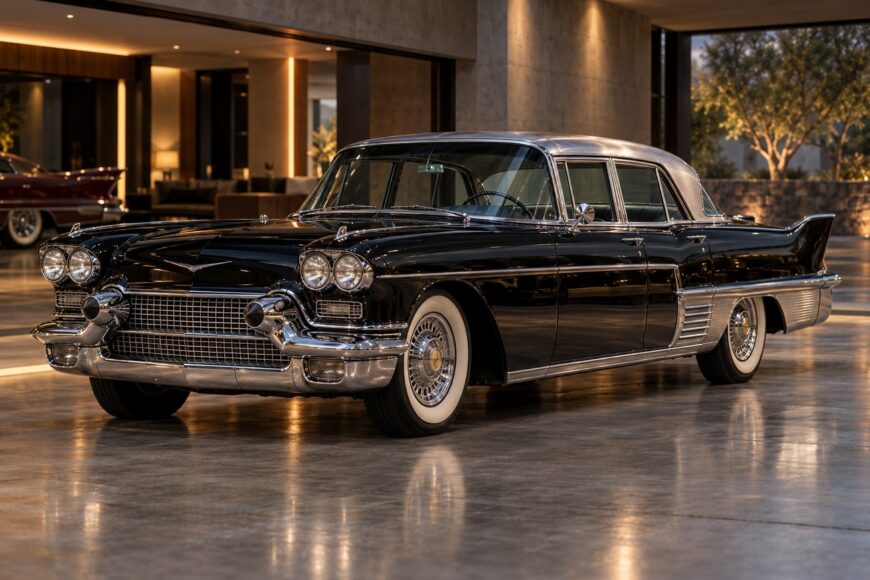
The 1957 Eldorado Brougham brought hand-built coachwork and unusually ambitious luxury equipment to a Cadillac showroom. Preserving one today presents a different kind of challenge. A gleaming car may still have missing trim, incorrect interior fittings, or electrical features that work only intermittently.
Those details matter because the Brougham was built in small numbers, with components that often cannot be replaced by parts from a familiar 1950s Cadillac. Its original price established its place in the luxury market; its condition, completeness, and documented history determine what a surviving example represents now. That distinction begins with why Cadillac built such an exceptional car.
- Why Cadillac Built the 1957 Eldorado Brougham
- A Hand-Finished Body That Is Hard to Replace
- Inside: Luxury Features and Their Hidden Complexity
- V8 Power and the Air-Suspension Fact Check
- What Makes Restoration So Demanding
- How to Judge Originality Before You Buy
- Frequently asked questions
- How much is a 1957 Cadillac Eldorado Brougham worth today?
- Which Cadillac Eldorado is the most sought after?
- Was the Eldorado Brougham the most expensive car sold in 1957?
- Why are original Brougham personal accessories often missing?
Why Cadillac Built the 1957 Eldorado Brougham
Cadillac offered the Eldorado Brougham for the 1957–1958 model years. The 1957 car was a hand-built four-door hardtop, and production that year totaled 400. It occupied a position beyond the regular Eldorado range, with its own body details and a level of finishing that demanded more individual work.
At approximately $13,000 new in 1957, it cost more than twice as much as many regular-production Cadillacs. That figure conveys the scale of Cadillac’s ambition, although comparisons with Rolls-Royce require care: models, specifications, and prices differed by market. The Brougham was among the most costly American cars offered that year, without needing a worldwide superlative to make the point.
Hand assembly also shaped the car’s character. Panels and trim needed fitting to the individual body, while its equipment brought mechanical and electrical systems together in ways a conventional Cadillac did not. For an owner, the distinction is practical: a standard-model parts catalog cannot be assumed to provide every answer.
The original sticker price is historical context, not a formula for present-day value. Two Broughams with equally polished paint can differ substantially in correct components, quality of earlier repairs, and strength of documentation. Those differences deserve more attention than a simple comparison with what the car cost when new.
A Hand-Finished Body That Is Hard to Replace
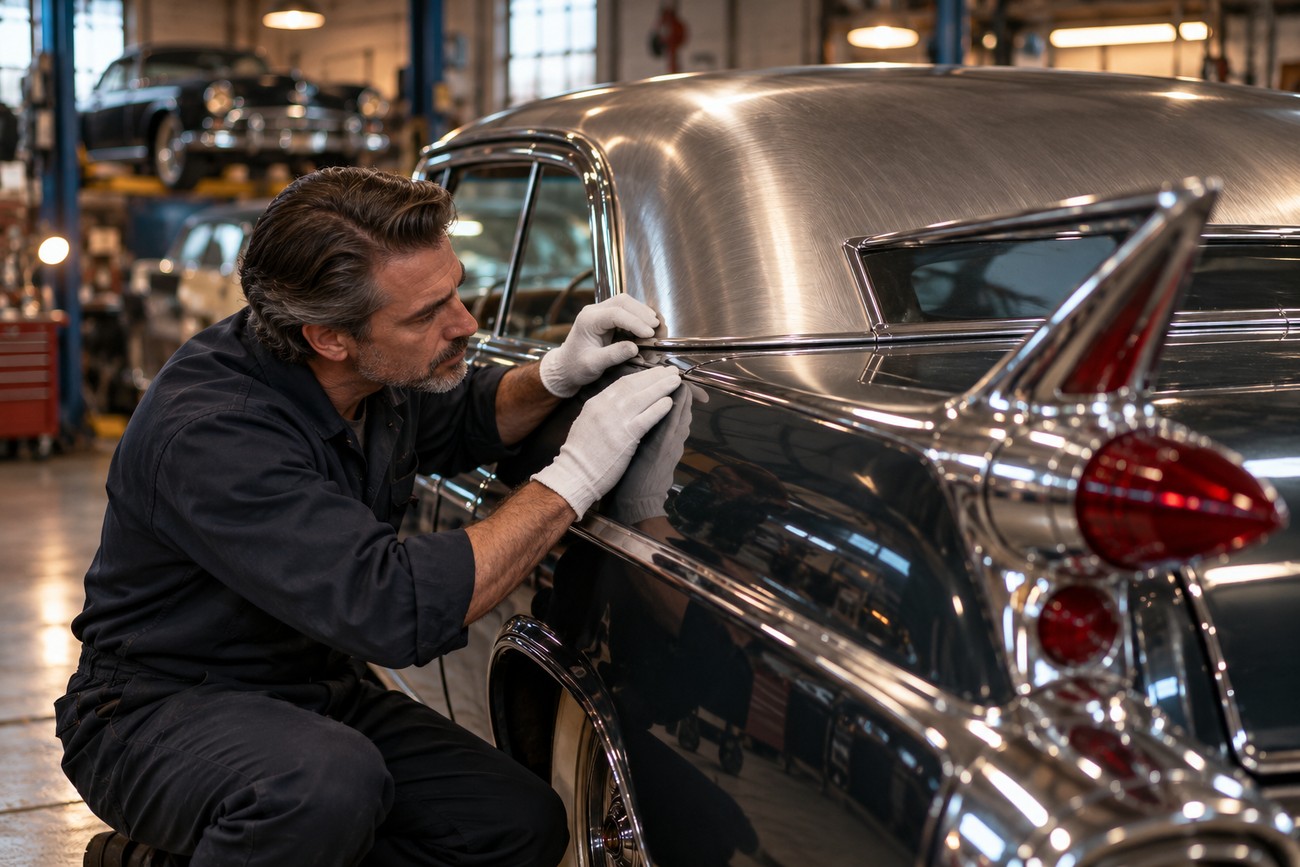
The stainless-steel roof is the Brougham’s most immediately recognizable surface. The car’s rear fins and distinctive lamps complete a shape that looks related to contemporary Cadillacs yet has its own identity. Examine the roof’s finish separately from the painted panels; its condition may tell a different story from the rest of the body.
Many panels and trim pieces were hand-fitted or made specifically for the Brougham. A molding that appears close to one from a regular Eldorado may differ in profile, length, or attachment. Apparent similarity is a poor basis for buying a replacement, particularly when original small-batch trim is difficult to find.
Modern, perfectly symmetrical panel gaps are not a reliable measure of factory authenticity on a hand-finished car. Look instead for a coherent pattern of fit, sound metal, and evidence of how any damage was repaired. Fresh paint can conceal filler or corrosion left beneath an earlier restoration.
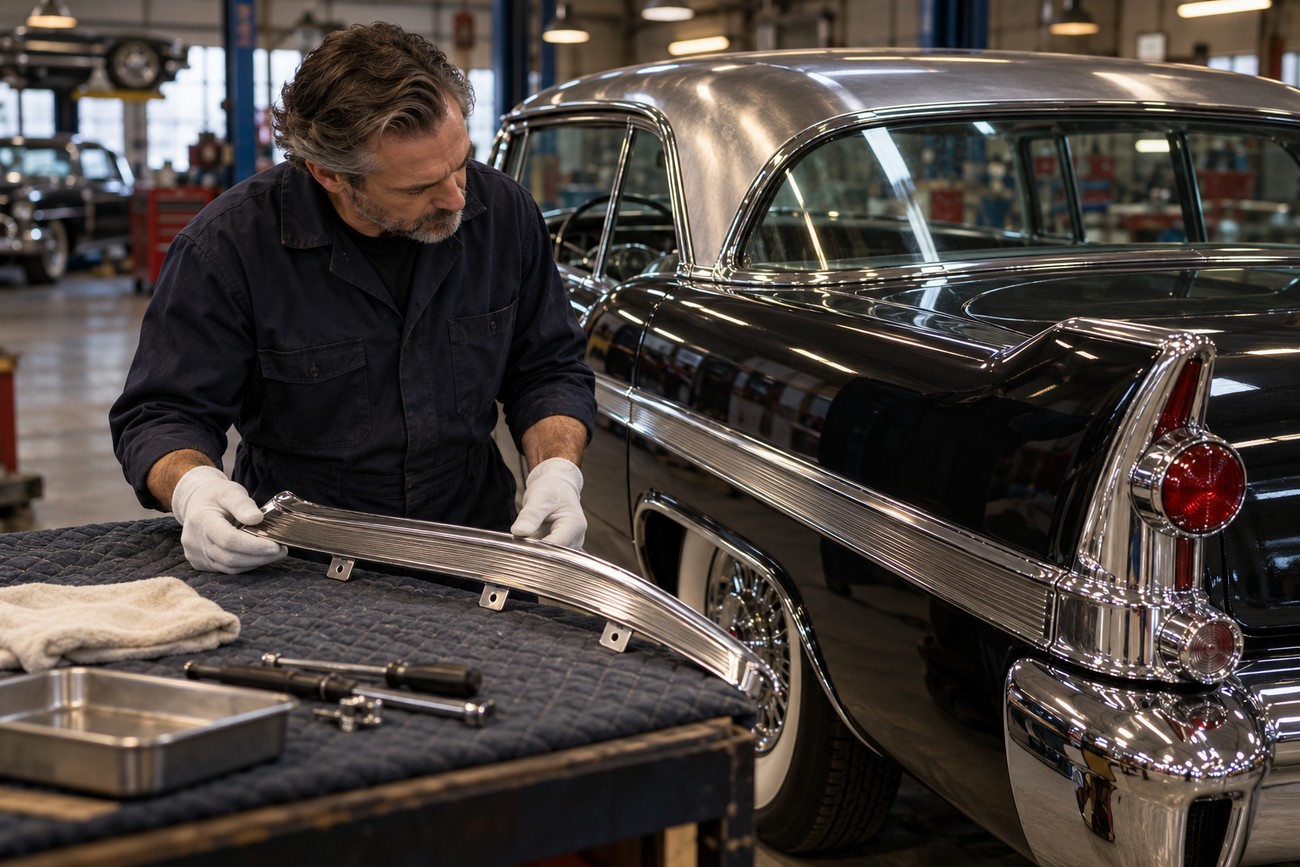
Brightwork calls for the same scrutiny. Heavy grinding can erase a scarce molding’s original profile even if the finished chrome looks clean in photographs. A damaged piece may take longer to resolve than a more conspicuous mechanical problem, making close inspection worthwhile before purchase or bodywork.
Inside: Luxury Features and Their Hidden Complexity
The Brougham’s cabin combined carefully chosen materials with power-operated conveniences and a seat-position memory feature. Its personal accessories added to the sense of a car prepared around its occupants. Together, these details explain why interior completeness matters as much as the condition of the exterior.
A listing may name power seats, locks, windows, or other equipment without establishing that each system is present, correct, and working on that particular car. Check the fitted components and their operation rather than treating an equipment list as proof. Replacements from another Cadillac can look plausible while differing in pattern, finish, or fit.
Seat-memory mechanisms, locks, switches, and wiring deserve a deliberate functional inspection. Faults may involve more than a single failed motor, and proper repair can require someone familiar with the Brougham’s arrangements. A car that starts and drives smoothly can still carry a substantial electrical project behind its dashboard and door panels.
Original upholstery, fittings, and removable accessories can be harder to obtain than their small size suggests. A retrim may make the cabin presentable without reproducing the correct material or detail. Anyone pursuing an authentic restoration should identify what survives before deciding what can realistically be recreated.
V8 Power and the Air-Suspension Fact Check
The 1957 Brougham used a 365-cubic-inch V8 rated at approximately 325 horsepower, paired with a Hydra-Matic automatic transmission. Those specifications suited a substantial luxury car built for composed travel. On the road, its size and weight remain apparent, particularly when braking or changing direction.
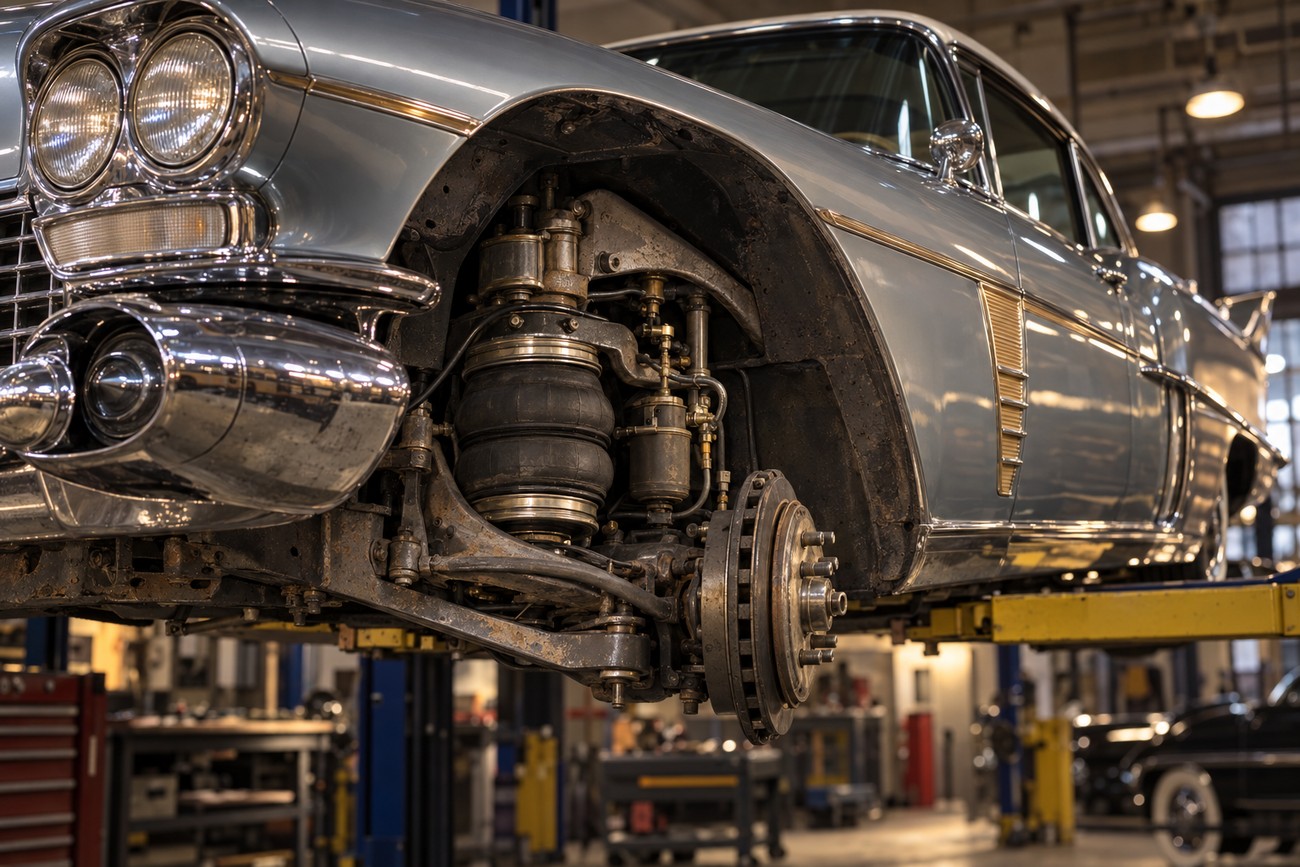
Factory air suspension was a feature of the 1957 Brougham. The claim that 1957 cars came standard with coil springs and that air suspension arrived only in 1958 is incorrect. This matters during an inspection because suspension type affects both originality and the work needed to put a car right.
Some surviving cars have coil springs. Their present hardware does not establish how they left the factory; the installation may be a later conversion. Ask for records of the change and inspect its execution rather than accepting either “original suspension” or “factory coils” on the strength of a sales description.
Test the suspension’s operation alongside the engine, transmission, brakes, and steering. A short drive may reveal how the car behaves, but it cannot by itself explain the history of altered components. Mechanical condition and factory specification are related questions that require separate answers.
What Makes Restoration So Demanding
A Brougham project can appear largely complete while lacking the pieces that make completion difficult. Exterior moldings, cabin fittings, and other small-batch components may have limited availability. Specialist labor then becomes important because a substitute part often needs more than a simple bolt-on installation.
Earlier work can introduce another layer of uncertainty. Corrosion may remain beneath repairs, while incorrect replacement pieces can be difficult to recognize once fitted and finished. Before approving a repaint or a full interior retrim, establish what is original, what has been repaired, and what is absent.
Electrical systems and factory air suspension need functional checks, not merely a glance at tidy components. Specialist rebuilding may be necessary where wiring, controls, or mechanisms have deteriorated. Budgeting solely from the car’s appearance leaves little room for faults revealed when each feature is tested.
The stainless-steel roof and delicate brightwork also need appropriate finishing methods. Aggressive polishing can change a surface or soften a trim profile that cannot readily be replaced. A careful restoration plan protects surviving material first and treats fabrication or substitution as a documented decision.
How to Judge Originality Before You Buy
Begin with the car’s identifying numbers and available records. Specialist Cadillac club records may help corroborate a Brougham’s identity and trace parts of its history. They cannot, on their own, prove that every panel and fitting now on the car is original, especially after multiple restorations.
Next, inspect the body and account for its trim piece by piece. Check panel condition, the stainless-steel roof, rear lamps, and the fit of moldings, then compare uncertain parts with reliable Brougham references. Ordinary Cadillac components should never be assumed to be direct replacements.
Move inside to verify materials, fittings, and any claimed personal accessories. Restoration invoices and dated photographs can help explain what was retained, remade, or replaced; a seller’s description alone cannot settle those questions. Test the electrical features and suspension after the completeness check, preferably with someone who knows the model.
An honest car with visible wear and clear documentation may be easier to assess than a striking example assembled with unidentified parts. For a purchase decision, weigh condition alongside correct components, completed work, and what remains missing. Recent comparable sales are useful only when those differences are taken into account.
Frequently asked questions
Questions about the Brougham often mix historical facts with judgments about individual surviving cars. Production and original price can be stated directly; value and originality require evidence tied to the example being considered.
How much is a 1957 Cadillac Eldorado Brougham worth today?
There is no single reliable value for every 1957 Brougham. Compare recent documented sales, then account for each car’s condition, originality, correct equipment, completeness, and restoration records. The approximately $13,000 price when new establishes historical context, not a present-day estimate.
Which Cadillac Eldorado is the most sought after?
There is no single answer across all collectors. The hand-built Brougham appeals to buyers who prize its rarity, construction, and unusual equipment, while other Eldorados attract interest for different designs and driving experiences. Demand for a model does not remove the need to judge an individual car on its merits.
Was the Eldorado Brougham the most expensive car sold in 1957?
It was a notably expensive American car, priced at approximately $13,000 new. Calling it the world’s most expensive car sold in 1957 would require comparisons across different models, specifications, and markets, including contemporary Rolls-Royce offerings. Its exceptional price is clear without that unqualified claim.
Why are original Brougham personal accessories often missing?
Removable accessories can become separated from a car as owners change or a restoration proceeds. A claimed complete set deserves its own examination: check that the items are appropriate and ask for photographs or records connecting them to the car. Their presence in a sale does not, by itself, establish that they have remained with it since new.







