
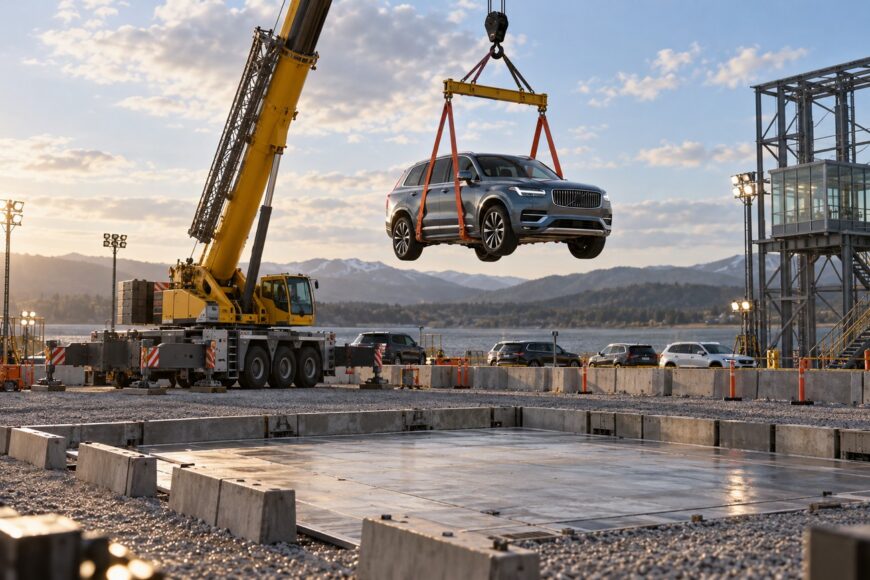
A Volvo hanging from a crane before falling 30 meters to the ground is a striking image. In 2020, Volvo Cars used that image to demonstrate a rescue-focused research project designed around severe vehicle damage and the difficult work of reaching occupants afterward.
The central issue is practical. Strong passenger compartments can help preserve occupant space, yet high-strength structures and distorted load paths may make modern vehicles harder for rescuers to cut open. The footage should therefore not be read as proof that a Volvo is indestructible. It shows an extreme research method intended to support extraction training and rescue knowledge.
- What Volvo Actually Did in the 30-Meter Drop Test
- Why Drop Cars Instead of Running a Normal Crash Test?
- The Rescue Problem: Stronger Cars Can Be Harder to Open
- What the Test Was Supposed to Give Rescue Services
- What the Video Does Not Prove
- How to Read the Test Without Falling for the Hype
- Frequently asked questions
- What personality typically chooses a Volvo?
- Why might Volvos lose value despite their safety reputation?
- Which Volvos should buyers stay away from?
- Does the 30-meter test tell rescuers where to cut every Volvo?
What Volvo Actually Did in the 30-Meter Drop Test
The public test took place in 2020 at the Volvo Cars Safety Centre. Volvo used a crane to drop 10 new Volvo vehicles of different models from a height of 30 meters. The vehicles were dropped multiple times, creating heavily damaged structures for rescue teams and engineers to study.
This corrects a common version of the story in which one car is dropped once and the result is treated as a single dramatic crash test. The project involved several vehicles, different body types, and repeated impacts. That variation mattered because a severely damaged crossover, sedan, or wagon may present different access problems, even when the impact appears similar from a distance.
Volvo described the work as research for rescue services, conducted through the Volvo Cars Safety Centre. The facility had already been used for training with damaged vehicles, so the drop sequence formed part of a broader effort to help responders work around modern vehicle structures.
The purpose was not to produce a consumer score or an industry ranking. It was to create difficult wrecks that could be examined during occupant-extraction exercises. The exact public count of drops is not specified in the available brief, but the vehicles were dropped multiple times rather than subjected to one isolated fall.
Why Drop Cars Instead of Running a Normal Crash Test?
Conventional crash tests are controlled by design. They use defined speeds, impact angles, barriers, dummies, and measurement systems to compare occupant protection under repeatable conditions. That consistency is valuable for certification and safety ratings, but it does not reproduce every severe deformation that rescuers may encounter after a real crash.
Volvo’s drop method targeted damage patterns associated with high-speed single-vehicle crashes, side impacts, and collisions with trucks. These scenarios can produce unusual angles, major height differences, and uneven loading across the body. A 30-meter drop is therefore an extreme research method, not a typical collision benchmark or a standard crash-test height.
Before the drops, engineers calculated the pressure and force required to reach the intended level of deformation. That preparation helped turn an otherwise uncontrolled-looking demonstration into a planned research exercise. Even so, the result should be understood as a selected set of severe damage conditions rather than a complete representation of real-world crash physics.
Repeated impacts also served a practical purpose. Rescue training benefits from seeing how structures behave after different combinations of crushing and distortion, especially when familiar entry points have shifted. The method could expose problems that a clean, single-barrier test might leave outside its main scope.
The Rescue Problem: Stronger Cars Can Be Harder to Open
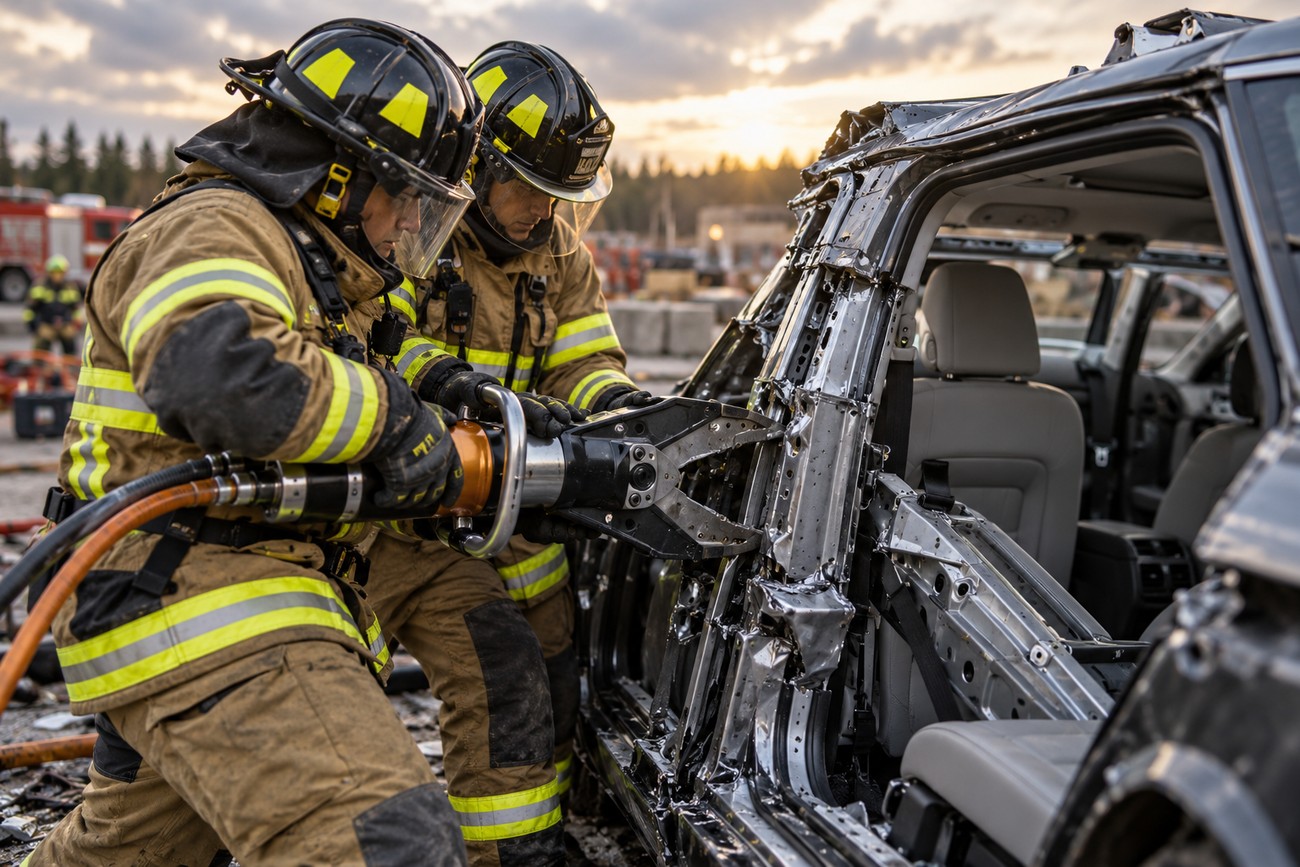
Modern vehicles use high-strength materials and engineered load paths to manage crash energy and preserve the occupant safety cell. Those features can improve protection during an impact, but they may also make cutting more demanding after the vehicle has been badly deformed. A responder may face reinforced sections, compressed pillars, or panels carrying loads in directions that are difficult to judge from the outside.
The remaining position and condition of the occupant safety cell are especially important. If that cell stays relatively intact, it can define where rescuers can place tools and how they can create a controlled opening. If the cell has shifted or folded, a familiar cutting location may be unsafe, inaccessible, or ineffective.
Rescuers assess the remaining safety cell and the vehicle’s load paths before choosing a cutting point. Familiar locations from older vehicles cannot automatically be treated as safe or useful on a heavily deformed modern car.
Different vehicle types and models can deform differently in extreme impacts. A side-loaded sedan may present a different structure from a high-riding vehicle struck at another angle, even if both have similar visible damage. That is why a rescue test involving multiple models can support broader training while still falling short of universal cutting instructions.
The project was intended to help rescue services practice extracting occupants from heavily damaged modern vehicles. Its value lies in understanding how deformation affects access, tool placement, and the space available around the occupants. It does not replace on-scene assessment, model-specific rescue information, or the judgment of trained responders.
What the Test Was Supposed to Give Rescue Services
Volvo said the findings about occupant extraction would be compiled into a separate research report. The company intended to provide that report free to rescue services. Its purpose was to turn the damaged vehicles into practical lessons about deformation and access rather than leave the exercise as a video demonstration.
The work also built on rescue-service training at the Volvo Cars Safety Centre. Training with real damaged vehicles can help responders understand how a passenger compartment, roof, doors, pillars, and other structural areas may interact after a severe impact. That practical exposure can be more useful than relying only on undamaged vehicles or simplified diagrams.
Free access does not automatically make a report universal. Its usefulness depends on the vehicles operating in a particular region, the hydraulic and battery-powered tools available to local teams, and the procedures used by the relevant rescue service. A lesson developed around one manufacturer’s vehicles may need adjustment before it is applied elsewhere.
The intended output was therefore a training resource, not a buyer-facing safety score. It could improve awareness of difficult extraction conditions while still requiring responders to consult current vehicle information and assess each wreck individually.
What the Video Does Not Prove
The test was not a certification crash test and was not used to assign a safety rating. It was a rescue-focused research test. The vehicles were deliberately subjected to extreme damage so that rescue implications could be studied rather than tested against a standard intended to compare cars for consumers.
A 30-meter drop also does not represent every serious road crash, much less the average collision. Real impacts vary by speed, direction, vehicle mass, surface, restraint use, rollover behavior, and secondary impacts. The drop sequence represents extreme crash damage selected for research purposes.
The phrase “most extreme crash test” should be treated carefully. It is Volvo’s marketing description, not a technical standard with a universal definition. The footage can show that the cars were exposed to a dramatic and damaging method, but it cannot establish an absolute measure of Volvo safety.
Public materials also do not fully disclose the calculation protocol and success criteria. Viewers may see the crane, the fall, and the wrecked vehicles without seeing every engineering assumption, measurement, or limitation behind the exercise. That gap matters when a visual demonstration is used to support broad claims about vehicle strength.
How to Read the Test Without Falling for the Hype
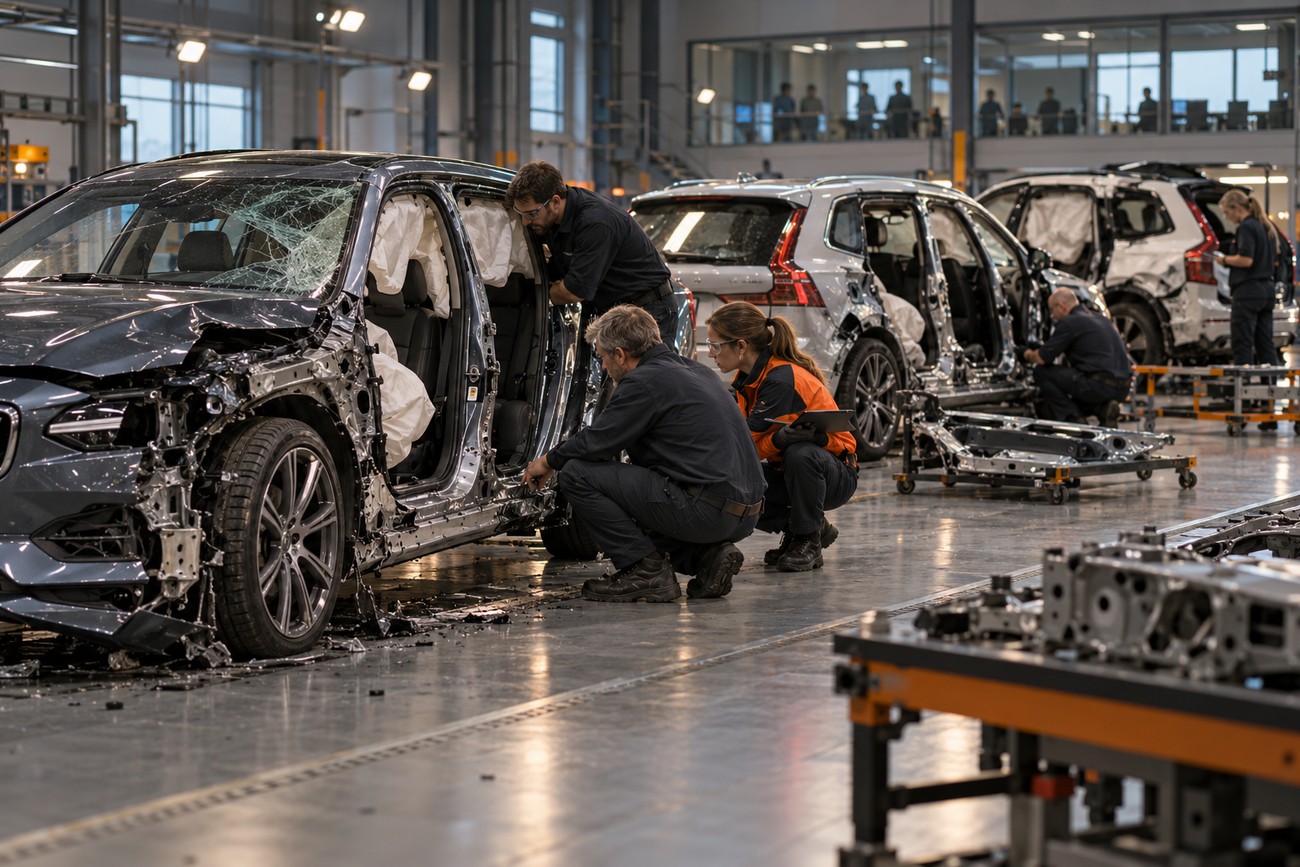
Start with the stated objective: accumulating rescue knowledge. The central purpose was to study access to occupants in severely damaged modern vehicles, not to set a drop record or prove that one brand is immune to crash forces.
Next, separate confirmed facts from incomplete online retellings. The confirmed outline is that the project took place in 2020, involved 10 new Volvo vehicles of different models, used multiple drops from 30 meters, and was conducted as rescue-focused research by the Volvo Cars Safety Centre. Some online accounts confuse the height, the number of vehicles, or the purpose of the test.
Using 10 different vehicles and multiple impacts improves the range of conditions available for comparison. It still does not create universal rescue instructions. Findings cannot automatically be generalized to every Volvo model, every model year, or every crash configuration.
A careful reader should also distinguish the demonstration from the follow-up material. The planned research report was intended to explain extraction findings for rescue services, while the video mainly communicates the severity of the exercise. The report, local training, current vehicle data, and on-scene assessment carry more operational value than the spectacle of the drop itself.
Frequently asked questions
The drop test can answer questions about rescue research, but it cannot support conclusions about personality, resale value, or which specific vehicle a consumer should buy.
What personality typically chooses a Volvo?
Volvo buyers are often associated with a safety-conscious and pragmatic image, but a rescue test cannot establish personality traits. People choose vehicles for many reasons, including space, design, driving needs, technology, price, and brand familiarity.
The 30-meter project provides information about severe vehicle damage and rescue access. It does not show that Volvo owners share a particular temperament or lifestyle.
Why might Volvos lose value despite their safety reputation?
Resale value depends on model-specific demand, age, mileage, condition, maintenance history, market supply, powertrain concerns, insurance costs, and regional preferences. Crash-safety messaging may influence buyer perception, but it does not determine depreciation on its own.
The rescue experiment contains no resale data. It cannot show whether a particular Volvo will retain value or lose it, so that judgment requires market and ownership data for the relevant model and model year.
Which Volvos should buyers stay away from?
The drop footage does not justify a blacklist. Responsible buying advice requires model-year-specific reliability information, recall records, inspection results, service history, and evidence about the particular vehicle being considered.
A car involved in an extreme research drop is not being evaluated as a used-car purchase. Buyers should treat safety research and ownership-risk research as separate areas of evidence.
Does the 30-meter test tell rescuers where to cut every Volvo?
No. It provides research evidence about deformation and occupant extraction, not universal model-specific cutting instructions. Vehicle variation, crash direction, the condition of the safety cell, and the tools available to a local rescue service all affect the safest access plan.
Responders need current rescue information and an on-scene assessment for the vehicle in front of them. The test can support training and awareness, while precise entry decisions remain dependent on the individual wreck and trained rescue procedures.







