
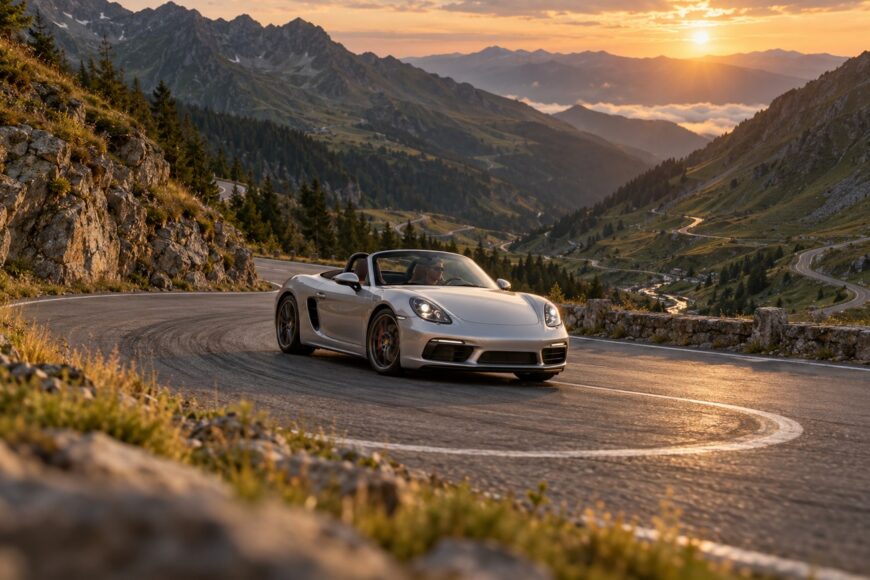
The Porsche Boxster looks made for a road like the Transfagarasan: compact, rear-wheel drive, responsive, and open to the scenery. DN7C has a less romantic reality, with slow traffic, fog, rough patches, tight hairpins, and demanding descents that can disrupt the driving rhythm.
The car has more than enough capability for the route, yet engine power rarely sets the pace. Sightlines, surface condition, traffic, and brake capacity matter more. Treat the Transfagarasan as a high-mountain drive with engaging sections rather than an uninterrupted performance run.
- What the Transfagarasan Actually Demands from a Boxster
- Choose the Right Season, Time, and Traffic Window
- Power Is Not the Limiting Factor on the Mountain
- The Descent: Brake Heat, Engine Braking, and Driver Fatigue
- Fog, Tunnels, Rocks, and Rough Patches: The Hidden Friction
- Open-Top Touring: Great Views, Real Weather Costs
- A Sensible Boxster Plan for the Drive
- Is the Transfagarasan a Great Porsche Drive or an Overhyped One?
- Frequently asked questions
- How long does it take to drive the Transfagarasan Scenic Road?
- Where should you start the Transfagarasan?
- Which car is called the “poor man’s Porsche,” and is that relevant to a Boxster trip?
What the Transfagarasan Actually Demands from a Boxster
The Transfagarasan is DN7C in Romania’s Southern Carpathians, rising to 2,034 m above sea level. Its appeal comes from the scale of the landscape and the road’s changing character, from wooded approaches to exposed high-altitude sections. The route’s elevation changes are substantial, so the car and driver work through repeated climbs, descents, and tight changes of direction.
Many corners are 180-degree hairpins rather than flowing bends. They reward accurate positioning and a clear view more than late braking or high entry speed. A Boxster’s steering and balance are useful here, although the road often gives you too little visibility to exploit them fully.
Earlier Boxster models commonly use rear-wheel drive, have two seats, and measure approximately 4.37 m long and 1.80 m wide. Those dimensions are manageable on a narrow mountain road, but the car still needs room when meeting traffic or avoiding stones near the edge.
Loose debris, rough patches, and sudden changes in visibility make smooth inputs more valuable than aggressive ones. A two-seat roadster also offers limited flexibility if the trip expands beyond light touring luggage, so packing discipline matters before the climb begins.
Choose the Right Season, Time, and Traffic Window
The high-mountain section is usually open from 30 June to 1 November, while conditions and official access controls remain decisive. A clear forecast alone does not confirm that the pass is open. Check current access information before setting out, especially early or late in the usual season.
Traffic on the high section is permitted only in daylight, from 06:00 to 22:00. This restriction affects route planning as much as weather does. A late arrival can leave too little margin for a slow convoy, a fog bank, or several safe stops.
An early weekday usually offers a better chance of lighter traffic than a peak-season daytime visit. It does not guarantee an empty road, since local traffic, coaches, and other travelers still shape the pace. Peak periods can produce stop-and-go movement and frequent photo stops, particularly around viewpoints and the summit area.
Arriving at midday in peak season can turn a sports-car drive into sightseeing from behind several vehicles. That is still a worthwhile trip if the scenery is the priority, but drivers seeking a more continuous rhythm should plan around the traffic window rather than relying on the Boxster to create one.
Power Is Not the Limiting Factor on the Mountain
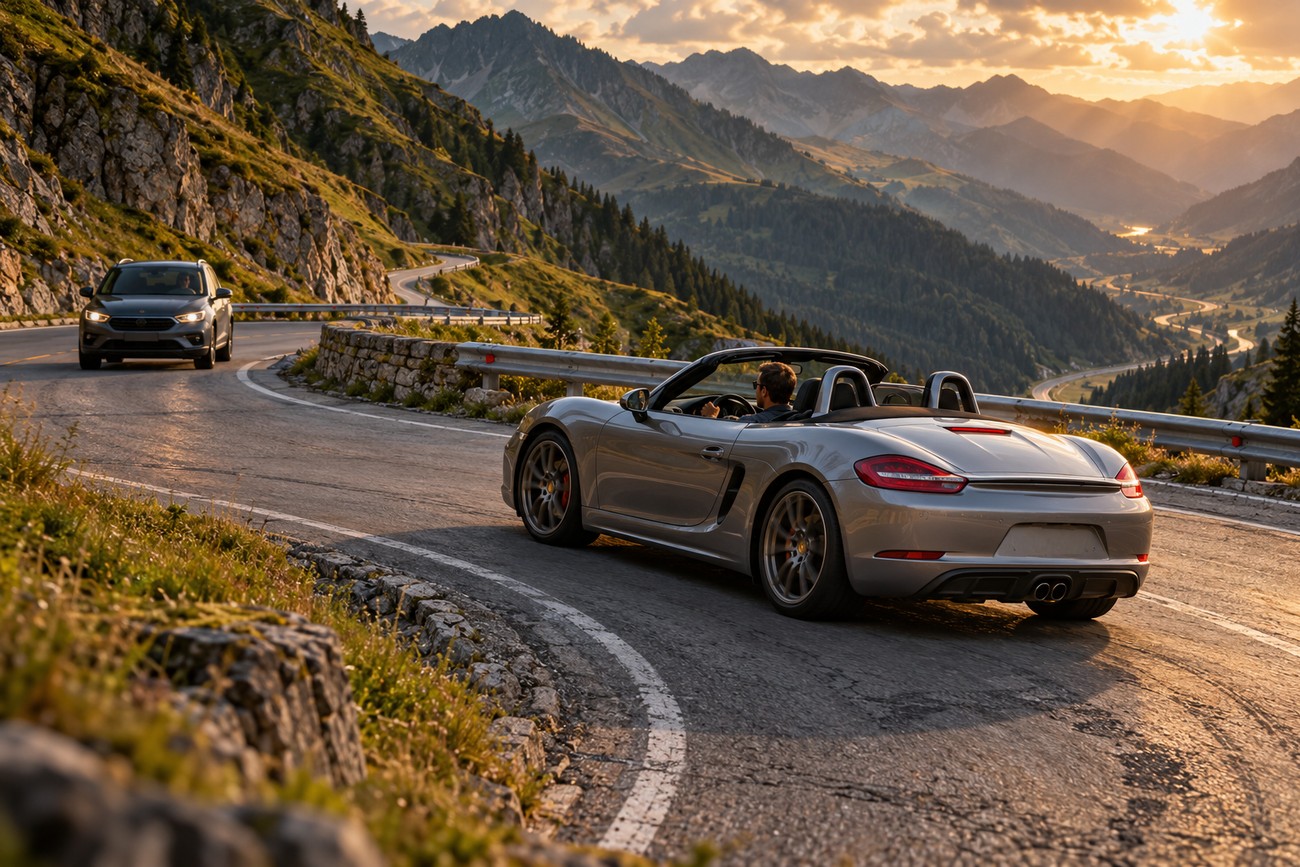
Boxster versions span approximately 204–400 hp across generations and specifications. The 982-generation Boxster uses engines ranging from 2.0 to 4.0 liters, giving buyers a broad choice of performance levels. Every version can provide sufficient acceleration for safe overtaking opportunities where conditions and traffic rules allow.
On the Transfagarasan, the useful qualities are throttle control, traction, steering accuracy, and predictable braking. Corner geometry, traffic, visibility, and surface condition usually limit the pace before horsepower does. A more powerful model may reach the next bend sooner, yet the bend still requires the same clear sightline and margin.
Romanian passenger-car limits are generally 50 km/h in built-up areas, 90 km/h outside built-up areas, and 130 km/h on motorways. Those legal limits do not describe a realistic mountain-road average. The practical pace can be approximately 40 km/h on average, depending on bends, traffic, stops, and visibility.
That average is a planning guide, not a target to maintain. A Boxster should be driven at a speed that leaves room for an oncoming vehicle, a cyclist, a pothole, or loose stone beyond the next visible section. The road’s character rewards restraint because every blind corner can reset the conditions.
The Descent: Brake Heat, Engine Braking, and Driver Fatigue
The descent is often the most consequential part of the drive. Repeated hairpins require repeated speed reduction, and drivers who keep light pressure on the brake pedal through every bend can build unnecessary heat. Reports of overheating or fading brakes are a practical warning, especially after a long downhill section.
Select an appropriate lower gear before the descent becomes demanding, allowing engine braking to help control speed. This does not remove the need for the brakes, since corners and changing traffic still require pedal input. It reduces the amount of continuous pedal pressure and gives the braking system more recovery opportunity between applications.
Experienced drivers reduce sustained pedal pressure before the descent, use engine braking early, and treat a soft pedal as a reason to stop safely rather than continue.
A Boxster can have ample performance for the route while still demanding careful brake management. If the pedal feels soft, braking response changes, or the driver senses that performance is deteriorating, find a safe place to stop and allow the car to recover. Do not continue downhill simply to complete a planned section.
Fatigue adds another layer of risk. Long descents require repeated concentration, precise positioning, and constant scanning for traffic and debris. Wind and noise can increase tiredness in an open car, so a short, safe break may improve the quality of the drive more than pushing on for another viewpoint.
Fog, Tunnels, Rocks, and Rough Patches: The Hidden Friction
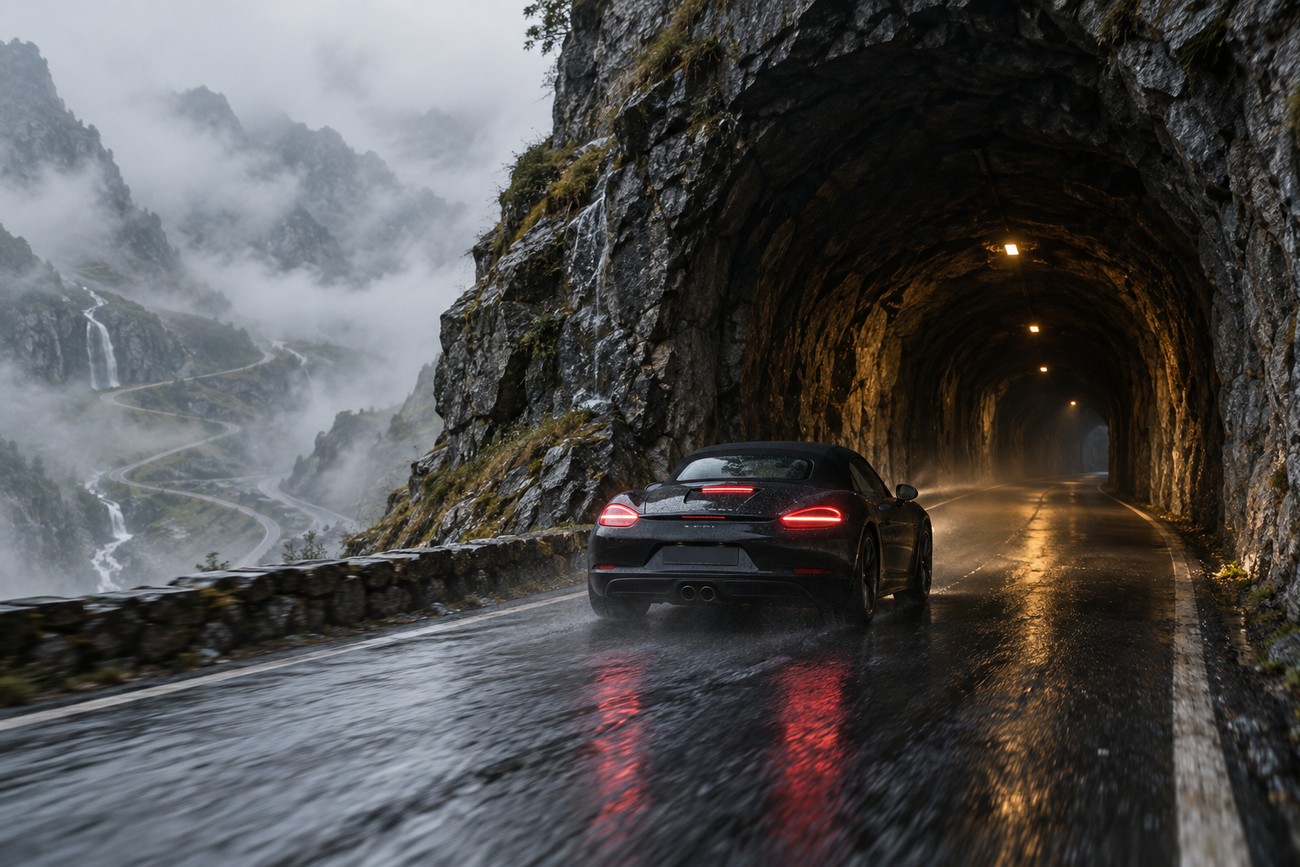
Fog can arrive suddenly and significantly reduce visibility near the high point. The change may be quick enough to turn a scenic run into a low-speed visibility exercise. Reduce speed before sightlines disappear, use appropriate lighting, and leave additional space for vehicles ahead.
The tunnel near the summit is described as narrow and poorly lit. Enter it at a controlled speed, with the car’s lighting ready and attention focused on lane position. The transition from bright mountain light to a dark, confined section can make a previously comfortable pace unsuitable.
Some sections may contain potholes, loose stones, or rockfall debris. These hazards favor a scanning driver who looks beyond the next hairpin and avoids placing the wheels close to uncertain edges. Sudden steering or braking to miss debris can create its own problem, particularly when another vehicle is approaching.
A low, sport-oriented suspension and limited ground clearance can make rough sections less comfortable. The Boxster’s compact footprint helps on narrow pavement, while its low stance demands care over damaged surfaces and debris. Slow down early enough to keep the suspension settled rather than arriving at a rough patch under heavy braking.
Open-Top Touring: Great Views, Real Weather Costs
An open roof improves the visual experience, especially where the road rises above the surrounding valleys. You hear the changing surface and weather more clearly, and the elevated views feel more immediate. The same openness exposes occupants to cold air and wind at altitude.
Weather can change abruptly near the high point, even during the usual operating season. A roof-down start in warm lower valleys can become uncomfortable after the climb. Keep warm clothing accessible rather than buried in luggage, and treat roof position as a comfort and concentration decision.
Wind and noise can increase fatigue during a long mountain drive. This matters on the descent, where attention is already occupied by braking, cornering, and traffic. Closing the roof for a section can make the drive quieter and easier to manage without diminishing the route itself.
The best convertible experience may therefore include several roof changes rather than one fixed choice. Open it when the weather is stable and the road is flowing; close it when cold, wind, fog, or noise begins to reduce concentration.
A Sensible Boxster Plan for the Drive
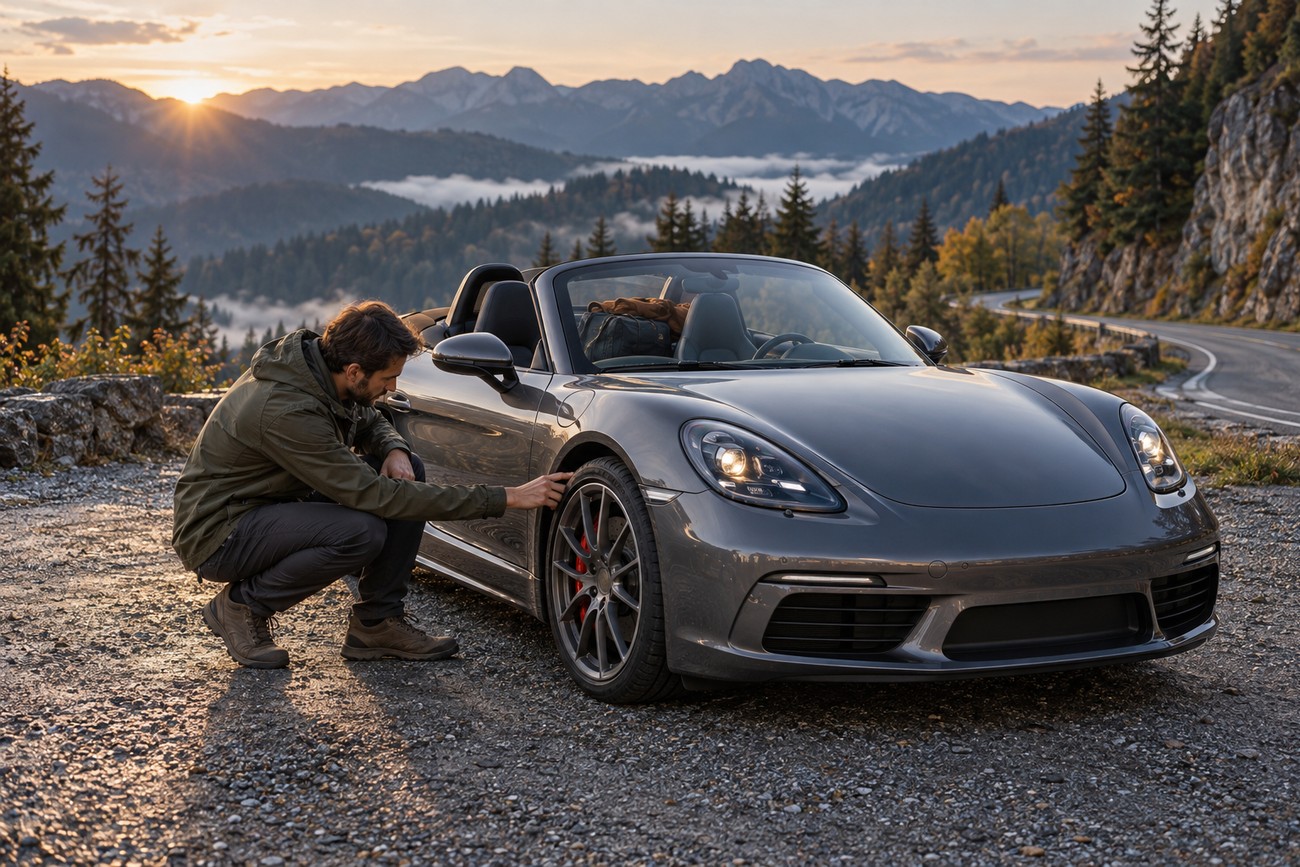
Start by confirming that the high section is open and that your intended crossing fits within the 06:00–22:00 daylight window. An early weekday is usually the strongest option for a calmer drive, although traffic and weather remain unpredictable. Build the itinerary around flexibility rather than a tightly timed summit arrival.
Before leaving, check the car’s general readiness, including tire condition, fluid levels, lights, and brake feel. The aim is to identify obvious problems before the climb, not to turn a scenic trip into a workshop inspection. Pack warm clothing, keep the cabin quiet enough for sustained concentration, and leave room for safe stops.
Allow more time than a map’s moving estimate suggests. Traffic, photo stops, fog, and rough sections can extend the crossing, while daylight restrictions limit how late you can remain on the high road. A route that looks short on paper can become a full outing once viewpoints and changing conditions are included.
- Confirm seasonal access and current official restrictions.
- Choose an early weekday where possible.
- Check tires, lights, fluids, and brake feel.
- Plan for brake heat and use a lower gear on sustained descents.
- Carry warm clothing and allow time for fog, stops, and slow traffic.
- Keep speed compatible with sightlines, surface condition, and traffic.
The realistic pace is governed by road conditions and traffic rather than the Boxster’s maximum power. If a convoy forms, maintain a safe gap and wait for a genuinely suitable opportunity before changing position. The best drive is the one that leaves enough margin to enjoy the scenery on the way back down.
Is the Transfagarasan a Great Porsche Drive or an Overhyped One?
The Transfagarasan offers genuine strengths for a Boxster: clear steering, compact dimensions, rear-wheel-drive balance, and dramatic scenery. Engaging sections appear between slower stretches, and the car can feel especially well suited to the road when visibility is good and traffic is light.
The compromises are equally real. Hairpins, tourist crowds, photo stops, rough pavement, fog, seasonal access, and daylight restrictions prevent the route from being consistently fast. A low sports car may also be less comfortable over damaged surfaces than the brochure photographs suggest.
For a driver seeking a scenic mountain journey with moments of satisfying handling, the route is a strong match. For someone expecting an uninterrupted performance road, it will likely disappoint. The Boxster suits the Transfagarasan dynamically, with qualifications that concern brakes, clearance, weather, and patience.
The fairest verdict is to treat it as a scenic mountain drive with engaging sections, not as a guaranteed performance road. Plan carefully, accept the slow parts, and let visibility and road condition set the pace. That approach preserves both the enjoyment of the car and the safety margin the mountain requires.
Frequently asked questions
How long does it take to drive the Transfagarasan Scenic Road?
The moving pace is commonly approximately 40 km/h on average, but the full outing takes longer because of traffic, stops, fog, and daylight restrictions. A clear, lightly trafficked run and a busy peak-season crossing can feel like entirely different journeys even on the same road.
Use the average pace only as a broad planning frame. Add time for viewpoints, photo stops, slow vehicles, weather changes, and any safe pause needed after a demanding descent. Finishing before the 22:00 daylight limit should remain part of the plan rather than an afterthought.
Where should you start the Transfagarasan?
Either the southern or northern approach to DN7C can work. Choose the side that fits your wider itinerary, the direction in which you want to travel, and your strategy for avoiding the busiest periods. A southern start may suit a route coming from the south, while a northern start can make more sense for a journey continuing toward northern Romania.
Whichever direction you choose, aim to reach the high section early and check access conditions before departure. Starting from one side does not guarantee lighter traffic, so the day’s weather, road status, and intended stopping points should guide the decision.
Which car is called the “poor man’s Porsche,” and is that relevant to a Boxster trip?
“Poor man’s Porsche” is an informal nickname applied inconsistently to different cars, so it has no single universally agreed meaning. It is a piece of enthusiast shorthand rather than a technical category with a defined engine, layout, or handling standard.
That label has little practical relevance to a Boxster trip. Route suitability depends on braking, tires, ground clearance, visibility, driver control, and road condition. Comparing cars through a nickname can obscure the factors that matter most on the Transfagarasan.







