
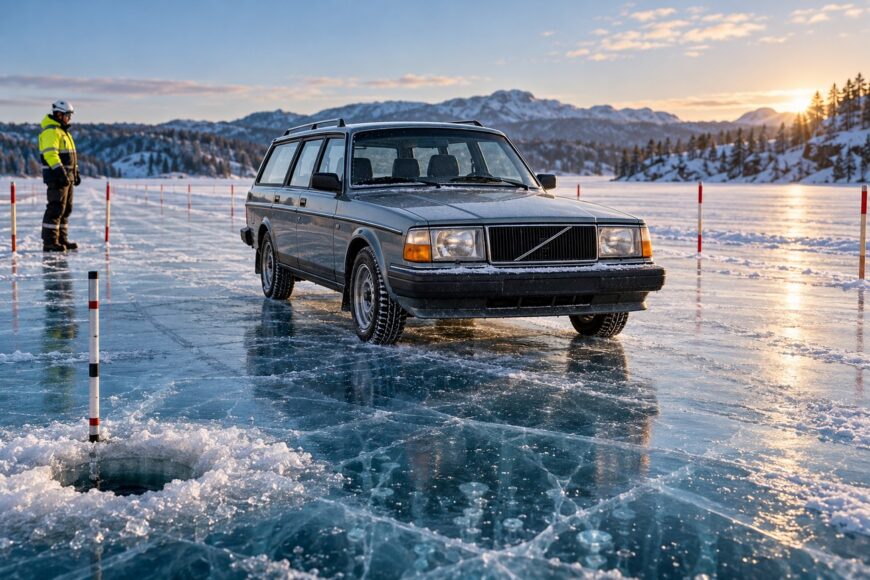
A Volvo 240 may look like an ordinary passenger car, but its actual loaded weight, the lake’s ice quality, and the rules governing the crossing matter more than a single number found online. The relevant load includes the car, driver, passengers, fuel, and luggage.
Some emergency guidance specifies at least 30 cm of ice for an official automobile crossing. Common northern guidance for passenger cars often gives 20–30 cm, but that range is not a universal standard and cannot certify an ordinary frozen lake.
The safer decision is often deciding when not to drive. A route with uncertain ice quality, unclear authority, changing weather, or no reliable inspection should be treated as unavailable, regardless of what a thickness estimate appears to show.
- The short answer: 30 cm is a benchmark, not permission
- Ice-thickness benchmarks by vehicle and crossing type
- Why thickness alone cannot certify a frozen lake
- What the Volvo 240 changes—and what it does not
- Official ice roads versus an ordinary frozen lake
- The mistakes that make a “safe” number unsafe
- Frequently asked questions
- How many pounds will 12 inches of ice hold?
- How cold is too cold for driving a Volvo 240?
- What should you do if the ice starts cracking while the car is moving?
The short answer: 30 cm is a benchmark, not permission
The different figures reflect different guidance systems. A passenger-car estimate may be intended as a broad reference, while a designated automobile crossing may use at least 30 cm as one requirement within a managed route and operating plan.
That distinction explains why online advice may mention 20 cm, 25 cm, or 30 cm or more without necessarily being contradictory. The figures may cover different vehicle classes, water conditions, safety margins, and measurement methods.
For a Volvo 240, the calculation must use the full loaded weight rather than an empty or brochure figure. Include the driver, passengers, fuel, and cargo, then consider whether the ice is freshwater or saltwater and whether the route contains weak sections.
Even a measured 30 cm does not authorize a crossing by itself. Official signs, route status, local restrictions, inspection results, and current weather conditions take priority over generalized online guidance.
Ice-thickness benchmarks by vehicle and crossing type
The figures below are reference points from different guidance systems, not self-issued permits to drive. Their apparent differences reflect different vehicle categories and operating conditions.
| Crossing or vehicle type | Reference thickness | Important qualification |
|---|---|---|
| Pedestrian crossing | 15 cm or more | Applies to a person crossing under the relevant guidance; it does not establish vehicle capacity. |
| Passenger car | 20–30 cm | Common northern guidance range; not a universal standard. |
| Official automobile crossing | At least 30 cm | A cited emergency-guidance benchmark, subject to route, signs, and operating conditions. |
| Loaded motor vehicle up to 3.5 t | 25 cm | Reference from cited Russian occupational-safety guidance; not interchangeable with every crossing rule. |
| Horse-drawn transport | 20 cm | Reference from the same cited occupational-safety guidance. |
| Full-size SUV or large pickup | 30 cm | Popular guidance reference, not a universal guarantee. |
| Truck | 40 cm or more | Popular guidance reference; vehicle load and route conditions remain decisive. |
| Pedestrian prohibition detail | 10 cm | In the cited reference, a pedestrian prohibition sign may be removed at 10 cm while the motor-vehicle prohibition remains. |
These values should be read as boundaries used in particular contexts, not as a universal conversion from thickness to permission. A 25 cm reference for a loaded vehicle, for example, does not override a local rule requiring 30 cm for an official crossing.
The table also does not describe the route’s weakest point. Ice may be thinner near the shoreline, around a crack, above moving water, or where snow has changed freezing conditions. A vehicle crossing requires confidence in the complete driving line, not only in a convenient measurement point.
Why thickness alone cannot certify a frozen lake
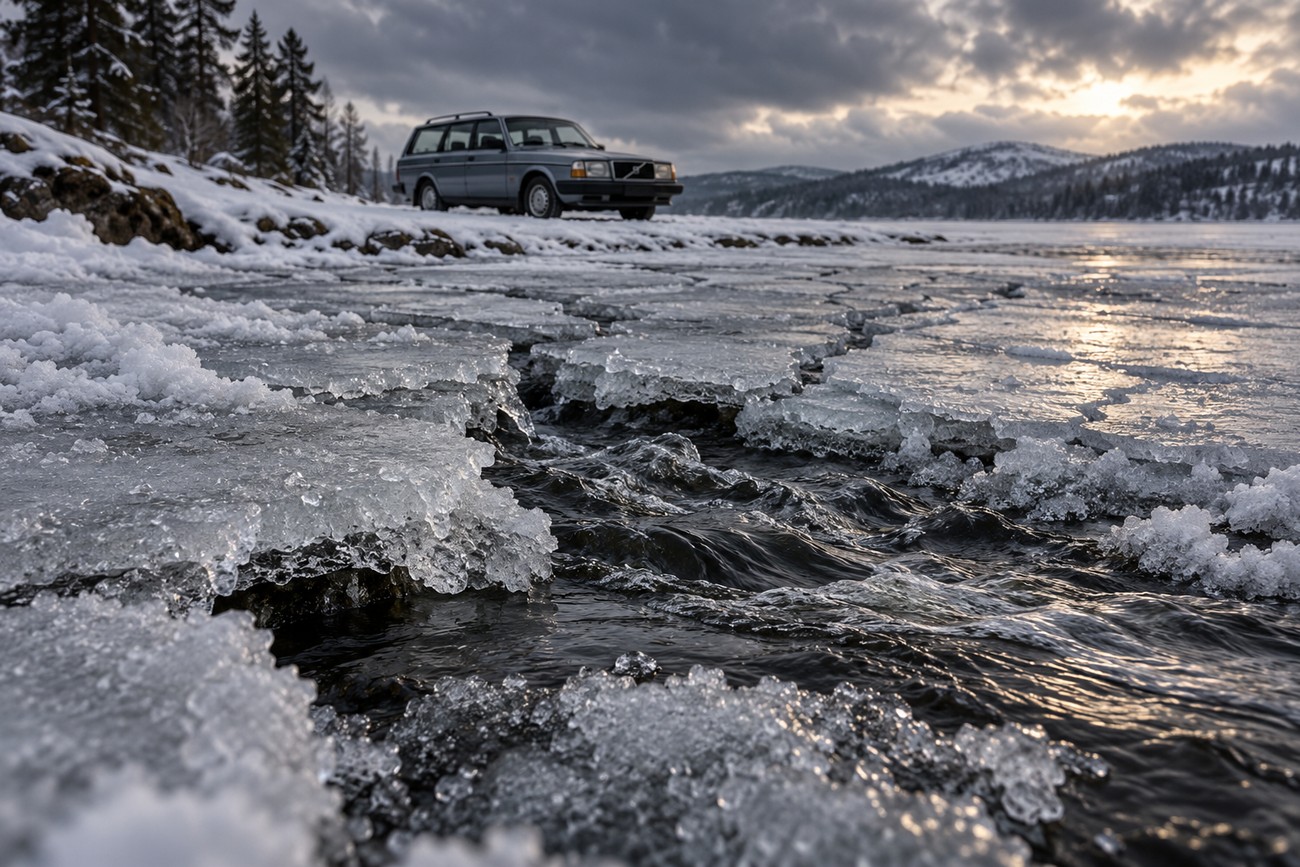
Ice thickness is only one part of load-bearing capacity. Cracked, gray, porous, layered, or thaw-damaged ice can be unsafe despite a substantial measurement, especially where different layers have formed under changing temperatures.
Snow can hide cracks and weak areas while also changing how the surface freezes. Current-affected water may produce unreliable ice near channels, inlets, outlets, and other local features. Shoreline ice deserves particular caution because it can be thinner or weakened by changing water levels.
Freshwater and saltwater also cannot be treated as equivalent. At the same thickness, ice load capacity is commonly treated as 25–30% lower on saltwater than on freshwater. If the water type is uncertain, a freshwater assumption creates an avoidable safety-margin error.
Color is an unreliable shortcut. So-called black ice may look smooth and solid, while gray or opaque ice may reflect air, water, or structural changes; appearance alone does not establish strength or uniformity.
One measurement cannot represent an entire route. A lake crossing may pass over several ice conditions, and the weakest section controls the decision. Without a competent inspection of the planned line and its approaches, a thickness number remains incomplete evidence.
What the Volvo 240 changes—and what it does not
The Volvo 240’s older rear-wheel-drive sedan layout does not create an exemption from ice-loading limits. Traction, drivetrain layout, and the car’s reputation for winter durability do not increase the structural capacity of the ice.
Use the Volvo’s total operating load: the vehicle, driver, passengers, fuel, and cargo. Passengers and luggage can move the car into a different practical category than an empty passenger car, while additional fuel and equipment also add weight.
Movement on an approved ice route should be smooth and predictable. Avoid abrupt acceleration, hard braking, sharp turns, and unnecessary stops, because sudden inputs can increase stress and make recovery more difficult if the surface changes.
Plan the entry, crossing line, and exit before moving onto the ice. Treat the drivetrain as a way to control the car, not as extra structural safety.
A rear-wheel-drive car may also respond differently as grip changes, particularly during throttle application or a turn. That handling issue is separate from whether the ice can carry the vehicle, so good control cannot compensate for inadequate or uncertain ice.
Official ice roads versus an ordinary frozen lake
An official ice road is a managed crossing, not simply a lake that has frozen over. Its status may depend on inspections, a designated route, vehicle limits, opening and closing decisions, traffic spacing, and weather restrictions.
Official signs and local instructions control the decision. A posted weight limit, prohibition, or closure remains decisive even if an internet table suggests that the measured thickness could support a car.
In northern regions, some ice roads may begin preparation above 20 cm, followed by checks of ice quality, snow, cracks, and route conditions. Preparation of a route therefore does not mean that every nearby part of the lake is suitable for travel.
Local restrictions may be stricter than informal guidance because they include a safety margin and traffic-management requirements. An ordinary frozen lake has no equivalent assurance unless a responsible authority or qualified local operator has inspected and opened a specific crossing.
The mistakes that make a “safe” number unsafe
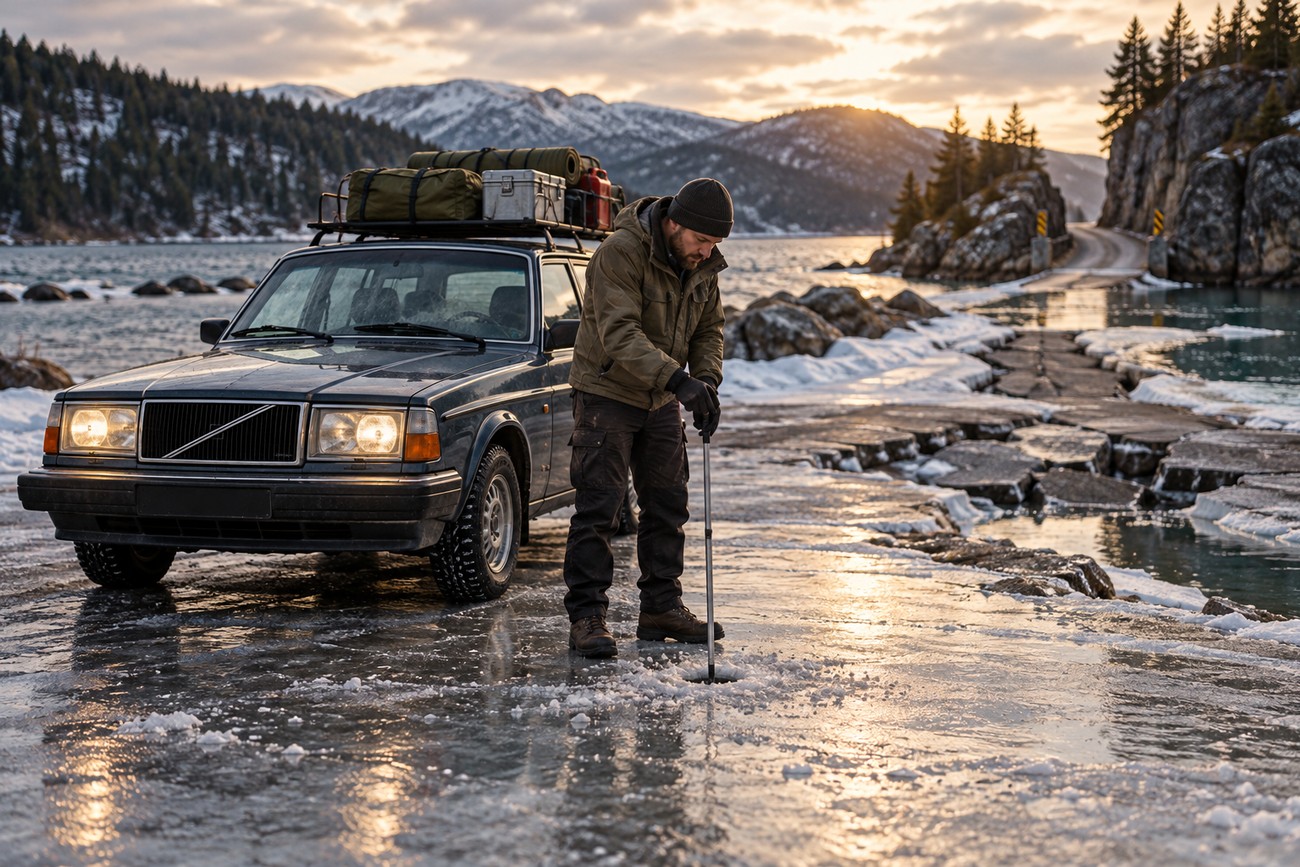
Measuring one accessible spot is a common failure. The result says little about the shoreline, the centerline, an exit, a crack, or an area affected by current. The planned route needs its own assessment, and uncertainty at any critical point should stop the trip.
Another shortcut is using an unloaded-car figure for a loaded Volvo 240. The relevant mass includes everyone and everything in the vehicle. A generic passenger-car number cannot account for the particular load or the ice conditions on that day.
Color creates a second false sense of certainty. Smooth, dark, or “black” ice may still contain weak layers, while snow can conceal damage. Freshwater and saltwater also differ, and the uncertainty becomes greater if the water type is not known.
Weather can change the decision before the thickness visibly changes. Warming, wind, snowfall, and spring deterioration can weaken or obscure the route. There is no reliable universal formula that converts vehicle mass into safe thickness under all ice and weather conditions.
A crossing that looks official may still be closed, restricted, or limited to a particular route. Signs and local rules take priority over generalized online figures. If those instructions are missing, unclear, or inconsistent with the observed conditions, do not drive onto the ice.
Frequently asked questions
How many pounds will 12 inches of ice hold?
There is no reliable universal pounds-per-inch conversion for 12 inches of ice. A thickness-only figure cannot account for ice quality, cracks, porosity, internal layers, snow, currents, shoreline conditions, or whether the water is fresh or saltwater.
Even if 12 inches is measured consistently, the result must be interpreted against the complete route and its weakest section. The vehicle’s full loaded weight and the crossing authority’s limits are more useful than a standalone carrying-capacity estimate.
How cold is too cold for driving a Volvo 240?
There is no single air-temperature cutoff that determines whether a Volvo 240 can be driven. Extreme cold can affect starting, battery performance, fluids, seals, tire behavior, and visibility even when the ice itself is strong enough for the route.
Before departure, confirm that the battery and charging system work, fluids are suitable for the conditions, doors and seals operate, windows can be cleared, and the vehicle can be recovered if it fails. Vehicle readiness is a separate requirement from ice load-bearing capacity.
What should you do if the ice starts cracking while the car is moving?
Follow the crossing’s posted emergency procedure and any instructions from crossing staff or local authorities. Avoid impulsive steering, hard braking, or sudden acceleration, which can reduce control and create additional stress while the vehicle is moving over an uncertain surface.
Keep movements controlled and prioritize the designated escape or exit procedure rather than improvising a sharp turn. If the route has no clear emergency instructions or responsible operator, that absence is itself a reason to avoid making the crossing.







