
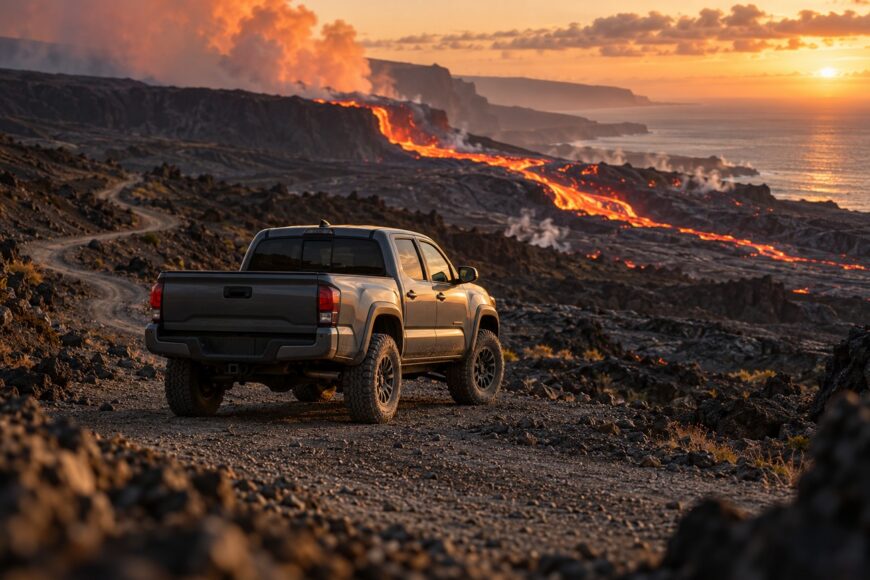
Driving a Toyota Tacoma toward a Hawaiian lava flow can look like a rare combination of open terrain, black basalt, and a highly capable truck. The visual appeal is real, especially where a permitted road or viewing route reaches a broad volcanic landscape.
Lava often moves slowly enough for people to leave its path, yet that does not make an approach safe. Roads, communications, utilities, and escape routes can disappear before the flow reaches the vehicle. This article concerns legal, currently permitted access only; it does not encourage crossing closures, entering restricted areas, or driving onto active lava.
- Can a Tacoma Safely Reach a Hawaiian Lava Flow?
- What Rough Lava and Volcanic Dust Do to a Toyota Tacoma
- The Legal and Safety Limits of a Lava-Field Drive
- How to Prepare for a Permitted Approach—and When to Turn Around
- Frequently asked questions
- How high can Kīlauea send lava?
- What makes the Toyota Tacoma Hawaii Edition unique?
- What year was the worst year for Toyota Tacoma?
- How high is Kīlauea spewing lava?
Can a Tacoma Safely Reach a Hawaiian Lava Flow?
Lava speed alone is a poor basis for a driving decision. Flow speed and direction depend on viscosity, slope, and terrain, and the flow generally follows the path of least resistance. A slow front can still divert into a road corridor, surround a vehicle, or make a return route unusable.
Some lava flows can reach the sea in less than 24 hours. Before that happens, they may destroy roads, buildings, communications, and other infrastructure. A Tacoma may remain physically distant from the flow while the route behind it becomes a dead end.
Photographs and older trip reports cannot establish current access. Check current notices from the National Park Service, Hawaiʻi County, and the U. S. Geological Survey’s Hawaiian Volcano Observatory before leaving, then check again near the route. Conditions, access, and the distance to the flow can change daily.
What Rough Lava and Volcanic Dust Do to a Toyota Tacoma
Loose, sharp basalt is harder on a truck than its dark, solid appearance suggests. It can cut tire sidewalls, catch beneath the chassis, and accelerate suspension wear. A sudden transition from pavement to broken lava also reduces speed far more than photographs usually imply.
Uneven surfaces can strike rocker panels, skid areas, the differential, brake lines, wiring, and the oil pan. Four-wheel drive improves traction, while all-terrain tires may offer useful resistance to abrasion, but neither prevents punctures, underbody impacts, or electrical damage.
Advertised ground clearance is measured without every real-world variable. Cargo, skid plates, tire size, and suspension sag can reduce the space available under the truck. There is also insufficient verified Tacoma-owner reporting on active lava fields to treat anecdotal claims as a reliable safety record.
Volcanic dust creates a second maintenance problem. It can clog the air filter, contaminate brake hardware, and work into joints until they squeak. The vehicle may drive home normally while abrasive dust remains in places that need inspection.
The Legal and Safety Limits of a Lava-Field Drive
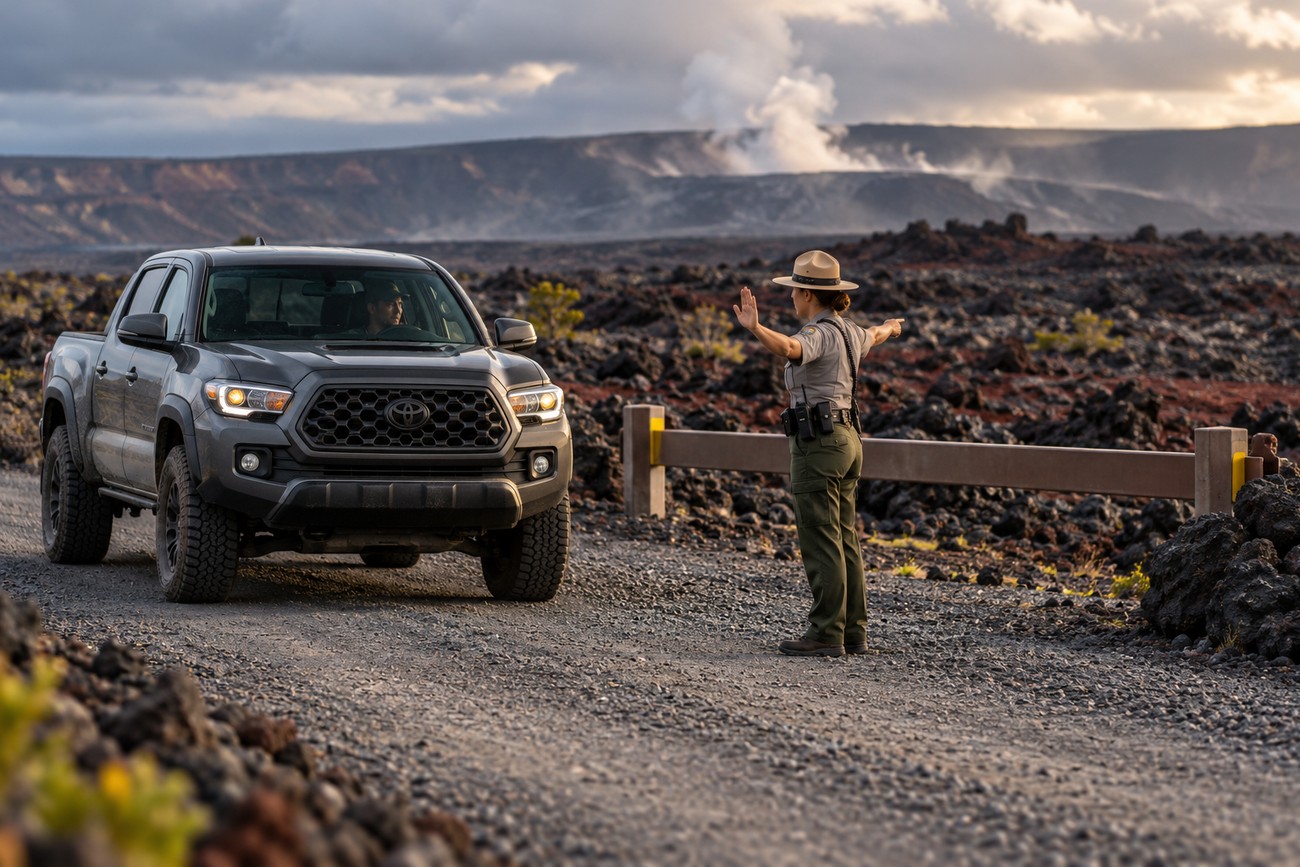
In Hawaiʻi Volcanoes National Park, motor vehicles are prohibited on the gravel emergency access route near the end of Chain of Craters Road. A published example described approximately 3.8 miles of loose gravel to a viewing area, with the nearest point to the flow about 0.5 mile away. Those figures describe an example, not a permanent route specification.
Park rules prohibit damaging, collecting, removing, or disturbing natural and cultural resources, including lava rock. A careful driver can still violate the rules by leaving an authorized road for a better photograph or by driving around a closure. Four-wheel drive does not change the legal boundary.
Black, cooled-looking ground can conceal hot voids, unstable crust, cracks, and other volcanic hazards. Volcanic gas can also make an apparently safe stopping point dangerous, especially when wind shifts. Leave immediately if breathing or eye irritation, a bad odor, or worsening health develops.
Hawaiian lava hazard zones run from Zone 1, the most hazardous, to Zone 9, the least hazardous. The zone number does not certify a particular road’s safety or current passability. Treat the map as regional context and follow the latest site-specific instructions.
How to Prepare for a Permitted Approach—and When to Turn Around
Start with the route, not the truck. Confirm that the road is officially open to motor vehicles, review closure notices, and carry a full-size spare that matches the vehicle’s requirements. In a remote area, one puncture can become a serious problem when communications and evacuation options are limited.
Use smooth throttle control and choose a line that avoids sharp edges and deep drops. Wheelspin increases tire damage and reduces control. Loose gravel on an authorized route can be more difficult than it appears, particularly for an inexperienced driver, so maintain a pace that preserves an easy escape.
Protecting the tires and keeping a clean exit line matter more than extra throttle when loose basalt begins moving under the tires.
Turn around if gas worsens, the road is damaged, communications are lost, or the escape route narrows. A flow can make the return journey harder even when the forward route still looks open. Do not assume a route is permanently available.
Afterward, wash the truck thoroughly and inspect the tires, air filter, brakes, suspension, joints, and underbody. Give particular attention to sidewalls, brake components, wiring, the oil pan, and skid areas. Volcanic dust should be treated as abrasive contamination rather than ordinary road dirt.
Frequently asked questions
The questions below address vehicle-specific points that cannot be settled by Tacoma capability alone. Current volcanic conditions require current official reporting.
How high can Kīlauea send lava?
There is no single permanent height. Lava-fountain height changes with the eruption and with the behavior of each event, so a fixed figure quickly becomes misleading.
For visibility, ash, gas, and access decisions, a current HVO bulletin is more useful than a historical maximum or a video from an earlier episode. The bulletin can also indicate whether conditions are changing near roads and viewing areas.
What makes the Toyota Tacoma Hawaii Edition unique?
“Hawaii Edition” is not a universally standardized Tacoma trim with one specification across every market and model year. It may refer to a regional or dealer-associated package, so equipment can vary.
Verify the vehicle’s model year, VIN record, window sticker, and included equipment before treating the label as a technical upgrade. The designation does not remove volcanic, access, or road-destruction risks.
What year was the worst year for Toyota Tacoma?
There is no universally agreed worst Tacoma year. The answer depends on the defect or repair issue being considered, the vehicle’s maintenance history, and whether applicable recalls were completed.
For a used truck intended for rough volcanic terrain, inspect the individual vehicle carefully. Service records, underbody condition, tire age, and evidence of previous impacts provide more useful information than a broad label applied to an entire model year.
How high is Kīlauea spewing lava?
The current height depends on the active eruption and can change during the event. A live or recent HVO report is the appropriate source for the present figure.
Even a lower fountain does not establish safe access. Gas direction, closures, unstable ground, visibility, and road conditions can determine whether a permitted viewpoint remains suitable for stopping.







