
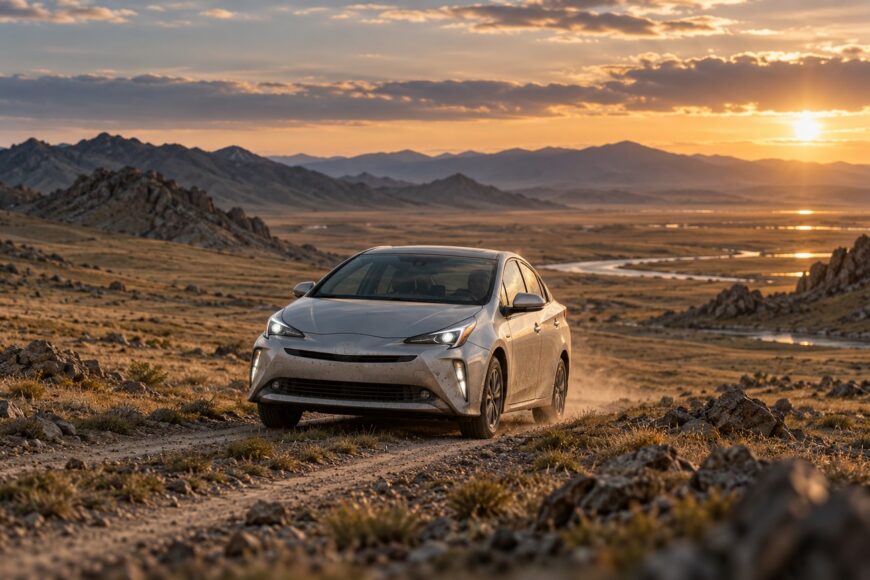
A Toyota Prius can cover long distances efficiently, but Mongolia exposes weaknesses that ordinary road-trip planning often misses. Outside Ulaanbaatar, most routes are unpaved tracks, ruts, and unmarked steppe routes without shoulders. Fuel, recovery support, and reliable communications may disappear long before the map suggests.
The decision depends on the route, weather, vehicle condition, and contingency plan rather than the Toyota badge or advertised range. A well-prepared Prius can suit paved roads and firm gravel. Deep ruts, sand, mud, rocks, winter conditions, and remote river crossings require a more cautious assessment.
- Can a Prius Really Cross Mongolia?
- Route, Fuel and Border Planning
- Prepare the Prius for Tracks, Weather and Recovery
- How to Drive the Difficult Sections
- Frequently asked questions
- What is the triangle of death on a Prius?
- How can you start a Prius after a very cold night in Mongolia?
- What should you do if a Prius gets stuck far from a settlement?
Can a Prius Really Cross Mongolia?
Yes, on suitable routes and in favorable conditions. A Prius is most reasonable on paved roads, maintained gravel, and firm tracks where you can choose a steady line. Outside Ulaanbaatar, however, most surfaces are dirt tracks, ruts, and unmarked steppe routes without shoulders, so route quality can change within a short distance.
Low ground clearance and front-wheel drive limit the car in deep ruts, rocks, sand, and mud. The hybrid battery supports efficient driving and smooth low-speed control, yet it does not turn the Prius into an off-road vehicle. A washout or rocky river approach can damage the underbody before the car reaches terrain that a four-wheel-drive vehicle would handle routinely.
Mongolian traffic also demands attention on apparently empty roads. Roads with right-hand traffic include livestock, pedestrians, overloaded trucks, and sudden maneuvers. A right-hand-drive Prius can reduce your view of oncoming traffic when overtaking on narrow roads, making patience and clear visibility more important than maintaining speed.
Weather changes the decision quickly. Rain can turn a familiar track into mud; after drying, hard cross-ridges can punish the suspension. A route that was manageable in dry weather may become unsuitable after a storm, especially if there is no practical place to turn around.
Route, Fuel and Border Planning
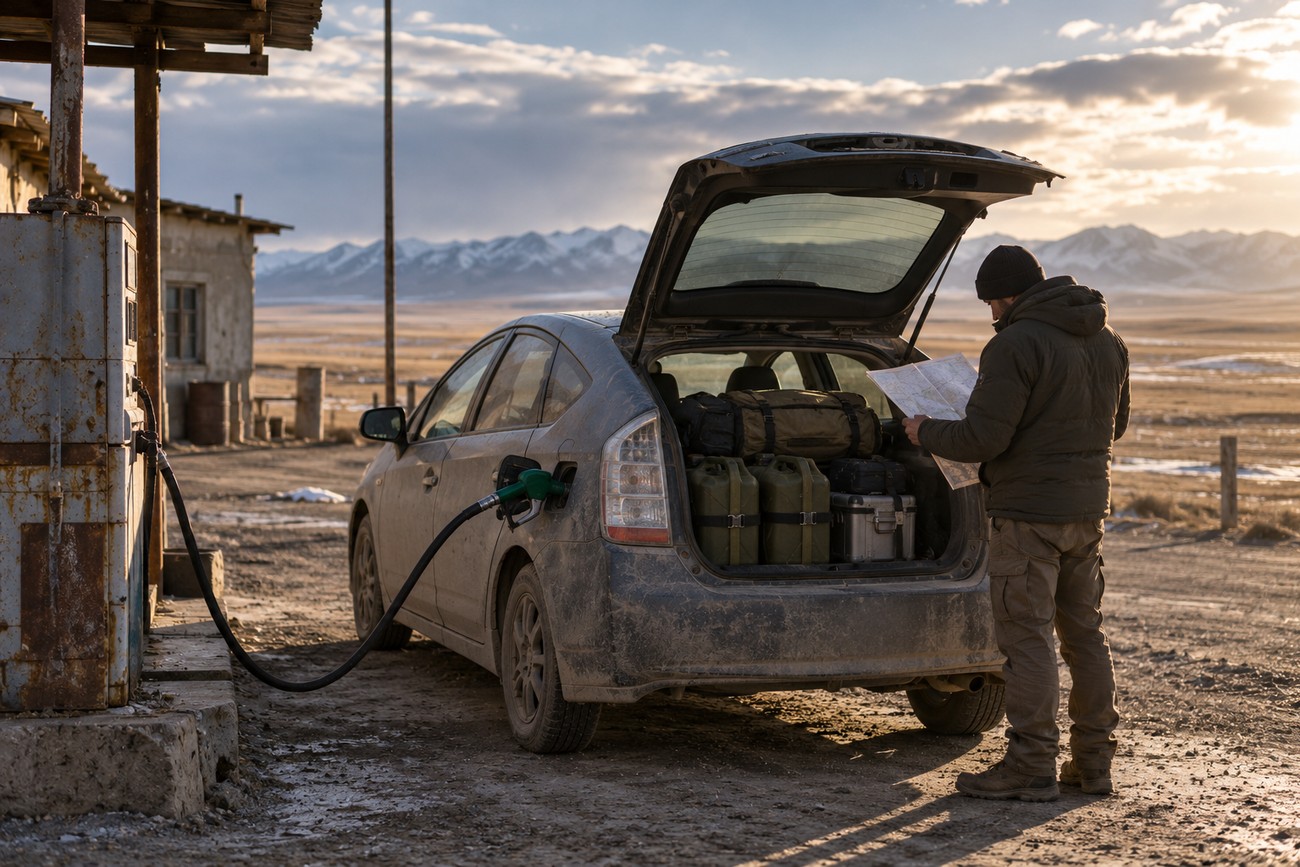
Plan remote legs around dependable fuel opportunities rather than the Prius’s official range. Remote-route planning often uses about 200 km between reliable refueling opportunities. The advertised Prius range is substantially higher, but it does not account for unavailable fuel, detours, sand, wind, terrain, or winter consumption.
Refuel at every usable station, even when the tank is only partly depleted. A station may be absent from an offline map, closed, or out of the required gasoline. Sand, deep ruts, a full load, strong headwinds, and repeated stops can also reduce fuel economy enough to invalidate a careful-looking calculation.
Carry offline maps and a paper route, then verify the intended line locally before committing to it. Online navigation can direct a vehicle through wetlands, sand, or private land, and a collection of visible tracks does not prove that each one is passable. Allow time for detours and for turning back before a route becomes a recovery problem.
Border preparation usually includes registration documents, proof of ownership, route details, and prior coordination with Mongolian customs. Motor insurance is mandatory in Mongolia, so confirm that foreign-vehicle coverage is valid before crossing. International driving permits under the 1968 Vienna Convention are accepted; documents under the 1949 Convention may not be recognized.
Prepare the Prius for Tracks, Weather and Recovery
Arrange a detailed inspection before departure. Check the high-voltage battery, 12-volt battery, inverter cooling system, suspension, tires, and underbody. A failed 12-volt battery can immobilize the Prius even when the high-voltage battery is serviceable, so its condition matters as much as the hybrid system’s headline performance.
Remote travel may require equipment that is not supplied for an expedition: a spare wheel or suitable puncture equipment, sump protection, a compressor, tools, and materials for basic self-recovery. Carry enough water, warm clothing, and food for an unexpected delay. For remote sections, add offline maps, a paper route, satellite communication or a tracker, and a clear evacuation plan.
Cold weather deserves its own decision point. At temperatures around −30 °C or lower, an excessively cold traction battery may prevent the hybrid system from starting. Ice, snowdrifts, and sharply reduced hybrid-system efficiency add further risk, while a weak 12-volt battery can turn a cold start into complete immobilization.
Toyota does not recommend trailer towing or using a tow hitch or carrier on a Prius. If recovery is necessary, do not drag the car with its driven wheels on the ground. The driven wheels must be lifted, or all four wheels should be lifted, because improper towing can damage the hybrid drive.
How to Drive the Difficult Sections
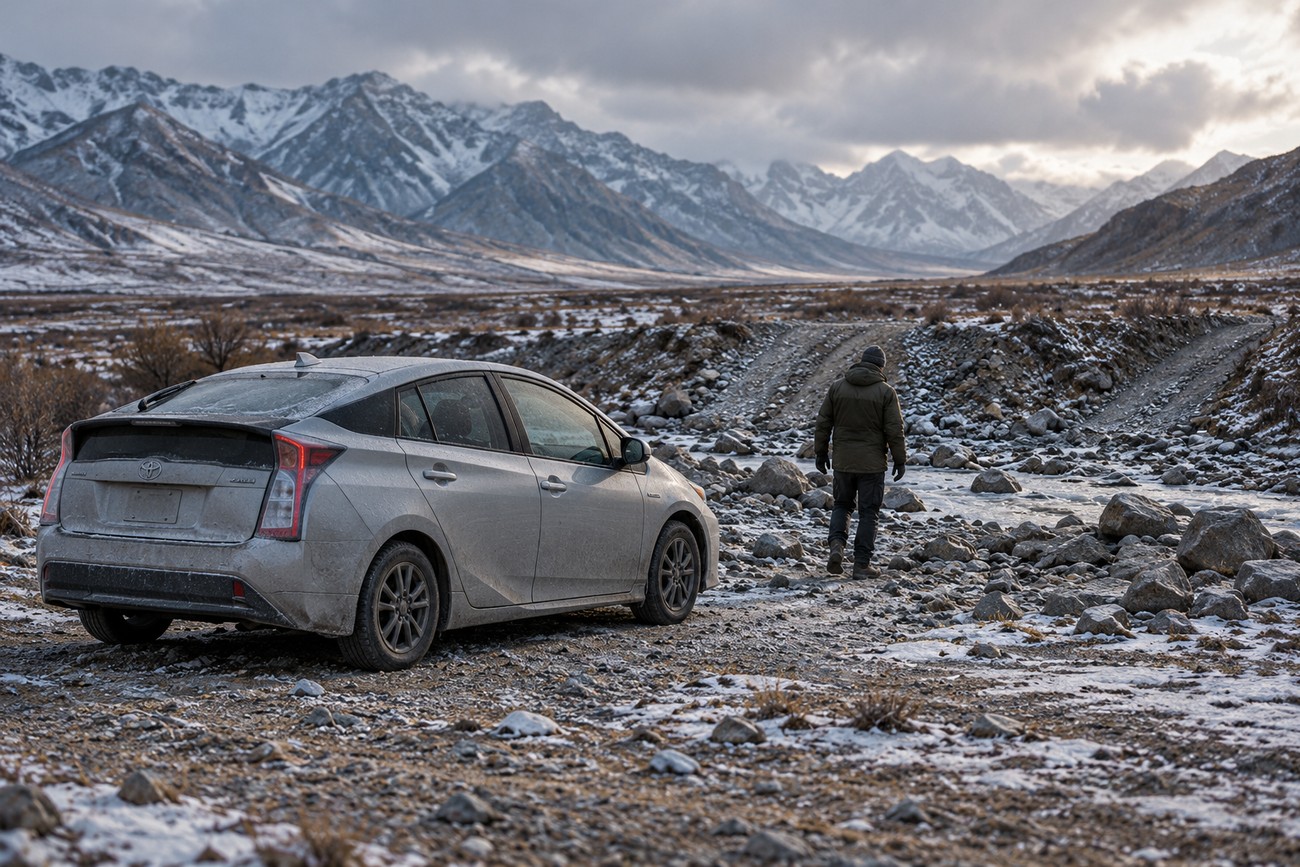
Choose the firmest line rather than automatically following the most-used rut. Examine the ground, slope, and space available for turning before entering a section. Low clearance makes washouts, rocks, and dry river crossings particular hazards, so slow speed and a deliberate line are more valuable than momentum.
Stop before a visible washout or ford and inspect the depth, bottom, and both exits on foot. Water can conceal a sharp step or soft edge, and a low-clearance Prius may be impossible to reverse once the front wheels drop in. Do not assume that hybrid electronics make the vehicle waterproof.
Walk the entire crossing line before committing to it, including both exits. A few minutes on foot can reveal that the only apparently open route ends in a bank where a low-clearance car cannot turn or be recovered.
In sand, reduce tire pressure only if you have a compressor and can monitor the tires. Incorrect pressure can unseat a tire, leaving you with a second problem far from help. Rain, hardened corrugations, headwinds, full loading, and repeated stops all increase strain and fuel use.
Avoid night driving outside towns because of poor visibility, livestock, absent lighting, and unexpected obstacles. If the Prius becomes stuck, prompt assistance may be unavailable, along with water, heat, or communications. Stay conservative early, preserve the ability to turn around, and request recovery before digging or repeated wheelspin makes the situation worse.
Frequently asked questions
A Prius’s warning systems, cold-weather starting, and recovery procedures require extra attention in remote Mongolia. The following answers address these risks and the steps that can reduce them.
What is the triangle of death on a Prius?
“Triangle of death” is an informal name for the master warning indicator. It signals that the car has detected a fault, but it does not identify the failed component by itself. Stop safely, read the accompanying message, and obtain diagnostic codes before deciding whether the vehicle can continue.
In a remote area, treat the warning as a reason to reduce risk rather than simply clear the light and carry on. The cause may involve the hybrid system, the 12-volt supply, cooling, or another vehicle system, and those possibilities require different responses.
How can you start a Prius after a very cold night in Mongolia?
Protect the car from wind and allow it to warm gradually if possible. Check the 12-volt battery first, because its failure can prevent the hybrid system from becoming ready even when the traction battery is healthy. Avoid repeated start attempts, which can further drain the 12-volt supply.
If the traction battery is excessively cold, temperatures around −30 °C or lower may prevent start-up. A warm shelter, proper charging support, or professional recovery is safer than improvised heating or opening high-voltage components in the field.
What should you do if a Prius gets stuck far from a settlement?
When the vehicle is safe, stay with it, conserve water and heat, and share your coordinates with your contact or recovery provider. Keep doors closed, avoid unnecessary electrical loads that could exhaust the 12-volt battery, and make the vehicle visible to approaching help.
Request recovery early and avoid prolonged wheelspin or digging that can bury the car deeper. If leaving the vehicle becomes necessary because of an immediate threat, record the route and coordinates first and take essential water, clothing, and communication equipment.







