
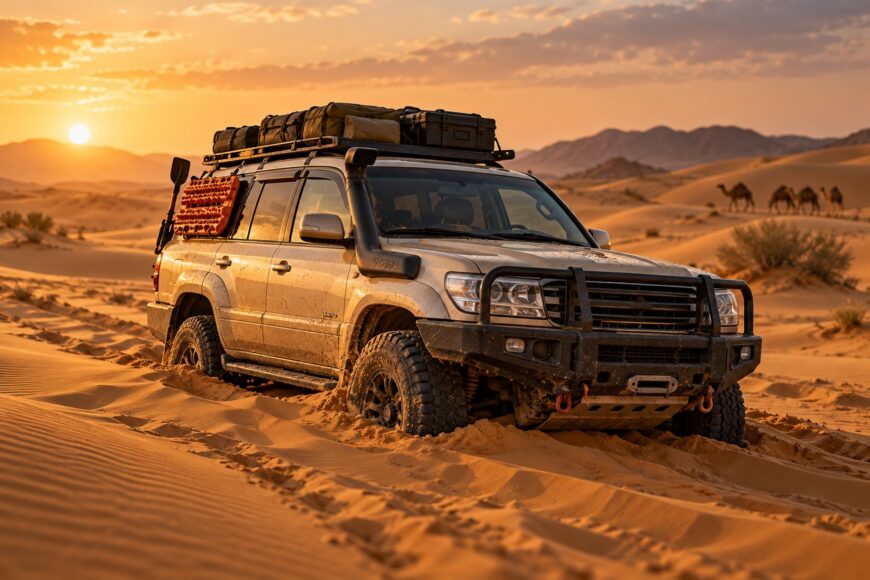
A capable, heavy Land Cruiser can become firmly stuck in soft sand within seconds. Its engine may still run perfectly, the four-wheel-drive system may be engaged, and the tyre may be turning exactly as intended while the vehicle settles onto its axles.
Sand travel is governed by load, tyre pressure, terrain, heat, and driver technique more than by reputation or maximum power. A Land Cruiser is a strong platform for remote travel, but its performance depends on the exact generation, market specification, tyres, equipment, and condition.
Toyota’s clearance, wading, payload, and towing figures are useful operating limits. They are not a promise that every Land Cruiser can cross every dune safely, or that factory equipment makes recovery unnecessary.
- What a Land Cruiser Can—and Cannot—Promise in Camel Country
- Prepare the Vehicle: Payload, Tyres, and Pressure
- How to Drive a Heavy 4×4 Across Soft Sand and Dunes
- Heat, Drivetrain Stress, and Route Management
- Recovery Planning When the Land Cruiser Gets Buried
- The Modifications That Can Make Desert Travel Worse
- Frequently asked questions
- Which Land Cruiser is best for overlanding?
- What are the downsides of using a Land Cruiser for overlanding?
- How should I check a used Land Cruiser before a desert trip?
What a Land Cruiser Can—and Cannot—Promise in Camel Country
There is no single desert specification for the Land Cruiser. Ground clearance, mass, engine, tyres, cooling equipment, transmission, and permitted loads vary by generation and market. A vehicle that works well on graded tracks may be poorly prepared for deep dunes once passengers, water, fuel, luggage, and accessories are added.
Published ground-clearance figures for current Land Cruiser versions are approximately 205–216 mm, depending on market and configuration. That is a useful measurement for judging rocks and ridges, but it says little about flotation in loose sand. A long wheelbase and high vehicle mass can still leave the underside resting on a dune crest or soft ridge.
Toyota lists a wading depth of up to 700 mm for certain LC150 and Commercial versions. This figure applies to specified vehicles and conditions; it does not certify safe travel across soft sand or dunes, and it does not describe prolonged water exposure, speed, or the vehicle’s thermal reserve.
The phrase “desert-ready” is therefore too broad to guide a purchase. The sensible assessment starts with the route, expected payload, tyre construction, local support, and the vehicle’s actual service history. A well-maintained, lightly loaded example with suitable tyres can be more useful than a heavily modified vehicle with impressive equipment but little remaining payload.
Prepare the Vehicle: Payload, Tyres, and Pressure
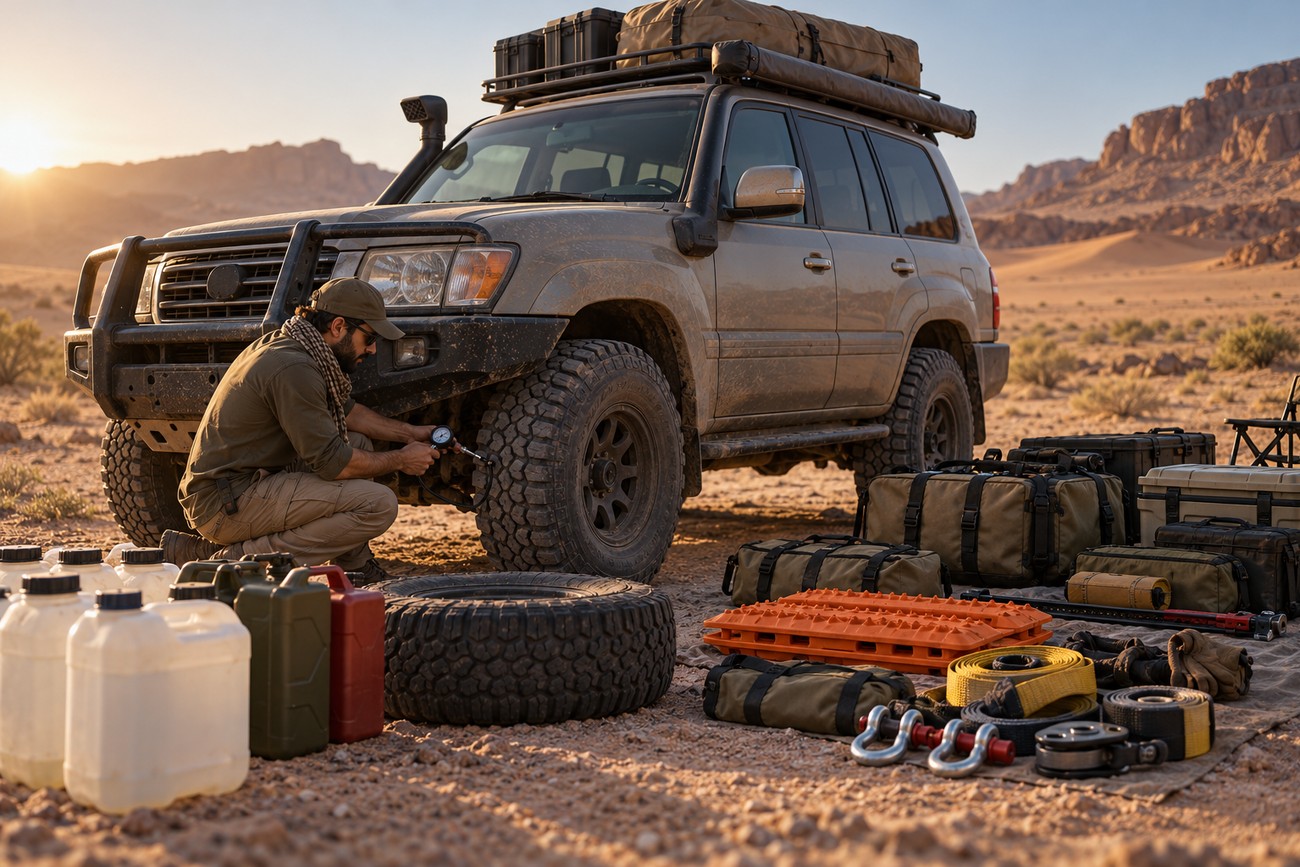
Payload disappears quickly on an overland trip. Some Land Cruiser Commercial versions list approximately 593–810 kg of payload, but every occupant, supply, accessory, spare wheel, and recovery item counts toward that limit. Water and fuel are essential in remote terrain, so they must be included before deciding whether a bumper, winch, roof rack, or second spare is practical.
Lowering tyre pressure generally increases the contact patch and helps the vehicle float across sand. The correct setting depends on actual mass, tyre construction, speed, and temperature, so a universal number copied from a forum or advertisement is unsafe. Excessive deflection can damage the sidewall or allow the tyre to debead, particularly during steering input.
A short test run is more useful than a memorized pressure figure. Reduce pressure gradually, drive a controlled section, check sidewall deflection and steering response, then inspect heat before committing to a longer sandy route.
Carry a reliable compressor and a gauge that can be read in bright conditions. Check pressure on cold tyres where possible, and remember that heat changes the reading. Sustained driving on hard surfaces at reduced pressure can overheat the sidewalls, so reinflate before extended road travel rather than treating low pressure as a permanent setting.
Road-oriented tyres may perform acceptably on firm sand but can be less forgiving in deep, sharp-edged terrain after pressure is reduced. Inspect tread, sidewalls, valve stems, and the spare before departure. A short local test also reveals whether the loaded vehicle wanders, bottoms out, or places excessive strain on the tyre shoulders.
How to Drive a Heavy 4×4 Across Soft Sand and Dunes
Soft sand rewards smooth, continuous torque rather than maximum power. Apply the throttle progressively and keep the vehicle moving without chasing speed. Abrupt acceleration can spin the driven wheels, remove the sand beneath them, and leave the Land Cruiser sitting lower within seconds.
Choose a line that follows firmer contours and avoids unnecessary sharp turns. Existing tracks are not automatically safer: they may contain loose pockets, buried stones, or sharp debris. On a dune, inspect the exit before committing, and avoid a climb that ends with no room to crest or turn safely.
Stopping on a dune climb, across a slope, or in a soft depression makes restarting substantially harder. A loaded Land Cruiser can dig itself in quickly after stopping, especially if it is still running road pressure. If a stop is necessary, use level, firmer ground and leave enough space to move away without a high-torque launch.
Multi-Terrain and traction-control systems can manage the grip that remains at the contact patch. They cannot create traction where the tyres are spinning in loose sand. Select the appropriate drive mode for the vehicle, but use it as an aid to careful throttle control rather than as an automatic recovery system.
Heat, Drivetrain Stress, and Route Management
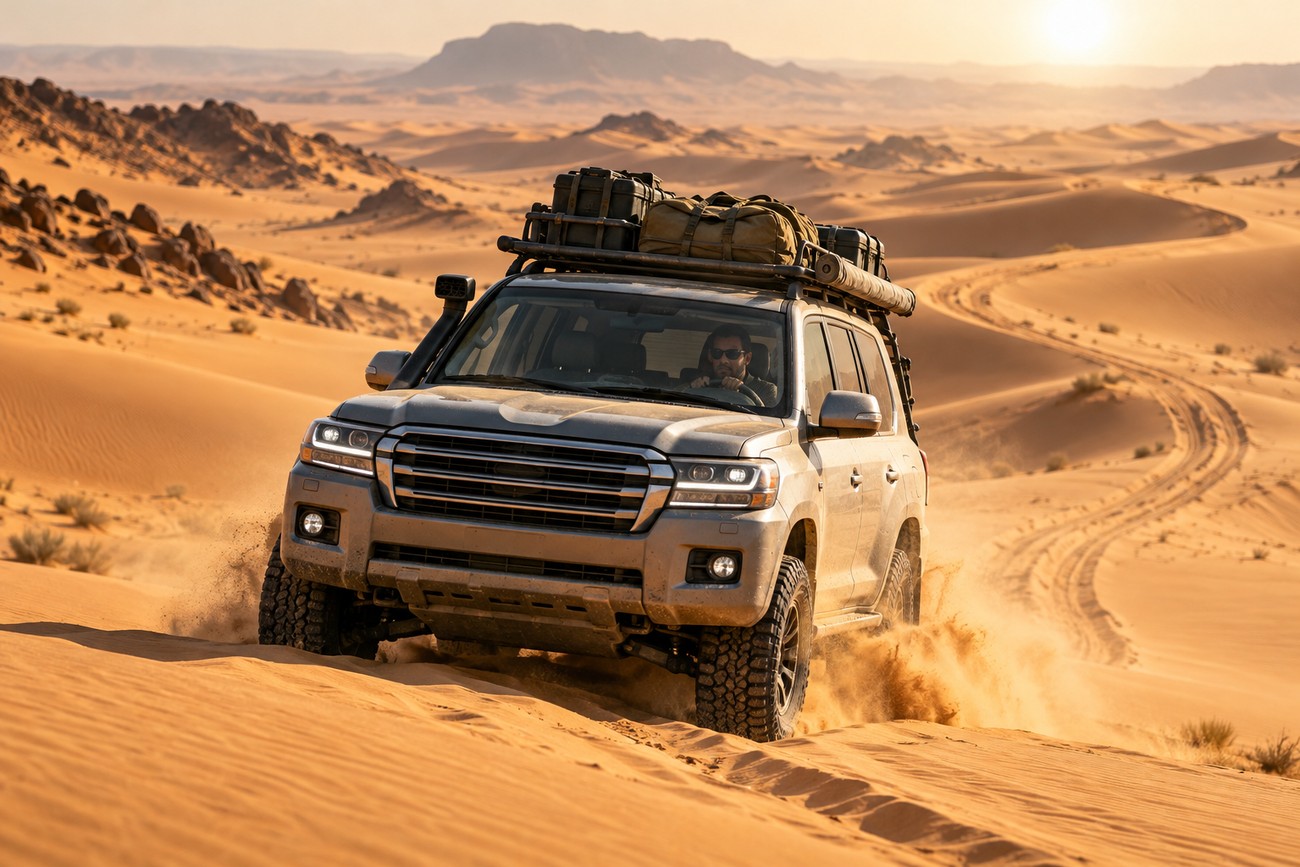
Slow travel through deep sand demands continuous effort from the engine, transmission, cooling system, and driveline. High ambient temperatures, heavy loads, long climbs, and restricted airflow can raise operating temperatures even when the vehicle is moving at modest speed. A route that appears short on a map may impose a long period of high mechanical load.
Drivers commonly report heat concerns involving the engine, transmission, or drivetrain during this type of travel. Such reports are configuration- and market-dependent, so they should not be turned into a universal claim about every Land Cruiser. The practical response is to monitor warning lights, temperature indications, unusual smells, shifting behavior, and changes in engine response.
Plan rest points on firm ground rather than stopping on a ridge or in a hollow. A pause allows the vehicle and occupants to recover, but idling in extreme heat is not automatically a cooling strategy. If temperatures rise or a warning appears, stop the load-producing work and follow the vehicle manual rather than attempting to reach the next waypoint.
Ground clearance and a stated wading depth do not measure cooling reserve or drivetrain endurance during hours of loaded desert driving. They describe different limits. Before a remote crossing, confirm that service intervals are current and that the radiator, belts, hoses, transmission, and underbody protection are in sound condition.
Recovery Planning When the Land Cruiser Gets Buried
Recovery equipment belongs in the route plan, not at the bottom of a shopping list. A shovel, traction boards, compressor, correctly rated straps and shackles, communication, navigation, water, and an evacuation plan cover the basic needs of a remote sand trip. Each item should be accessible without unloading the vehicle.
Start recovery early. Clear sand from in front of the tyres and beneath the chassis, reduce unnecessary resistance, and place traction boards under the driven wheels. Digging around a heavy vehicle becomes harder as the chassis settles, especially when the ground is hot and there is no shade.
A factory tow or recovery eye is not a substitute for correctly rated straps, shackles, and an appropriate anchor. Confirm the recovery points before departure, and use equipment whose ratings match the vehicle and the intended recovery method. Never rely on a decorative tie-down or an attachment point whose purpose is unclear.
A winch does not guarantee self-recovery in featureless sand. It needs a suitable tree, a ground anchor, or a second vehicle, and a sand anchor must match the Land Cruiser’s mass and the actual ground conditions. Communication and an evacuation plan matter just as much as hardware when the route is beyond reliable road assistance.
The Modifications That Can Make Desert Travel Worse
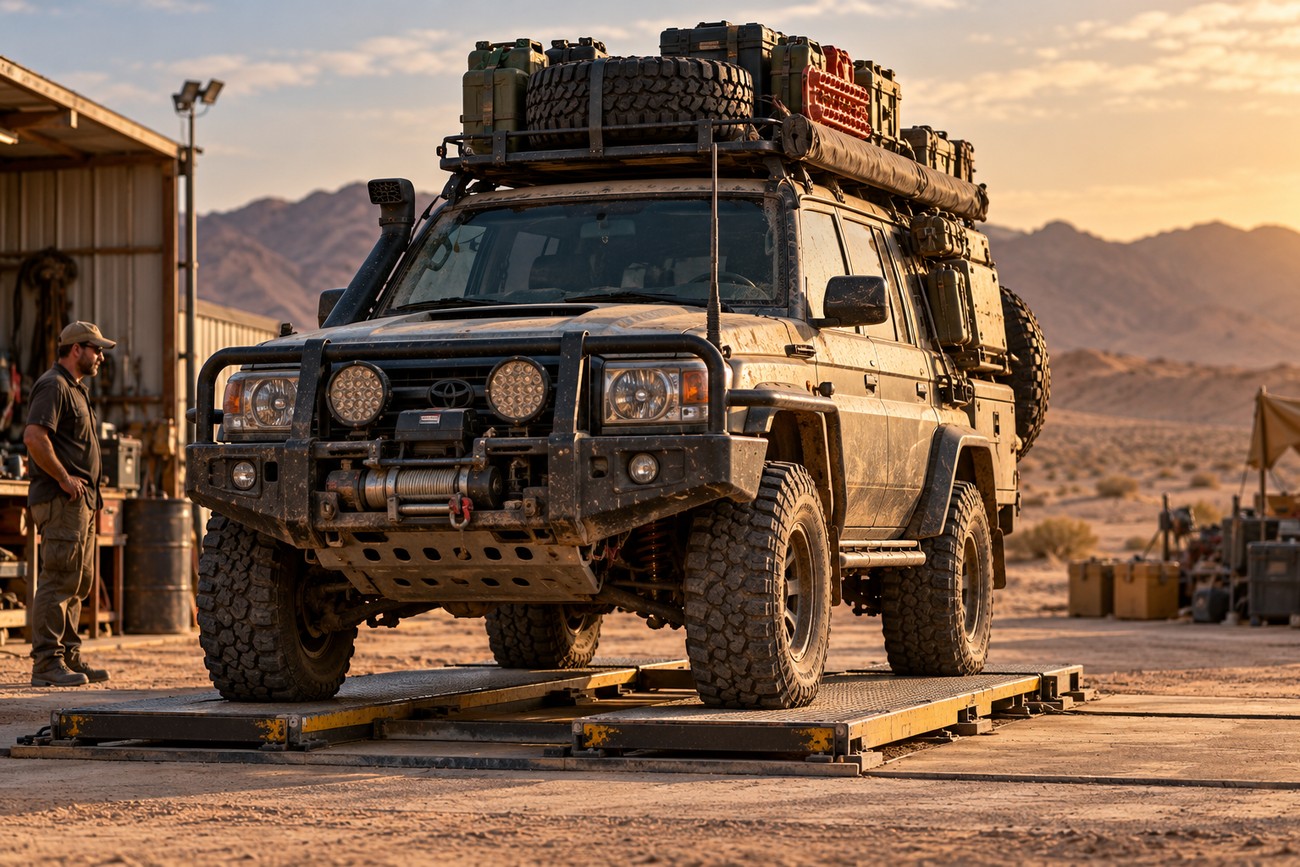
Heavy bumpers, winches, roof racks, extra spare wheels, armor, and recovery gear consume payload before water, fuel, and passengers are loaded. They also change the center of gravity and may increase the effort required to extract the vehicle. A modification list should therefore be weighed against the route rather than treated as a measure of preparedness.
Roof-mounted equipment adds height and can affect stability on side slopes. A second spare may provide useful redundancy, yet its weight and mounting position still count against the permitted mass. Check the loaded vehicle on a scale where possible, and compare the result with the exact plate and manual rather than a generic online specification.
A lift kit can alter suspension geometry, increase CV-joint loads, and raise the risk of suspension damage if the specific kit is poorly engineered or fitted. More ground clearance does not mean more payload capacity; Toyota treats clearance and permitted mass as separate specifications. Certification and compatibility with the exact vehicle are more important than the lift height alone.
Towing ratings also vary by version. Approximately 3,000 kg applies to some LC150 models, while approximately 3,500 kg applies to some newer versions. The vehicle plate and manual control the permitted trailer mass, which does not automatically account for passengers, luggage, accessory weight, or vertical load on the hitch.
Frequently asked questions
Which Land Cruiser is best for overlanding?
The best Land Cruiser is the one that matches the route, payload, mechanical condition, tyre choice, and available service support. A newer vehicle may offer stronger driver aids and improved refinement, while an older model may have simpler field repairs or better parts availability in a particular region.
Compare usable payload after modifications, cooling condition, wheel and tyre support, fuel range, recovery options, and local knowledge. A lightly modified vehicle with a clear maintenance history is often a sounder overlanding choice than a heavily equipped example carrying more hardware than its permitted mass allows.
What are the downsides of using a Land Cruiser for overlanding?
The main disadvantages are weight, width, fuel and supply demands, and the difficulty of recovering a heavy vehicle from soft sand. Vehicle size can restrict route choices, while water, fuel, spare parts, and recovery equipment add further mass and storage pressure.
Accessories can also become a financial and mechanical burden. Excessive modifications may reduce payload, raise the center of gravity, complicate servicing, and create new failure points. A Land Cruiser’s strength does not remove the need to budget for tyres, recovery equipment, inspections, and regional service support.
How should I check a used Land Cruiser before a desert trip?
Begin with the cooling system, service records, warning history, fluid condition, and evidence of overheating. Test transmission behavior when cold and hot, inspect four-wheel-drive engagement, and look for leaks, damaged wiring, worn mounts, and underbody impacts. The inspection should match the exact engine, generation, and market specification.
Check tyre age, tread, sidewall damage, spare-wheel condition, recovery-point integrity, and the mounting of every accessory. Look for sagging suspension, overloaded springs, cracked brackets, and signs that the vehicle has regularly carried more than its permitted load. Complete a loaded road and sand test before departure, and verify that the compressor, navigation, communication equipment, and recovery gear all work.







