

Releasing the accelerator in a Tesla can make the car slow smoothly and strongly enough to feel as though the brake pedal has disappeared from daily driving. The expectation is appealing: lift your foot in traffic, let regenerative braking do the work, and arrive at a controlled stop. In practice, a sudden lift can produce sharp deceleration, a nose-diving sensation, or an uncomfortable ride for passengers.
The response also changes from one drive to the next. Battery temperature, state of charge, available tire-road traction, the Tesla model, and software can all affect regenerative braking. A cold or fully charged battery may provide much less deceleration, while slippery conditions can cause the system to limit regeneration.
The central skill is controlled accelerator modulation. One-pedal driving means using strong regenerative deceleration when you release the accelerator; it does not mean abandoning the brake pedal. You still need the brakes for emergency stops, precise low-speed control, and any situation in which regeneration is limited.
- What One-Pedal Driving Actually Means in a Tesla
- How to Change One-Pedal Behavior on a Tesla
- The Technique: Modulate the Accelerator Instead of Dropping It
- When Regeneration Suddenly Feels Weak or Strong
- Common Mistakes, Hidden Trade-Offs, and Brake Use
- Frequently asked questions
- How do you change one-pedal driving on a Tesla when the regeneration setting is missing?
- What should you do when the Tesla shows reduced regenerative braking?
- Why does a Tesla sometimes use the friction brakes at the end of a one-pedal stop?
What One-Pedal Driving Actually Means in a Tesla
One-pedal driving relies on regenerative braking that begins when you reduce or release accelerator input. The electric motor changes its operating state and resists the vehicle’s motion, creating deceleration while sending part of the vehicle’s kinetic energy back toward the battery. The effect can be strong even when you lift smoothly, giving the system time to slow the car without an abrupt change in speed.
Energy recovery is useful, although it is not 100% efficient. Losses occur in the motor, inverter, battery, and charging chemistry, so the car cannot return all of the energy used to accelerate it. Regeneration can improve efficiency over a route with frequent speed changes, yet it does not create energy or guarantee a range increase.
Tesla still has a conventional brake pedal and friction brakes. In some situations, the car uses blended braking, combining regenerative braking with friction braking. That can help produce the requested deceleration when regeneration alone is insufficient, especially as speed falls or the battery cannot accept more energy.
Normal release-based deceleration is different from an emergency stop. It is also different from the precise final control needed when edging into a parking space or stopping close behind another vehicle. Apply the brake pedal promptly for urgent deceleration, and use it whenever the car is not slowing as expected.
How to Change One-Pedal Behavior on a Tesla
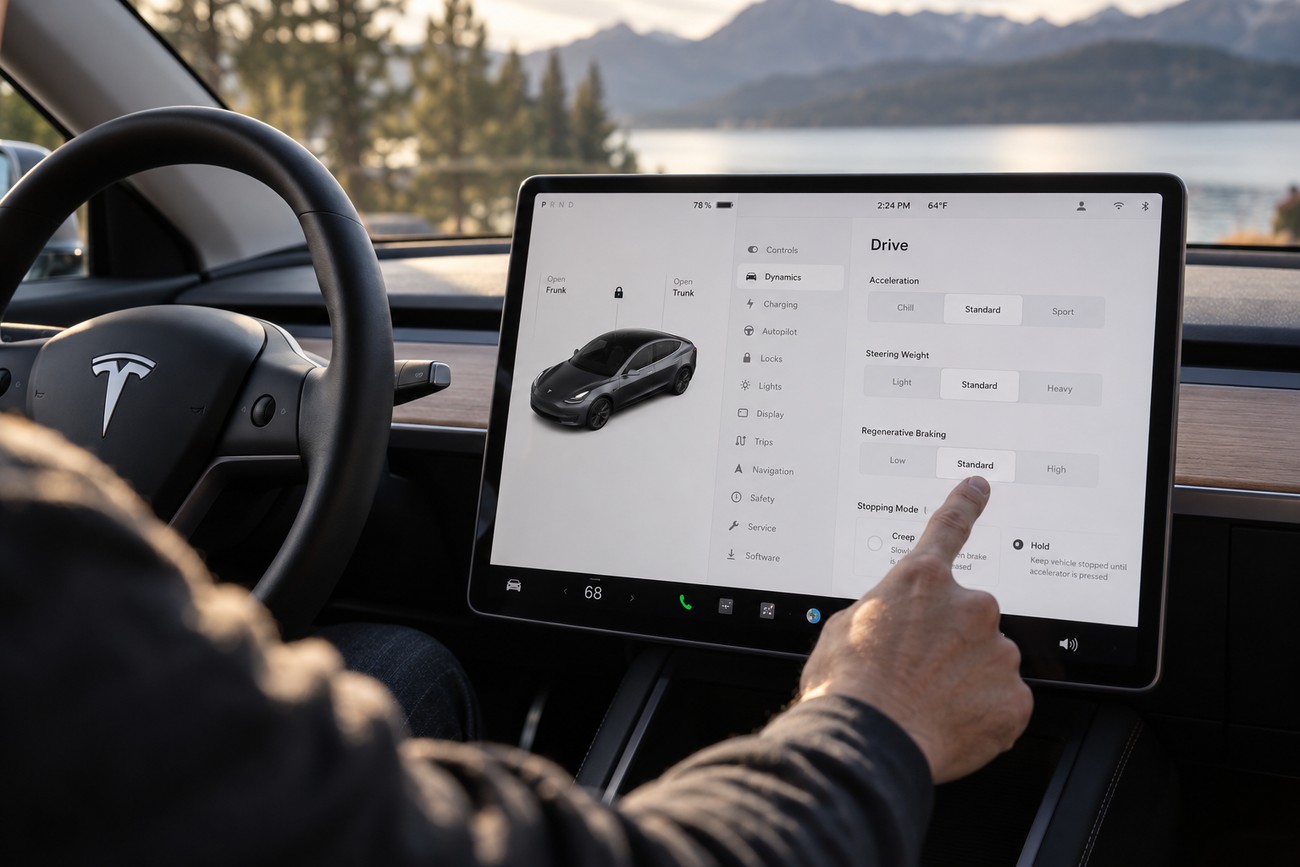
There is no single permanent regeneration setting that applies to every Tesla. Available controls, names, and behavior vary by model and software version. Many recent Tesla models have removed or reduced the permanent Low/Standard regenerative-braking selector, so instructions written for an older vehicle may not match the menus in your car.
Start by checking the current touchscreen controls for drive, stopping, and related assistance settings. Then consult the owner’s manual for the exact model and software version. The display may show an available adjustment, provide only limited control, or leave regenerative behavior to the vehicle’s software and battery-management system.
Even an available setting will not override every operating condition. Regenerative braking is shaped by the Tesla model, software, battery temperature, state of charge, and available tire-road traction. A vehicle that feels gentle after a cold start may become more forceful after the battery warms, while a highly charged battery may reduce regeneration.
If no fixed adjustment is available, change your technique rather than expecting a hidden switch to restore an older behavior. Release the accelerator earlier and more gradually, leave more space in traffic, and keep the brake pedal ready. The same Tesla can also feel different after a software update or under different battery conditions.
The Technique: Modulate the Accelerator Instead of Dropping It
Smooth one-pedal driving begins with the right foot. Instead of letting the accelerator return immediately to zero, reduce pressure in small increments and notice how the car responds. This millimeter-level release lets you choose a gentle coast, moderate deceleration, or stronger regenerative braking without making each speed change abrupt.
In stop-and-go traffic, leave a larger following gap while learning. That space gives you time to ease off the pedal gradually rather than making a late, full release. In a queue, repeated full releases can create a pattern of sharp slowing and acceleration; a small, steady accelerator input often settles the car’s speed more comfortably.
A tiny, steady accelerator input can stabilize speed and passenger comfort in slow traffic. Repeatedly releasing the pedal to zero tends to create avoidable surges, especially when the gap ahead is already short.
Approach turns by reducing speed before the turn, then use light accelerator input to maintain a stable pace through it when conditions allow. For a final stop, expect regenerative braking to contribute less at low speeds. Use the brake pedal for the last part of the stop or for exact positioning, and rely on the vehicle’s available hold behavior only after confirming how your Tesla operates.
Abrupt accelerator release can cause jerky deceleration and a nose-diving sensation. Passengers often notice this before the driver does, particularly in urban traffic. Smooth pedal movement is therefore a safety and comfort skill: it helps you maintain a predictable gap and reduces unnecessary head movement inside the cabin.
When Regeneration Suddenly Feels Weak or Strong
A cold battery can sharply reduce or temporarily remove regenerative braking until the battery warms. The car may then roll farther after you lift the accelerator than it did on the previous drive. On a cold morning, reduce speed earlier, increase your following distance, and expect to use the brake pedal more often until the response becomes consistent.
A fully charged battery may have little room to accept regenerated energy. As a result, regenerative deceleration can be greatly reduced just after charging. Treat the first part of that drive as a different braking environment and avoid relying on the familiar lift-off response when approaching traffic, intersections, or a downhill section.
Low traction creates another change. On snow, ice, standing water, or another slippery surface, the system may limit regeneration for stability. Release-based deceleration can then feel less predictable, and abrupt pedal movements may make speed control harder. Drive more slowly, make inputs progressively, and use the brake pedal smoothly when additional control is needed.
Long descents can expose the same limitation in a different way. The battery may reach an energy-acceptance limit while the car is still descending, reducing regenerative deceleration. Select a safe speed before the descent, monitor the changing response, and be prepared to use the friction brakes rather than assuming regeneration will remain constant.
The practical rule is simple: yesterday’s pedal response is not a promise for today. Battery temperature, charge level, traction, and software logic can all change the balance between regeneration and friction braking. Adapt speed and following distance before the change becomes urgent.
Common Mistakes, Hidden Trade-Offs, and Brake Use

A common mistake is releasing the accelerator completely in every situation. Full release is appropriate when you need strong deceleration and have enough space, yet it can be too abrupt in a close queue, during a gentle turn, or with a passenger who is sensitive to motion. Modulate the pedal and use the brake when a more exact response is needed.
Another mistake is treating one-pedal driving as a substitute for attention. It does not remove the need for a safe following distance, visual scanning, or emergency braking. The car may decelerate less than expected because of a cold battery, high state of charge, limited traction, or a long descent, so your driving plan must allow for those changes.
Frequent regeneration also does not mean friction-brake wear is zero. The friction brakes remain necessary and still require maintenance. Because they may be used less often, have them inspected as recommended and use them appropriately when conditions call for them; infrequent use can allow corrosion or sticking to develop in some environments.
Some owners report less fatigue in city driving after adapting to one-pedal control. That is an experience-based observation, not a universal measured result. Other drivers find the system tiring during the learning period, especially if they repeatedly make abrupt releases and corrections.
Range gains are not automatic either. Regeneration returns part of the vehicle’s kinetic energy to the battery, with losses in the motor, inverter, battery, and charging chemistry. Traffic, speed, climate, route, and driving style can have a greater effect than whether you use a strong lift-off technique, so smooth anticipation matters more than chasing a particular pedal habit.
Frequently asked questions
How do you change one-pedal driving on a Tesla when the regeneration setting is missing?
First, confirm the vehicle’s model, software version, and current touchscreen menus. Check drive and stopping controls, then read the owner’s manual for that exact Tesla. Many recent models no longer provide a permanent Low/Standard regenerative-braking selector, so the absence of that option may be normal rather than a fault.
If no fixed adjustment is available, control the effect with the accelerator: release gradually, leave more space ahead, and use the brake pedal for precise or urgent slowing. Remember that battery temperature, state of charge, traction, and software can change regeneration even when you have not changed a vehicle setting.
What should you do when the Tesla shows reduced regenerative braking?
Reduce speed earlier, increase the following distance, and stop expecting the usual lift-off deceleration. Use the brake pedal when needed, especially near intersections, stopped traffic, and downhill sections. Check whether the battery is cold or highly charged, since either condition can sharply reduce the battery’s ability to accept regenerated energy.
If the road is slippery, make all inputs gradual because low traction can also cause the system to limit regeneration. The response should become stronger as relevant battery conditions change, but continue driving according to the braking available now rather than relying on how the car felt on a previous trip.
Why does a Tesla sometimes use the friction brakes at the end of a one-pedal stop?
Regenerative braking contributes less at low speeds, so it may not provide the precise final stop you want. The brake pedal can supply the last part of deceleration and help the vehicle stop accurately, particularly near another car, a curb, or a parking position.
Tesla also uses blended braking in some situations, combining regenerative and friction braking. The friction brakes remain necessary for precise control, emergency stops, and conditions that limit regeneration, so their occasional use is normal and does not mean one-pedal driving has failed.







