
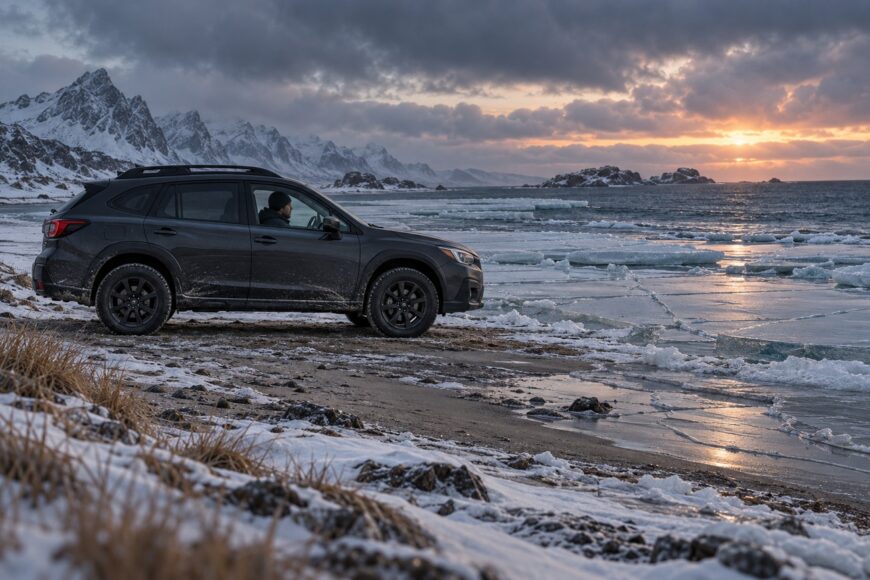
A Subaru may have impressive traction, yet a frozen beach combines low grip with the possibility of structural ice failure. Symmetrical all-wheel drive can help the car begin moving, but it cannot make thin, cracked, salty, or uneven ice carry the vehicle safely. It also cannot restore braking and steering control once the tires lose contact with a predictable surface.
The first decision is therefore about the surface, route, and escape options. A frozen beach is a changing load-bearing environment with shoreline gaps, runoff, currents, snow-covered weak spots, and water hazards. Driving technique matters only after the ice has been assessed and found suitable; no universal thickness figure can guarantee a safe crossing in every location.
- Is Driving a Subaru on a Frozen Beach Safe?
- Check the Ice Before the Car Goes Near It
- What Subaru AWD Can—and Cannot—Do on Ice
- Prepare the Route, Car, and People Before Entry
- How to Move a Subaru Across Firm Ice
- If the Subaru Gets Stuck or the Ice Starts to Fail
- Frequently asked questions
- What is the best vehicle for driving on beach sand?
Is Driving a Subaru on a Frozen Beach Safe?
Driving a Subaru on a frozen beach is safe only under controlled conditions that include suitable ice, a verified route, favorable access, and a recovery plan. The beach should be treated as a changing load-bearing surface rather than an ordinary icy road. Ice near the shore may be thinner, separated from dry land, or weakened by water movement even when the open surface looks solid.
Subaru AWD can improve acceleration traction by distributing drive to the wheels with available grip. It does not remove the low coefficient of friction on ice, increase the structural strength of the surface, or guarantee braking and cornering control. A car may pull away cleanly and still slide when the driver turns, lifts off the throttle, or applies the brakes.
Cracks, currents, springs, runoff, salt, and uneven ice can make a route unsuitable even when the ice appears thick. Snow can conceal surface changes and weak areas, while a shoreline edge may contain voids or a gap between the ice and land. An attractive, uninterrupted white surface is therefore poor evidence of load-bearing capacity.
Videos of cars crossing frozen water or sliding on beaches often show a prepared area, favorable weather, and a recovery team outside the frame. Controlled training uses a selected surface, instructor control, and a planned exit. An unassessed wild beach offers none of those safeguards, so recreational stunt footage should not be used as a safety reference.
Check the Ice Before the Car Goes Near It
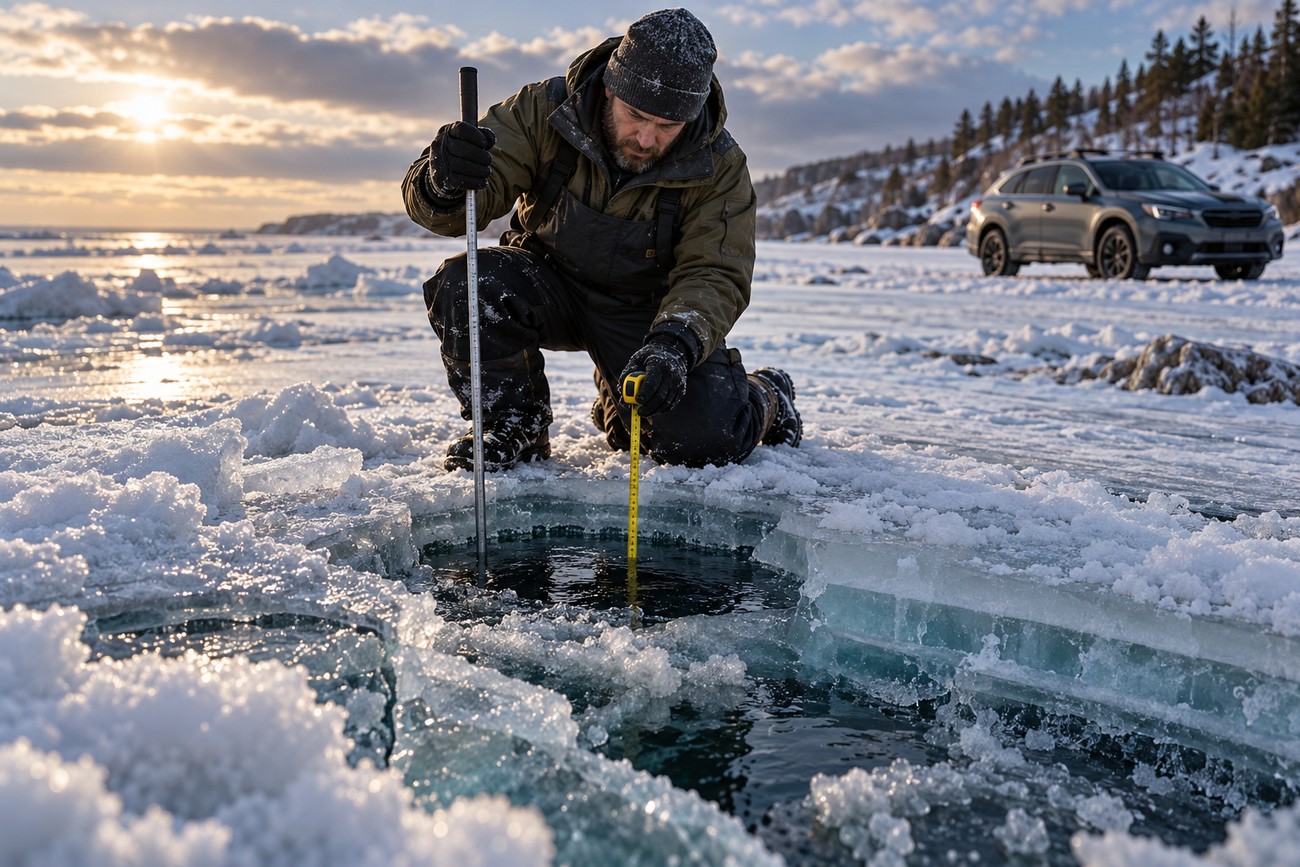
Ice thickness is a useful measurement only when combined with information about ice quality and the route. Some official guidance uses 25–30 cm of ice for a passenger car, with the condition that the ice and route are suitable. Other regional guidance cites 15 cm for a vehicle up to 2 tonnes, with strict caveats about ice character, cracks, and local conditions. These figures are conditional guidance, not automatic permission to drive.
Guidance for equipment up to 6 tonnes may cite 35–45 cm, yet a larger figure still cannot make cracked or heterogeneous ice acceptable. Ice type, currents, springs, runoff, and salinity affect its load-bearing capacity. Saltwater ice may have approximately 25–30% lower load-bearing capacity than freshwater ice at the same thickness, which is especially relevant on coastal beaches.
Unknown ice and visibly cracked ice are stop signals. Pay particular attention to shorelines, springs, streams, runoff channels, snow-covered sections, and areas where the surface changes color or texture. A crack may reflect ordinary movement, but without a competent local assessment, you cannot reliably determine whether it is harmless or part of a weak structure.
Choose a route with a flat, gently sloping bank and a gradient of no more than 5–6 degrees. Inspect the approach on foot from a safe position, identify where the ice begins, and check whether the edge is actually joined to land. A short distance across a weak shoreline transition can be more hazardous than a longer stretch of sound open ice.
Passenger safety starts before the vehicle reaches the edge. Put passengers out before entry, keep the doors ready for immediate opening, and leave the locks unlocked for emergency exit. Where conditions justify that precaution, removing heavy clothing and footwear can make evacuation easier. If the thickness, structure, or route remains uncertain, leave the car on land.
What Subaru AWD Can—and Cannot—Do on Ice
AWD helps most during acceleration, when torque can be shared across several wheels and available traction can be used more effectively. That benefit is easy to mistake for general control. Once the vehicle is moving, all four tires still depend on the same low-friction surface for steering and braking.
On polished ice, the Subaru may feel as if it is floating. Steering inputs can produce a delayed response, followed by a sideways drift when the tires finally lose their remaining grip. Wheelspin can appear suddenly on a snow-covered patch, and a transition from snow to bare ice can change the vehicle’s behavior within a short distance.
Tires, inflation, surface transitions, vehicle weight, and driver inputs all affect the result. No particular Subaru model should be treated as automatically suitable for a frozen beach. AWD may help the car get moving from a slippery section, but it offers no guarantee that the car will stop before a crack, turn without sliding, or remain level if the ice fails.
The useful distinction is between traction and control. A vehicle that moves under power is not necessarily one that can be directed or stopped. Smooth inputs, large following margins, and a route with no need for emergency turning are more valuable than testing the maximum traction available.
Prepare the Route, Car, and People Before Entry
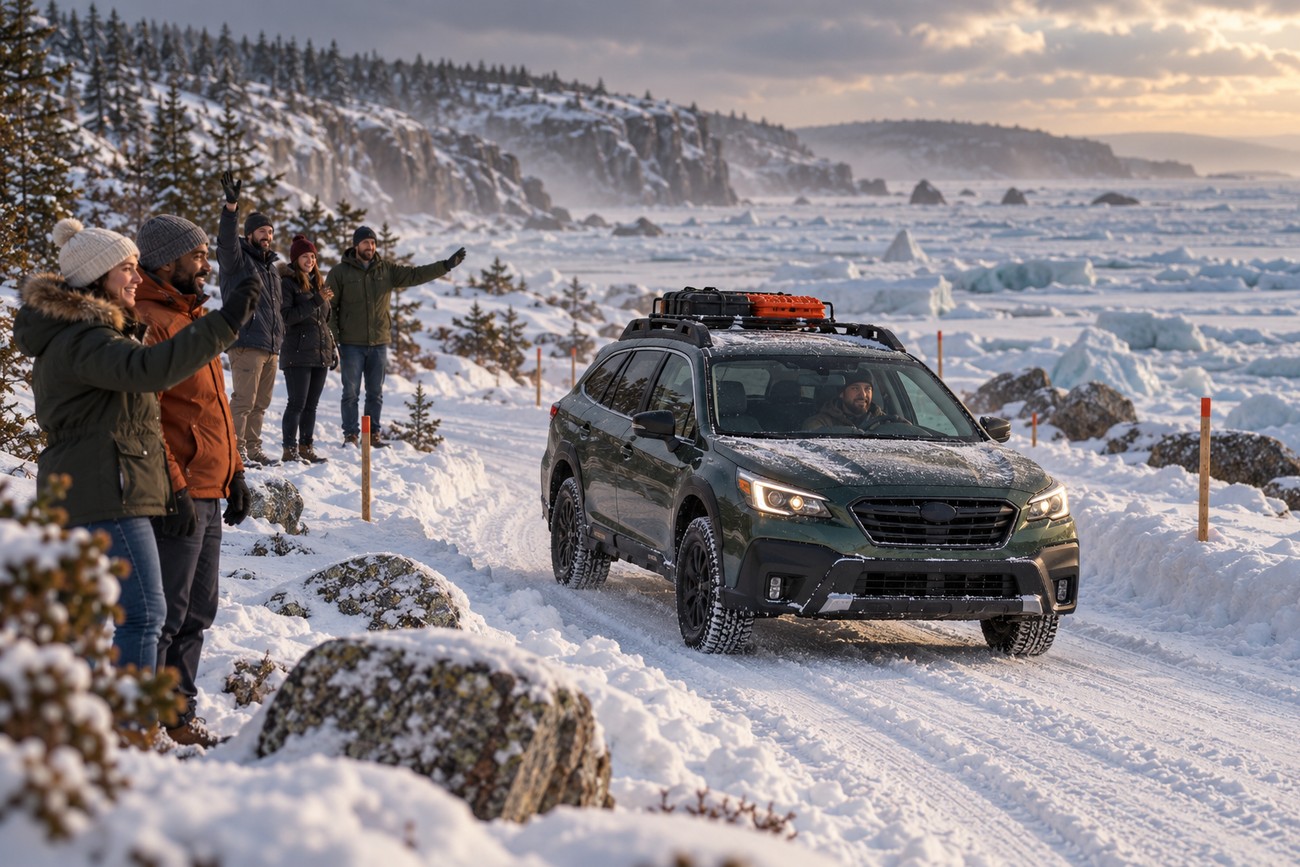
Plan the complete route before driving onto the ice, including the entry, crossing line, exit, and a place where the vehicle could be stopped without turning around. Avoid improvising near the shoreline. The edge can contain cracks, voids, or a separation between the ice and dry land that is hidden by snow, spray, or a changing tide.
Passengers should be put out before the vehicle enters the ice route. This reduces the load and, more importantly, gives everyone a clear position on firm ground while the driver makes the crossing. Keep communication simple, and ensure that no one walks onto the ice beside the vehicle unless the surface has also been assessed for pedestrians.
Doors should be ready for immediate opening or remain unlocked for emergency exit. Seat belts and heavy outer clothing can complicate movement during a sudden evacuation, so some guidance recommends removing heavy clothing and footwear before entry when conditions justify that precaution. The decision should account for cold exposure and the distance to safety; the point is to avoid clothing that restricts movement if the vehicle must be abandoned.
Use only equipment that supports a planned recovery, and keep the route free of unnecessary stops. A tow strap, suitable attachment points, and communication equipment may help with a snow bog, but they do not solve structural ice failure. If the planned route requires a sharp turn, a reverse maneuver, or a stop on uncertain ice, revise the plan before entry.
How to Move a Subaru Across Firm Ice
Approach the entry slowly and align the vehicle with the planned route. Guidance commonly recommends steady movement up to 15 km/h. The exact pace depends on visibility, surface condition, and the route, but the operating principle is consistent: use smooth, uninterrupted inputs and leave enough space to avoid an abrupt maneuver.
Apply the accelerator gently and keep the steering nearly straight. Avoid sudden throttle, sharp steering, hard braking, and rapid changes in direction. A spinning wheel can remove snow and reduce the useful surface under the tire, while a sharp steering input can start a slide before the driver feels the loss of grip.
A preselected escape route and smooth, uninterrupted inputs matter more than testing the Subaru’s maximum traction. If the crossing depends on a last-second turn or stop, the route was not prepared well enough.
Stopping, turning around, and overtaking on the ice route should generally be avoided. If the vehicle begins to drift, reduce abrupt inputs and look toward the intended path rather than chasing the movement with quick steering. Braking and steering corrections should remain progressive; aggressive correction can turn a small slide into a sideways departure from the route.
Training in low grip should take place on a prepared surface with instructor control. Exercises involving acceleration, steering during a skid, and vehicle stabilization can teach useful responses, but an unknown beach is a poor classroom. The presence of AWD does not make experimentation on open ice acceptable.
If the Subaru Gets Stuck or the Ice Starts to Fail
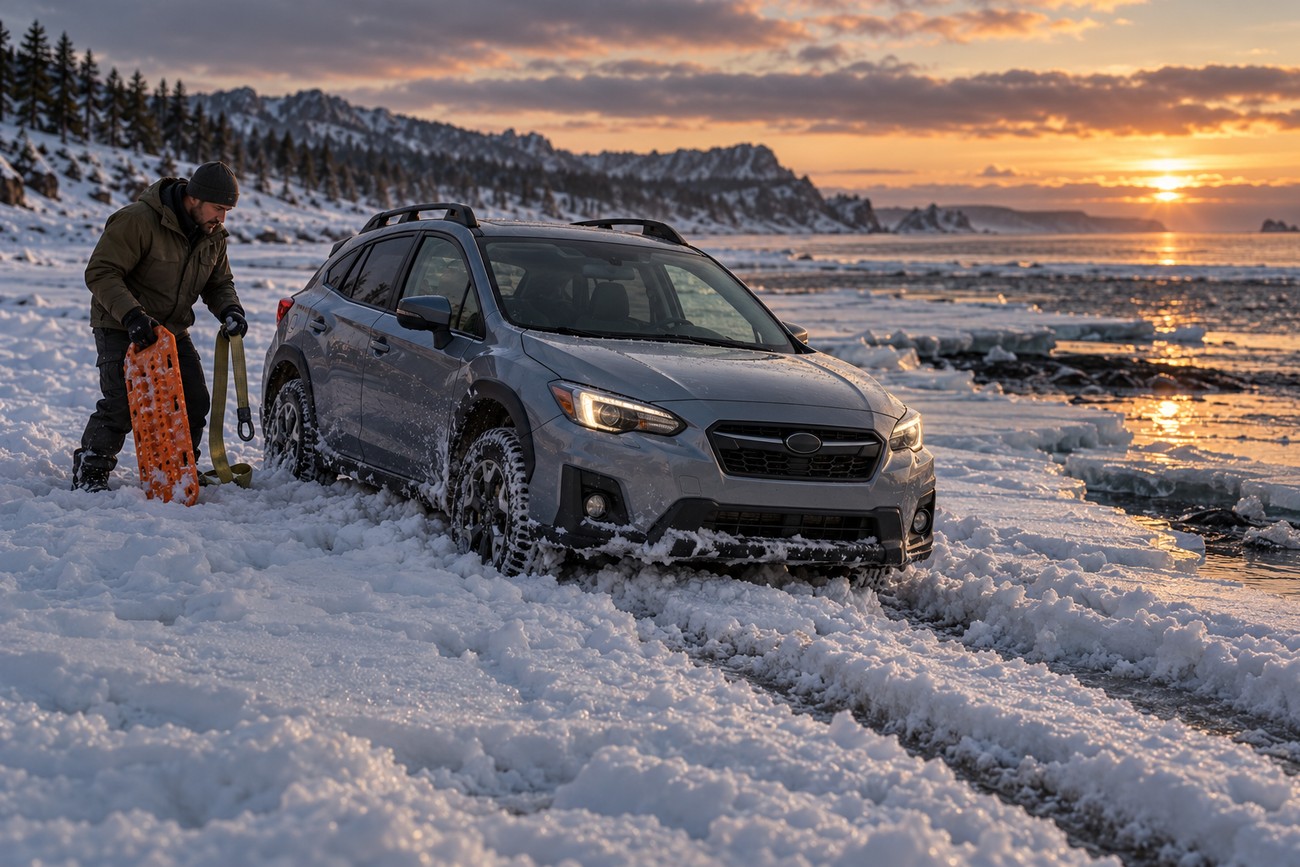
A snow-covered section can leave the vehicle bogged down even when the ice underneath is sound. Repeated throttle applications may spin the wheels, dig through the snow, and move the car closer to a weak edge. Stop before the vehicle sinks deeper, assess the direction of safe movement, and use traction or recovery equipment only from a stable position.
Keep recovery movements small and deliberate. Do not rock the vehicle aggressively, make repeated high-power attempts, or send another vehicle onto uncertain ice to pull it out. AWD is not a recovery or survival system; it can increase the force applied to the surface while doing nothing to improve the surface itself.
If the ice starts to crack, dip, or move, prioritize passenger exit and emergency response over saving the car. Give clear instructions, avoid sudden weight shifts, and move people toward firm ground using the safest available route. A vehicle that has begun to break through can become unstable quickly, so delay increases exposure to cold water and may make escape more difficult.
After a vehicle falls through ice, doors may be difficult to open immediately because outside water pressure holds them shut. A door may become easier to open once the cabin is partially filled with water, although waiting for that condition is a last-resort survival detail, not a procedure to test. Windows, emergency tools, and a practiced exit plan can matter because electrical systems may fail and normal controls may become unreliable.
Call emergency services as soon as it can be done without delaying escape. Do not re-enter the vehicle for property, and do not approach a break-through area casually after the occupants are out. The same weak ice that failed under the Subaru may not support a rescuer, a second vehicle, or recovery equipment.
Frequently asked questions
Frozen beaches combine vehicle, surface, and evacuation risks, so general off-road advice often leaves out important details. The answer below separates sand performance from ice safety and focuses on the qualities that determine whether a vehicle can be used responsibly.
What is the best vehicle for driving on beach sand?
The best vehicle for beach sand is one that combines low ground pressure, suitable tires, adequate clearance, manageable weight, and a realistic recovery plan. AWD can help maintain movement when traction changes, but it is only one part of the package. A heavy vehicle with poor flotation can dig in despite having four driven wheels, while a lighter vehicle with appropriate tires may travel more gently over firm sand.
Recovery planning should cover access, turning space, attachment points, communication, and the possibility that the tide or surface may change. Sand capability does not transfer automatically to frozen water. On ice, the key questions become structural thickness, cracks, currents, salinity, and evacuation; a vehicle that performs well on a beach may still be unsuitable for the ice route.







