
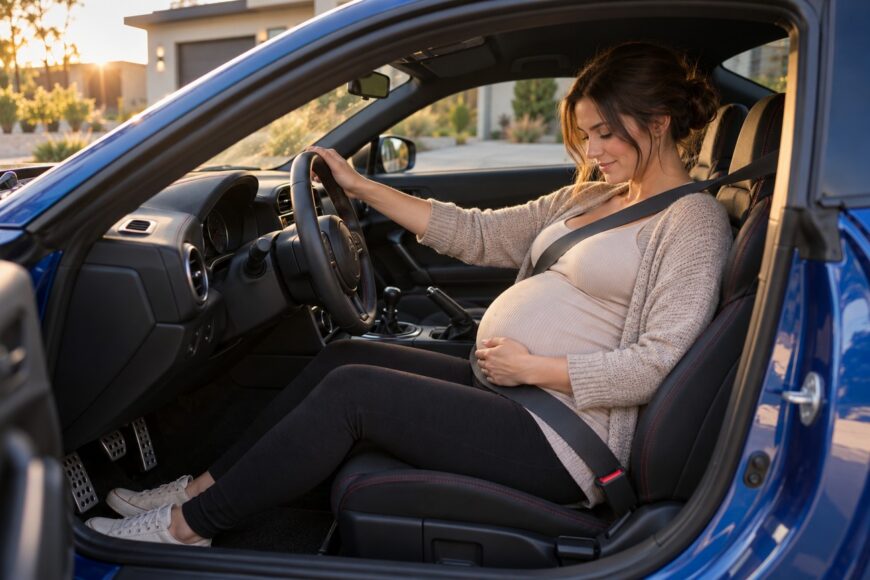
A Subaru BRZ can feel familiar and manageable at the start of pregnancy, then become difficult as the low seat, compact cockpit, and steering-wheel position leave less room for a changing body. The practical issue is whether you can sit comfortably, use the restraint correctly, and control the car without strain.
Pregnancy alone does not set a universal date for stopping driving. Symptoms, complications, medical advice, and your ability to operate the BRZ safely determine the decision. Later pregnancy may make this particular car impractical even when no new diagnosis has appeared.
- Is it safe to keep driving a BRZ while pregnant?
- Set up the BRZ cockpit around your changing shape
- Wear the standard belt correctly—and leave the airbag on
- The BRZ-specific discomforts worth taking seriously
- Make trips shorter and know when to pull over
- When the BRZ no longer fits, change the transport plan
- Frequently asked questions
- What should I do after a crash if I feel fine?
- What pregnancy information should I bring on a solo drive?
- At what stage of pregnancy should you stop driving?
- How long is too long to sit in a car while pregnant?
Is it safe to keep driving a BRZ while pregnant?
For an uncomplicated pregnancy, driving may remain possible if you feel alert, can reach every control, and can maintain a safe position behind the wheel. There is no universal pregnancy week or trimester at which everyone must stop driving. The decision should follow your condition and the car’s actual fit rather than a calendar deadline.
Fainting, severe nausea, dizziness, unusual drowsiness, or reduced alertness can make driving unsafe. Pregnancy complications, including a threatened miscarriage, threatened premature labor, placenta previa, severe hypertension, or other restrictions identified by your maternity clinician, require individual medical advice before you continue. A diagnosis does not create one blanket rule for every driver, so discuss your specific limits with the clinician managing your pregnancy.
Feeling well is necessary for a safe trip, but it is not sufficient if your abdomen is close to the wheel, your knees are cramped, or you cannot press the brake or clutch fully. A driver who is stretching, twisting, or bracing against the seat may lose precision during an emergency. Later pregnancy can reduce mobility and concentration, making driving impractical even without a new medical problem.
Set up the BRZ cockpit around your changing shape
Perform the fit check while the car is parked. Adjust the seat first, then the steering wheel, aiming to create as much practical space as possible between your abdomen and the wheel while preserving full pedal and steering control. Keep the wheel directed toward your chest rather than your abdomen, and confirm that you can turn it confidently without leaning forward.
Move the seat far enough back to protect clearance, then test the entire pedal range. In a manual BRZ, press the clutch fully; in either transmission, apply the brake firmly and check that your leg is not locked or forced to reach. A suggested abdomen-to-wheel gap of 10 cm is useful as a practical reference, not a validated guarantee of safety or a substitute for a functional fit check.
Moving the seat back can create welcome space around the abdomen while leaving the driver unable to brake firmly or depress the clutch fully. Check both clearance and pedal control before setting off.
Shorter drivers may face the hardest compromise because sitting close to the pedals can bring the wheel closer, too. Some BRZ owners report that the seat-to-pedal-to-wheel arrangement becomes difficult as pregnancy progresses, with comfort often changing around 20–24 weeks. These are owner experiences, not a vehicle-wide specification or a medical cutoff, and the result varies by driver, model year, and body shape.
Wear the standard belt correctly—and leave the airbag on
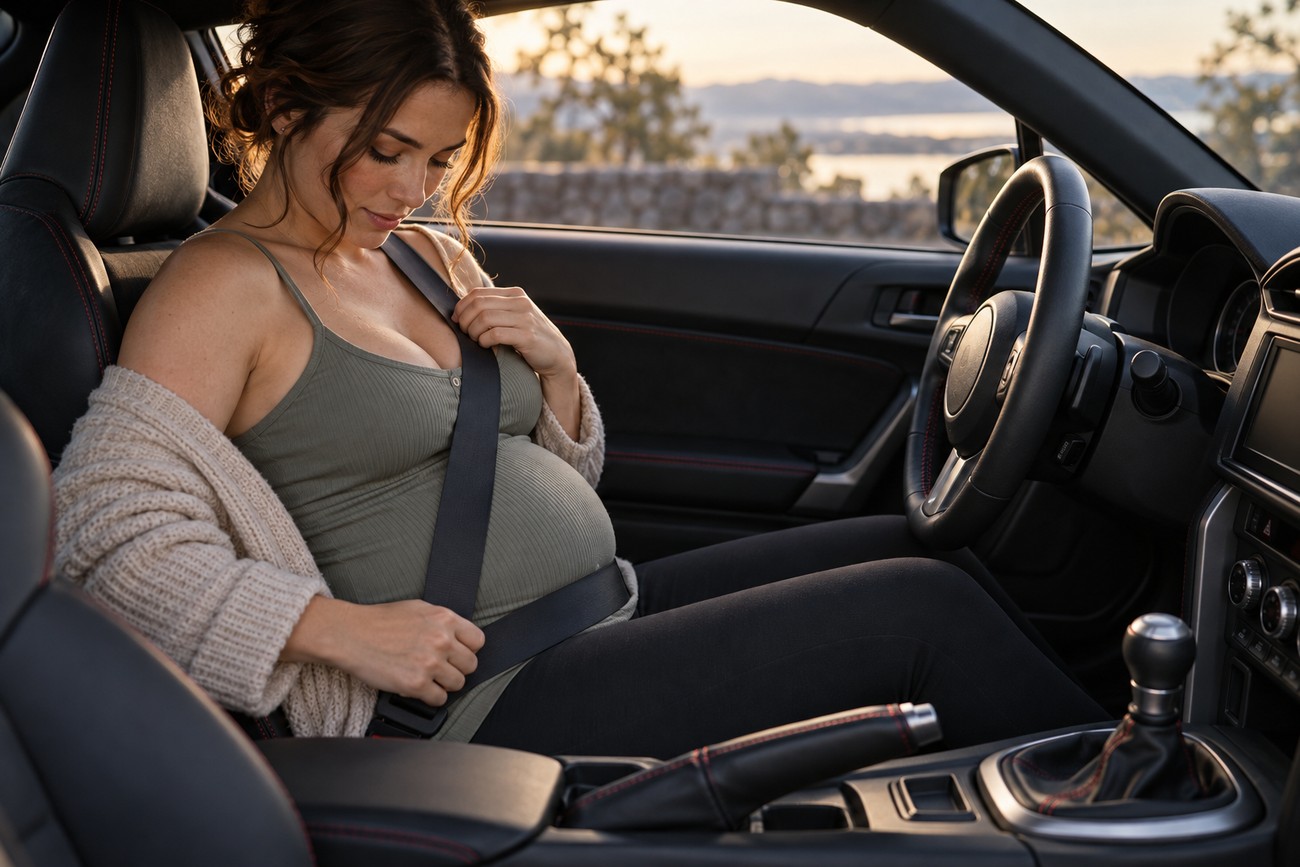
Use the BRZ’s standard three-point belt on every trip. Place the lap portion low across the hips, below the bump, where it rests on the pelvic bones. Route the shoulder portion between the breasts and beside the abdomen, keeping it flat and free from twists.
Loosening the belt, placing the shoulder strap behind your back, routing it under an arm, or skipping it removes the restraint’s intended protection. Discomfort calls for a stationary adjustment of the seat, belt position, clothing, or driving plan. It does not make an unrestrained position safer.
Keep the airbag enabled and maximize your distance from the steering wheel while retaining full control. The belt and airbag are designed to work together, and sitting farther back is useful only if you can still steer accurately and operate the pedals. Never place the shoulder strap across the abdomen.
Aftermarket pregnancy belt adapters do not automatically improve safety. Evidence and testing vary by product, and there is no single global standard that makes every adapter equivalent to the factory restraint. If you are considering one, ask your maternity clinician and check the product’s vehicle and restraint guidance rather than assuming its marketing claims apply to your BRZ.
The BRZ-specific discomforts worth taking seriously
The BRZ’s low seating position can make getting in, getting out, and changing position harder as pregnancy progresses. Pronounced seat bolsters may press on the hips or thighs, while a firm ride can increase discomfort during a longer trip. These are comfort and control concerns; BRZ vibration should not be presented as a proven cause of pregnancy complications.
Back, hip, and leg discomfort can appear sooner in a fixed driving position. In a manual BRZ, repeated clutch use in traffic adds physical work and may increase fatigue or leg discomfort. A small lumbar cushion may help some drivers, provided it does not push the body forward, reduce wheel clearance, or alter the belt’s position.
Reports that driving becomes uncomfortable around 20–24 weeks are anecdotes from some owners, not a medical or vehicle-wide cutoff. A driver may remain comfortable longer, while another may need to stop earlier because of pain, restricted movement, nausea, or difficulty maintaining attention. Treat the first loss of reliable control as a reason to change the plan.
Pregnancy is also a reason to retire an abrupt driving style. Leave more space, brake progressively, avoid sharp acceleration, and allow extra time for lane changes and exits. A sudden stop can be physically demanding even when there is no collision, so preserving a calm margin benefits both comfort and control.
Make trips shorter and know when to pull over
Plan each journey around access to a restroom, water, food, and a place to walk briefly. Stops roughly every 20–60 minutes can be a useful planning range, but this is flexible guidance rather than a fixed safe-sitting limit. Adjust the timing to symptoms, traffic, route conditions, and your clinician’s advice.
Sudden nausea, dizziness, unusual fatigue, blurred concentration, or a feeling that you may faint calls for a safe stop. Signal, leave the traffic flow when possible, and do not continue simply to reach the destination. If symptoms are severe, persistent, or linked to a pregnancy concern, seek appropriate medical help.
Long solo drives are harder to manage because help, restrooms, and suitable stopping places may be unavailable. Overnight driving adds darkness, fatigue, and fewer services, so it is sensible to avoid it when symptoms or late-pregnancy discomfort are present. A passenger who can drive or assist with a stop may reduce the risk of being stranded while unwell.
Keep the route simple and tell someone where you are going if you must travel alone. Carry your maternity records or exchange card and identification where they can be reached quickly. These preparations do not make a difficult trip safe by themselves, but they can help responders and clinicians understand your situation if your condition changes.
When the BRZ no longer fits, change the transport plan

Stop driving the BRZ when correct belt placement, useful wheel clearance, full pedal operation, and reliable attention cannot coexist. This remains the right decision even if another vehicle might still fit you. A car change is a practical response to changing space and control needs, not a failure or a sign that every pregnant driver must stop at the same stage.
Ask someone else to drive, use a roomier vehicle, or arrange another form of transport when the cockpit becomes restrictive. A higher vehicle may make entry and exit easier, while a different seat and pedal layout may preserve the distance needed from the wheel. The replacement still needs its own stationary belt and control check.
Later pregnancy may make active driving impractical without a new diagnosis. Increased abdominal size, fatigue, pelvic discomfort, reduced mobility, and the need for frequent stops can all change the balance. Some clinicians are more cautious about driving late in pregnancy, especially on long journeys, so individual advice matters more than a general promise that good current symptoms guarantee continued suitability.
Reassess after any significant change in symptoms, seating position, or vehicle. If you cannot make the BRZ work without leaning forward, compromising the belt, or losing confident control, leave the driving to someone else. That decision protects your ability to respond safely and gives your maternity team a clearer basis for advice.
Frequently asked questions
What should I do after a crash if I feel fine?
Seek prompt maternity assessment after a crash, even if you feel well and the impact seemed minor. Symptoms may not appear immediately, and a clinician can decide whether you need monitoring, examination, or follow-up based on the collision and your stage of pregnancy.
Seek urgent medical advice if you have significant pain, bleeding, fluid loss, contractions, faintness, breathing difficulty, or reduced fetal movement where that is relevant to your stage of pregnancy; call emergency services for severe symptoms or an emergency. Do not drive yourself for assessment if you feel impaired. Provide the clinician with the collision details, your medical information, and any assessment already completed at the scene.
What pregnancy information should I bring on a solo drive?
Carry identification, accessible maternity-care contact details, and relevant medical information, such as your exchange card or pregnancy record, current medications, allergies, blood-group information if recorded, and the name of your maternity unit. Keep these items where a passenger or responder can find them quickly.
Tell a trusted person your route and expected arrival time. A phone with emergency contacts available can help if you become unable to explain your situation clearly. Local medical services may have different documentation practices, so follow the advice of your maternity team and carry the records they recommend.
At what stage of pregnancy should you stop driving?
There is no universal stage at which every pregnant driver must stop. Stop when symptoms, complications, clinical advice, or the physical fit of the vehicle make safe control uncertain. Later pregnancy may make the BRZ impractical even when another vehicle remains usable.
Arrange a review with your maternity clinician if you are unsure, especially after fainting, severe nausea, dizziness, pain, bleeding, or a diagnosis that may affect alertness or mobility. A short fit check in the parked car can support the discussion, but it cannot replace medical advice.
How long is too long to sit in a car while pregnant?
There is no single time limit that is safe for everyone. A trip becomes too long when discomfort, fatigue, swelling, nausea, reduced concentration, or the lack of suitable breaks prevents you from remaining alert and in control. Route conditions and access to restrooms also matter.
Plan opportunities to stop and move roughly every 20–60 minutes, adjusting that range to symptoms and clinical advice. Break up longer journeys, avoid driving through the night when fatigue is likely, and postpone a trip if you cannot identify safe places to stop or obtain help.







