
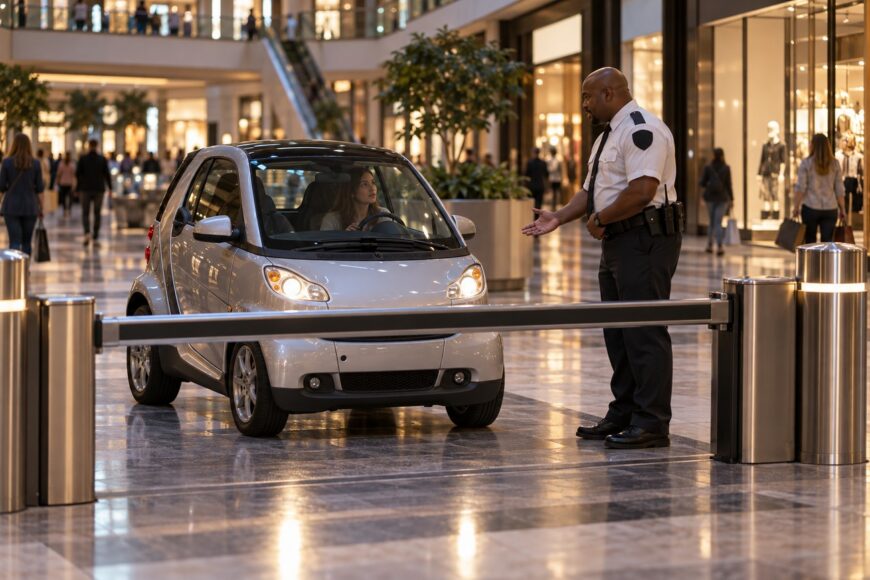
A Smart can look small enough to drive through a shopping mall, especially where a conventional car would struggle to turn. That assumption misses the central issue: mall access is controlled by site rules, pedestrian exposure, building safety requirements, and the potential cost of damaging floors, glass, doors, or tenant property.
This article concerns authorized service access and controlled promotional or film events. It does not describe ordinary driving through customer areas. In most malls, vehicles use a designated service route under advance approval, during a controlled low-traffic window, with appropriate pedestrian separation and supervision.
- Why a Small Smart Is Not Automatically Allowed Inside
- What Makes a Smart Easier—and Still Risky—to Maneuver
- How Cars Actually Enter a Shopping Mall
- Three Indoor Mall Access Scenarios Compared
- The Safety and Building Risks That Matter More Than Vehicle Size
- Common Mistakes That Get Drivers Turned Away or Cause Damage
- The Approval Checklist for a Mall Vehicle Move
- Frequently asked questions
- How do they drive cars into malls for a promotional event?
- What should a written approval for indoor vehicle access include?
- What is the common problem with Smart cars in very tight indoor spaces?
Why a Small Smart Is Not Automatically Allowed Inside
Most shopping malls prohibit ordinary vehicle movement through public shopping galleries under their internal rules. Those rules apply even when a vehicle is physically small enough to pass between columns, displays, or storefronts. Security personnel enforce an operating policy rather than making an individual judgment about whether a particular Smart might fit.
The Smart ForTwo has historically had a very short wheelbase and small turning radius, which can help on narrow service routes. Compact dimensions, however, do not create permission to enter a public indoor space. Authorization, pedestrian safety, fire requirements, ventilation, and evacuation routes are separate questions from whether the vehicle can physically pass.
Risk also depends on speed, mass, visibility, pedestrian behavior, and available stopping space. A small car moving near a storefront can still injure someone, strike a fixture, or become difficult to stop on a slope. In a crowded gallery, people may step sideways, turn around, or emerge from a shop entrance without seeing the vehicle in time.
An electric Smart removes local exhaust, but it remains subject to pedestrian, fire-safety, evacuation, and property-protection requirements. An internal-combustion vehicle adds carbon monoxide and ventilation concerns in an enclosed space. The correct question for an operator is therefore whether the entire movement can be approved and controlled, rather than whether the car is small.
What Makes a Smart Easier—and Still Risky—to Maneuver
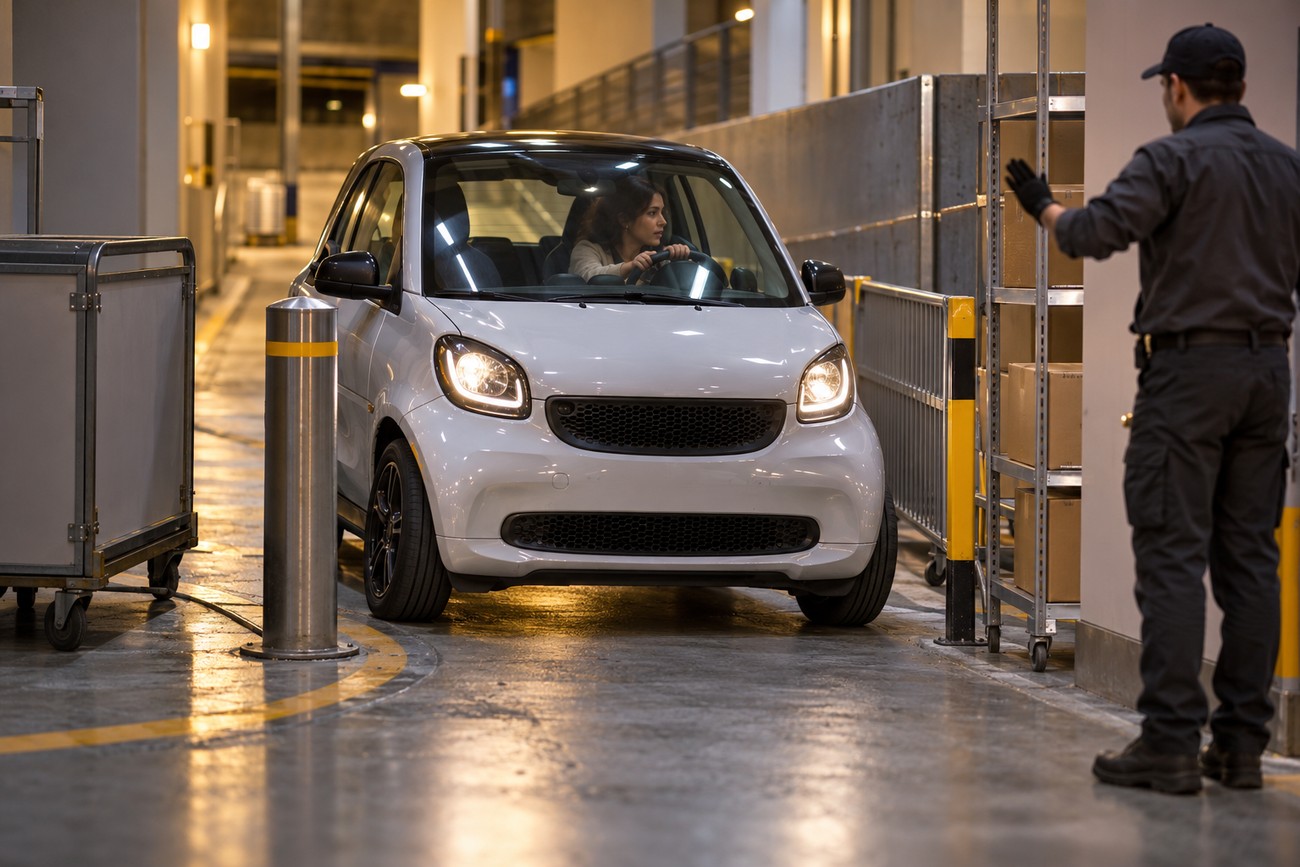
The Smart ForTwo has historically had a very short wheelbase and small turning radius. Those characteristics can make a controlled service route easier to negotiate than one designed for a larger vehicle, particularly around loading areas and narrow approaches. They are useful handling advantages, not a substitute for a route assessment.
Clearance remains a practical problem. Mirrors can meet bollards, carts, temporary barriers, or shelving even when the body appears to fit. A tight turn may also fail at the junction between a ramp and a level floor, where the available angle, curb, or wall position matters more than the car’s overall length.
Indoor surfaces create another limit. Polished flooring, ramps, and painted areas may offer less predictable grip than ordinary asphalt, so low speed and gentle control are important. A short car can still need more space than expected to stop safely when a pedestrian enters its path.
Small vehicles may be less noticeable to pedestrians in a crowded indoor environment. A shopper who sees a delivery van may instinctively keep clear, while a compact car can blend into the background or sit below the expected sightline. That visibility problem can outweigh the advantage of a small turning radius.
How Cars Actually Enter a Shopping Mall
Authorized vehicle access normally begins with advance approval from facility management, security, or another designated site contact. The approved route usually uses a service ramp, loading dock, or designated load-in route rather than a customer entrance. The timing is commonly tied to a nighttime or low-traffic window so the movement can be separated from normal shopper activity.
Driving on an approved load-in route is a different scenario from driving through a public shopping gallery. A vehicle may be permitted to travel from a dock to a specified display or work area while still being prohibited from crossing the main retail circulation space. The written approval should make that distinction clear.
Controlled movements may require minimal speed, hazard lights, an escort, and temporary separation from pedestrians. Staff may hold doors, pause shoppers, move carts, or close a short section of the route while the vehicle passes. These controls are intended to manage the environment around the car because its compact dimensions cannot eliminate unpredictable human movement.
Approaching through the main entrance is usually the wrong plan. Automatic doors, polished thresholds, queuing shoppers, display fixtures, and narrow sightlines make a customer entrance difficult to control. Poor service-entry signage can make the correct route hard to find, so the driver should obtain clear arrival instructions before reaching the property rather than improvising at the curb.
Three Indoor Mall Access Scenarios Compared
The same vehicle can be treated very differently depending on the purpose, route, and controls approved by the mall.
| Scenario | Who authorizes it | Where the vehicle travels | Timing and pedestrian controls | Typical restrictions |
|---|---|---|---|---|
| Ordinary customer-area driving | Usually prohibited under the mall’s internal rules | Public shopping galleries, entrances, or customer circulation areas | No ordinary operating plan; shopper movement is uncontrolled | Do not enter without a specific written exception and event plan |
| Authorized service-route or load-in access | Facility management, security, or the designated site authority | An approved service ramp, loading dock, or designated load-in route | Low-traffic window, minimal speed, hazard lights, escort, and temporary pedestrian separation may be required | Limited to the approved route, vehicle, purpose, time, and operating conditions |
| Controlled promotional or film-display event | Mall management and the event’s responsible operational team | A surveyed route to a specified display or filming position | Timed closure or managed pedestrian separation, escort, and controlled positioning after entry | One-off event approval; the vehicle may be restricted to a static display area and cannot assume ordinary mall access |
The Safety and Building Risks That Matter More Than Vehicle Size
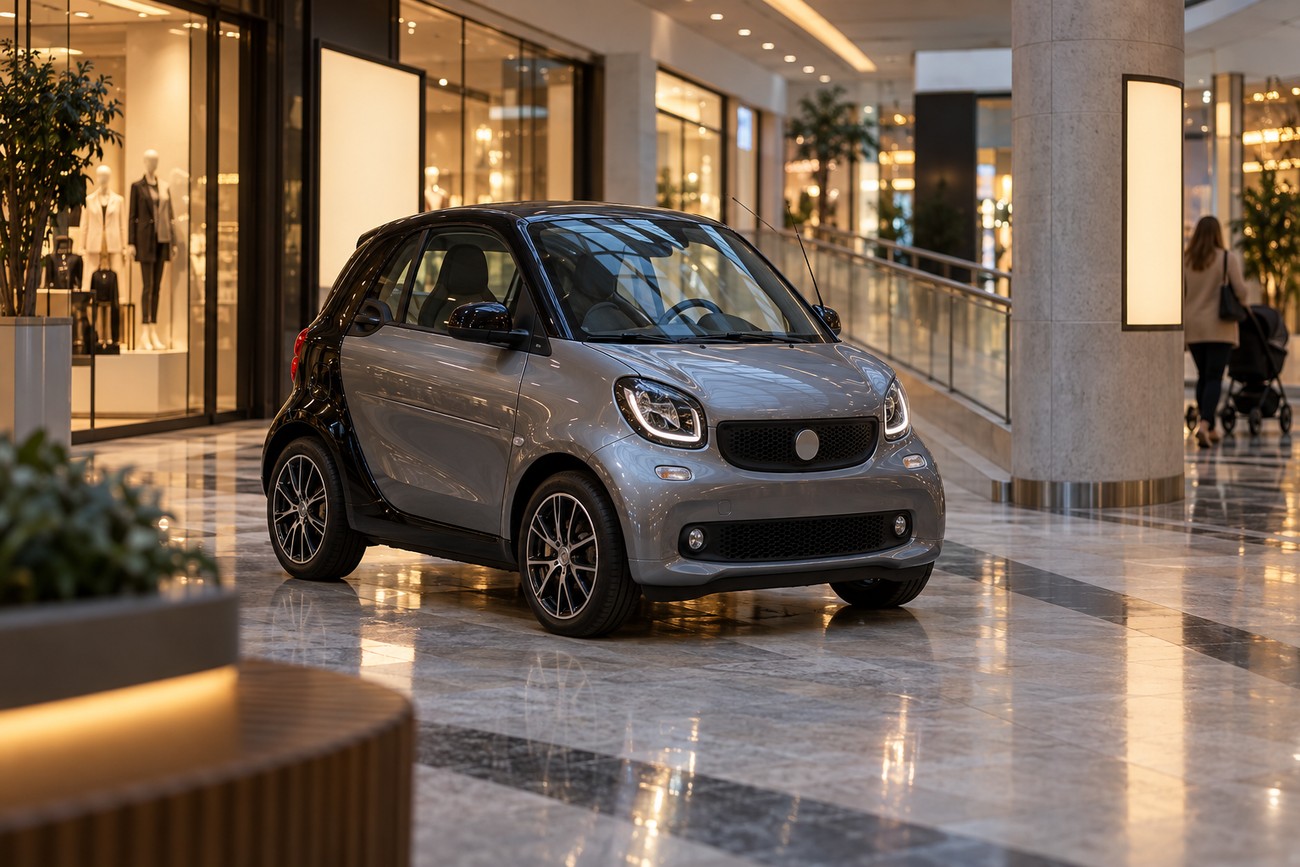
The main exposure is pedestrian movement. People may step out of shops, walk behind a friend, move around a stroller, or cross a route while looking at a phone or display. Poor sightlines near columns, advertising panels, carts, and temporary barriers can leave little time to react, even at a very low speed.
Surfaces and building features add separate hazards. Polished floors, sloped ramps, thresholds, curbs, glass storefronts, and automatic doors all require clearance and careful control. An indoor mistake can damage floors, curbs, glass storefronts, or automatic doors, and the resulting repair or access restriction can disrupt tenants as well as the event itself.
Evacuation routes require particular attention. A vehicle, barrier, or display positioned in the wrong place can reduce the usable path for people leaving the building or interfere with emergency operations. An electric Smart has no local exhaust, but it remains subject to fire-safety and evacuation controls, along with the mall’s requirements for protecting people and property.
An internal-combustion vehicle in an enclosed space can increase carbon monoxide and ventilation risks. Exhaust smell or a feeling of poor air quality is a warning that the building’s normal conditions may not support the movement. Ventilation arrangements, engine-running time, and any requirement to move the vehicle into position without prolonged idling should be confirmed before approval.
Vehicle weight and speed still matter even when the car is compact. The stopping space available on a ramp or beside a storefront may be more important than the vehicle’s width. A facility team is therefore managing a complete operating system—vehicle, driver, route, surfaces, pedestrians, ventilation, and emergency access—not simply selecting a car that fits.
Common Mistakes That Get Drivers Turned Away or Cause Damage
The most visible mistake is arriving at the main entrance and expecting security to make an exception. The main entrance is usually not the authorized vehicle entry point, and a small car may still be refused because the approach cannot be isolated from shoppers. A driver who has not confirmed the service entrance may spend time searching for poorly marked access points or blocking a customer drop-off area.
Failing to check the mall’s rules in advance creates a second problem. A parking card or parking subscription does not automatically authorize indoor driving, and a previous successful entry does not create permanent access. Approval may change with an event, loading activity, staffing level, crowd conditions, or a different operating window.
Compactness is also commonly mistaken for permission and safety. Mirrors can still clip carts, posts, or temporary barriers, while a pedestrian may fail to notice the vehicle until it is close. Drivers should avoid relying on the car’s short wheelbase or small turning radius as evidence that every route is suitable.
Too much throttle on a polished floor, ramp, or tight turn can make a minor clearance error worse. Internal-combustion vehicles may also create an exhaust smell or ventilation concern in an enclosed route. These are practical reasons to use very low speed, gentle control, and a planned stop point rather than trying to complete the movement quickly.
The Approval Checklist for a Mall Vehicle Move
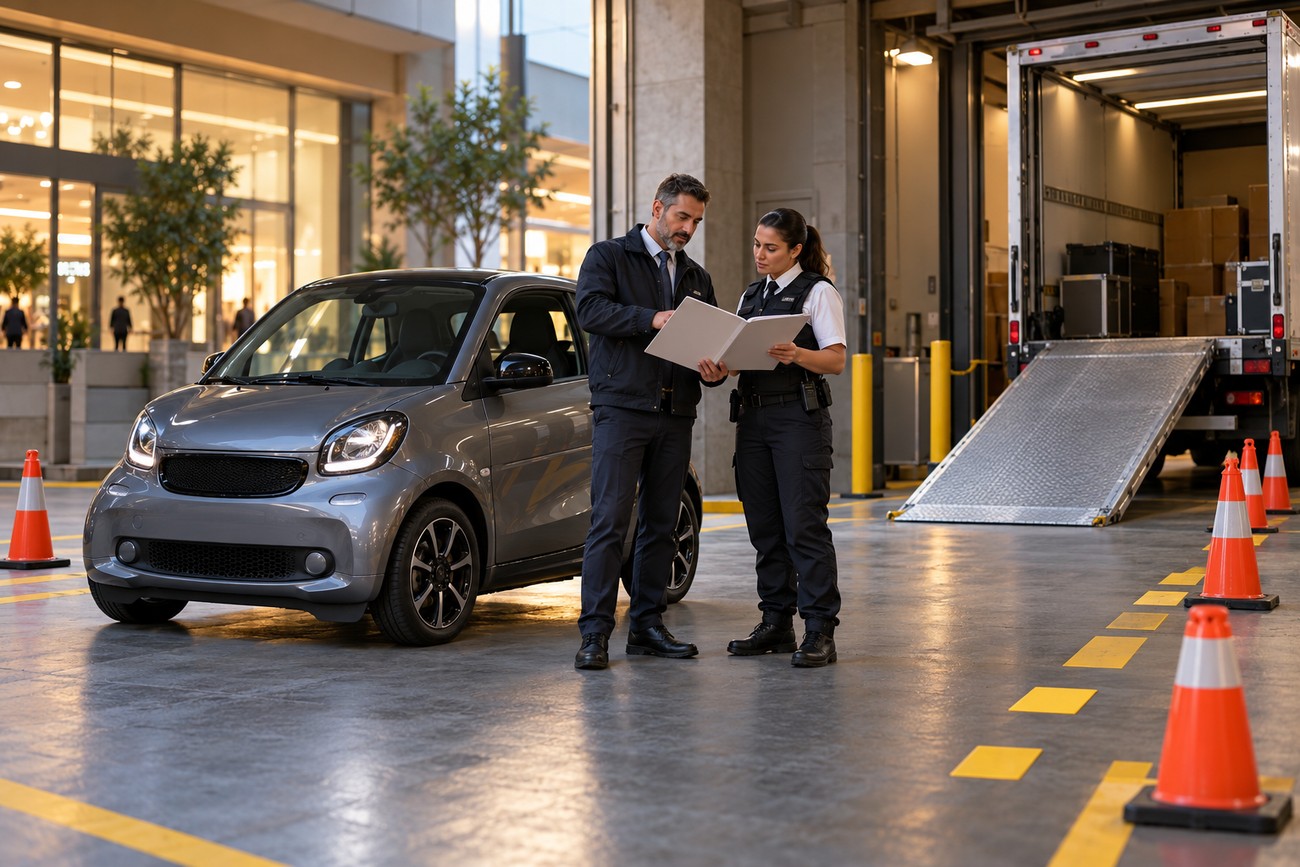
Start by contacting facility management or security before the vehicle arrives. Ask for the relevant internal procedure, the correct service entrance, and the person responsible for approving the movement. The request should state whether the purpose is loading, maintenance, a static display, filming, or another controlled activity.
Obtain written approval for the exact date, purpose, route, time window, vehicle type, and operating conditions. Confirm height and width clearances, ramp junctions, turning points, floor restrictions, door dimensions, and any areas where the vehicle must stop. A verbal instruction at one entrance is not a standing right to enter the building.
Facility teams approve an exact route and time window because clearance at ramp junctions, pedestrian separation, escort responsibility, and a clear stop condition determine whether the movement can be controlled.
Identify the escort and agree on how pedestrians will be separated from the route. Confirm whether hazard lights, a spotter, temporary barriers, a door attendant, or a radio contact are required. The plan should also state who can stop the movement if the route becomes crowded, a door fails, visibility changes, or an unexpected obstruction appears.
Finally, verify the vehicle’s powertrain and ventilation requirements. An internal-combustion vehicle may require specific controls because of carbon monoxide and ventilation risks, while an electric Smart still needs fire-safety, evacuation, and collision controls. Conditions can change on the day, so the responsible contact should have authority to delay, reroute, or cancel the move.
Frequently asked questions
Indoor vehicle access is an operational exception that depends on a specific plan. These answers address the practical details that separate a controlled movement from ordinary driving through a mall.
How do they drive cars into malls for a promotional event?
The event team first obtains approval, identifies the vehicle and purpose, and inspects the proposed route with facility and security staff. The inspection should cover the service entrance, ramp junctions, door clearances, turning points, flooring, stopping areas, and any conflict with evacuation routes or tenant operations.
On the approved day, staff use a timed closure or temporary pedestrian separation, an escort, and a controlled low-speed movement. The vehicle is then positioned in the agreed display or filming location, with its final position checked against doors, walkways, emergency paths, and nearby fixtures. This is a one-off controlled event, not evidence that customers may drive through the mall.
What should a written approval for indoor vehicle access include?
It should identify the vehicle, the purpose of the move, the exact route, the date, and the approved time window. It should also name the responsible mall contact, the driver or operating team, the escort, and any requirements for hazard lights, pedestrian separation, or temporary closures.
A useful approval also records clearance constraints, the intended stopping or display position, the vehicle’s powertrain, ventilation or fire-safety conditions, and a contingency plan. That plan should say who may stop the movement and what happens if the route is crowded, blocked, or no longer safe.
What is the common problem with Smart cars in very tight indoor spaces?
Limited visibility and unpredictable pedestrian movement can matter more than the Smart’s width or turning radius. A compact vehicle may be difficult for shoppers to notice beside displays, columns, carts, or other visual clutter, and people may enter its path without recognizing that a vehicle is moving nearby.
The driver also needs clearance for mirrors, bodywork, doors, and turning at ramp junctions. If the route cannot provide a clear sightline, a safe stopping area, and reliable separation from pedestrians, the safer option may be a static display or an alternative delivery method rather than driving the car inside.







