
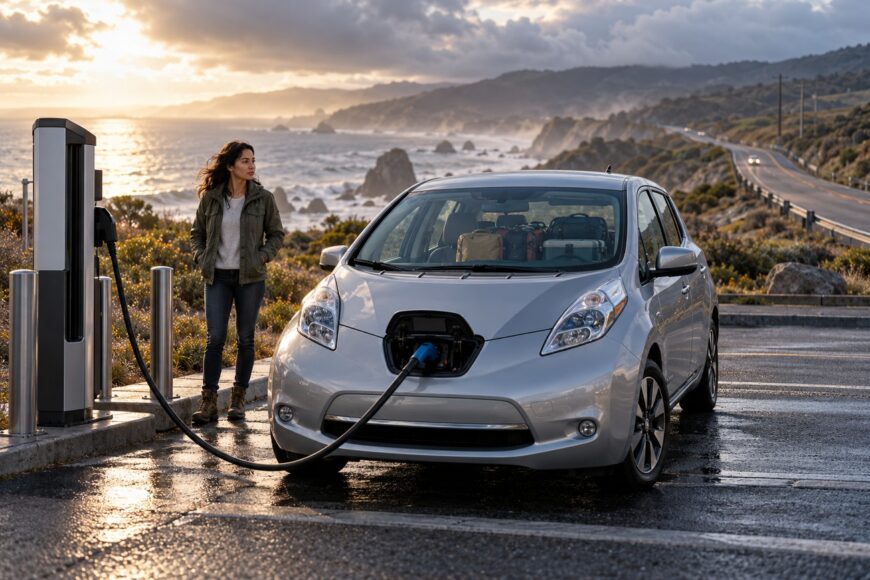
A Nissan Leaf can cross the country, yet the trip may be slow, highly weather-dependent, and more exposed to charger failures than a modern CCS or NACS EV. The limiting factor is rarely one headline range figure. Battery version and condition, CHAdeMO availability, highway speed, repeated fast charging, and the quality of your reserve plan all shape whether the journey feels manageable or becomes a sequence of improvised delays.
The Leaf uses CHAdeMO for DC fast charging, while newer charging deployments increasingly prioritize CCS and NACS. That leaves some long-distance corridors with fewer compatible stops and less redundancy. A healthy 62-kWh Leaf e+ gives you more flexibility than a 40-kWh Leaf, but neither version turns a sparse charging network, cold weather, or a hot battery into a predictable road-trip system.
- Can a Nissan Leaf Really Go Coast to Coast?
- 40-kWh vs. 62-kWh Nissan Leaf for a Cross-Country Drive
- Plan the Route Around CHAdeMO, Not Just the Map
- Highway Speed, Weather, and Battery Heat Change the Math
- What a Full Charging Day in a Leaf Actually Feels Like
- The Mistakes and Hidden Risks That Break the Itinerary
- Frequently asked questions
- What year should you avoid when buying a Nissan Leaf for a coast-to-coast trip?
- How far can a Nissan Leaf travel on a full charge?
- What is the most common problem with a Nissan Leaf on a long trip?
Can a Nissan Leaf Really Go Coast to Coast?
A coast-to-coast Leaf trip is technically possible on some routes. Practicality varies sharply with the car, the season, and the charging corridor. A route with dependable CHAdeMO stations and suitable overnight stops can work; a route built around isolated or unreliable connectors may require long detours, lower speeds, or extra nights.
The standard Leaf has a 40-kWh battery, while the Leaf e+ has a 62-kWh battery. That difference affects how often you need to stop and how much reserve you can carry for wind, elevation, traffic, or a station that is unavailable. Battery degradation can widen the gap further, especially in an older or heavily used car.
Advertised range is a reference point rather than a highway-trip guarantee. Practical distance depends on battery condition, speed, wind, temperature, heating use, and elevation. Consumption rises sharply around 65–75+ mph, so a plan based on relaxed city driving can fail quickly on a fast interstate route.
Distance is only one part of the problem. Because the Leaf relies on CHAdeMO, a long trip also becomes an infrastructure and time-management exercise. A single connector may be occupied or offline, and sparse coverage can make the next usable stop too far away for a low-reserve arrival. The larger battery helps, yet it does not remove that logistical risk.
40-kWh vs. 62-kWh Nissan Leaf for a Cross-Country Drive
The battery choice changes the margin available between charging stops, while both cars retain the same CHAdeMO dependency. The comparison below describes trip roles rather than promising a fixed distance.
| Factor | 40-kWh Leaf | 62-kWh Leaf e+ |
|---|---|---|
| Battery capacity | 40 kWh | 62 kWh |
| Likely trip role | More dependent on closely spaced, reliable charging stops and conservative driving | More flexible for longer gaps, weather changes, and backup planning |
| Charging-stop implications | Usually requires tighter route discipline and less tolerance for a failed connector | Can combine a wider choice of stops with a larger arrival reserve |
| Sensitivity to degradation | Capacity loss can remove a substantial part of the usable trip margin | Retains more absolute capacity, although degradation still affects route feasibility |
| CHAdeMO dependence | Uses CHAdeMO for DC fast charging | Uses CHAdeMO for DC fast charging |
| Coast-to-coast suitability | Possible on a carefully supported route, with greater exposure to delays and detours | Generally more suitable, provided the battery is healthy and the route has compatible, reliable stops |
The 62-kWh version improves flexibility rather than eliminating the Leaf’s main constraints. Both versions use CHAdeMO, both can be affected by battery temperature, and repeated DC fast charging can reduce later charging speed. A degraded 62-kWh car may also be a weaker road-trip choice than a healthy 40-kWh car on a particularly well-supported route.
For a used Leaf, battery condition deserves the same attention as the badge on the trunk. Model year alone does not reveal how much usable capacity remains. A route review should begin with the actual condition of the battery and then test whether that capacity leaves a practical reserve at highway speed.
Plan the Route Around CHAdeMO, Not Just the Map
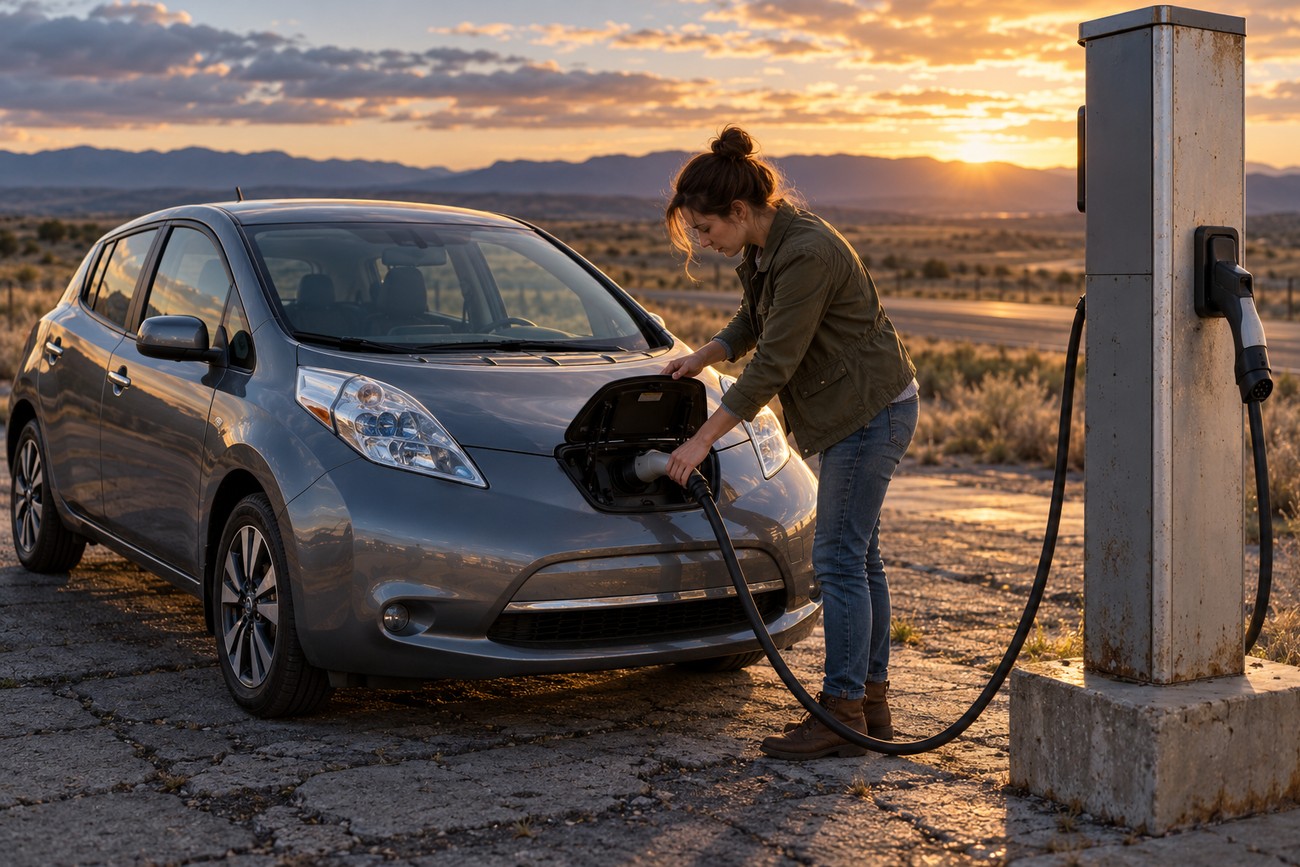
Start with compatible charging locations, then connect them into a route. Most newer US and European charging deployments increasingly prioritize CCS or NACS, so a map full of fast chargers can give a misleading impression of Leaf coverage. Confirm that each candidate stop has a working CHAdeMO connector rather than assuming that every DC station can serve the car.
Redundancy matters more than the shortest line between two cities. CHAdeMO coverage may be sparse, poorly duplicated, or represented by a single connector at a site. If that connector is occupied, offline, or unable to communicate with the Leaf, the problem can extend beyond a short delay when alternatives are separated by a substantial drive.
Build three versions of each vulnerable leg: plan A, plan B, and plan C. Check live status, current occupancy, recent user reports where available, opening access, and the distance to the next compatible option on the day of departure. A route that works on a static map can still fail at lunchtime, during a local outage, or after an unexpected detour.
Overnight charging changes the calculation. A dependable hotel with Level 2 charging can be more useful than a nominally faster hub that is unreliable or crowded, because it gives the next day a known starting point. Confirm that the charger is available to guests, that parking access matches your arrival time, and that the plan still works if the evening DC stop is delayed.
Highway Speed, Weather, and Battery Heat Change the Math
Speed is one of the easiest variables to control and one of the most expensive to ignore. Leaf highway consumption rises sharply at approximately 65–75+ mph. Driving at approximately 60–65 mph can produce a materially better practical result than driving at 70–75 mph, which may determine whether a backup station remains reachable.
Weather consumes the margin in several ways. Cold temperatures reduce practical range, cabin heating adds another load, and a cold battery may accept less charging power. Headwinds and climbing sections can have a similar effect, while elevation changes may make a leg look easy on a map and difficult in the car.
Winter planning therefore needs more than a seasonal adjustment to the dashboard estimate. Northern and mountainous sections can combine cold, heating, wind, and elevation on the same day. A reserve that feels generous in mild conditions can disappear before the planned stop, especially in an aging battery.
The Leaf does not have active liquid battery cooling. Several DC fast-charge sessions in succession can heat the battery and cause thermal throttling, reducing later charging speed. The effect is especially relevant on long driving days in warm conditions, when the car may spend more time waiting for energy after each successive leg.
That limitation changes the best driving strategy. A slower day with longer destination or overnight charging may be more predictable than trying to maximize distance between rapid stops. Leaving time between sessions, reducing unnecessary high-speed driving, and avoiding a plan that demands repeated peak-rate charging can protect the schedule.
What a Full Charging Day in a Leaf Actually Feels Like
A full charging day involves more than plugging in and walking away. You may check whether the CHAdeMO connector is free, confirm that the session has started, monitor the charging rate, and decide how much energy to take before the next leg. If a stop is unavailable, the next decision can involve a detour, a lower-speed fallback, or a change to the day’s endpoint.
A station rated at 50 kW does not guarantee that the Leaf will receive 50 kW. Charging power depends on state of charge, battery temperature, and limitations at the station itself. As the battery fills, power can fall, and arriving with a high state of charge can make the early part of the session less useful than expected.
Reserve the most reliable CHAdeMO stop and a hotel with Level 2 charging before optimizing for the shortest route. That order protects the itinerary from a single failed connector and gives thermal limits less power over the next day.
For a long DC session, arriving low but not at an extreme state of charge is generally more effective than arriving nearly full. The aim is to spend the stop in a useful charging range while retaining enough energy to reach it safely. Exact behavior still depends on the battery, temperature, and charger, so a dashboard estimate should be treated as guidance.
Several DC fast charges in succession can make later sessions noticeably slower. The main burden may become waiting between compatible charges rather than driving distance alone. A route that looks reasonable in miles can therefore consume a full day through charging queues, reduced power, status checks, and the need to stop earlier than planned.
The Mistakes and Hidden Risks That Break the Itinerary
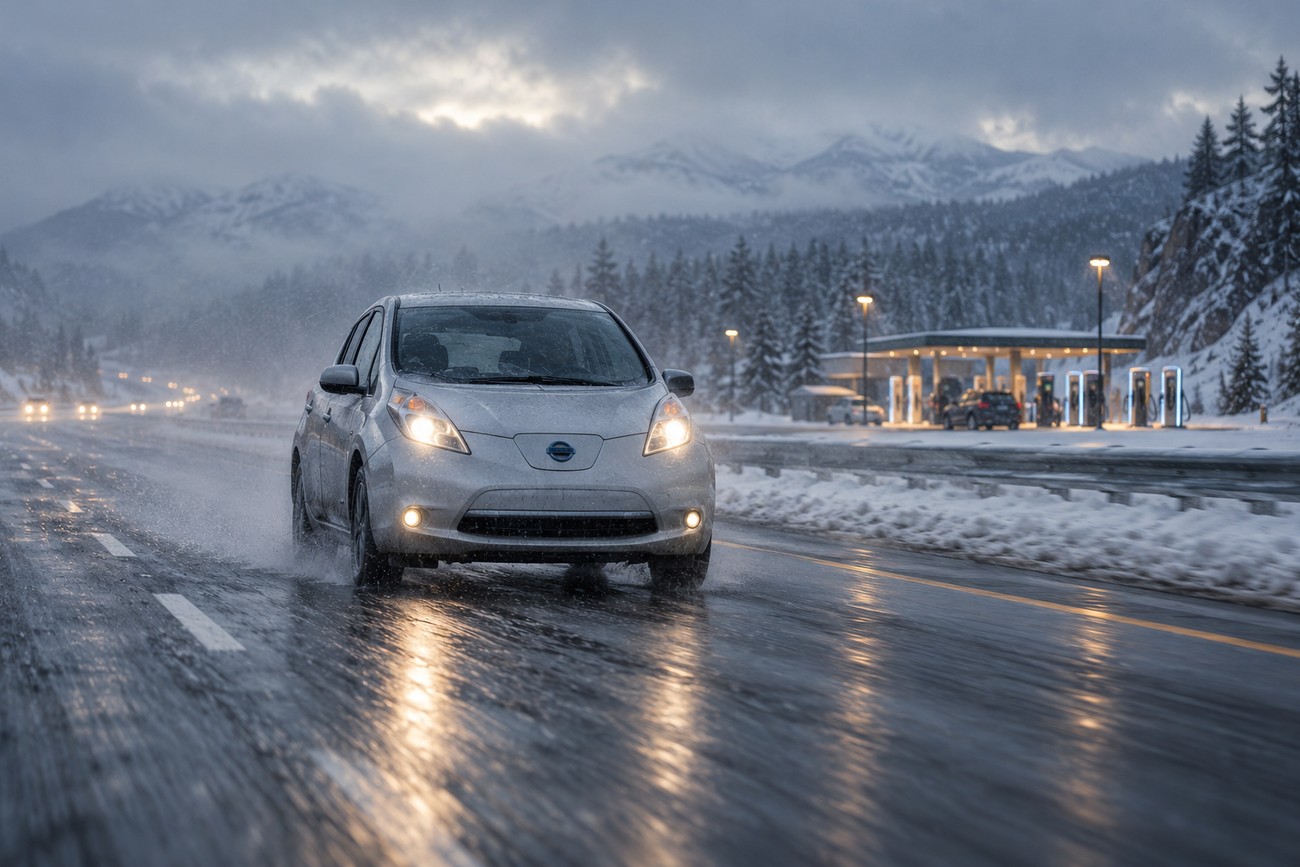
The most common planning error is using advertised range instead of a route-specific highway estimate with reserve. A Leaf driven at 70–75 mph into a headwind in cold weather has a different operating margin from the same car moving at 60–65 mph in mild conditions. Treat the estimate as a starting signal, then account for speed, temperature, wind, elevation, heating, and battery condition.
Connector assumptions cause a second class of failures. A station shown on a map may be occupied, offline, or unable to serve the Leaf because its available equipment is CCS or NACS. One broken CHAdeMO connector can become a major logistical problem when the next compatible location is far away, especially after sunset or in a small town with limited services.
Battery age adds a quieter risk. Older or heavily used Leafs can have substantially less usable capacity, and the spread between individual cars can be large. A full-charge display that looks acceptable in a driveway may offer too little margin for a demanding interstate leg. Check the car’s actual battery condition before committing to a route rather than relying on model year or the original specification.
Nighttime and winter plans deserve their own verification. A station may be technically present yet difficult to access after closing hours, while cold temperatures, cabin heating, wind, and elevation can erase the reserve assumed in ideal conditions. Level 2 charging at a hotel can save the next day, but only if access and availability are confirmed in advance.
- Confirm that every primary and backup stop has CHAdeMO compatibility.
- Inspect live station status and occupancy on the day of departure.
- Identify backup stops and an overnight location with dependable Level 2 charging.
- Check the battery’s condition and plan around the car’s current usable capacity.
- Set a lower-speed fallback plan for wind, cold, elevation, or a failed charger.
Frequently asked questions
What year should you avoid when buying a Nissan Leaf for a coast-to-coast trip?
There is no universal model year to avoid. A Leaf with unknown or heavily degraded battery capacity should be rejected for this use regardless of its model year, because the remaining usable capacity determines whether the planned legs and reserve are realistic.
Screen the car by battery condition, charging behavior, and route requirements. A newer vehicle with an uncertain history can be a weaker choice than an older Leaf with documented, healthy capacity and a route that has dependable CHAdeMO coverage.
How far can a Nissan Leaf travel on a full charge?
There is no fixed full-charge distance for highway travel. The dashboard figure is condition-dependent guidance, and the usable distance changes with battery version, degradation, speed, temperature, wind, heating, and elevation.
For planning, recalculate from the conditions you expect and keep a meaningful reserve for a failed or occupied charger. A lower-speed route estimate is more useful than the displayed number when the journey depends on reaching a single CHAdeMO stop.
What is the most common problem with a Nissan Leaf on a long trip?
Battery degradation is the key screening issue before departure because it changes every leg of the trip. Charging delays are visible on travel day, while reduced capacity can quietly make the entire route too tight, particularly in cold weather or at interstate speeds.
Once battery condition is acceptable, the main day-to-day problems are CHAdeMO availability, unreliable single connectors, and slower charging after repeated DC sessions. These risks should be evaluated together rather than treated as isolated inconveniences.







