
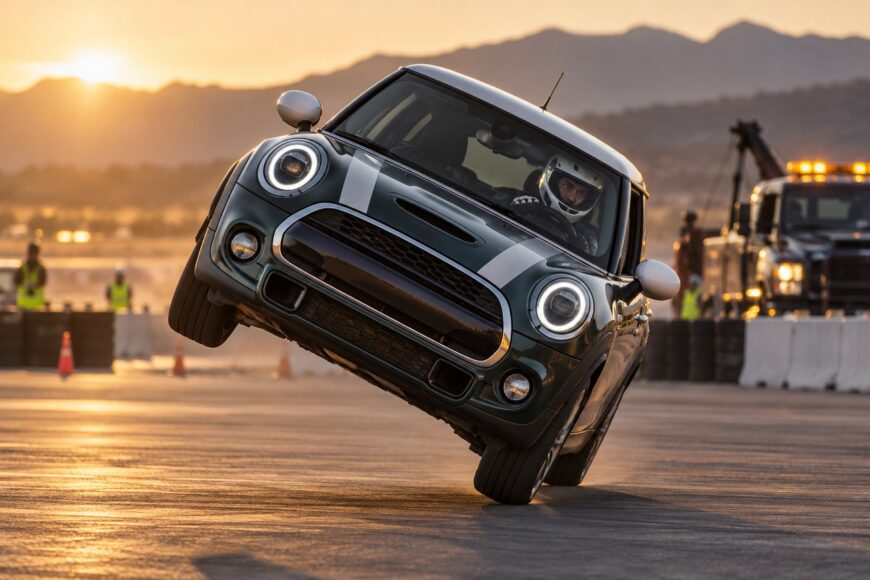
A MINI riding on two wheels has an unmistakable visual appeal: the compact body lifts, the roofline tilts toward the pavement, and a familiar hatchback suddenly looks like a stunt machine. That image can make the maneuver seem like a simple contest between courage, speed, and throttle.
It is nothing like that mechanically. A brief wheel lift is different from sustained two-wheel travel, in which the car effectively rolls on the sidewalls of its tires and asks the drivetrain, fuel system, lubrication system, and suspension to work outside their normal design conditions. This article examines those failure points and professional limits rather than offering a road-use tutorial.
- What Driving a MINI on Two Wheels Actually Means
- The Physics Behind the Balance
- Why a Stock MINI Is Not Ready
- The Failures That End the Stunt
- How Professionals Control Risk
- Gyroscopes, MINI Myths, and the Real Limits
- Frequently asked questions
- What is driving a car on two wheels called?
- What personality typically drives a MINI Cooper?
- Why does my MINI Cooper jerk when accelerating?
What Driving a MINI on Two Wheels Actually Means
Two-wheel driving is a stunt in which the vehicle travels while supported on two wheels. The important distinction is duration: a momentary lift during a maneuver may last only briefly, while controlled, sustained travel requires the car to remain balanced as its load path changes continuously.
Once the MINI is tilted, the loaded tires carry forces through a much smaller and less familiar contact arrangement. The car is effectively rolling on the sidewalls of the tires, which must resist deformation, heat, and lateral loading. That is why a vehicle can look stable for a few seconds while its tires and suspension are already accumulating stress.
Balance comes from weight transfer and changing tire grip. Center of gravity, suspension stiffness, tire width, drivetrain behavior, and mass distribution all influence whether the car stays in a narrow equilibrium or falls back onto four wheels. Engine power can affect how the vehicle responds, but horsepower alone does not create a stable load path.
A short wheel lift should therefore not be treated as proof that a MINI is ready for prolonged two-wheel travel. The two situations involve different loads, different thermal exposure, and different consequences if balance is lost. On a public road, traffic, curbs, uneven surfaces, and hard obstacles leave no controlled recovery area, making the maneuver especially unsuitable.
The Physics Behind the Balance
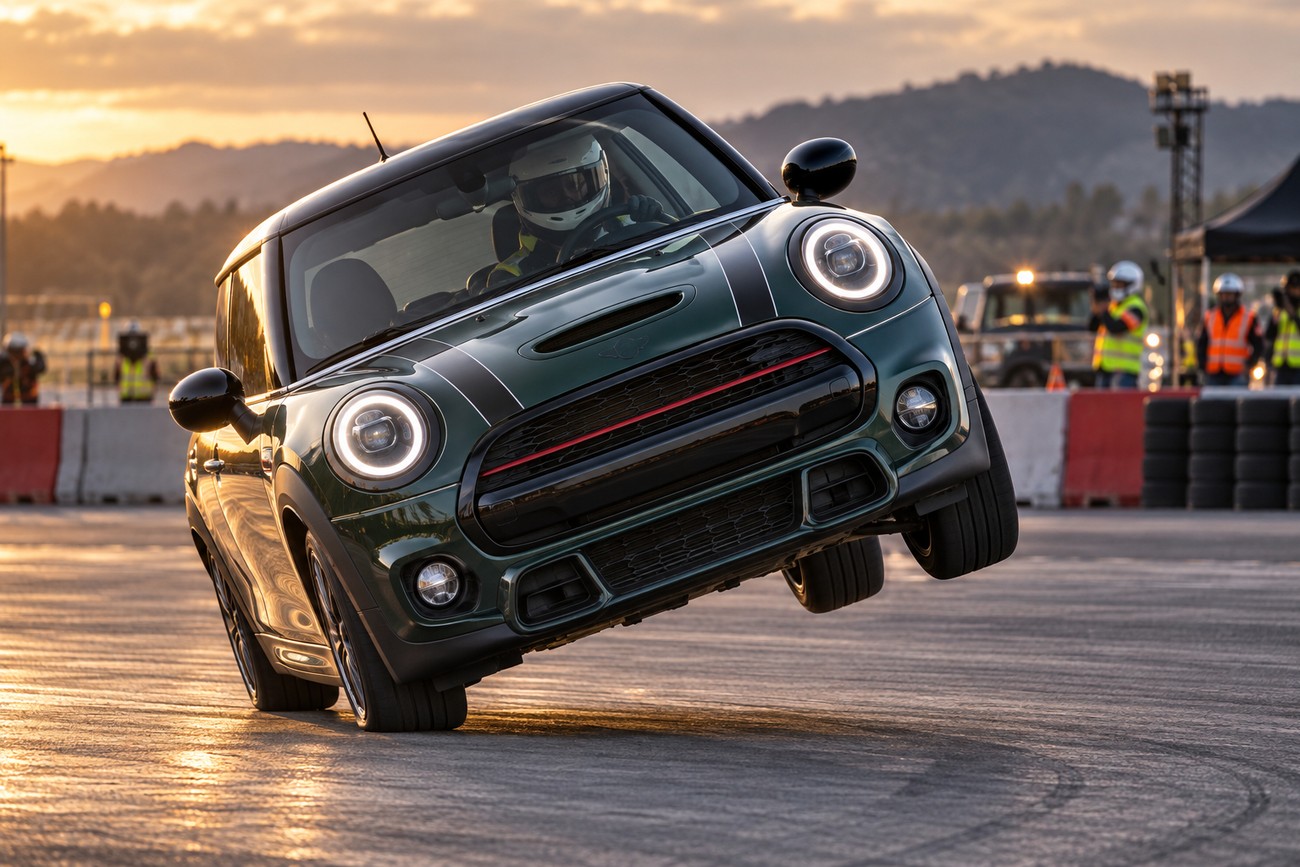
Cornering load moves weight across the chassis and changes the grip available at each tire. As the body rolls, one side becomes more heavily loaded while the other side becomes lightly loaded or leaves the ground. Available traction then depends on how the tires, suspension, and drivetrain preserve useful contact, not simply on how much force the engine can produce.
Drive-force distribution becomes critical when one driven side is lightly loaded. An open differential may allow the unloaded side to spin, while the tire carrying the useful load receives less effective drive. A locked differential or comparable traction strategy is therefore presented as more suitable for sustained two-wheel running, although the exact behavior still depends on the vehicle layout.
More throttle cannot replace that mechanical stability. Extra drive can increase wheelspin, disturb the balance, or make recovery more abrupt. The car must have predictable traction while its mass is displaced; otherwise, the accelerator becomes another source of instability rather than a solution.
Lubrication adds a separate limit. One source claims that many vehicles begin to experience lubrication problems beyond a 16-degree inclination, but that figure is a single-source warning, not a universal engineering specification. The actual limit depends on the engine, oil pan, pickup arrangement, oil level, and duration of the tilt.
Fuel-pickup behavior and oil pressure should be verified under the intended inclination before anyone discusses balance. A car can look visually stable while the engine is already being starved of fuel or lubrication.
Engine lubrication is another major restriction. A conventional wet-sump system is not designed for prolonged extreme inclination because oil can move away from the pickup and interrupt pressure. A dry-sump system is commonly cited as a solution for maintaining oil pressure in such conditions, but it is a substantial engineering change rather than a simple adjustment.
The differential, tires, fuel system, and lubrication system also interact. A locked differential may improve drive distribution, but it cannot protect a tire from overheating or an engine from oil starvation. These preparations can be expensive, and driving skill does not replace them.
Why a Stock MINI Is Not Ready
A standard MINI is engineered for ordinary road loads, cornering, braking, and brief suspension events. Sustained two-wheel running changes the demands on several systems at once. Differential behavior, tire construction, fuel delivery, engine lubrication, cooling, and the suspension’s landing-load path must be considered as one system.
Tire preparation is particularly easy to misrepresent. Severe sidewall loading may require higher-than-stock pressure and suitable tire construction to help preserve the tire’s shape. Standard pressure may contribute to debeading during a severe tilt, while one off-road context instead mentions slightly reduced pressure; there is no universal pressure number. The correct setup is vehicle- and tire-specific and should be established by qualified specialists, not copied from another car.
Fuel movement creates a less visible failure. During a long tilt, fuel can move away from the pickup, so an otherwise healthy engine may lose supply and stall. Some descriptions cite at least three-quarters of a tank, while others cite at least half a tank to help keep the fuel pump submerged. These are source-dependent guidelines, not universal specifications for every MINI or fuel-tank design.
Engine lubrication is another major restriction. A conventional wet-sump system is not designed for prolonged extreme inclination because oil can move away from the pickup and interrupt pressure. A dry-sump system is commonly cited as a solution for maintaining oil pressure in such conditions, but it is a substantial engineering change rather than a simple adjustment.
The differential, tires, fuel system, and lubrication system also interact. A locked differential may improve drive distribution, but it cannot protect a tire from overheating or an engine from oil starvation. These preparations can be expensive, and driving skill does not replace them.
The Failures That End the Stunt
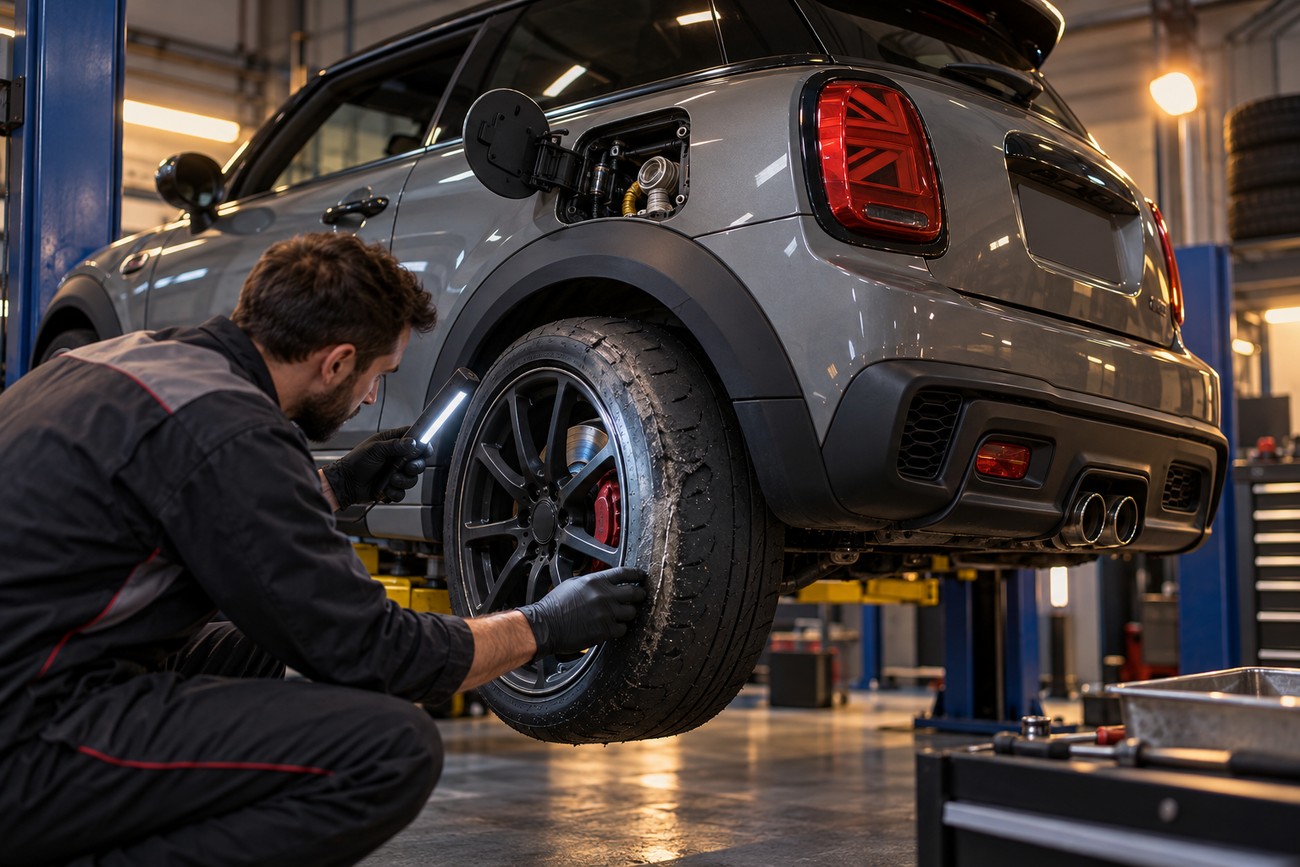
One failure chain begins at the tire. Long sidewall loading increases heat and wear, and unsuitable pressure or tire construction can allow the bead to unseat. The result may be a rapid loss of control rather than a gradual warning. A tire that appears intact after a brief lift may still have experienced damaging deformation.
Another chain begins in the fuel tank. Fuel moving away from the pickup can make the engine stall, especially during a sustained tilt. Losing power while the car is balanced on two wheels removes an important part of the vehicle’s response at the same moment that the driver has the least room for correction.
Oil starvation is harder to see from outside. Ordinary wet-sump lubrication is not designed for prolonged extreme tilt, so oil pressure can fall even while the engine sounds normal for a short period. The resulting damage may appear after the stunt rather than during it, which makes a quick visual inspection a poor measure of success.
An open differential can add wheelspin when one driven side is lightly loaded, and the car may lose its usable drive before the body appears dramatically unstable. The return to four wheels creates its own danger: the transition can impose a sharp impact load through the suspension and body. Springs, dampers, wheels, mounts, and structural attachment points may all receive loads they were not designed to absorb repeatedly.
How Professionals Control Risk
Professional stunt work begins with a controlled venue, a prepared vehicle, and a recovery plan. The surface, run-off area, barriers, medical arrangements, communications, and weather conditions matter as much as the car. A public road lacks the predictable space and isolation required to manage a failed balance or a damaged tire.
The vehicle is validated as a system rather than judged by appearance. Inspection covers tire construction and condition, differential behavior, fuel delivery, oil pressure, cooling, suspension, steering, wheel retention, and the path through which landing loads enter the body. A setup that works on one MINI may be unsuitable for another because layout, engine, transmission, and suspension details differ.
Pre-run and post-run inspections are equally important. A tire can show heat damage, a mount can shift, or a suspension component can take an impact without producing an immediate dramatic symptom. Professionals also define a stop condition before the attempt, so an unusual vibration, pressure change, engine behavior, or loss of balance ends the run rather than becoming a reason to continue.
Recovery is rehearsed as part of the stunt, not left to instinct. The return to four wheels must be considered in the design of the car and the venue because it can create a concentrated load through the suspension and body. This is one reason a controlled demonstration is materially different from an experiment on a street.
Gyroscopes, MINI Myths, and the Real Limits
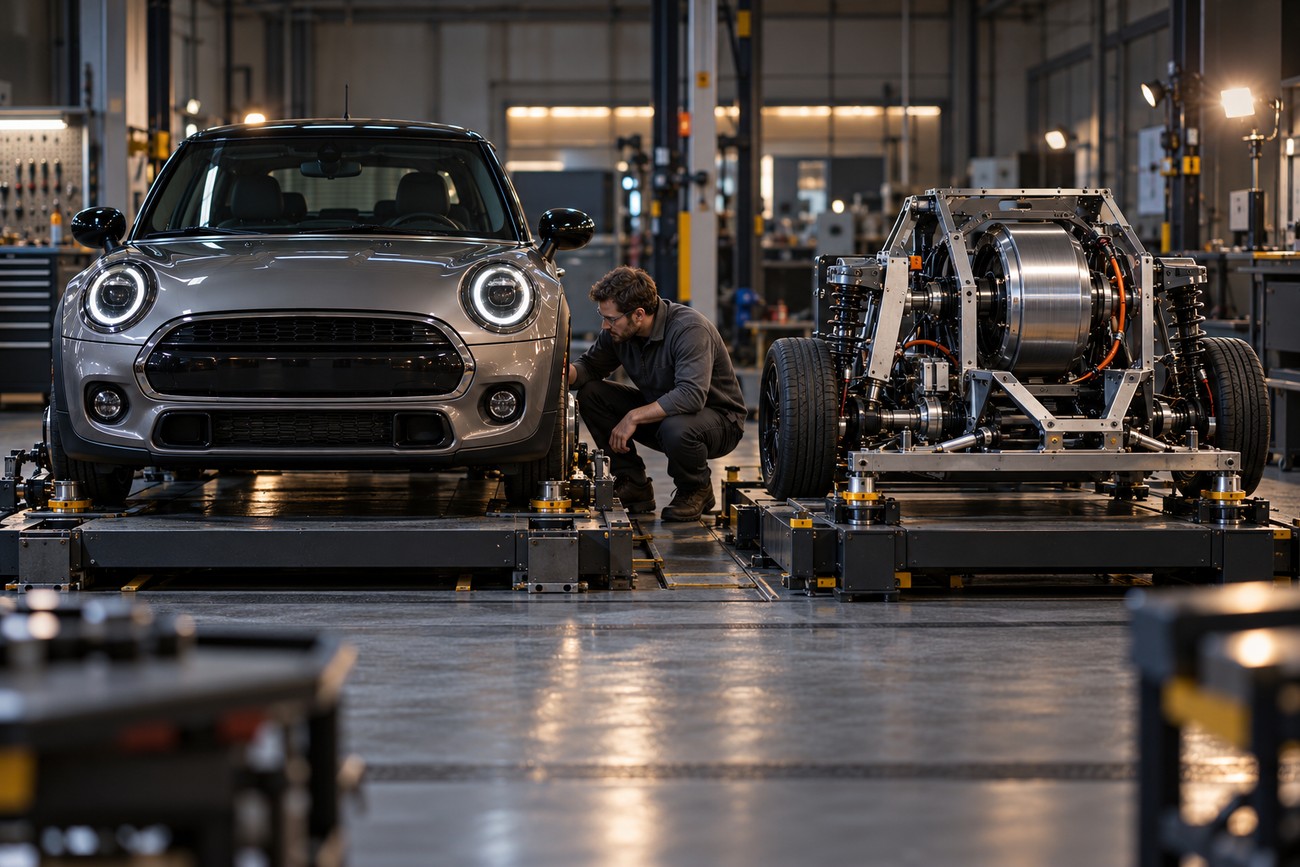
The idea that any car can drive on two wheels with enough throttle ignores the role of center of gravity, mass transfer, tire grip, suspension stiffness, tire width, and drivetrain behavior. A MINI’s agile and playful character may make it entertaining to drive, but that does not make its standard chassis a stunt platform.
Gyroscopic stabilization does not turn the maneuver into an easy or reliable trick. The historical Gyro-X project is a useful example because it was a specialized concept rather than an ordinary MINI. It was described with an 80-hp MINI Cooper S engine, and its gyroscopic concept could reportedly hold up to a 40-degree lean in a turn.
That same concept reportedly lost stability above 100 km/h. The example shows both the promise and the limitation of stabilization: a carefully engineered system can extend the operating envelope, yet it remains sensitive to speed and conditions. It should not be confused with a conventional MINI equipped with no equivalent system.
The spectacle also hides the cost of reliability. Sustained two-wheel travel can require drivetrain changes, suitable tires, fuel-system preparation, lubrication modifications, and attention to landing loads. A brief, controlled image is therefore a poor guide to what the car can safely repeat.
Frequently asked questions
Terminology and everyday driving questions often overlap with stunt footage, but they describe different problems. The answers below separate standard language, vehicle character, and ordinary mechanical faults from sustained two-wheel driving.
What is driving a car on two wheels called?
It is commonly called two-wheel driving, two-wheel stunt driving, or a car driving on two wheels. “Two-wheel driving” can describe sustained travel while the vehicle is supported by two wheels, whereas a wheel lift, wheelie-style moment, or brief stunt appearance may last only an instant.
Using the longer terms helps distinguish a controlled demonstration from ordinary cornering or a short loss of contact. Technical references usually need that distinction because the tire, drivetrain, and suspension demands are substantially different.
What personality typically drives a MINI Cooper?
A MINI Cooper is often associated with an agile, playful, and responsive driving character. Its compact dimensions and alert steering can make ordinary road driving feel lively, especially on winding routes and in urban spaces.
That character is separate from the specialized skill and engineering required for a two-wheel stunt. Enjoying an energetic car does not imply an appetite for public-road experimentation, and stunt control depends more on preparation and vehicle behavior than on personality.
Why does my MINI Cooper jerk when accelerating?
Acceleration judder can come from clutch engagement, worn or damaged engine and transmission mounts, drivetrain play, traction-control intervention, or an engine misfire. A problem may also appear when the powertrain is cold, under load, or changing between drive modes.
Diagnosis should begin with fault codes and a careful inspection of mounts, clutch operation, driveshafts, and engine performance. Stunt physics is not a useful explanation for an everyday jerk during acceleration; persistent symptoms warrant a qualified inspection before further driving.







