
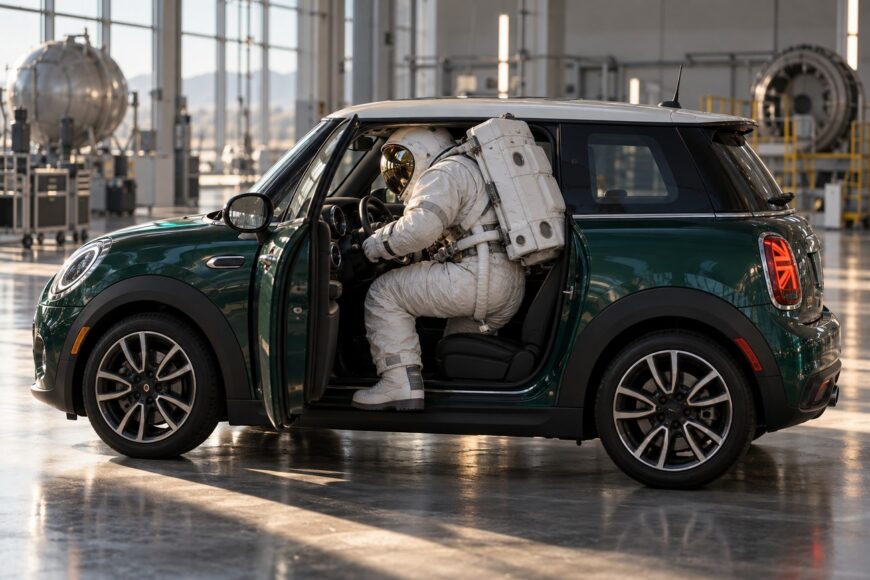
A compact MINI cabin leaves little room for a driver wearing a pressure suit designed for vacuum. The helmet approaches the roof and pillars, the shoulders crowd the steering wheel, and the backpack-like life-support unit changes how the driver can turn and sit. Looking bulky is only the visible part of the problem.
The meaningful test is whether a suited driver can get in, fasten and release the belt, see around the car, operate each control reliably, and get out in an emergency. Those demands interact: a seating position that clears the helmet may make a control harder to reach. No certified MINI-specific spacesuit driving test was identified, so the sensible conclusion is a human-factors assessment, not a claim that a particular car-and-suit combination has been proven safe or unsafe.
- Why the Spacesuit Is the Real Vehicle Constraint
- Getting Into a MINI Is the First Failure Point
- What the Controls Feel Like Through the Suit
- Visibility, Mirrors, and Emergency Maneuvers
- The Myths That Make This Look Safer Than It Is
- Can the Setup Be Made Workable?
- Frequently asked questions
- What personality is usually associated with MINI Cooper drivers?
- What personality drives a MINI Cooper?
- Which MINI Cooper should I stay away from?
- What is the most common problem with a MINI Cooper?
Why the Spacesuit Is the Real Vehicle Constraint
An extravehicular activity (EVA) spacesuit is a sealed life-support system for vacuum exposure. It integrates pressure, oxygen, CO₂ removal, thermal regulation, communications, and an emergency reserve. Its components must function together, which limits how freely the wearer can bend or reposition parts of the suit to fit a vehicle.
The NASA Extravehicular Mobility Unit (EMU) operates at about 4.3 psi / 29.6 kPa, below atmospheric pressure. That lower pressure helps limit suit stiffness, but it also makes the transition from a pressurized cabin a decompression concern requiring appropriate procedures. Once configured for use, the suit still resists movements that an ordinary driver makes without thinking, such as reaching across the body or turning to look behind.
Weight alone gives a misleading picture of the driving problem. Bulk and stiffness affect seating and reach, layered gloves reduce touch, and the helmet constrains vision. A driver can clear the door opening and still be unable to perform a quick, repeatable control movement from the restrained driving position.
Getting Into a MINI Is the First Failure Point
Entry should be assessed before anyone considers moving the car. The helmet, shoulders, and Portable Life Support System (PLSS), the backpack-like unit attached to the suit, need clearance through the door opening and past the pillars. Effective suit clearance includes the helmet, shoulders, torso, and PLSS throughout a body turn, rather than just the width of the helmet facing forward.
Inside a compact MINI cabin, bulky equipment can contact the steering wheel, center console, door, pillars, or roof. Moving the seat back may create knee or wheel clearance while making the belt buckle or other controls harder to reach. Contact matters even when the driver technically fits: a rigid point pressing against the suit can make a seated posture difficult to sustain.
Fastening the belt is a separate task from sitting down. The driver must locate the buckle through gloves, route the belt as intended, and confirm that it holds the suited occupant in a usable position. The reverse action matters just as much. A helmet and PLSS can substantially slow an ordinary exit, especially if the driver cannot turn freely toward the door.
No certified MINI-specific spacesuit driving test was identified. Cabin dimensions and adjustments therefore cannot establish that a particular suit will fit, that its restraint will work as intended, or that its wearer can leave promptly. Those questions require assessment with the actual vehicle, suit configuration, and occupant, without treating a successful entry as proof of roadworthiness.
What the Controls Feel Like Through the Suit
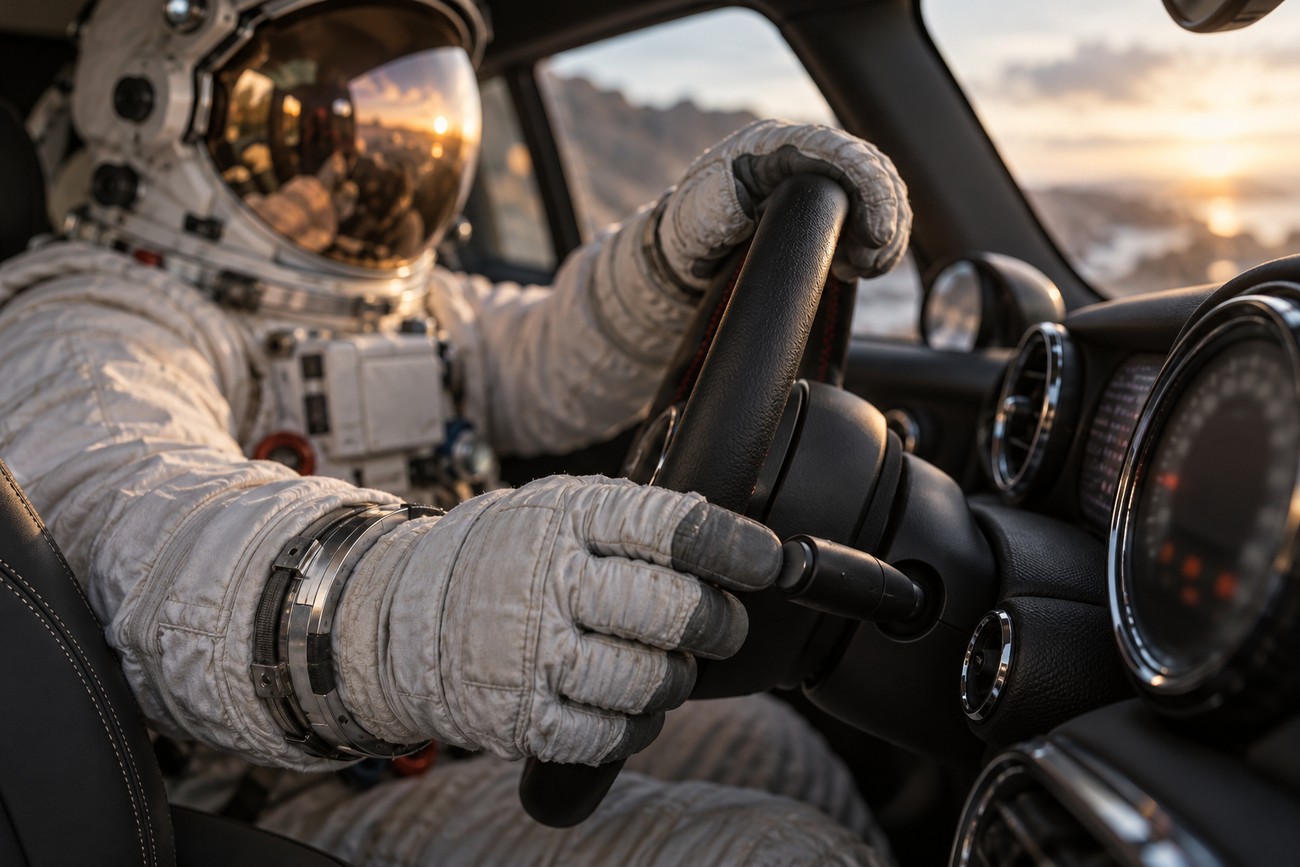
Gloves are a primary control limitation. Low pressure and layered construction reduce grip strength, finger sensitivity, and fine-motor precision. A driver may be able to grasp the wheel yet struggle to tell whether a small button has engaged or whether a fingertip has found the belt release.
This distinction becomes important with stalks, switches, and adjustments that rely on precise finger placement. Assuming normal hand control because a bare hand can reach a control is a common error. The useful standard is whether the suited driver can perform the same action accurately, repeatedly, and without an awkward change in posture.
Check control movements and belt release with the suit pressurized or otherwise fully configured for the proposed use. An unpressurized garment can give a misleading impression of finger movement and reach.
Steering adds a larger-motion problem. In a closely packaged cabin, the driver’s forearms or suit can meet the wheel or console during a turn, even if the hands rest comfortably on the wheel while stationary. Repeated steering from a constrained posture may also tire the hands, shoulders, and neck, making a control check at the start of a session an incomplete measure of sustained usability.
Visibility, Mirrors, and Emergency Maneuvers
A helmet restricts visibility through visor geometry, glare, fogging, and a limited field of view. Those effects vary with the suit and conditions, so a clear forward view while parked says little about the view needed at an intersection or during a lane change. Instruments and mirrors also have to remain visible from the position the driver can actually maintain while belted.
Blind-spot checks demand more than turning the eyes. The driver may need to rotate the head and torso, bringing the helmet, shoulders, and PLSS closer to the pillar, roof, or seat. The effective clearance for that rotation can disappear before the driver reaches the angle needed to look over a shoulder.
Mirrors help, but extra mirror checks do not fully replace rapid direct confirmation of nearby traffic. Their coverage depends on adjustment and driving position, while a restricted head turn can leave uncertainty during reversing or a quick maneuver. That uncertainty is especially consequential when there is little time to make another check.
A stationary assessment should therefore include the actual sight lines for mirrors, instruments, rearward checks, and the intended driving environment. If the driver has to unbelt, lift off the seat, or twist the suit against a hard interior surface to see an area, that view is not reliably available while driving.
The Myths That Make This Look Safer Than It Is
Pop-culture portrayals often treat a spacesuit as an inconvenience that a determined driver can work around. The engineering concern is cumulative: restricted movement, reduced tactile feedback, limited vision, difficult restraint, and slower emergency evacuation can affect the same maneuver. A minor delay in each task may become a serious problem when the tasks must happen together.
The idea that weight is the dominant obstacle also misses the seated-driver problem. Even where the suit’s mass can be accommodated, its shape and stiffness still govern reach and clearance. A driver needs room to rotate, steer, buckle up, and get out, not merely enough space to sit still.
NASA equipment should not be assumed to suit every cabin because it is highly engineered. EVA suits are designed for vacuum exposure and external work, not for the ergonomics of a small car. Likewise, finding one workable seat adjustment in a MINI does not establish clear sight lines, dependable control use, or an emergency exit path.
These are human-factors concerns rather than a MINI-specific certification or crash-safety conclusion. A compact cabin can increase hard-point contact and complicate evacuation when the driver wears bulky pressure equipment. Without testing the actual setup, claims that it is safe—or that every configuration will fail—go beyond the available evidence.
Can the Setup Be Made Workable?
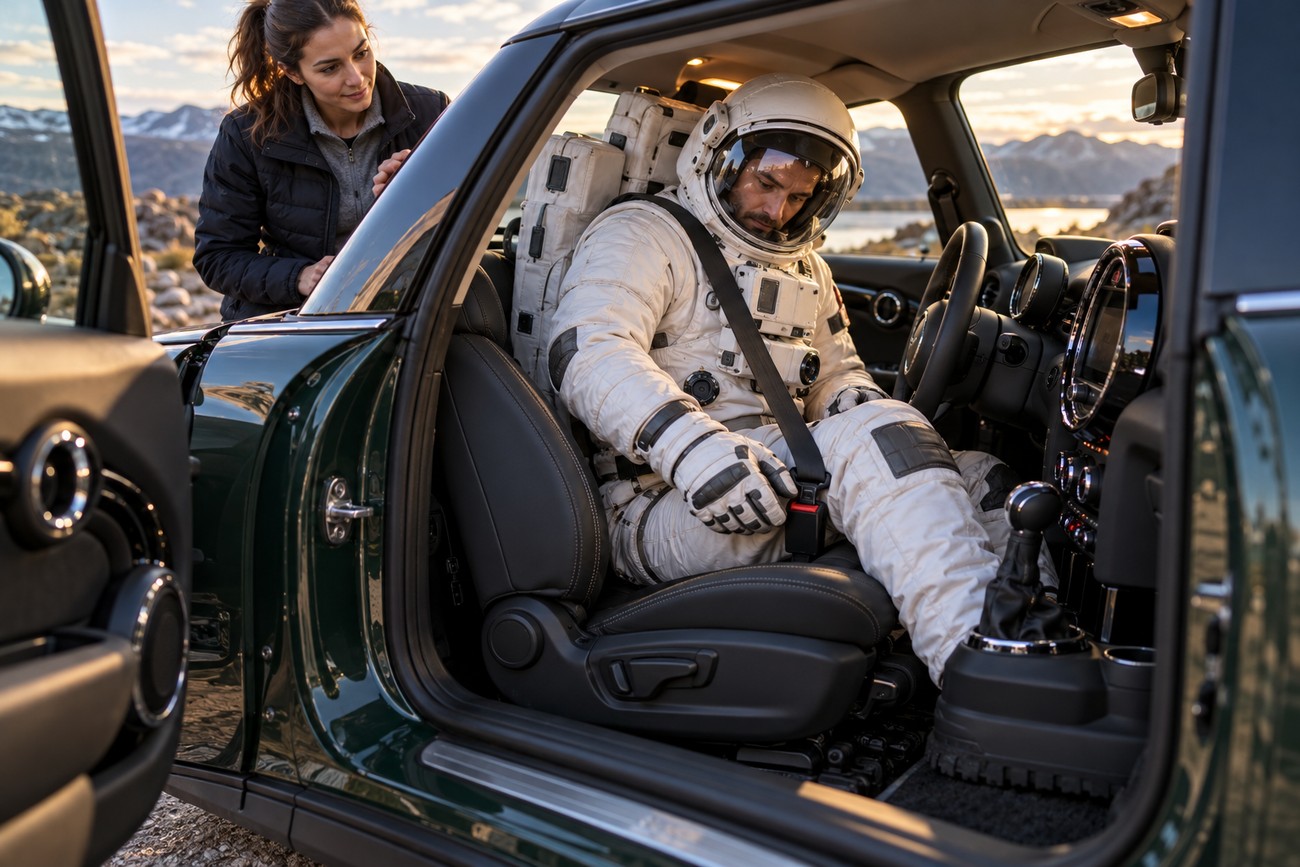
A cautious evaluation starts with the suit fitted and configured for the proposed use. Only then should the seat and steering wheel be adjusted and the belt tried. Adjusting an empty cabin first can create a driving position that disappears once the helmet, gloves, and PLSS are present.
Before any movement, the driver would need to demonstrate entry, proper restraint, reliable access to essential controls, and release of the belt. Checks should include repeatable steering and switch operation, mirror and blind-spot visibility, and an exit using the door as it would be available in an emergency. If another person must help with a routine action, that dependency belongs in the assessment.
A brief stationary check can miss accumulating fatigue. Holding the head away from a pillar or keeping the shoulders raised to clear the wheel may feel manageable at first, then degrade control and attention. The assessment must consider whether the driver can maintain the required posture and movements, not simply achieve them once.
Adjustments may reduce interference, but they cannot remove the suit’s fundamental restrictions on touch, movement, and vision. No adjustment guarantees normal driving performance in an EVA suit. Without a demonstrated fit, reliable control, adequate sight lines, effective restraint, and a workable exit plan, the setup should not be treated as ready for driving.
Frequently asked questions
Questions about MINI drivers and model choice often appear alongside this topic. They are separate from spacesuit compatibility: a driver’s preferences or a car’s maintenance history cannot establish whether a suited person can control and leave that car safely.
What personality is usually associated with MINI Cooper drivers?
The cultural stereotype is an expressive driver who likes a compact car with distinctive styling and responsive handling. It describes an image, not a reliable personality profile. People choose a MINI for many practical and personal reasons, none of which predicts how they would manage its controls in a spacesuit.
What personality drives a MINI Cooper?
There is no single personality type. A driver may value the car’s size for urban parking, prefer its driving feel, or simply like its appearance. Those preferences can explain a purchase; they do not substitute for checking fit, visibility, and control access when unusual protective equipment is involved.
Which MINI Cooper should I stay away from?
Avoid choosing a specific used MINI solely by its badge or appearance. Be especially cautious about a car with incomplete maintenance records, unresolved warning lights, or repairs the seller cannot explain. Model year, engine, condition, and upkeep all matter, so a vehicle-specific inspection is more useful than a blanket claim that one MINI is always the wrong choice.
What is the most common problem with a MINI Cooper?
There is no single most common problem that accurately covers every MINI Cooper generation and condition. Fault patterns depend on the model year, engine, and maintenance history. For a particular car, review its service records and arrange an independent inspection; a general reliability claim cannot tell you whether that car is sound, and it says nothing about spacesuit compatibility.







