
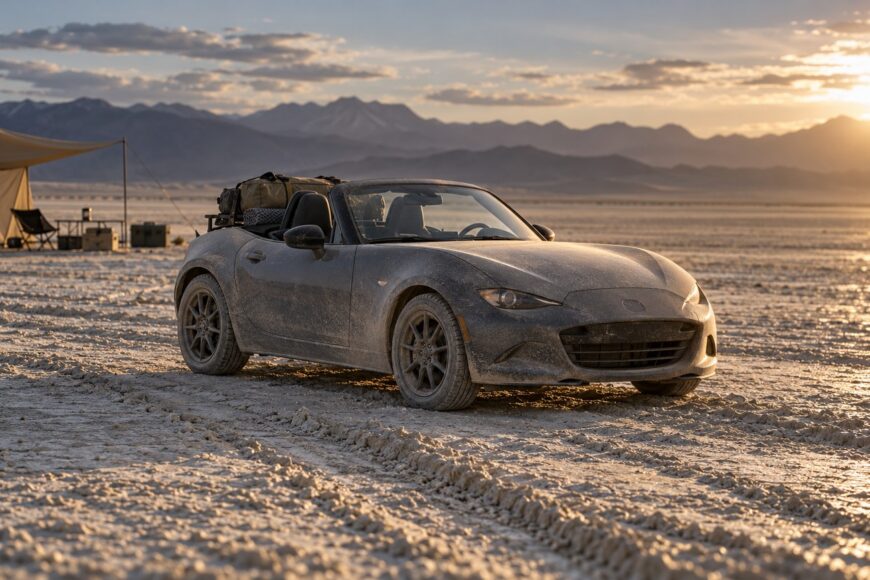
Driving a Mazda MX-5 to Burning Man has an obvious appeal: it is light, engaging, and enjoyable on the long paved approach to Black Rock Desert, Nevada. The contradiction begins where the pavement ends. Low ground clearance, a short wheelbase, a soft top, and fine alkaline playa dust create problems that ordinary road-trip preparation does not solve.
The MX-5 can reach the event, but “can make the drive” is a weak test. You also need to accept difficult access, limited field repairs, extensive cleaning, and a serious inspection afterward. The real decision is whether the car is worth that workload and exposure, not whether its engine can cover the distance.
- Can a Mazda MX-5 Actually Handle Burning Man?
- Prepare the MX-5 Before Departure
- Driving the Event Road and Playa Without Making It Worse
- Living With the Car at Camp
- The Damage You May Not Notice Until You Leave
- Common MX-5-to-Burning-Man Myths and the Go-or-No-Go Decision
- Frequently asked questions
- How much does it realistically cost to go to Burning Man in an MX-5?
- What should you not bring to Burning Man in a Mazda MX-5?
- How much horsepower can a Mazda MX-5 handle for this trip?
Can a Mazda MX-5 Actually Handle Burning Man?
Yes, an MX-5 can be driven to Burning Man, provided the route, weather, loading, and surface conditions remain manageable. The car’s low ground clearance and short wheelbase make loose, rutted, or corrugated ground less forgiving than ordinary highway travel. The low nose can scrape, the underside can ground, and the car may struggle where a taller vehicle would simply roll through.
Light weight helps with fuel use and may reduce the effort required to recover the car if it becomes stuck. It does not provide more clearance, protect the underside, or improve the car’s ability to cross soft shoulders. On a wave-like event road, the short wheelbase can also make vibration and pitching feel sharper, particularly after traffic has broken up the surface.
Fine alkaline playa dust adds a second problem. It enters narrow gaps around the intake, radiator, condenser, brakes, seals, luggage, and cabin. A soft top offers less protection from cabin and luggage contamination than a closed hardtop, so clothing, electronics, tools, and food can acquire a dusty coating even when the roof remains closed.
There is little margin for improvisation once you are in the desert. Service and replacement parts are extremely limited, and a roadside problem may require a long wait or outside assistance. Treat the MX-5 as a road car entering a hostile work environment, rather than as an off-road vehicle made safe by driving slowly.
Prepare the MX-5 Before Departure
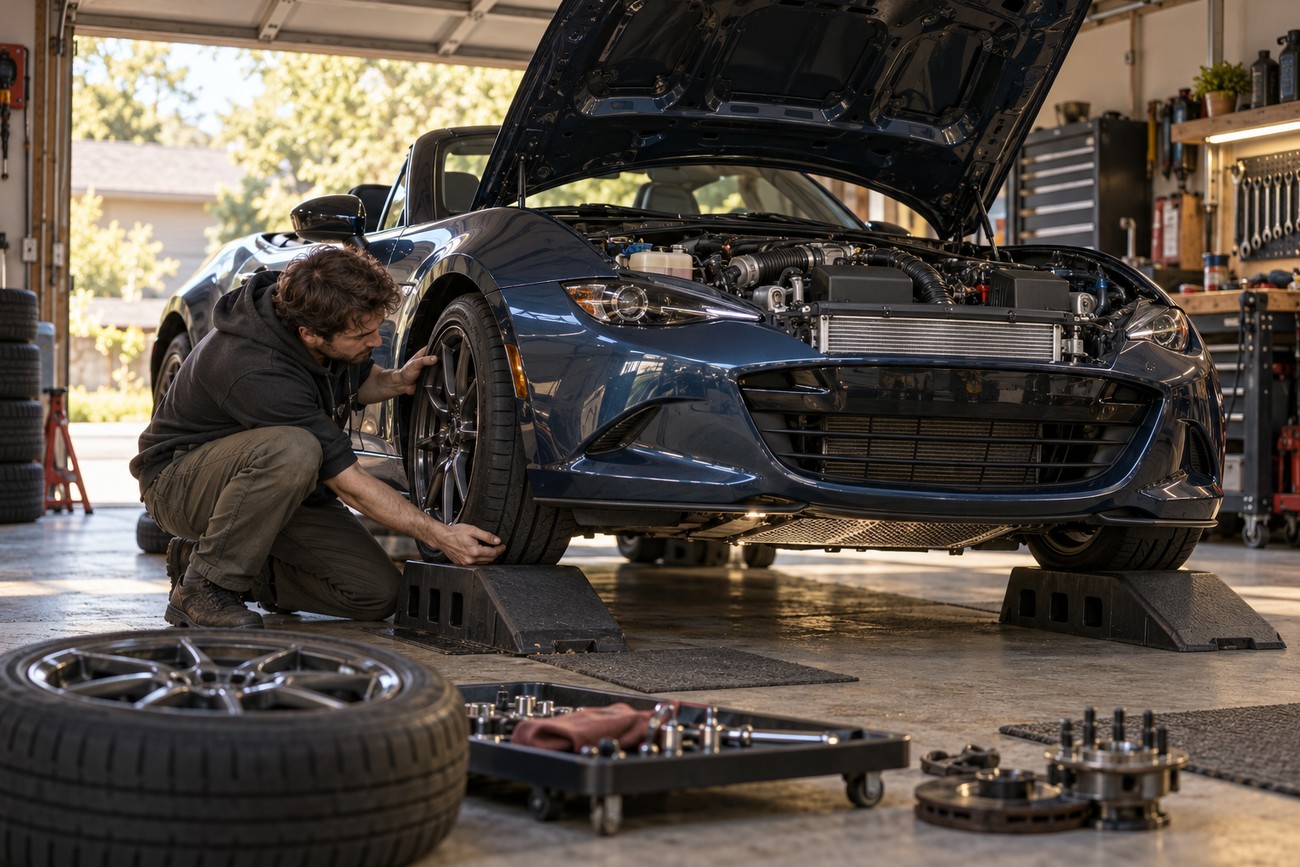
Begin with a mechanical inspection rather than decorative protection. Check tire condition and choose tires with useful sidewall reserve for the road and load you will carry. Inspect the suspension, steering, brakes, belts, battery, cooling system, and wheel bearings; a marginal component that survives a normal trip may fail after exposure to dust and corrugations.
Owners commonly recommend extra protection for the radiator, air intake, and underbody. These are sensible playa safeguards, but they are practical community advice rather than official Burning Man requirements. Any guard or screen must preserve airflow and avoid creating a new place for dust to collect, especially in front of the radiator or condenser.
Carry a spare air filter and, if your car has one, a spare cabin filter as practical consumables, not as official event requirements. The same logic supports protecting the intake, radiator, and underside before departure: replacement access in the desert is limited.
Service the filtration and sealing systems before loading the car. Check the airbox, intake connections, cabin-filter housing if fitted, door seals, trunk seals, and soft-top seals. Treat suitable rubber seals according to the manufacturer’s guidance, and inspect narrow drains so dust does not obstruct them later.
Pack clothing, electronics, food, tools, and documents in sealed containers that can be opened without exposing everything else. Leave clear access to the spare wheel or repair equipment, visibility through every window, and the parts of the cabin needed in an emergency. Bring cleaning consumables, water, rags, and replacement filters; a full fuel tank cannot compensate for restricted cooling airflow or a blocked intake.
Driving the Event Road and Playa Without Making It Worse
The event road can become dusty and corrugated, producing vibration or a steady rumble, particularly after traffic. The MX-5’s short wheelbase can make the vibration feel sharper, while its low nose increases the risk of scraping. Reduce speed before rough sections, keep both hands on the wheel, and let the suspension work instead of carrying momentum into a rut or crest.
Smooth, controlled low-speed driving is preferable to abrupt acceleration. Spinning the rear tires raises a dust cloud, reduces visibility, and can dig the car into loose ground. Use gentle throttle, avoid sudden steering inputs, and leave room for the dust from vehicles ahead to clear before continuing.
Approach changes in surface and elevation diagonally only where that can be done safely and without crossing into traffic. Protect the low nose at entrances, exits, camp edges, and soft shoulders. Deep ruts and loose margins deserve more caution than the center of a visibly compacted track; if the line ahead looks likely to put the underside on the ground, stop and reassess rather than relying on momentum.
Follow event rules concerning dust, fire, and departure, and do not plan around a quick roadside repair. A small issue can become a recovery problem if the car is parked where other traffic cannot safely pass. Keep essential tools accessible, but assume that the best repair may be prevention and a controlled exit.
Living With the Car at Camp
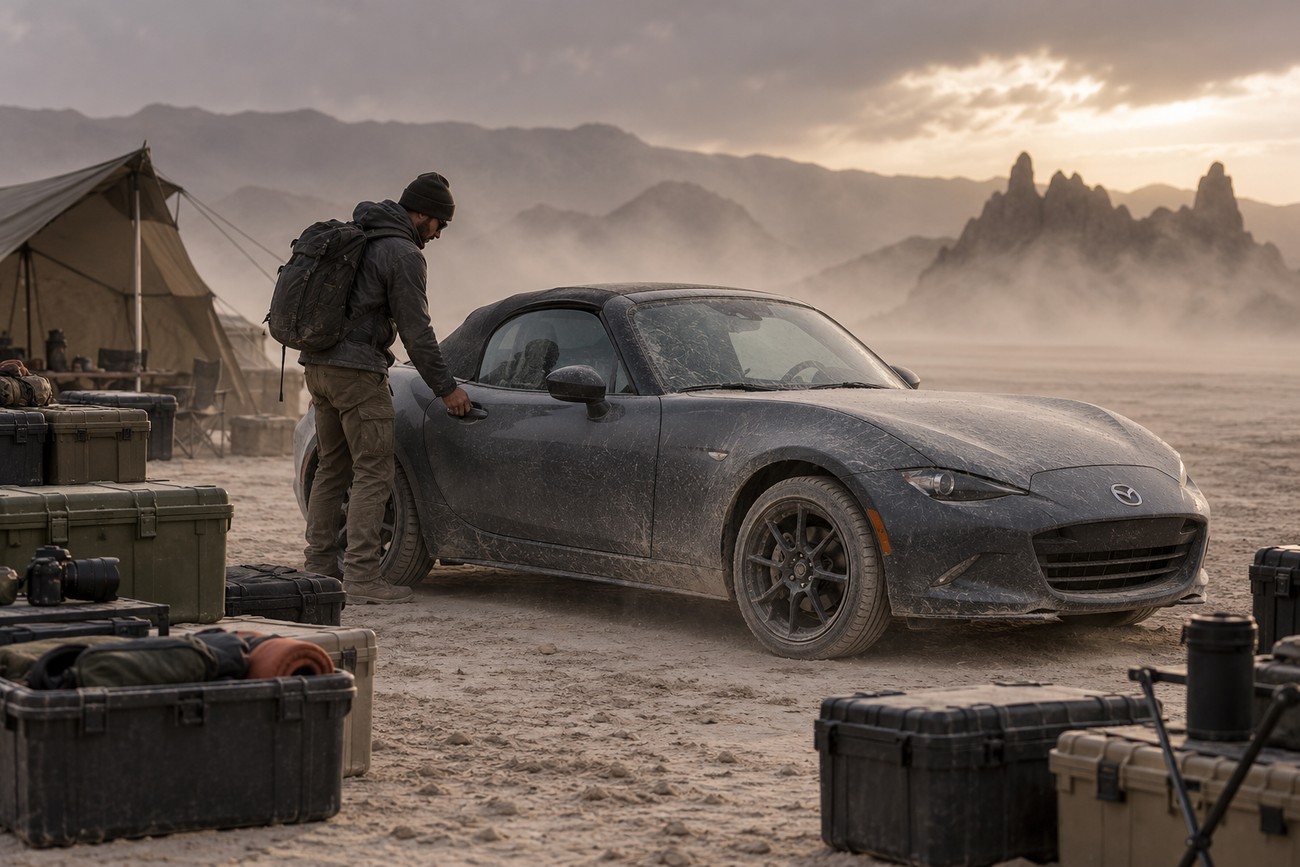
Keep the soft top closed whenever conditions are dusty, including while the car is parked if wind is moving across the playa. Open-top driving turns the cabin into a dust collector, and leaving the cabin open allows contamination to settle into seats, carpets, luggage, and dashboard gaps. Avoid opening doors and the trunk unnecessarily during a dust event.
Fine alkaline dust reaches cabin spaces, luggage areas, electronics, brakes, bearings, and other narrow gaps. Store clothing, food, cables, cameras, and tools in sealed containers rather than loose bags. Fragile items should have hard protection, because a dusty soft bag does little to stop abrasion or prevent contamination when it is opened.
A cover is not a complete solution. Windblown dust can still enter gaps, and a loose cover may rub abrasive dust against the paint. If you use one, secure it carefully and remove it when conditions make movement likely; otherwise, reducing openings and protecting the interior is often more useful than wrapping the whole car.
Keep water, rags, spare filters, brushes, and suitable cleaning supplies where they can be reached without unpacking the entire vehicle. Use them for controlled wipe-downs rather than stirring dust through the cabin. On-site maintenance and cleaning options are limited, so a modest supply of consumables can prevent a small contamination problem from becoming a daily nuisance.
The Damage You May Not Notice Until You Leave
Completing the drive does not mean the car escaped without consequences. Alkaline playa dust is abrasive and can accelerate wear in rubber, belts, joints, seals, bearings, and other exposed mechanisms. It can also settle in brake hardware and wheel hubs, where symptoms may appear later as scraping, crunching, or humming.
Cooling deserves particular attention. Dust can restrict the radiator and condenser, reducing airflow when the engine needs it. For a small sports car, cooling reserve and clean airflow paths matter more than simply having a full fuel tank. Watch for changes in temperature, fan behavior, air-conditioning performance, or visible debris before starting the return journey.
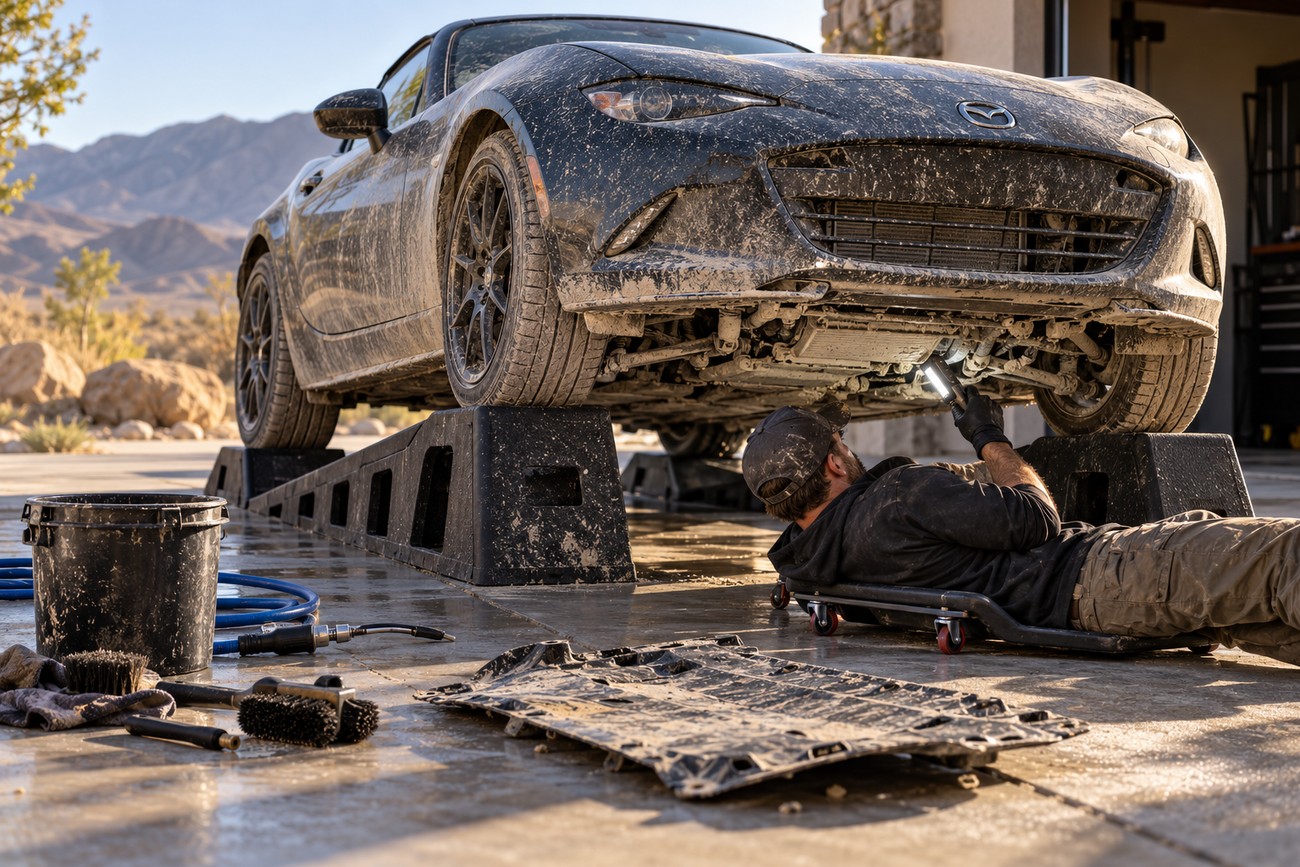
After returning, arrange a complete underside wash rather than relying on an ordinary exterior wash. Rinse the underbody, suspension, wheel wells, brake areas, and cooling surfaces with a method appropriate for the vehicle, and avoid forcing contaminated water into sensitive electrical connectors or bearings. A professional wash may be sensible where access to the underside is poor.
Inspect the car by zones:
- air intake, air filter, cabin filter if fitted, and filter housings;
- radiator, condenser, cooling fans, and airflow openings;
- brakes, wheel hubs, bearings, suspension joints, and seals;
- hinges, locks, drains, soft-top channels, and trunk recesses;
- electrical areas, connectors, battery surroundings, and cabin niches;
- underbody panels, exhaust components, fasteners, and scraping points.
Clean first, then listen and inspect again after some normal driving. Dust hidden behind a seal or in a drain may not show during a quick wash. Treat new noises, steering changes, brake drag, overheating, and electrical faults as inspection prompts rather than harmless playa souvenirs.
Common MX-5-to-Burning-Man Myths and the Go-or-No-Go Decision
Driving slowly does not make every car safe. It reduces impact and wheelspin, but it cannot remove the MX-5’s low clearance, short-wheelbase behavior, dust intrusion, or underbody contact risk. Light weight also does not compensate for limited protection beneath the car.
A cover does not stop all dust, and a single ordinary wash may leave contamination in the intake, brakes, bearings, seals, drains, and underside. The work after the event is part of the trip plan. Budget time and access for cleaning and inspection before treating the car as ready for normal use.
The MX-5 is a reasonable choice only if you accept the conditions honestly. Go if the car is mechanically sound, the load can be sealed and kept light, the driver can tolerate careful progress, and you have a plan for cleaning and inspection afterward. Do not go if the trip depends on a quick repair, optimistic weather assumptions, or the belief that a full tank and low speed solve the main risks.
Frequently asked questions
How much does it realistically cost to go to Burning Man in an MX-5?
There is no responsible single total because the largest costs depend on the trip length, starting location, ticket arrangements, camping method, and condition of the car. Build the budget in separate categories: event access, fuel, food and water, camping supplies, vehicle preparation, consumables, cleaning, and possible professional post-playa service.
The MX-5 can reduce some transport and camping volume, while its limited cargo space may require more careful or specialized packing. Reserve a separate contingency for filters, tires, recovery help, or inspection work. A cheap drive can become an expensive vehicle cleanup if the post-playa work is omitted from the original plan.
What should you not bring to Burning Man in a Mazda MX-5?
Avoid loose powder-sensitive gear, bulky objects that cannot be sealed, and fragile equipment without hard protection. Do not fill the cabin with items that block visibility, interfere with controls, or prevent access to emergency equipment and the luggage compartment.
Choose compact containers that can be secured against movement and opened without exposing everything nearby. Keep cleaning supplies and essential tools accessible, while storing electronics and clothing away from door gaps, soft-top channels, and floor-level dust. The car’s limited space rewards fewer multipurpose items rather than a collection of loose extras.
How much horsepower can a Mazda MX-5 handle for this trip?
There is no single safe horsepower limit across MX-5 generations and engine builds. Engine condition, cooling capacity, drivetrain setup, tires, suspension, load, and calibration matter more than a headline power figure for this journey.
Extra power does not solve low clearance, loose-surface traction, restricted cooling airflow, or dust exposure. In playa conditions, predictable throttle response and controlled torque are more useful than additional output. A well-maintained, appropriately loaded car with clean airflow paths is a better candidate than a more powerful car with marginal cooling or aggressive tires.







