
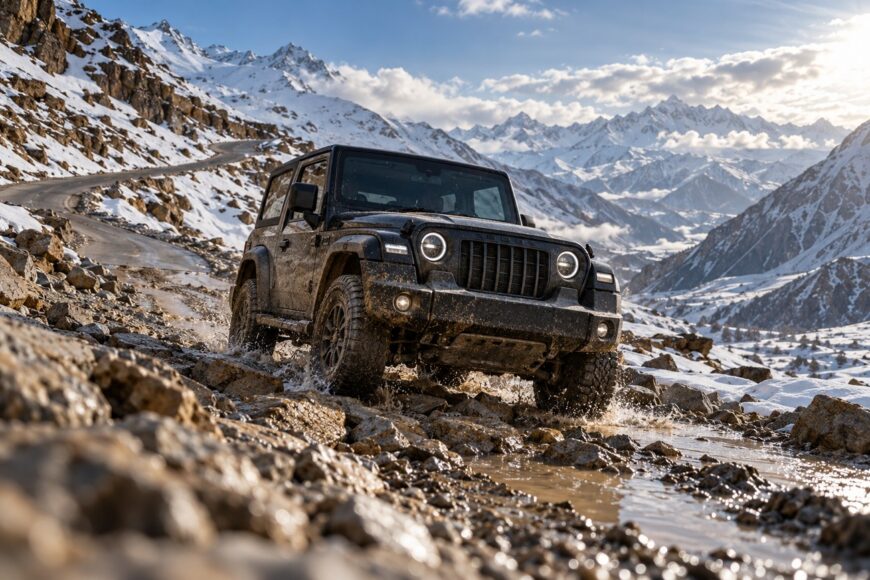
Driving a Mahindra Thar to Khardung La is feasible when the vehicle, route, and crew are treated as one system. The Thar may offer useful ground clearance and, in the right version, four-wheel drive, yet those advantages do not remove the effects of altitude, changing weather, traffic controls, or driver fatigue.
The approach from Leh can feel straightforward because the road to South Pullu is mostly paved. The character changes above South Pullu, where dirt, rocks, mud, ruts, and meltwater streams can slow progress sharply. Khardung La is approximately 39–40 km from Leh and leads toward Nubra, but the short distance does not guarantee a short or predictable drive.
- What the Drive to Khardung La Is Really Like
- What to Arrange in Leh Before You Leave
- Why South Pullu Is the Turning Point
- Which Mahindra Thar Setup Makes Sense
- Driving the Thar When Altitude and Traffic Take Over
- Common Mistakes and Myths About the Route
- Mahindra Thar Variants and Route Implications
- Frequently asked questions
- What should you do if the driver develops a heavy head or dizziness on the way?
- Which car can beat the Mahindra Thar on Khardung La?
- What are the disadvantages of the Mahindra Thar?
- What are the best cars for a Leh Ladakh trip?
- Which car can beat Mahindra Thar?
What the Drive to Khardung La Is Really Like
The route begins with a relatively manageable climb out of Leh. Until South Pullu, the mostly paved surface can encourage a false sense of security, especially in a capable-looking SUV. The pass leads toward Nubra, and the road distance is modest, but traffic, checkpoints, and road controls can make the journey take far longer than a map suggests.
Above South Pullu toward North Pullu, the surface may include dirt, rocks, mud, ruts, and meltwater streams. Conditions can change during the same outing as snowmelt, rain, or runoff damages a section that appeared passable earlier. A Thar can handle difficult ground more confidently than many ordinary cars, but it still needs careful speed and line choice.
Narrow one-lane sections are another practical limit. Washouts, avalanches, accidents, and control points can create queues or force vehicles to wait while traffic is managed. A route that looks simple in photographs may therefore involve long pauses, reversing on tight sections, or slow negotiation around damaged ground.
The central challenge is the combination of altitude, traffic, weather, and the upper road section. The vehicle may climb without complaint while the driver’s concentration declines. That difference matters: the Thar’s capability can help with traction and clearance, but it cannot compensate for poor visibility, unstable terrain, or an unwell crew.
What to Arrange in Leh Before You Leave
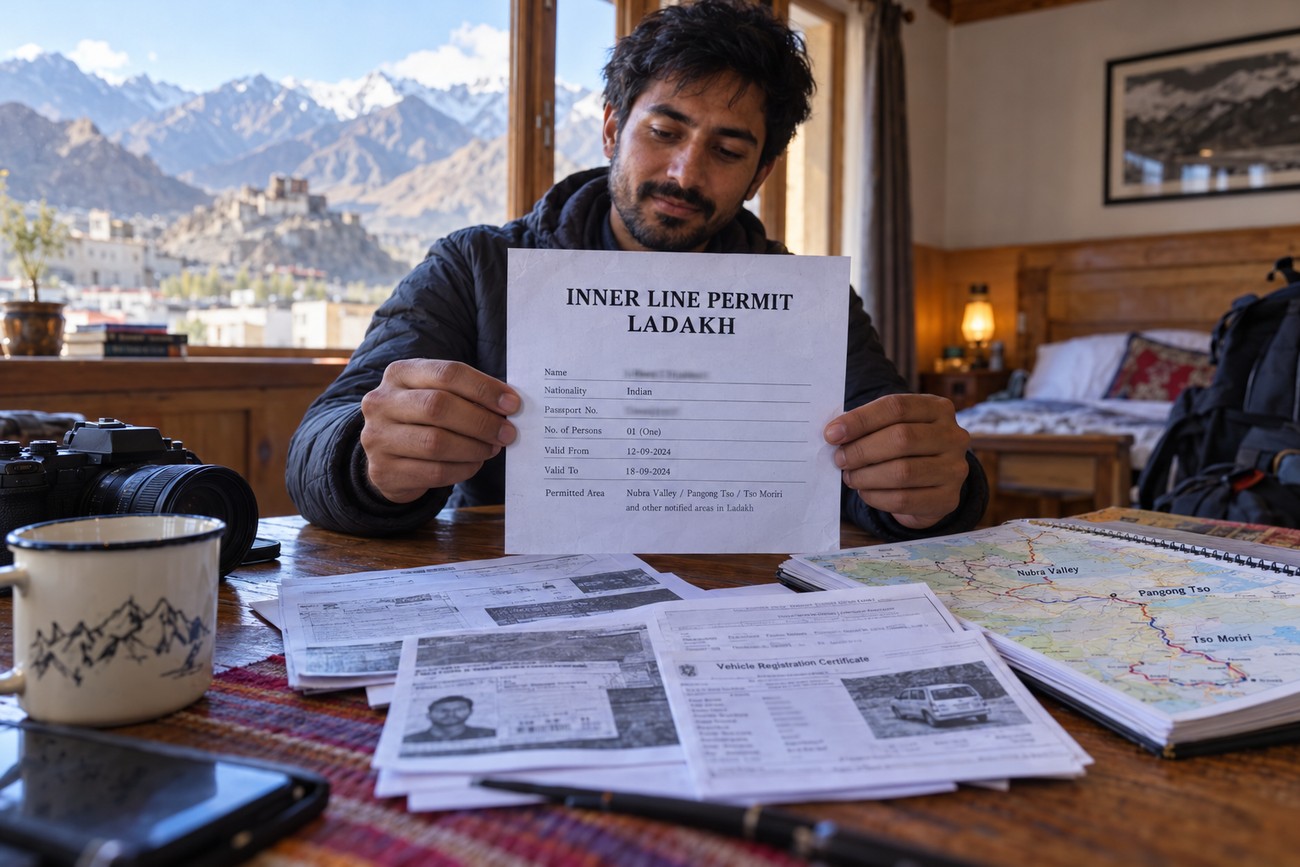
Plan to spend at least 2 days in Leh for acclimatization before crossing the pass. This requirement matters even if you are fit, have driven mountain roads before, or are using a four-wheel-drive vehicle. A rapid ascent can bring breathlessness, a heavy head, dizziness, and reduced comfort before the road reaches its roughest section.
An Inner Line Permit is required for tourists in Ladakh. Carry the permit and several copies because copies may be checked at route checkpoints. A missing document can disrupt the trip at the control point, regardless of how capable the vehicle is.
Confirm current access conditions in Leh before departure. There is no permanent winter closure, but temporary closures, traffic restrictions, and changing one-way arrangements are possible. Local instructions may also affect when vehicles are allowed to use narrow sections or proceed toward the pass.
Build flexibility into the day rather than promising yourself a fixed travel time. Queues, washouts, accidents, weather pauses, and checkpoint delays can all alter the schedule. A later return in worsening light or weather adds pressure to a route that already demands sustained concentration.
Why South Pullu Is the Turning Point
South Pullu is a useful point for assessing the drive in two parts. The lower approach is mostly paved, while the road toward North Pullu traditionally presents the more demanding conditions. Treating the whole route as an ordinary paved climb is one of the easiest ways to underestimate it.
Above South Pullu, mud can reduce grip, rocks can shift under the tires, and ruts can pull the vehicle away from the intended line. Meltwater streams may cross the road or deepen existing damage. Progress is often slow because preserving traction and avoiding underbody impacts matters more than maintaining momentum.
Ground clearance helps the Thar pass over some irregularities, yet clearance does not prevent washouts, avalanches, sudden weather changes, or oxygen deficiency. A high SUV can still become difficult to control when the surface is loose or when the driver’s attention is affected by altitude.
The upper section should therefore be judged on current conditions, not on the vehicle’s reputation. If water is cutting across the road, visibility is worsening, or the crew is becoming unwell, turning back may be the soundest decision. The limiting factor is often the combination of road and people rather than the engine’s ability to keep moving.
Which Mahindra Thar Setup Makes Sense
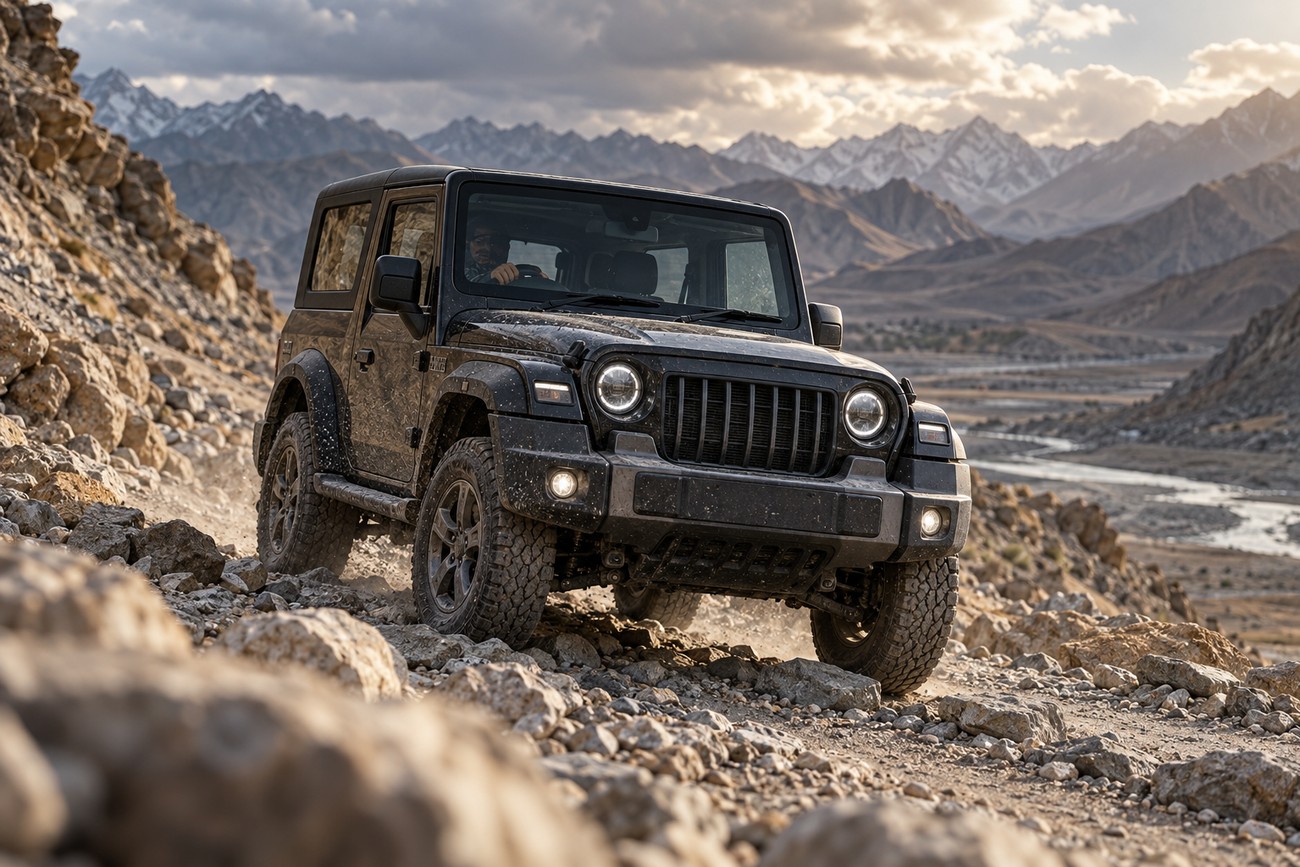
The name Mahindra Thar does not identify one universal specification. Current versions may include a 2.0-litre engine with 150 hp and 320 Nm, a 2.2-litre engine with 130 hp and 300 Nm, or a 1.5-litre engine with 117 hp and 300 Nm. Check the exact vehicle before setting out, particularly because 4WD is not available on every Thar version.
For this route, smooth traction and predictable low-speed control are more useful than maximum horsepower alone. A vehicle that delivers its torque calmly is easier to place on loose ground, especially when a sudden throttle input could break traction. Braking behavior matters just as much during slow descents and stops behind other vehicles.
In short-wheelbase Thar versions, the compact dimensions can be helpful on tight bends and narrow sections, but they also demand disciplined steering. Small corrections can have a noticeable effect on the vehicle’s line over ruts or broken ground. Keep inputs measured, and avoid treating a compact footprint as permission to rush.
Verify the drivetrain, tires, brakes, fluids, and general mechanical condition before leaving Leh. The specification sheet cannot show whether the particular vehicle is maintained or whether its tires suit the conditions. A sound 4WD setup improves options on difficult ground, while it still leaves weather, traffic, and crew condition as decisive factors.
Driving the Thar When Altitude and Traffic Take Over
Use a patient pace on the serpentine climb. Queues may form at narrow sections, and repeated stops can be unavoidable, so aggressive acceleration rarely saves meaningful time. On loose surfaces, smooth throttle and gentle steering preserve grip better than sudden inputs.
Altitude-related symptoms can include breathlessness, a heavy head, dizziness, and reduced comfort. Oxygen deficiency may impair attention and reaction even in experienced drivers. The Thar may continue pulling while the person behind the wheel becomes tired from slow climbing, repeated steering corrections, and prolonged concentration.
Concentration loss is an earlier warning than wheelspin or engine strain. Above South Pullu, experienced drivers reduce speed and steering inputs as soon as the crew becomes less focused, rather than waiting for the vehicle to show a traction problem.
Allow the crew’s condition to influence the decision to pause or turn around. Do not continue simply because the vehicle still has traction or engine power. If a driver develops significant dizziness or a heavy head, stop in a safe place, reassess the situation, and avoid leaving the decision until the road becomes narrower or the weather deteriorates.
Keep space from vehicles ahead where the road allows it, and expect delays rather than trying to recover lost time. A controlled climb reduces stress on the driver and gives more time to read water crossings, ruts, and oncoming traffic. Four-wheel drive is a traction aid, never a substitute for acclimatization or sound judgment.
Common Mistakes and Myths About the Route
Driving up immediately after reaching Leh is a poor plan. Travelers are commonly required to acclimatize in Leh for at least 2 days before crossing the pass, and the reason is practical: altitude can affect comfort, attention, and reaction before the vehicle reaches the most difficult road.
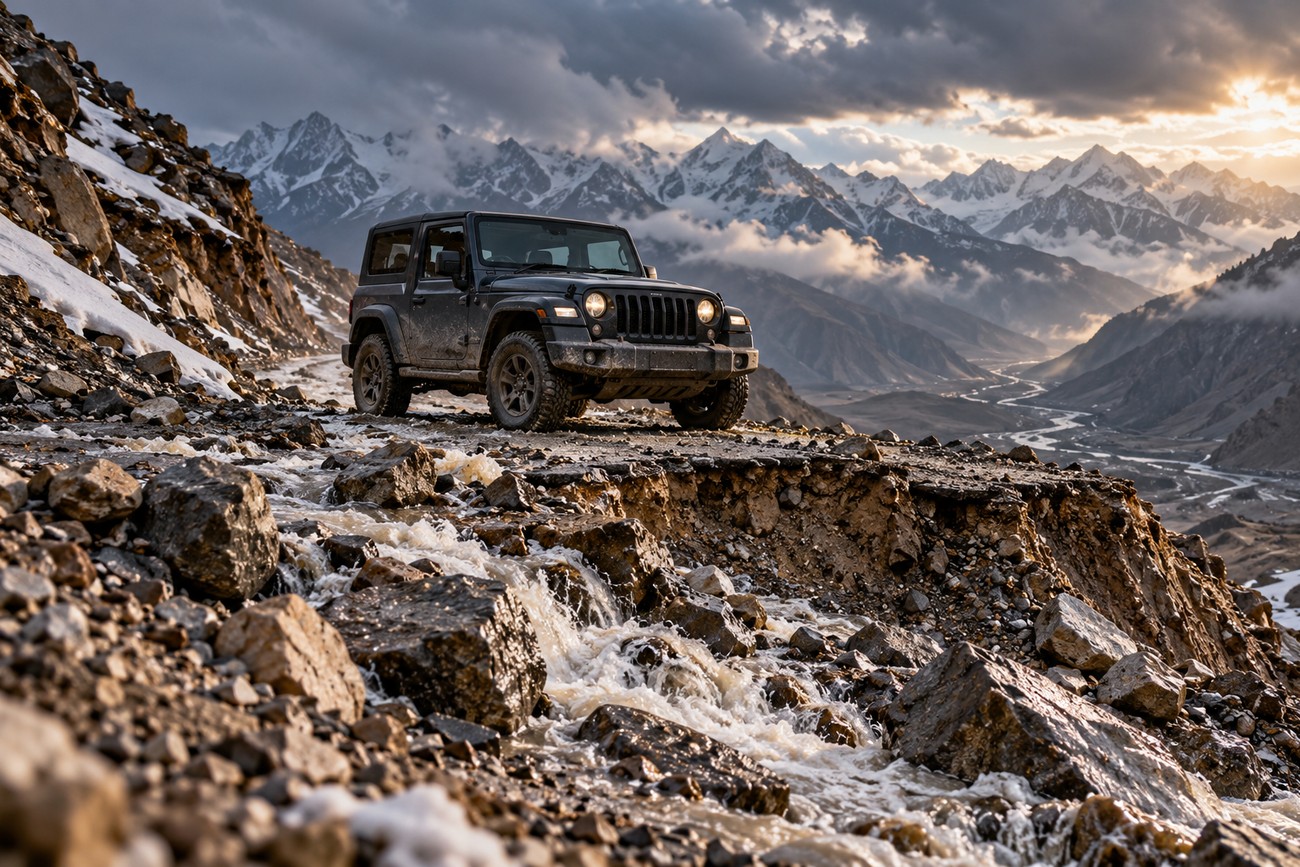
High clearance should not be confused with complete readiness. The Thar may clear rocks and ruts that challenge lower cars, but clearance does not prevent washouts, avalanches, changing weather, or hypoxia. The exact version also matters, since 4WD is not available on every Thar.
The pass’s elevation and status are also presented inconsistently. Official Ladakh references commonly state 18,379 ft (5602 m), while independent GPS and mapping data often show approximately 5359 m. Older tourist sources often call Khardung La the world’s highest motorable pass, while the Leh district site describes it as second after Umling La.
Neither disputed claim changes the practical decision. Treat the pass as a high-altitude route with variable access, temporary closures, traffic restrictions, and a demanding upper section. Marketing language about a “highest motorable road” or a capable SUV should never replace a check of permits, current conditions, and the crew’s readiness.
Mahindra Thar Variants and Route Implications
The figures below show why the exact engine and drivetrain matter, while also showing why power alone cannot determine suitability for Khardung La.
| Engine specification | Listed output | 4WD consideration | Practical implication for the climb |
|---|---|---|---|
| 2.0-litre | 150 hp and 320 Nm | Verify the exact version | Useful output for a controlled climb, but traction, braking, road condition, and driver condition remain decisive. |
| 2.2-litre | 130 hp and 300 Nm | Verify the exact version | Torque can support slow progress, while smooth throttle control matters more than chasing speed. |
| 1.5-litre | 117 hp and 300 Nm | Verify the exact version | Power is lower, yet careful low-speed driving and suitable drivetrain specification still matter more than a simple power ranking. |
Frequently asked questions
The vehicle’s specification is only one part of the decision. Road conditions above South Pullu, altitude, weather, traffic, and crew health can all change during the drive. The following answers focus on those practical limits.
What should you do if the driver develops a heavy head or dizziness on the way?
Stop at the first safe opportunity and reassess the driver’s condition. Do not continue simply because the Thar is still climbing; altitude-related symptoms can reduce attention and reaction quality before any mechanical problem appears.
If symptoms persist, worsen, or are accompanied by serious breathing difficulty or confusion, seek local assistance and follow appropriate medical guidance. The crew’s condition should set the turnaround decision, even when the vehicle has enough traction to continue.
Which car can beat the Mahindra Thar on Khardung La?
There is no universal winner for this route. The result depends on the exact Thar variant, whether it has 4WD, current conditions above South Pullu, the driver’s judgment, and how well the crew has acclimatized.
A different vehicle may be more suitable on a particular day if it offers the right drivetrain, predictable braking, and a well-maintained setup. That does not make model-versus-model rankings reliable, because mud, meltwater, traffic, and crew condition can change the outcome.
What are the disadvantages of the Mahindra Thar?
The Thar can demand more concentration than a road-focused vehicle on a long, slow mountain drive. Its short-wheelbase behavior requires careful steering on ruts and narrow sections, and its off-road capability can encourage drivers to take conditions less seriously than they should.
Variant confusion is another disadvantage: 4WD is not available on every version, so the model name alone is insufficient. The vehicle also cannot address altitude-related fatigue, traffic delays, or sudden changes in the upper-road surface.
What are the best cars for a Leh Ladakh trip?
The best choice is a well-maintained vehicle with predictable brakes, suitable ground clearance, and a drivetrain appropriate for the planned route. For Khardung La, confirm the exact vehicle specification rather than selecting by badge or advertising claim.
A suitable car still requires acclimatized occupants, the correct Inner Line Permit, current access information, and enough schedule flexibility for queues and temporary restrictions. Vehicle capability is only one part of a safe Leh Ladakh trip.
Which car can beat Mahindra Thar?
No car is guaranteed to beat a Mahindra Thar on Khardung La. A vehicle with an appropriate 4WD system, good tires, predictable brakes, and a careful driver may perform better in specific mud, rock, or meltwater conditions, while another vehicle may be disadvantaged by traffic or poor visibility.
The meaningful comparison is between the exact vehicle and the conditions on the day. Acclimatization, crew health, weather, road damage, and traffic management can matter more than a small difference in engine output.







