
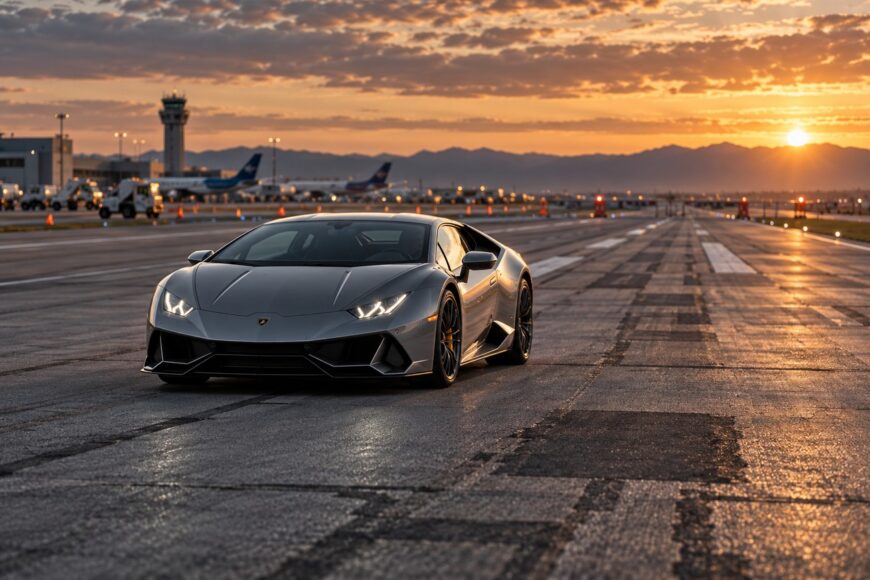
A Lamborghini on an airport runway makes a compelling picture: low bodywork, an open horizon, and enough straight pavement to make acceleration feel effortless. The setting appears to offer freedom from corners and traffic. Yet the length of the strip says little about how much of it a driver can safely or legally use.
Access rules, foreign object debris, changing grip, and the space needed to slow down matter more than headline horsepower. A runway may have joints and repair patches, while a controlled event may allow only brief, supervised runs. Before treating the booking as a chance to explore a supercar’s limits, assess the airfield, the car, and the rules governing both.
- Why a Runway Is Not Just a Very Long Racetrack
- What a Lamborghini Can Do—and What Actually Sets the Limit
- Permission, Marshalling and the Reality of a Runway Event
- FOD, Joints and the Surface Risks Supercar Owners Miss
- Tires, Brakes and Heat After the First Few Runs
- Common Mistakes, Hidden Costs and a Safer Decision Test
- Frequently asked questions
- Which car is commonly called a poor man’s Lamborghini?
- What is the average income of a Lamborghini owner?
- What should you confirm before booking a Lamborghini runway event?
Why a Runway Is Not Just a Very Long Racetrack
An active airfield is an operating environment, not a circuit with a longer straight. Non-aviation vehicles normally need explicit airport or airfield permission and must follow local procedures. The organizer’s access may cover a defined period and route, with other parts of the airfield remaining off-limits.
Runway pavement is built and maintained for aircraft operations, which does not make every section ideal for a low sports car. Asphalt, concrete, joints, old slabs, ruts, and repair patches can produce different grip and steering responses. A driver who sees only an empty straight may miss a change in surface until the car is moving quickly.
Ordinary track-day assumptions about run-off areas and recovery access may not apply. Runway edges, lights, signs, and adjoining operational areas can complicate a mistake. The most awkward moments may be slow turnarounds, exits, and edge-side taxiing, where the driver has less room to correct a poor line or avoid a raised joint.
Exposure also matters. A crosswind is more noticeable on an open runway than on a closed circuit, particularly as speed rises. The sensible target is a controlled run within the event’s limits, followed by a deliberate, unhurried return—not an attempt to reach the car’s published maximum speed.
What a Lamborghini Can Do—and What Actually Sets the Limit
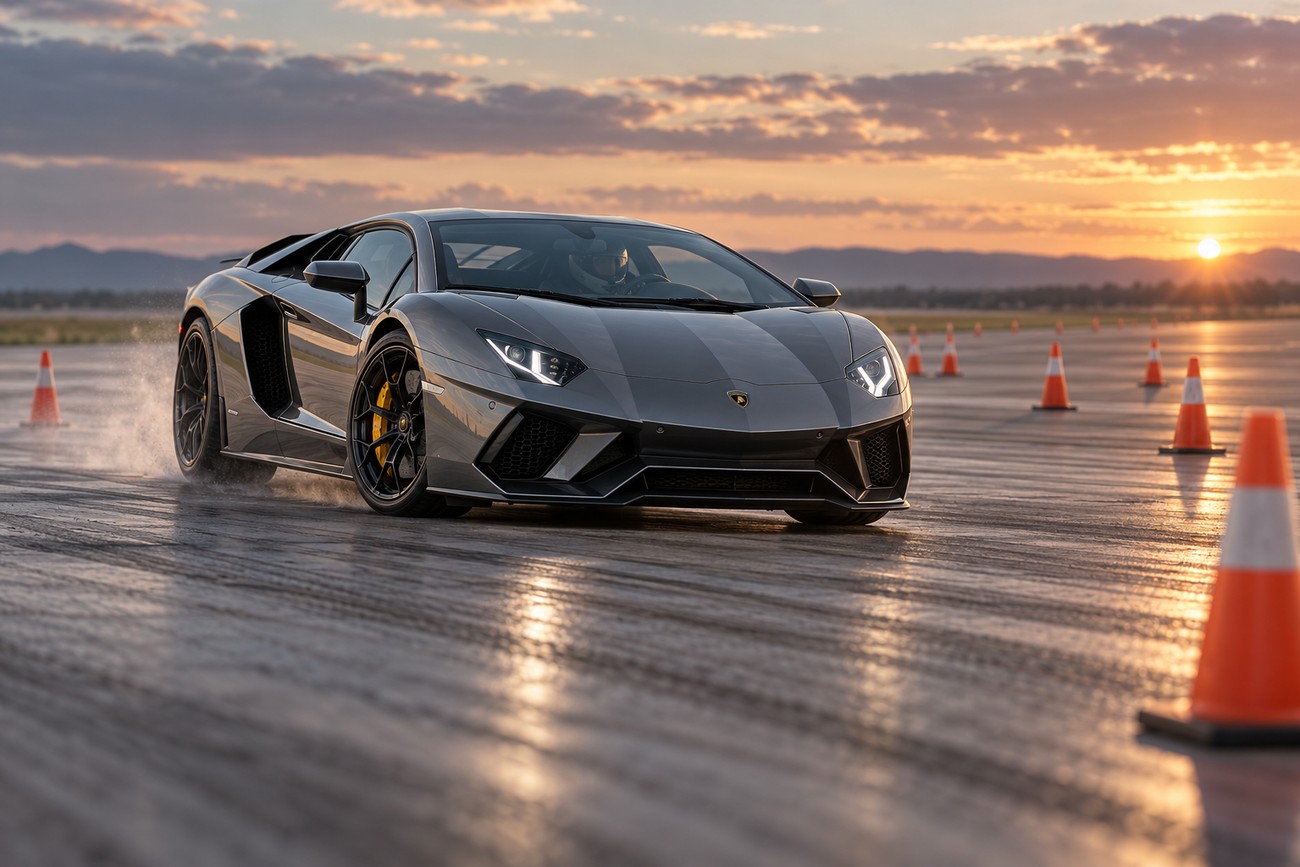
The Aventador’s quoted top speed is approximately 350 km/h, with 0–100 km/h taking approximately 2.9–3.0 seconds. Huracán versions reach approximately 325–325+ km/h, depending on version, and take approximately 2.9–3.3 seconds from 0–100 km/h. These figures describe vehicle capability under suitable conditions; they do not establish a safe runway target.
Usable speed depends on the whole run, including the available distance to brake. Tire condition, brake temperature, pavement consistency, and the driver’s ability to recognize changing grip can set the limit well before engine power does. A long visible straight is poor reassurance if its far end offers less stopping margin than expected.
All-wheel drive helps transmit power, but it cannot restore grip lost to cold or wet pavement. Nor can electronic systems make a rough patch disappear. A surface that feels settled under gentle acceleration may demand a steering correction under load or provide less traction during hard braking.
The practical measure of a successful run is repeatability: the car accelerates, tracks straight, and slows with consistent control. If the steering starts following ruts or the stopping point begins to drift, a higher speed adds little useful experience and substantially more exposure.
Permission, Marshalling and the Reality of a Runway Event
A legitimate runway event begins with explicit airport or airfield authorization and compliance with local operating procedures. Driving onto an airport surface without that permission is generally an unauthorized-access violation, not casual recreation. Taxiway and work-zone speeds are also subject to local rules; an event booking does not override them.
Good organization makes the permitted route unmistakable. Airfield coordination, marshals, reliable communication, and a clear evacuation plan determine when cars move, where they turn, and what happens if one stops. Those details matter as much as the driver briefing, especially when several vehicles share a short operating window.
Promotional claims of “full runway control” deserve a precise explanation. In practice, they commonly refer to a limited slot under strict rules, rather than permission to drive freely. Ask who can halt a run, how vehicles are released, and whether any part of the runway or return route remains unavailable.
Noise limits, weather, and airfield activity can shorten or cancel driving. A credible organizer should explain these conditions before payment, along with the schedule and emergency arrangements. A sanctioned event can reduce risk through planning and supervision, but it cannot eliminate it.
FOD, Joints and the Surface Risks Supercar Owners Miss
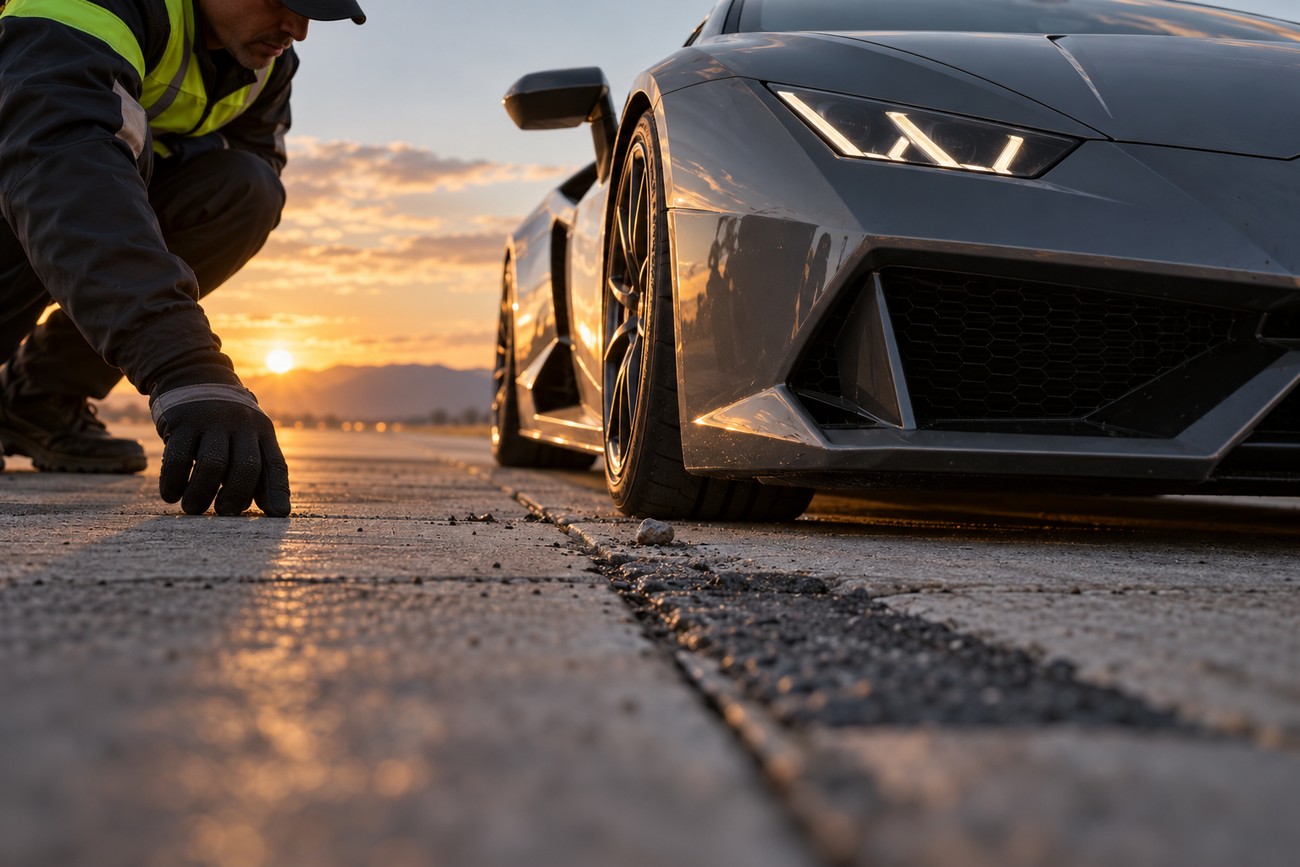
Foreign object debris, or FOD, includes stones, metal, rubber, and sand that can create operational or mechanical risk. It is a primary reason runway work or vehicle activity may be restricted or stopped. For a Lamborghini, a small object can mean a cut tire, damaged brake component, chipped paint, or a risk to an engine component.
A surface check before the first run is therefore essential, and conditions can change after other vehicles have used the strip. Ask how the organizer inspects and clears the driving line, including the turnaround and return route. A clean-looking runway viewed from the paddock is no substitute for a planned FOD check.
Pavement texture deserves the same scrutiny. Concrete joints, old slabs, ruts, and repair patches can pull at the steering or offer different grip from the surrounding asphalt. Noise and vibration may be noticeably greater than on a well-maintained circuit, making it harder to distinguish normal surface feedback from a developing tire problem.
Low ground clearance adds a separate cost risk. A splitter, underbody panel, sensor, or wheel-arch liner can meet a raised joint or damaged edge before the tires seem troubled. The slow route off the runway may be the place to protect these parts most carefully, despite being the least exciting part of the drive.
Tires, Brakes and Heat After the First Few Runs
Repeated acceleration followed by high-speed braking puts substantial heat into both brakes and tires. Once temperatures move outside a suitable range, stopping performance and tire grip can deteriorate together. Stock components that manage one controlled run may respond differently after several with little time to cool.
Runway aggregate can also be abrasive. Combined with heat, it may wear tires faster than a good circuit surface. Check that the fitted tires are appropriate for the event, and follow the approved pressure guidance rather than starting with very low pressure in pursuit of extra launch grip.
Temperature, brake-pedal consistency, and tire condition are abort signals, not targets to manage around until a planned run count is complete. A changed pedal or tire response calls for a stop and inspection before another launch.
Cold components need a measured start, too. Immediate full-throttle acceleration and hard braking leave little opportunity to learn how the tires and surface behave. Between runs, allow the checks and cooling time specified by the organizer or vehicle support crew.
Brake fade, a new vibration, or a car that no longer holds its line consistently is a reason to end the session. Pressing on may turn a disappointing short drive into tire, brake, or bodywork damage that lasts much longer.
Common Mistakes, Hidden Costs and a Safer Decision Test
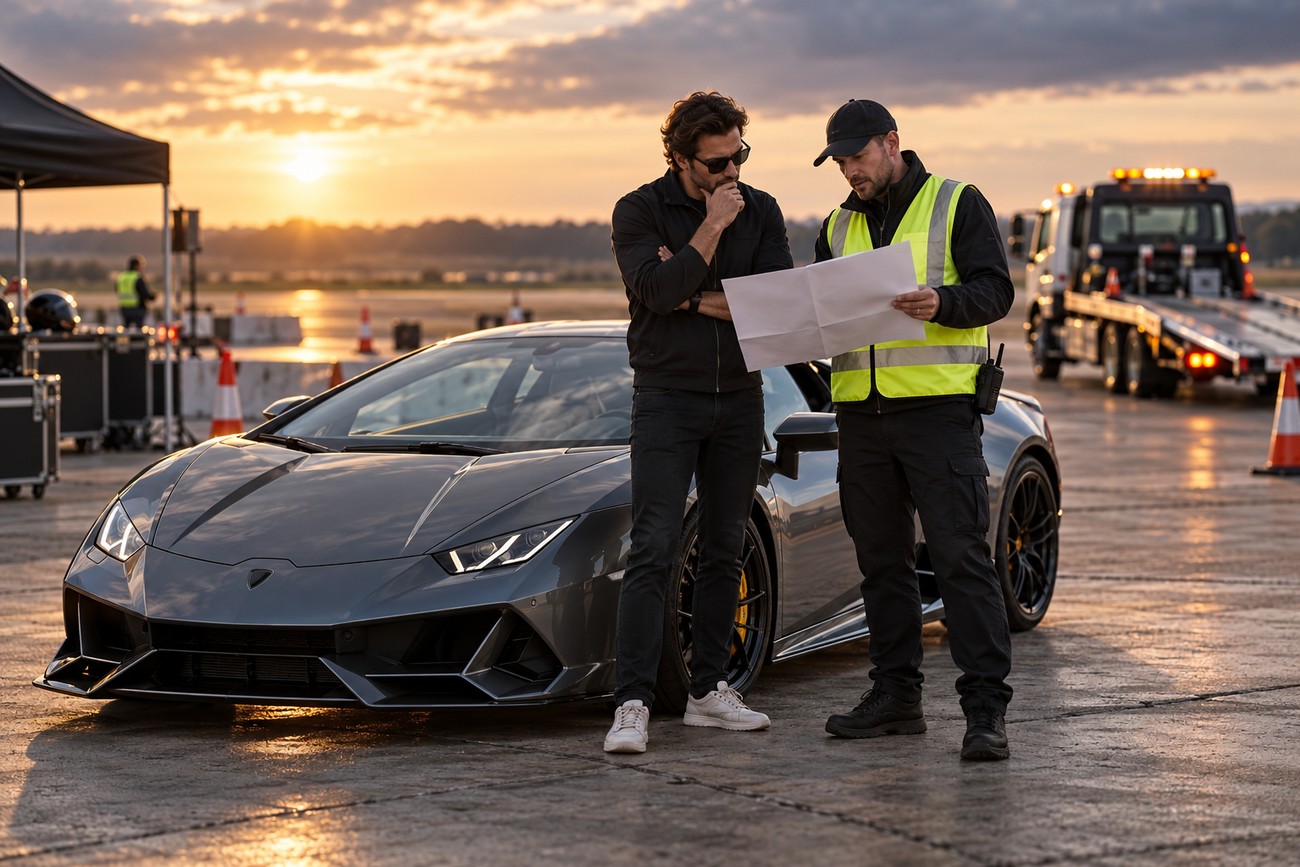
Start by asking the organizer to confirm authorization, the permitted route, and the actual driving schedule. Establish who inspects for FOD, whether the surface has been checked for damaging joints or patches, and what weather or noise conditions stop a run. Vague answers are a poor basis for committing an expensive car.
Next, clarify the support available if something goes wrong. You should know how a stopped car is reached, who coordinates recovery, and who bears responsibility for damage under the event terms. A waiting area full of cars does not, by itself, show that emergency arrangements are adequate.
Value depends on more than the advertised runway length. Events can involve substantial waiting and brief time behind the wheel; restricted slots or poor weather may reduce it further. Confirm what driving is actually included before comparing the cost with a conventional track day.
Budget attention for aftercare even when nothing dramatic happens. Washing away grit, inspecting tires, and checking the splitter, underbody, sensors, and liners can reveal damage that was easy to miss at the airfield. A wheel-alignment check may be sensible if the car struck a joint or subsequently pulls to one side.
The safest decision is sometimes to leave the car parked. An authorized event improves control, yet it cannot make an aging runway perfectly smooth or make a supercar absorb every mistake. If the surface, rules, or damage terms are unclear, the photographs are unlikely to justify the mechanical and financial risk.
Frequently asked questions
These related questions concern the nickname, ownership, and booking details rather than how to drive a runway run. Informal labels and online estimates deserve particular care because neither provides a reliable measure of a Lamborghini’s capabilities or its owners.
Which car is commonly called a poor man’s Lamborghini?
There is no universally recognized car with that nickname. Informal comparisons vary by region and context; the Pontiac Fiero, for example, is more commonly associated with the “poor man’s Ferrari” label and replica builds. Such labels say nothing reliable about Lamborghini performance, engineering, or ownership costs.
What is the average income of a Lamborghini owner?
There is no dependable official average income figure for Lamborghini owners. Income also differs from accumulated wealth, and a buyer may own a business or hold assets that a salary figure would miss. Treat unsourced online averages as estimates rather than established facts about owners.
What should you confirm before booking a Lamborghini runway event?
Get the cancellation and weather terms in writing, along with the damage-liability rules and the amount of actual driving time included. Confirm whether you will drive your own car or an event vehicle, who may access it, and what emergency support is present. These answers make the booking easier to assess than a headline claim about runway length.







