
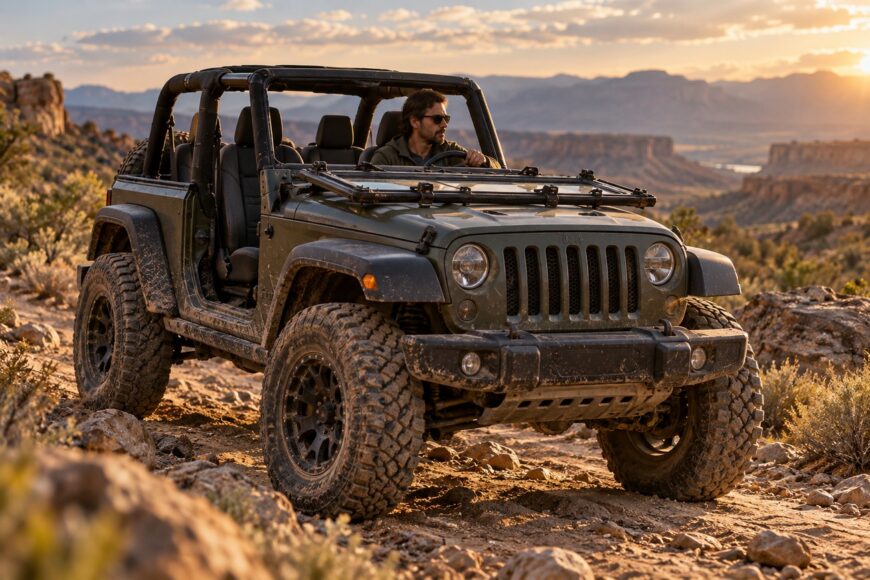
Folding a Jeep Wrangler’s windshield down delivers the open-air character that makes the feature appealing in the first place. You see more sky, hear your surroundings directly, and remove the glass from directly ahead of you for a short trail run or slow event route.
The less obvious part is that a factory folding mechanism does not automatically make public-road driving permissible or comfortable. Jeep’s instructions, local law, weather, traffic, and the condition of the hardware all matter. The preparation and later refitting can outweigh the benefit if the outing involves distance, speed, rain, or uncertain road conditions.
The setup makes the most sense as a deliberate, short-duration off-road configuration. Before using it, confirm the instructions for your exact Wrangler, understand the exposure to debris and weather, and decide whether the limited visibility gain justifies folding and later raising the windshield.
- Can You Drive With a Wrangler Windshield Down?
- What the Drive Actually Feels Like
- Before You Fold It: Hardware, Accessories, and Protection
- The Hard Part May Be Putting the Windshield Back
- Is the Open-Air Payoff Worth the Trade-Off?
- Frequently asked questions
- Why do Jeep Wrangler windshields fold down?
- What should you do if rain or hail starts while the windshield is down?
Can You Drive With a Wrangler Windshield Down?
The 2017 Jeep manual prohibits public-road driving with the windshield lowered. That is the clearest starting point for owners of that model year. Manuals can differ between generations and markets, so check the manual for your specific vehicle and the applicable law where you drive.
Jeep presents the doors-off, windshield-down configuration as an off-road setup, not as blanket permission for public-road use. A factory feature describes how the vehicle can be configured; it does not override local equipment requirements or create a universal legal exception.
Jeep requires the windshield to be secured in either the raised or lowered position. Seat belts remain required in both positions, and Jeep recommends using eye protection. With the glass out of the way, dust, insects, stones, and other road or trail debris can reach occupants directly.
There is no universal safe or legal speed for this configuration. A properly secured windshield is still subject to changing conditions, traffic, road surface, and local requirements, while the remaining frame and sport bar continue to affect visibility and occupant protection.
What the Drive Actually Feels Like
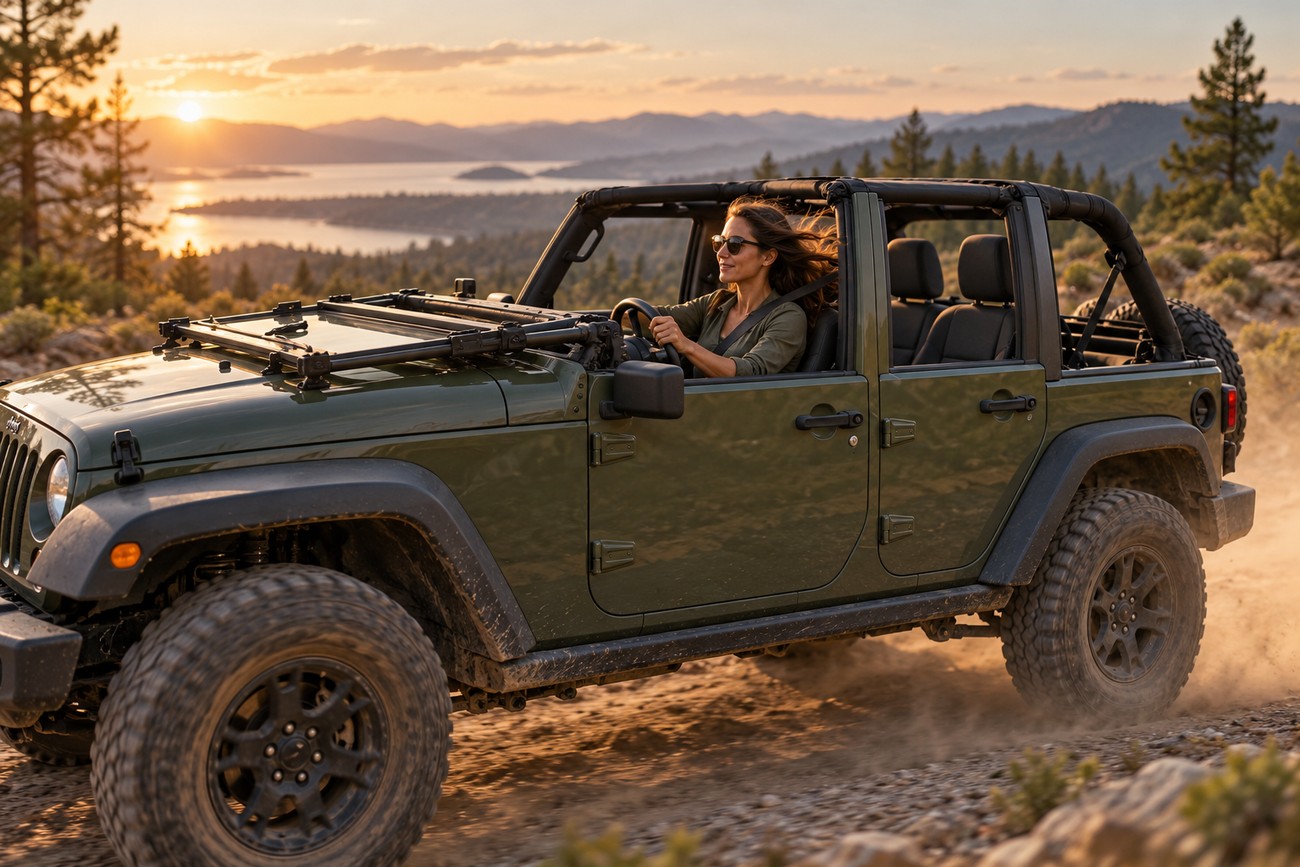
Owner reports describe a sharp increase in turbulence and noise around 30 mph, or about 48 km/h. Air does not arrive only from straight ahead: it can move between the door and the sport bar, with noticeable flow near the rear portion of the door. That makes the cabin feel less predictable than the simple image of air flowing over an open dashboard suggests.
At low speed, a short outing in dry weather can feel manageable. Owners commonly describe parade routes, slow trail sections, and occasional trips with a tailwind as more tolerable. Those are owner experiences, not Jeep approval or a safety recommendation.
Some owners report that 40 mph, or about 64 km/h, and below feels comfortable. That view varies with the vehicle, seating position, wind direction, temperature, and personal tolerance, and it should not be treated as an official limit. Jeep provides no universal safe-speed allowance for driving with the windshield lowered.
Fatigue is the practical problem that is easiest to underestimate. Noise, eye irritation, shifting airflow, and the need to protect your face can make even a legally permitted or off-road trip unpleasant. The effect can become tiring well before the vehicle feels mechanically strained.
Before You Fold It: Hardware, Accessories, and Protection
Use the procedure for your exact Wrangler generation and owner’s manual. Folding procedures vary, and both JK and JL procedures involve the wipers and their fasteners. JL owners commonly describe four side bolts in addition to the wiper-related hardware, but that detail should not be treated as a universal bolt count for every model.
Inspect the area before starting. Light bars, auxiliary lamps, brackets, and other accessories can physically obstruct the windshield as it folds. Check that the wiper hardware is accounted for, and keep removed fasteners and components in a protected place so they are available and undamaged during reassembly.
A dry or seized hinge deserves attention before any movement. Lubrication appropriate for the vehicle can help a stiff hinge move, while force can bend hinges or create alignment problems. If the frame does not move as intended, stop and consult the model-specific procedure rather than tightening or pulling harder.
Once lowered, the windshield must be secured in that position. Wear eye protection, use seat belts, and remember that the remaining frame and sport bar do not eliminate exposure to debris. A lowered windshield also does not turn the Wrangler into a vehicle suitable for every weather or road condition.
The Hard Part May Be Putting the Windshield Back
Owners often report that reassembly is harder than folding the windshield down. The frame and seal must meet in the correct position, and even a small misalignment can make fasteners difficult to start. A rushed installation can leave uneven contact, wind noise, or a path for water.
Forcing the hardware is a poor remedy. Tightening bolts against a misaligned frame can bend hinges, damage fasteners, or compress a tired seal unevenly. Work through the vehicle-specific alignment procedure, and stop if the parts do not seat without abnormal pressure.
Resolve the frame-and-seal fit before tightening hardware. A bolt that pulls the assembly into place can hide a poor seal until the next rain exposes it.
An aging seal can allow water around the cowl and into the cabin. Owners report leaks near the passenger floor and the upper audio area, while moisture near dash metal or electronics may cause damage that is not immediately apparent. After reassembly, inspect the seal contact and check for water intrusion after wet weather rather than assuming a dry cabin on the first drive proves the repair is sound.
Is the Open-Air Payoff Worth the Trade-Off?
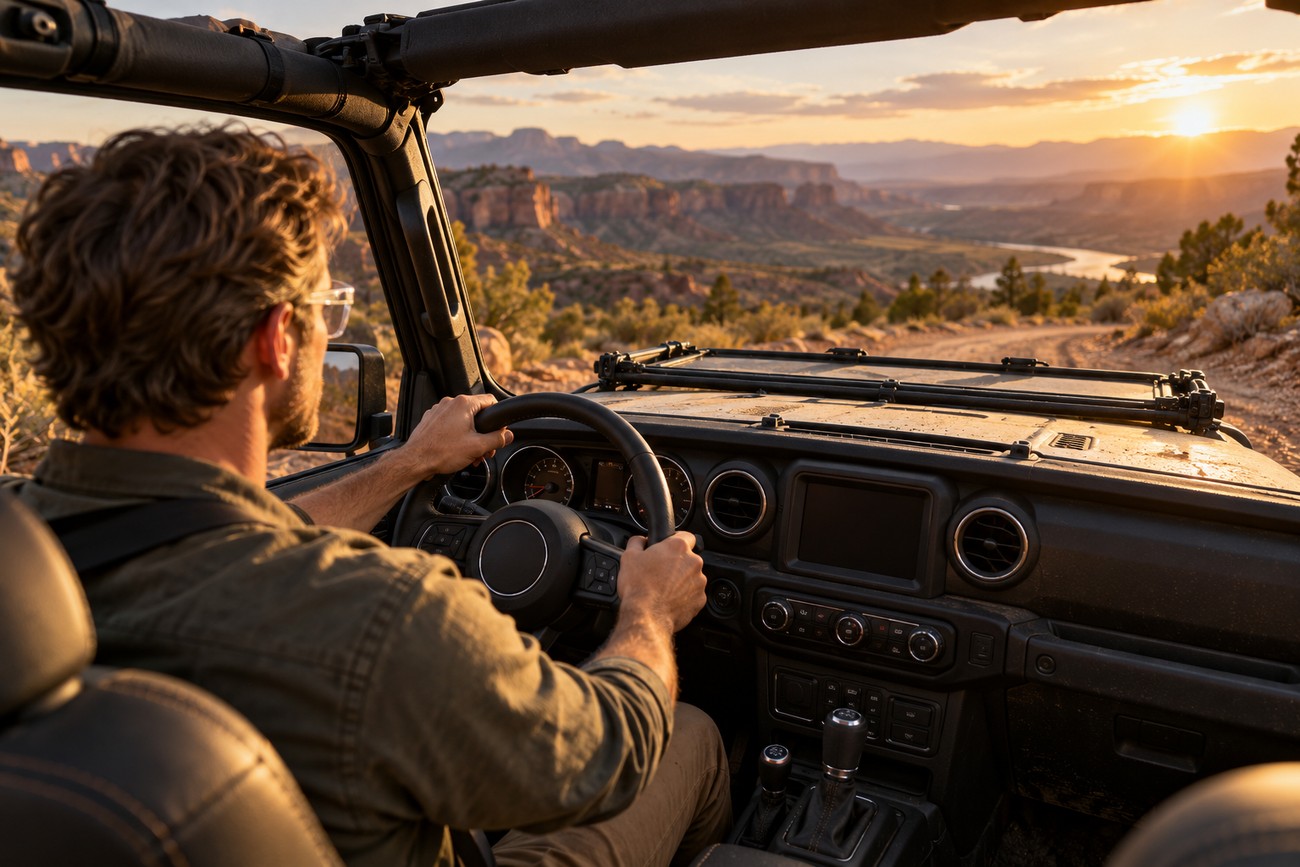
Lowering the windshield does not remove every visual obstruction. The pillars, frame elements, and sport bar remain, so the improvement in sightlines may be modest, especially on versions with a substantial frame or curved glass. The Wrangler becomes more exposed, but it does not become completely open.
The altered view also comes with altered exposure. Dust, stones, insects, and other debris can reach the occupants without the windshield ahead of them, and hail presents a particularly poor combination of impact risk and limited protection. Airflow can arrive from the sides and rear, so removing the glass does not guarantee a calm cabin.
Crash and rollover protection changes with the windshield lowered; the remaining structure does not disappear. The windshield frame, pillars, and sport bar still form part of the vehicle’s structure, but owners should not assume that the original raised-windshield configuration offers identical protection in every event.
The feature is easiest to justify for a controlled, short off-road outing in dry weather, where the open-air effect matters more than highway comfort. For a longer trip, uncertain weather, or a route requiring public-road travel, the preparation, legal questions, wind fatigue, and refitting risk can make keeping the windshield raised the more sensible choice.
Frequently asked questions
The questions below address the feature’s purpose and its practical limits.
They also cover what to do when weather changes while the windshield is lowered.
Always follow the instructions for your specific Wrangler and the requirements that apply where you drive.
Why do Jeep Wrangler windshields fold down?
The folding windshield is a factory open-air feature intended to support certain off-road and recreational configurations. It can reduce the barrier directly ahead of the occupants and provide a different trail experience, while the doors-off, windshield-down setup is presented by Jeep as an off-road arrangement.
Its factory design does not create blanket permission to use the vehicle that way on public roads. The 2017 Jeep manual prohibits public-road driving with the windshield lowered, so owners should check the manual for their specific Wrangler and the law applicable to their location.
What should you do if rain or hail starts while the windshield is down?
Stop in a safe place as soon as conditions allow and seek shelter from hail. Do not continue simply because the remaining route is short; without the windshield, occupants are directly exposed to impact, water, reduced visibility, and slippery conditions.
Restore the windshield only when the vehicle is safely stopped and the weather and surroundings allow the procedure to be completed correctly. Secure the assembly in its raised position according to the model-specific instructions, and check the seal afterward for signs of water intrusion.







