
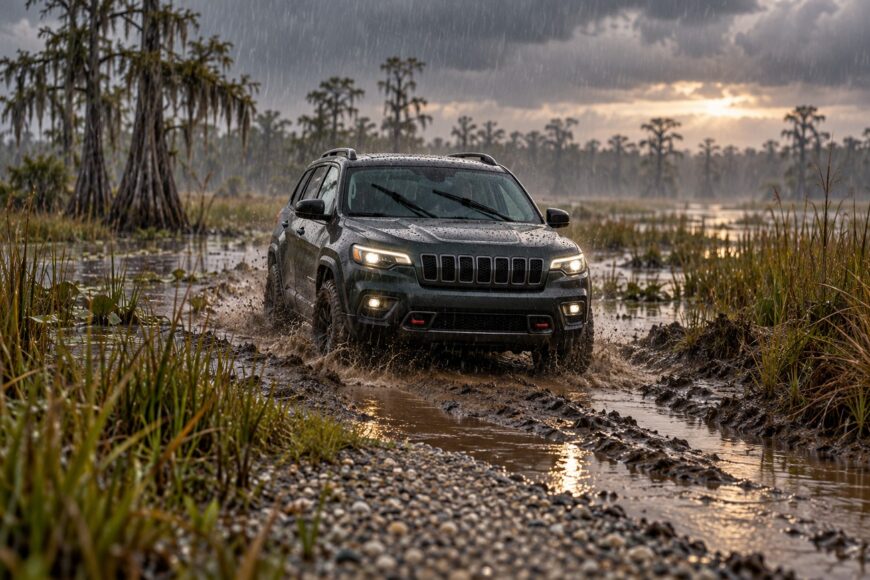
A Jeep Cherokee may handle a firm access road through the Everglades with little drama, then lose forward motion within a short stretch of soft mud. Ruts, standing water, uneven ground, and a slippery shoulder expose limits that are easy to miss on pavement. Four-wheel drive helps, but it cannot compensate for poor wheel contact or a chassis resting on the ground.
“Driving through the Everglades” describes a network of asphalt, gravel, dirt, levees, seasonally flooded sections, and tourist access roads. The surface beneath your tires matters more than the destination label. A standard Cherokee, a Trailhawk, and a prepared or lifted vehicle can face the same route with very different margins, while a marginal section may be better avoided altogether.
Factory water-fording and clearance figures are useful reference points, not permission to enter unknown water. Rain, recent traffic, visibility, the condition of the bottom, and access status can change the risk before the vehicle arrives. A sound decision may be to turn around while the vehicle still has firm ground beneath all four tires.
- What Driving Through the Everglades Really Means
- Cherokee vs. Trailhawk: Which Version Fits Soft Everglades Terrain?
- What the Trailhawk Numbers Actually Tell You
- Where a Cherokee Actually Gets Stuck
- Weather, Water, and the Decision to Turn Around
- How to Drive a Cherokee on Soft or Wet Ground
- Preparation: What Matters More Than a Big Engine
- Common Cherokee and Everglades Driving Myths
- Frequently asked questions
- What are the main weaknesses of a Jeep Cherokee for an Everglades drive?
- How deep of water can a Jeep Grand Cherokee drive through?
- What are the weaknesses of a Jeep Cherokee?
What Driving Through the Everglades Really Means
The Everglades does not present one continuous swamp road for vehicles. A drive may remain entirely on pavement, move onto gravel or dirt, follow a levee, or include a seasonally wet section near a tourist or nature access point. Each surface places different demands on tires, suspension clearance, steering control, and the driver’s ability to read the ground ahead.
Firm gravel can support a Cherokee comfortably, while saturated dirt may pull the same vehicle toward existing ruts. A raised road or levee can also create a sharp edge, a soft shoulder, or a narrow passing area. The route’s name tells you little about the condition of the next hundred yards.
Weather deserves more attention than the calendar alone. Dry-season and rainy-season conditions can differ substantially, and a recent storm may leave an otherwise passable access section wet, slippery, or difficult to see through. Standing water can conceal holes, uneven bottoms, and ruts deep enough to load the vehicle’s underbody.
Check current access information and inspect the surface before committing to a questionable section. Do not assume that every road or trail is open to Jeep traffic or that a tourist approach remains suitable after rain. The useful question is whether the specific surface in front of you still offers enough traction and room to retreat.
Cherokee vs. Trailhawk: Which Version Fits Soft Everglades Terrain?
The Trailhawk has equipment and geometry that increase its margin on soft or uneven ground. A standard Cherokee is commonly listed at 222 mm of ground clearance, while the Trailhawk is specified at 229 mm. Those figures are close on paper, yet the transfer case, low range, and Trailhawk-specific geometry have a larger practical effect than the small clearance difference alone.
| Feature | Standard Cherokee | Cherokee Trailhawk |
|---|---|---|
| Ground clearance | 222 mm is a commonly cited figure for the standard Cherokee; confirm the model year and equipment. | 229 mm |
| Transfer-case capability | Does not have the Trailhawk’s low-range transfer-case capability. | Active Drive II with a two-speed transfer case and low range |
| Low-range overall ratio | No Trailhawk low-range ratio | 37.5:1 |
| Off-road geometry | Trailhawk-specific figures do not apply automatically. | Approach 28.8°, ramp-breakover 21.9°, departure 31.8° |
| Water-fording specification | Do not transfer the Trailhawk figure to this version. | Stated water-fording depth of 610 mm, subject to conditions and limitations |
Active Drive II and its low range give the Trailhawk better control when the vehicle must move slowly over soft or uneven ground. The 37.5:1 low-range overall ratio supports torque multiplication and reduces the need for abrupt throttle inputs. A standard Cherokee can still be useful on firm access roads, but it should not be judged as mechanically equivalent to the Trailhawk.
Factory Trailhawk capability also differs from that of a prepared or lifted vehicle. A lift may alter clearance and approach angles, while tires, underbody protection, and recovery equipment affect whether those changes are useful in practice. Neither the standard Cherokee nor the Trailhawk should be treated as an all-purpose substitute for route knowledge and a recovery margin.
What the Trailhawk Numbers Actually Tell You
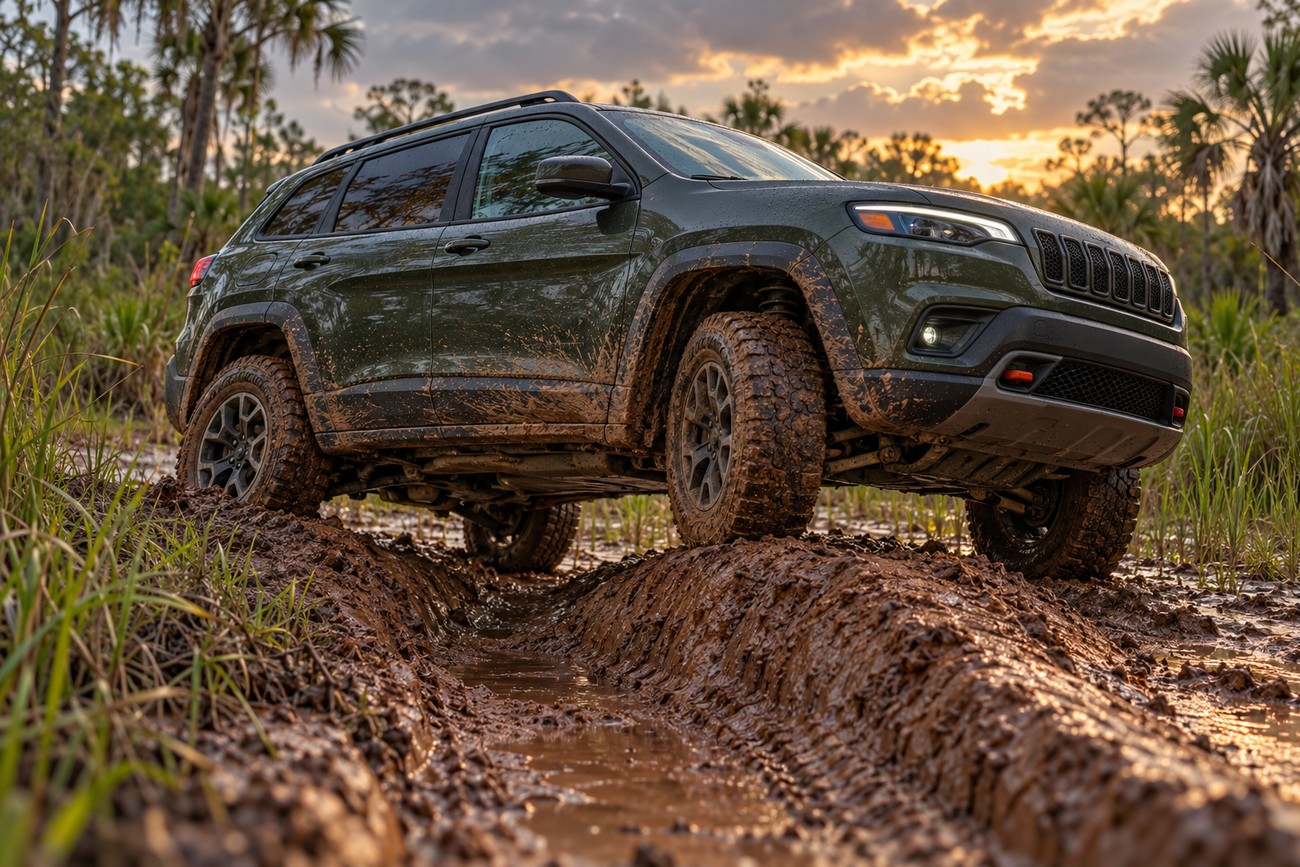
The Trailhawk’s stated approach angle is 28.8°, its ramp-breakover angle is 21.9°, and its departure angle is 31.8°. These measurements describe how the vehicle approaches an obstacle, crosses a crest, and leaves an obstacle without contacting the bodywork. They are most useful when the ground is firm enough for the tires to maintain a predictable line.
The 21.9° ramp-breakover figure deserves particular attention in ruts. A vehicle can clear the entrance and exit of a depression while the center of its underbody settles onto the crest between them. Once the belly carries the vehicle’s weight, additional engine output usually produces wheelspin rather than progress.
The Trailhawk’s stated water-fording depth is 610 mm. That is a specification limit for a defined test and vehicle configuration, rather than a safe depth for every crossing. Current, hidden holes, a soft bottom, waves created by another vehicle, and water reaching vulnerable components can all change the risk.
Water also removes visual information. A shallow-looking section may have a deep rut on one side, while a firm edge may collapse under the vehicle’s weight. Enter only when the route, bottom, exit, and retreat line are understood, and remember that the figure belongs to the stated Trailhawk specification rather than the Cherokee family as a whole.
Where a Cherokee Actually Gets Stuck
High-centering is one of the clearest failure modes in soft Everglades terrain. A heavy vehicle sinks into a rut until the belly or underbody rests on mud, taking weight away from the tires. At that point, 4LO can multiply torque at the wheels, but it cannot lift the chassis back onto a usable surface.
Diagonal articulation creates a different problem. If one rear wheel becomes unloaded or lifted, the available grip can fall sharply even though the other tires remain on the ground. A driver may respond with more throttle and deeper wheelspin, which can widen the rut and make recovery harder.
Once the belly is loaded or a rear wheel is unloaded, adding throttle is rarely the diagnosis. Check where the vehicle is supported, whether the chosen line preserves wheel contact, and whether the recovery position remains usable.
Soft ground can pull a vehicle toward an existing rut, especially when the driver follows a line that appears compacted but has been softened by rain. A rut then becomes both a steering constraint and a trap. Stopping at its deepest point leaves less room to change direction or build controlled momentum.
Engine power and low-range gearing solve different problems from tire grip. The drivetrain can deliver torque slowly and predictably, while the tires still spin on mud or lose contact over a crest. Tires, geometry, underbody clearance, and wheel contact therefore matter alongside the engine and transfer case.
Weather, Water, and the Decision to Turn Around
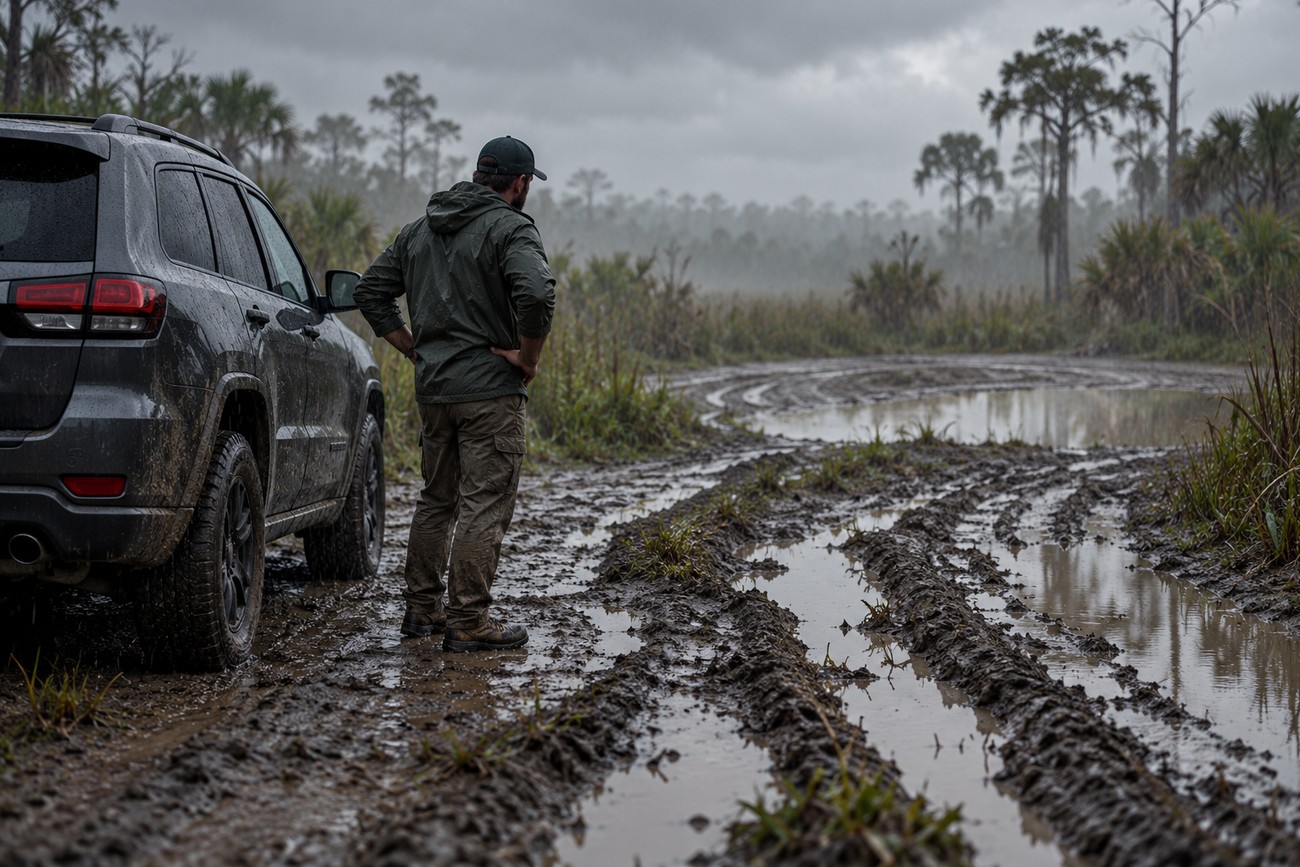
Dry conditions can leave a route firm enough for careful travel, while the rainy season can produce deeper ruts, standing water, reduced visibility, and a slick shoulder. A section that was easy to inspect on one visit may become difficult to read after rain. The change can occur on a tourist or nature access road as well as on a more remote dirt section.
Inspect the surface before entering an unknown stretch, and avoid approaching it at speed. Look for the firmest visible line, the likely depth of the ruts, and a place where the vehicle could turn around without placing its wheels in softer ground. If water hides the exit, the section is already demanding more certainty than the route may deserve.
Rising water, a softening shoulder, or repeated wheelspin is a reason to retreat early. Do not wait until the vehicle has stopped in the lowest part of the route. The best decision is often made before entry, because reversing from firm ground requires less force, less equipment, and less risk than recovering a high-centered vehicle.
Plan a recovery margin before committing to soft ground. That means allowing room for a failed attempt, avoiding a line that blocks the only exit, and recognizing that weather can remove the margin you had at the start. A calendar-based assumption is weaker evidence than the surface you can inspect now.
How to Drive a Cherokee on Soft or Wet Ground
Use controlled momentum rather than speed. Keep the vehicle moving steadily across a firm-looking section while remaining slow enough to respond to a rut, hidden hole, or changing water depth. Abrupt acceleration can break traction and dig the tires deeper into the surface.
Choose a line that keeps the tires on the firmest visible ground and limits unnecessary steering. Avoid stopping in the deepest part of a rut, on a muddy crest, or beside a soft shoulder. If a stop becomes necessary, aim for a position that preserves a clear route forward or backward.
Use low range when the terrain requires slow control and torque multiplication. The Trailhawk’s 37.5:1 low-range overall ratio can help the driver maintain a measured pace with less reliance on sudden throttle. 4LO remains a control aid, however, and cannot recover a vehicle that is high-centered or has lost wheel contact.
Repeated rocking is not a recovery plan. It can deepen the rut, heat the drivetrain, and reduce the remaining space around the vehicle. Tire choice, gentle throttle, careful steering, underbody protection, and a planned retreat usually matter more than trying to force the Cherokee through with additional power.
Preparation: What Matters More Than a Big Engine
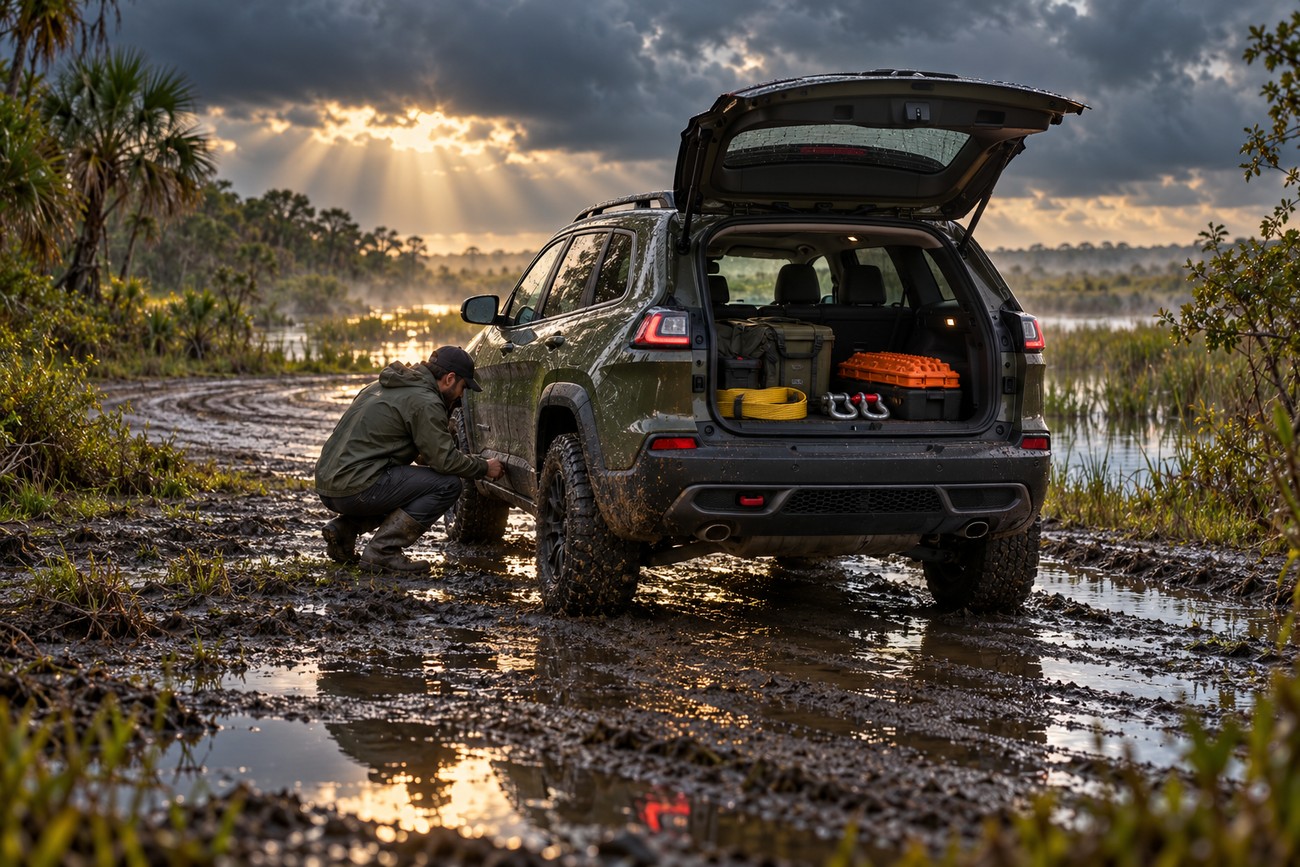
Confirm the exact Cherokee trim, model year, drivetrain, and factory equipment before judging its capability. Trailhawk specifications should remain specific to the Trailhawk. A standard Cherokee may be entirely suitable for a firm access road while lacking the low-range capability and geometry that provide extra margin on soft terrain.
Check the current route condition and weather close to departure. Pay attention to recent rain, visible standing water, access information, and whether the route offers a practical turnaround. A marginal section becomes a poor vehicle test when the driver cannot verify its bottom or exit.
Inspect the tires as a primary part of the vehicle’s off-road equipment. The tread and condition determine how much of the available drivetrain output reaches the ground. Consider underbody protection as well, because a route that does not stop the tires may still expose the belly and other components to ruts, rocks, or submerged edges.
Recent Trailhawk materials cite a 1.6-liter hybrid system with electric motors producing approximately 210–213 hp, with fuel economy of about 31 mpg on the U. S. cycle. Those figures provide useful ownership context, yet they do not replace traction, clearance, tires, or recovery planning. Carry enough margin for a failed attempt and decide in advance where continuing would become unreasonable.
Common Cherokee and Everglades Driving Myths
Ground clearance alone does not measure total capability. Approach, ramp-breakover, and departure angles determine how the vehicle meets uneven ground, while rut shape can make the 21.9° Trailhawk breakover figure the limiting factor. A Cherokee with adequate clearance at the entrance can still settle onto its belly in the middle of a depression.
Four-wheel drive and 4LO do not make a vehicle immune to getting stuck. Low range can provide slow control and torque multiplication, but it cannot create traction when the tires are spinning on mud, a rear wheel is unloaded, or the chassis is resting on the ground. Continuing to add throttle in that position often worsens the recovery.
The 610 mm water-fording figure applies to the stated Trailhawk specification and does not grant universal permission to drive through water. It does not remove the risks of current, holes, soft bottoms, waves, or damage to electronic systems. A standard Cherokee and a Grand Cherokee must also be evaluated from their own specifications and manuals.
Finally, a standard Cherokee is not equivalent to a Trailhawk, and a stock vehicle is not equivalent to a prepared or lifted one. Use the weakest condition on the route as the go/no-go test: the least capable trim, softest surface, poorest visibility, or most uncertain water crossing sets the practical limit.
Frequently asked questions
What are the main weaknesses of a Jeep Cherokee for an Everglades drive?
The main practical weaknesses are trim confusion, limited soft-ground traction, vulnerability to high-centering, and sensitivity to weather and recent rain. A standard Cherokee is commonly listed at 222 mm of ground clearance and does not have the Trailhawk’s low-range transfer-case capability, so its margin can disappear sooner on deep ruts or soft mud.
The Trailhawk improves that margin with 229 mm of clearance, Active Drive II, low range, and specific off-road geometry. It still depends on tire grip, wheel contact, a readable route, and a recovery plan. A route that has become saturated may exceed the useful capability of either stock version.
How deep of water can a Jeep Grand Cherokee drive through?
There is no single Cherokee figure that can be transferred to a Grand Cherokee. The Trailhawk Cherokee’s stated water-fording depth is 610 mm, but that specification belongs to that vehicle and configuration; it does not establish a Grand Cherokee limit.
Use the exact Grand Cherokee model’s manual and current crossing conditions. Depth, current, bottom quality, hidden holes, waves, and the water’s effect on vehicle systems can make a crossing unsafe before the published limit is reached.
What are the weaknesses of a Jeep Cherokee?
A Cherokee’s main weaknesses in demanding terrain are its dependence on the exact trim, limited grip on soft or wet ground, risk of belly contact in ruts, and reduced margin when weather changes the surface. Engine output alone cannot overcome a lifted wheel, poor tires, or a chassis supported by the ground.
For ownership decisions, the Trailhawk is the more suitable Cherokee version for slow, uneven access sections because of its low range and off-road geometry. Even that version is best treated as a capable stock vehicle with limits, rather than as a substitute for route assessment, suitable tires, and recovery planning.







