
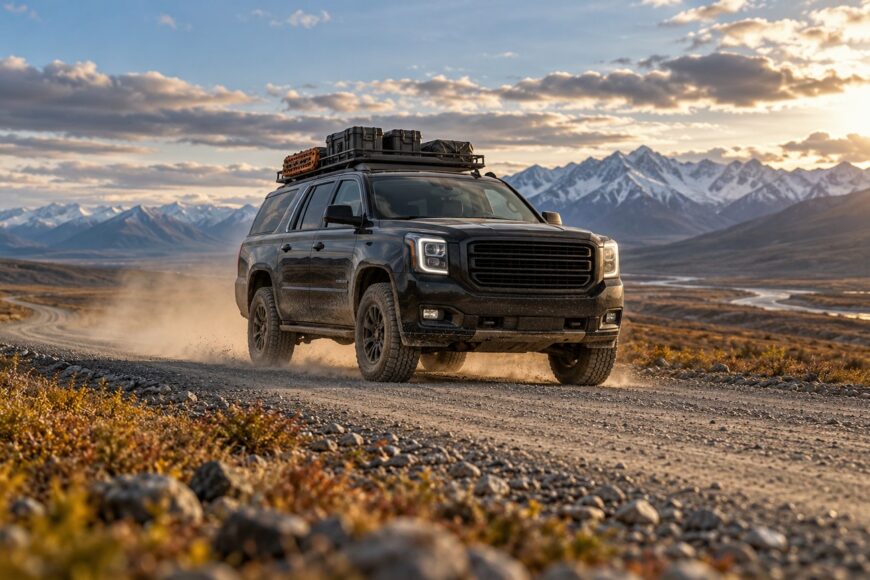
A GMC Yukon has the size, ground clearance, highway comfort, and available four-wheel drive to appear well suited to the Dalton Highway. Those qualities help, but they do not remove the risks created by a long gravel route, heavy truck traffic, changing weather, and limited access to assistance. A Yukon can be capable on the road while the trip remains poorly prepared.
The decisive issue is not whether the vehicle can physically reach Deadhorse. It is whether the vehicle, occupants, supplies, and contingency plan can withstand a damaged tire, a long delay, a sudden closure, or many hours without cellular service. On the Dalton, fuel autonomy, tire condition, communications, and the ability to wait safely matter at least as much as engine power.
- Can a GMC Yukon Handle the Dalton Highway?
- What the Dalton Highway Is Actually Like
- Fuel, Food, Water, and Communication: Build for Isolation
- Prepare the Yukon Before Leaving Fairbanks
- How to Drive Around Trucks, Gravel, and Road Damage
- Weather, Atigun Pass, and the Cost of a Closure
- The Mistakes That Turn a Yukon Trip Into an Emergency
- A Go-or-No-Go Decision Framework for the Dalton
- Frequently asked questions
- How fast can you drive on the Dalton Highway?
- What is the best month to drive the Alaska Highway?
- Which highway in Alaska is considered the deadliest?
Can a GMC Yukon Handle the Dalton Highway?
A modern GMC Yukon can be a suitable platform for the Dalton Highway if it is properly prepared. Modern versions may be available with four-wheel drive, and a 2021 Yukon Denali is cited with 4WD, a 10-speed automatic, and a 6.2L V8. Its size, seating capacity, cargo space, and comfortable highway behavior are useful before and after the remote section of the journey.
Four-wheel drive improves traction on loose gravel, mud, and snow, particularly when the road surface changes quickly. It can help the Yukon keep moving where a two-wheel-drive vehicle would struggle. That capability should be treated as one part of the preparation rather than as evidence that the route is safe under all conditions.
The Yukon’s weight also creates a less obvious problem. A heavy SUV carries substantial momentum into potholes and washboard, and repeated impacts can affect tires, wheels, suspension components, and steering. Gravel thrown by trucks can chip the windshield or damage exterior panels, while a puncture can become a long roadside problem if the vehicle has no full-size spare and no practical repair equipment.
Vehicle capability and trip safety are separate tests. Four-wheel drive does not solve a fuel shortage, a cracked windshield, an immobilized vehicle, an avalanche closure, or the absence of cellular service. A Yukon can handle the road mechanically and still leave its occupants exposed if the tires, fluids, emergency supplies, communications, and recovery plan are inadequate.
What the Dalton Highway Is Actually Like
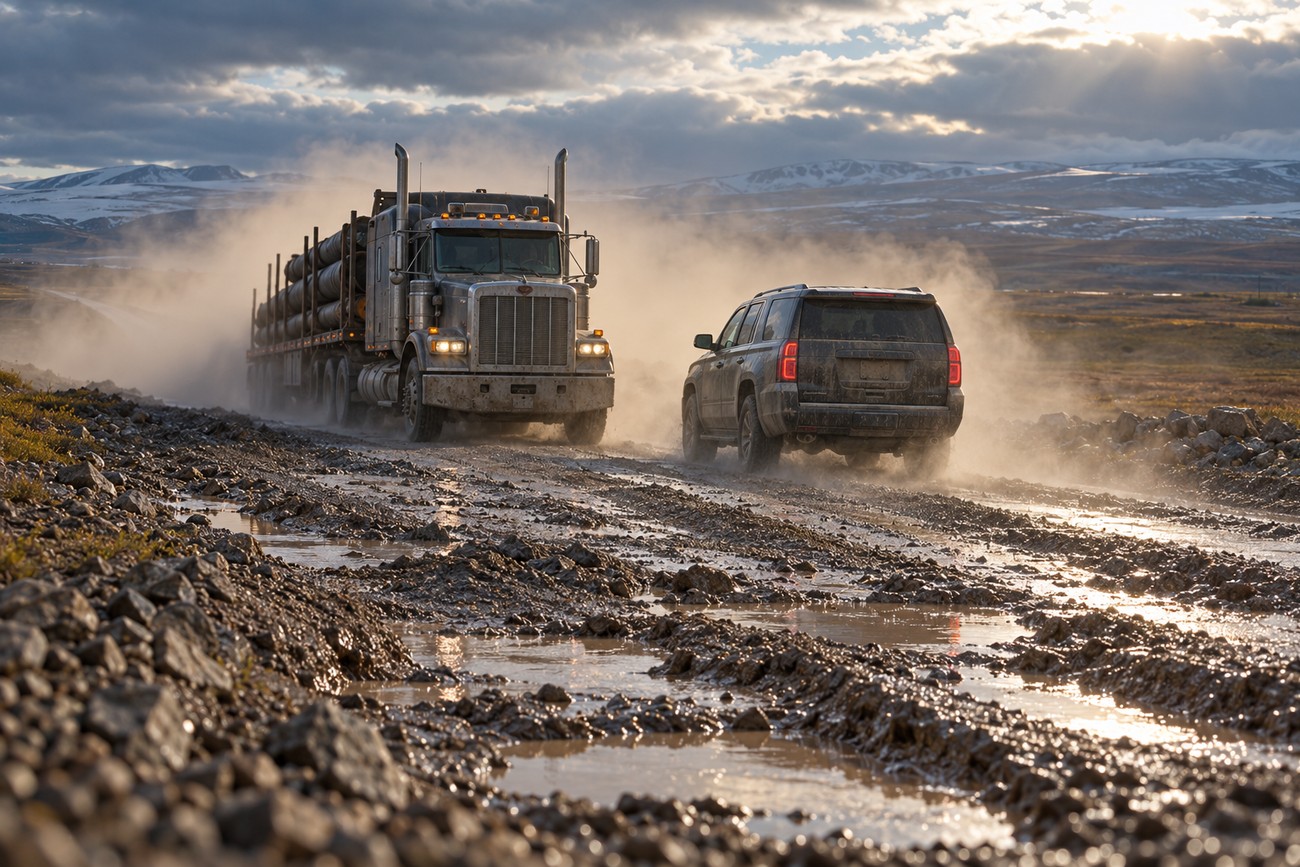
The Dalton Highway runs approximately 666 km (414 miles) from the Elliott Highway to Deadhorse. Most of the route is gravel, with asphalt on selected sections. That description matters because a large SUV may feel stable and comfortable on a smooth stretch, then encounter a sharply broken surface with little warning.
Alaska DOT& PF warns that the highway can be dirty, dusty, potholed, muddy, and difficult, and that it requires a prepared vehicle. Dry weather can produce a dense dust cloud behind or ahead of a truck. Rain can turn gravel slippery and increase the risk of sliding, while potholes and washboard can appear after a stretch that initially looks easy.
Drivers should expect the road surface to change faster than their confidence. A maintained-looking section can lead into deep corrugation, loose stone, standing water, or abrupt depressions. Reduced visibility behind a truck makes the problem worse because the driver may see the damaged surface only after reaching it.
One forum source claims that most of the route is paved. That conflicts with the official predominantly gravel description and should not guide vehicle preparation. Planning for a mostly paved highway would encourage the wrong tires, insufficient protection, and an unrealistic assumption that ordinary roadside help will be available.
Fuel, Food, Water, and Communication: Build for Isolation
A Yukon’s normal fuel range is not a dependable Dalton plan. Rough gravel, cold weather, idling, detours, slow progress, and delays can all increase consumption or reduce the distance that can be covered before refueling. Extra fuel creates time and decision-making margin when the next service point is unavailable or the route ahead is temporarily blocked.
Official Alaska road guidance recommends carrying extra fuel, food, water, a first-aid kit, warm clothing, and a spare tire. Each item covers a different failure. Food and water support a delay, warm clothing protects occupants if they must leave the heated cabin, and first-aid supplies matter when professional assistance may be delayed.
Pack the Yukon so that emergency supplies remain accessible even if luggage fills the cargo area. A full-size spare should be mounted securely, with a jack and tools that can actually lift the loaded vehicle and remove its wheel. Add equipment suitable for basic tire repair and recovery, while recognizing that tools are useful only if someone in the vehicle knows how to use them.
Cellular coverage may be absent for many hours after leaving Fairbanks and may be unavailable across much of the route until around Coldfoot Camp. GPS can show a position without providing a rescue route, and a phone can become irrelevant once it has no signal or power. Satellite communication is preferable for emergencies; a CB radio on channel 19 can help monitor truck traffic where available.
Plan for the possibility that a minor failure becomes an overnight delay. Keep water, food, warm clothing, first-aid supplies, a charged communication device, and basic lighting inside the passenger area rather than buried under cargo. A 4WD SUV can still be immobilized when fuel, communications, or emergency supplies are inadequate.
Prepare the Yukon Before Leaving Fairbanks
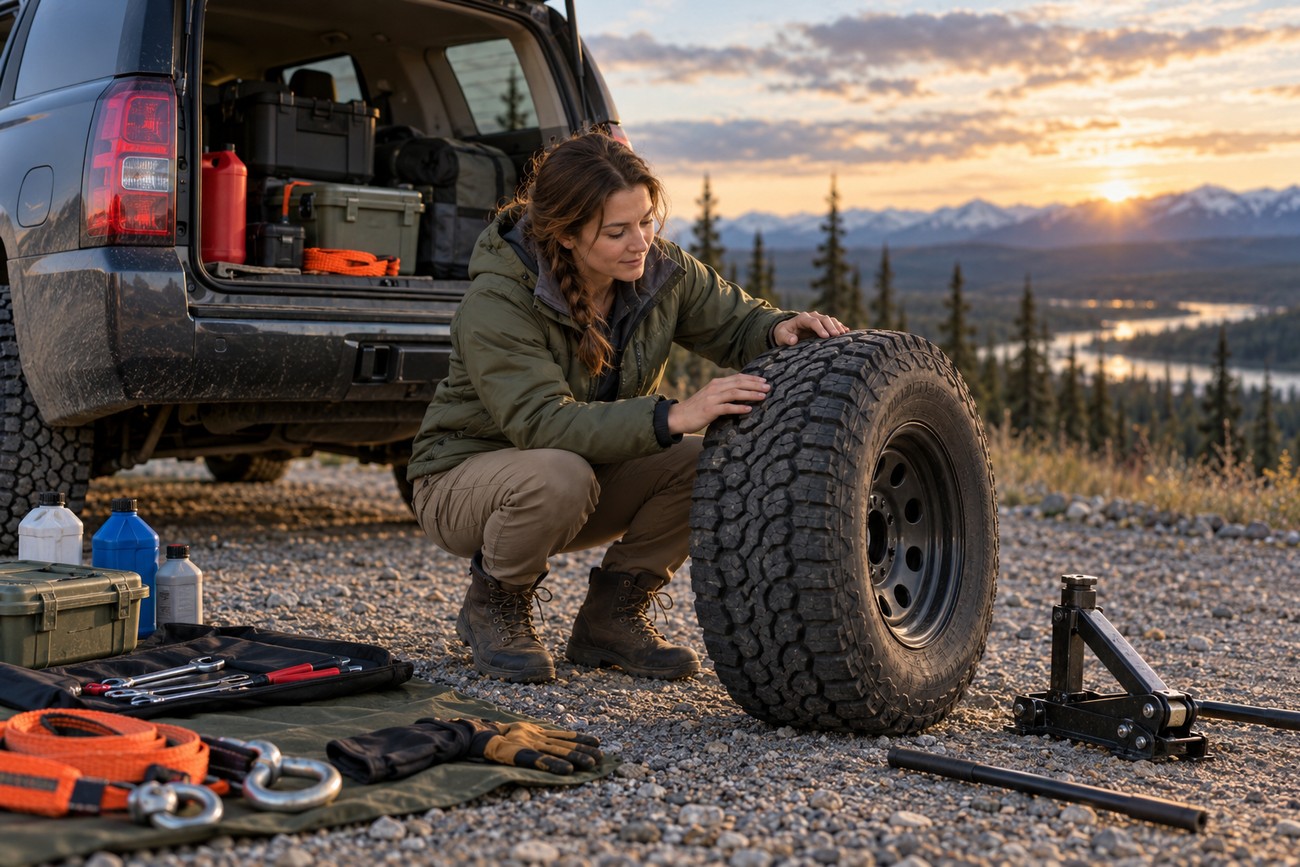
Begin with the tires, because they are the Yukon’s contact with every pothole, stone, and wet section. Inspect tread, sidewalls, valve stems, and pressures, including the spare. BLM guidance specifically includes checking tires and fluids before departure, and that inspection should cover leaks, brake fluid, engine oil, coolant, transmission fluid where appropriate, and windshield-washer fluid.
Confirm that the full-size spare is present, inflated, and compatible with the vehicle’s wheel and tire system. Test the jack on level ground before departure rather than discovering in mud or gravel that it cannot reach the correct lifting point. A tire-pressure gauge, compressor, plug kit where appropriate, gloves, and a way to loosen the wheel nuts are more valuable than decorative recovery equipment that has never been tested.
Cold-weather readiness deserves attention even during a summer departure. Check the battery, charging system, lights, wipers, heater, and defroster. Carry a windshield-cleaning method that works in dust and mud, and consider the exposure of the glass to stone impact. Tire selection matters more than the badge on the grille; winter-capable or studded tires may be appropriate when conditions justify them and local rules permit their use.
Rental status is a separate go-or-no-go issue. Many rental vehicles are not permitted on the Dalton Highway, and a policy may exclude damage, roadside assistance, or travel beyond a defined point. Obtain written permission, confirm insurance exclusions and assistance limits, and check whether the supplied tires and spare are suitable for the route. A rental counter’s general statement that the vehicle is an SUV is not route authorization.
How to Drive Around Trucks, Gravel, and Road Damage
Trucks and oversize loads are common on the Dalton Highway, so the Yukon driver must treat every meeting as a traffic-management problem. Reduce speed when the surface deteriorates, leave a generous following distance, and avoid sitting in a truck’s dust plume. Dust can hide potholes and stones, while the truck may brake or move around damage with little warning.
Gravel thrown by a heavy vehicle can chip or crack the windshield and damage bodywork. A large Yukon offers occupants more mass and space, but its windshield is still exposed and its tires can still be punctured. If a truck approaches, slow down, keep your lane, and give the oncoming vehicle room according to the road conditions; do not assume the larger-looking passenger vehicle has priority.
Experienced drivers avoid remaining in a truck’s dust and stone line because visibility and tire-impact risk can deteriorate together. CB channel 19 may help anticipate meetings, but the radio never replaces a clear view, a safe stopping distance, or a decision to wait.
Passing requires a clear surface, adequate visibility, and enough room to complete the maneuver without entering a hidden pothole or an oncoming traffic lane. A CB can help monitor truck movements where available, especially around blind terrain or narrow sections, but messages may be incomplete or misunderstood. Visual judgment remains the controlling factor.
After rain, wet gravel can become slippery, and a previously firm shoulder may not support the Yukon’s weight. In dry conditions, increase spacing rather than trying to see through dust. Following trucks slowly and maintaining distance reduces exposure to stones, sudden braking, and the loss of road visibility that turns a manageable surface into a surprise.
Weather, Atigun Pass, and the Cost of a Closure
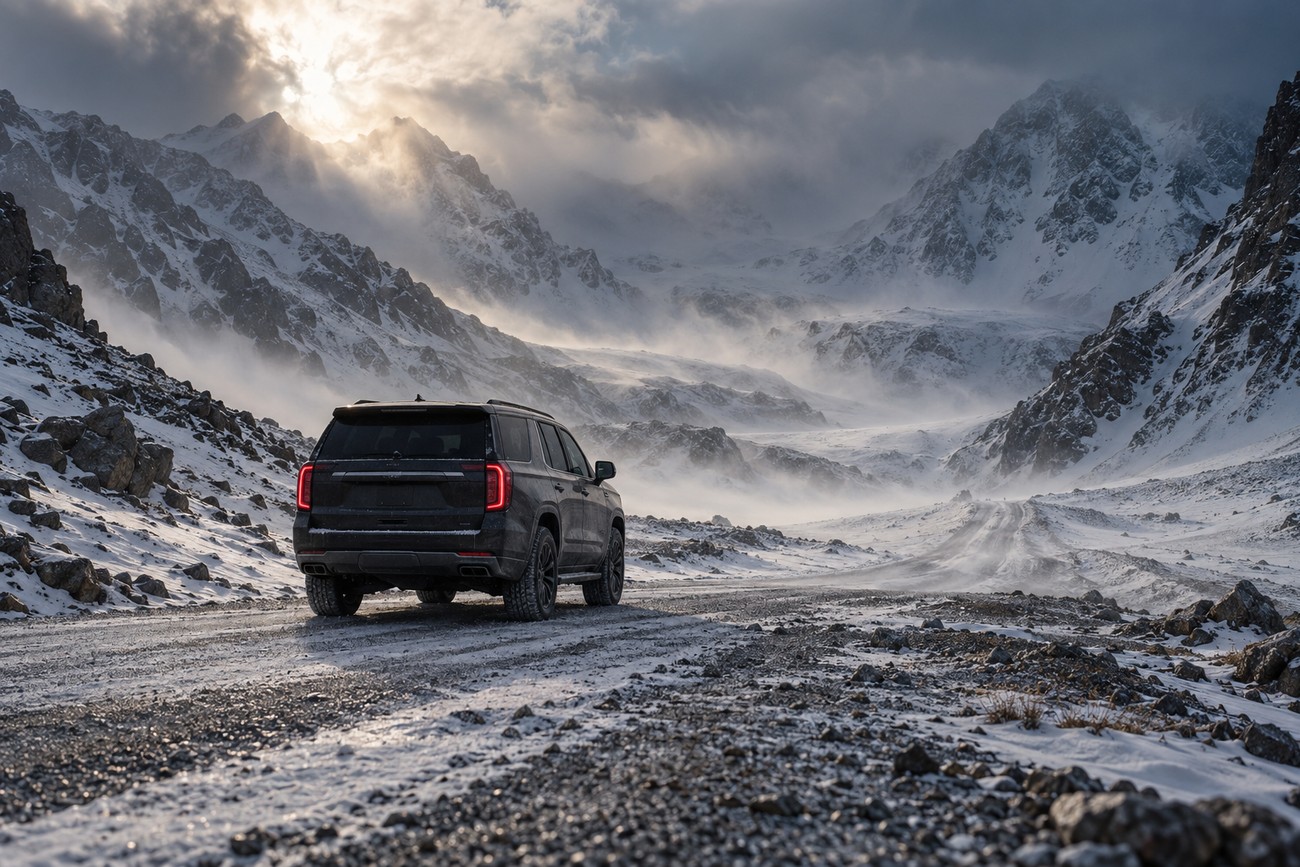
Summer does not remove winter risk from the Dalton Highway. Snow is possible in July, and north of Coldfoot, snow and ice are possible in any month. Winter conditions may begin as early as August and continue into June, so a calendar date is only one part of the decision.
Atigun Pass deserves particular respect because avalanches and road closures are possible there. A closure can last for days, and DOT& PF warns that drivers may be stranded on the highway for an extended period. The practical consequence is simple: a schedule built around arriving on a particular day has little value if the pass becomes unsafe.
Keep warm clothing inside the cabin, even if the forecast at departure suggests mild weather. Carry enough food and water to remain comfortable during a delay, and preserve a fuel reserve for heating and repositioning the vehicle. The Yukon’s heater is useful only while fuel, battery capacity, and a functioning engine remain available.
A no-rush schedule makes better decisions possible. If snow, ice, poor visibility, or a closure warning appears, waiting is often safer than forcing a crossing to protect a timetable. The same principle applies when the road turns muddy or the vehicle develops a tire, steering, or warning-light problem: stop early, assess the margin, and turn around if continuing would depend on luck.
The Mistakes That Turn a Yukon Trip Into an Emergency
The first failure mode is starting with marginal tires because the vehicle has 4WD. Worn tread, unsuitable construction, incorrect pressure, or a damaged sidewall can turn loose gravel into a loss of control or a puncture. Four-wheel drive can distribute engine power; it cannot create tire grip or repair a damaged casing.
The next mistake is carrying no full-size spare or repair kit. A slow leak may be manageable near a town, but a sharp stone or pothole can leave the vehicle unable to continue. If the spare is missing, incompatible, underinflated, or inaccessible under luggage, the advertised capability of the Yukon has little practical value.
Fuel is another compounding risk. A driver who begins with a normal range, encounters rough road, idles in cold weather, and then waits for a closure may discover that the original calculation allowed no margin. Trusting phone navigation creates a similar weakness: a map can assist with orientation, but it cannot guarantee current road conditions, cellular access, or immediate recovery.
A clear forecast is not a promise that conditions will remain clear at Atigun Pass or north of Coldfoot. Assuming that summer weather will hold, that a truck will always be nearby, or that 4WD makes the route safe can turn several small oversights into prolonged isolation. The principal vulnerability is remoteness, vehicle damage, and delayed assistance rather than a simple lack of engine power.
A Go-or-No-Go Decision Framework for the Dalton
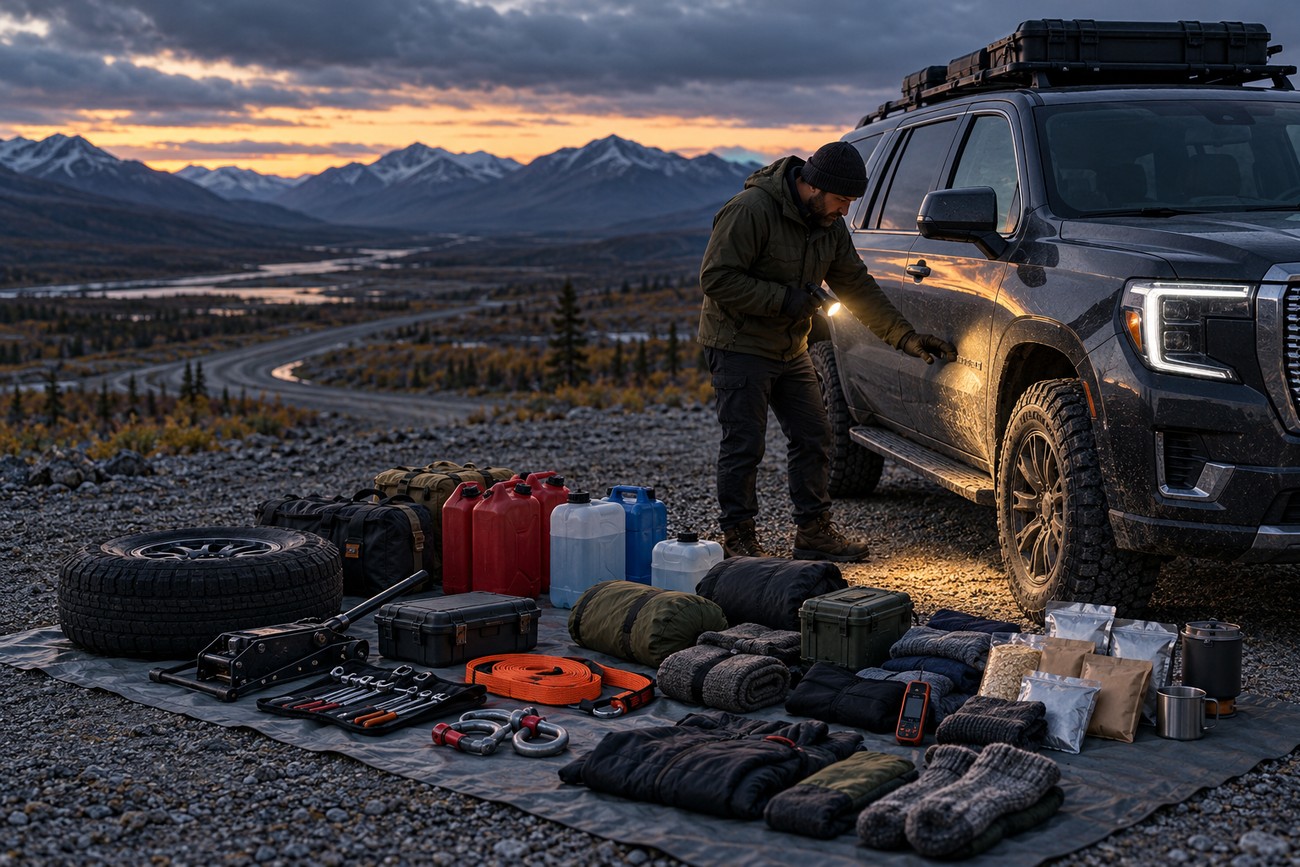
Make the decision in layers. First, confirm that the Yukon is legally and contractually eligible for the route, then inspect the tires, fluids, battery, lights, spare, jack, tools, and recovery equipment. Next, confirm extra fuel, food, water, warm clothing, first-aid supplies, and working communication equipment. A missing layer should delay the trip rather than be treated as a minor inconvenience.
Check current weather and road information, with particular attention to the forecast around Atigun Pass and conditions north of Coldfoot. Ask whether the schedule allows waiting for days without creating a dangerous fuel or food shortage. If the route is already deteriorating and the plan depends on crossing before conditions worsen, postponing is the rational choice even with a capable Yukon.
Think of the trip as a remote road journey with an independent support plan, not as an ordinary scenic drive. The Yukon should have suitable tires, a functioning full-size spare, enough fuel and supplies for delays, and a communication method that does not depend entirely on cellular coverage. A rental vehicle also needs written permission and clear coverage for the Dalton Highway.
Use this sequence before departure:
- Confirm vehicle authorization, current road information, and weather conditions.
- Inspect the tires, spare, fluids, battery, lights, glass, jack, and tools.
- Load extra fuel, food, water, warm clothing, first-aid supplies, and repair equipment.
- Test satellite communication and carry a CB radio on channel 19 where possible.
- Set a schedule with room to wait, turn around, or abandon the crossing.
Frequently asked questions
The Dalton Highway rewards preparation more than confidence. These answers address practical distinctions that are easy to miss when a Yukon’s comfort and four-wheel drive make the trip appear routine.
How fast can you drive on the Dalton Highway?
There is no meaningful universal trip speed for the Dalton Highway. Usable speed changes with washboard, potholes, dust, wet gravel, truck traffic, visibility, and posted limits. The correct pace is the one that preserves stopping distance, keeps the vehicle stable, and allows the driver to identify changing damage before reaching it.
A smooth-looking surface can end abruptly, and a truck’s dust can conceal both road damage and oncoming traffic. Slowing down before visibility deteriorates is safer than maintaining a planned average speed. The condition of the road, rather than the Yukon’s engine or suspension capacity, should determine the pace.
What is the best month to drive the Alaska Highway?
The Alaska Highway and the Dalton Highway are different roads, so a month that is comfortable for a trip on the Alaska Highway does not automatically remove snow, ice, or closure risk on the Dalton. The Dalton can have snow in July, and north of Coldfoot, snow and ice are possible in any month.
Choose the month according to the specific road, vehicle preparation, current conditions, and tolerance for delay. A generally favorable travel period can still include winter-like weather at higher or more exposed sections of the Dalton. Check conditions shortly before departure and keep enough flexibility to wait or turn around.
Which highway in Alaska is considered the deadliest?
There is no reliable single official answer that ranks one Alaska highway as the deadliest for every driver and every year. Risk depends on traffic, weather, road surface, visibility, vehicle condition, driver behavior, and the availability of assistance.
For the Dalton Highway, the defining danger is its remoteness combined with gravel, heavy trucks, severe weather, closures, and limited communications. That makes preparation and a margin for delay more useful than relying on a simplified road ranking.







