
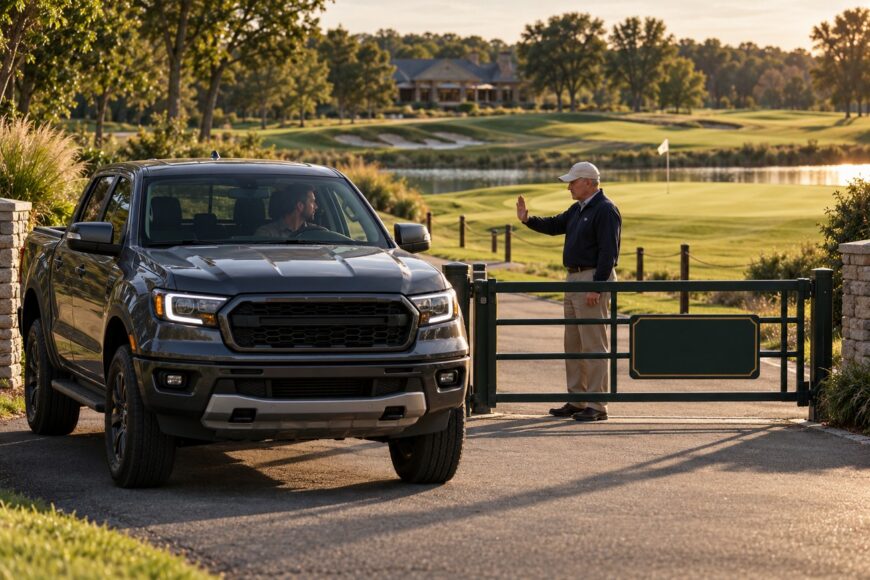
A Ford Ranger may handle rough terrain, while a golf course is a regulated sporting surface rather than ordinary off-road ground. Its tees, fairways, rough, greens, and bunkers are maintained for play, with access controlled by the club’s Committee.
An unapproved drive can leave ruts, damage drainage or buried irrigation equipment, interrupt play, and create a safety hazard around players. A promotional pass can therefore become a repair bill, an insurance dispute, or a club ban. The vehicle’s capability does not provide permission to enter.
- Is Driving a Ford Ranger on a Golf Course Allowed?
- Why a Golf Course Is Not Ordinary Off-Road Terrain
- What Can Go Wrong: Turf Damage, Safety, and Liability
- If Access Is Approved: Plan the Route and Conditions
- The Golf-Course PR Trap: Capability Is Not Permission
- Frequently asked questions
- What years of Ford Ranger should I stay away from?
- Which SUV is best for carrying golf clubs?
- What is the 90-degree rule for golf carts?
Is Driving a Ford Ranger on a Golf Course Allowed?
Permission comes from the club or its Committee. The absence of a warning sign does not create access rights, and the Ranger’s four-wheel-drive or off-road specification has no bearing on the club’s vehicle policy. The Committee determines boundaries, permissions, and temporary closures.
Most club rules prohibit vehicles on tees, greens, fairways, bunkers, and protected dark-green or yellow turf. Some clubs prohibit guest use of powered vehicles across the course altogether, reserving vehicle access for maintenance, emergencies, or specifically approved service work.
Staff access is usually a controlled operational exception. Maintenance vehicles may have designated routes, schedules, and procedures that account for turf conditions, buried systems, and player safety. Those arrangements do not automatically extend to a privately owned pickup, guest, sponsor, or media crew.
Written authorization should identify the driver, vehicle, route, date, operating window, spotter arrangements, and responsibility for damage. It should also state whether the club can stop the activity because of weather, play, or changing ground conditions. A casual verbal agreement with a member or employee offers weak protection when the Committee, insurer, or property owner later reviews the entry.
Why a Golf Course Is Not Ordinary Off-Road Terrain
An 18-hole course is typically 6,000–7,000 m long and contains distinct playing zones: tees, fairways, rough, greens, and bunkers. Each zone has a different maintenance purpose, soil profile, mowing regime, and tolerance for traffic. A line that appears firm from the driver’s seat may still be unsuitable for a heavy vehicle.
Golf-course turf is a sports surface supported by layered soil, drainage, irrigation, and buried infrastructure. Sprinkler heads, electrical lines, drainage runs, plastic access covers, and inspection points may sit below or close to the grass. A tire crossing one of these components can create a repair problem even when the surface shows little immediate damage.
Off-road traction measures the ability to maintain movement over uneven ground. Turf-safe loading depends on how the vehicle distributes weight, how sharply it turns, and how its tires interact with the root zone. Golf-cart tires and pickup tires distribute load differently, so a Ranger’s ability to climb or cross rough ground does not establish compatibility with the turf.
Wet conditions amplify the risk. Rain, irrigation, standing water, and soft rough increase rutting, slipping, wheelspin, and recovery risk. A turning maneuver can tear the surface more severely than a straight pass, while a recovery attempt can extend damage into adjacent turf.
Course bridges and paths may be designed around golf-cart traffic, with a benchmark of at least 2 m in width and 2 t load capacity. That figure is an engineering limit for golf-cart-oriented access, not permission for a Ranger to travel across the course. The path surface, approach grades, edge protection, and supporting structure still require specific approval for the proposed vehicle.
What Can Go Wrong: Turf Damage, Safety, and Liability
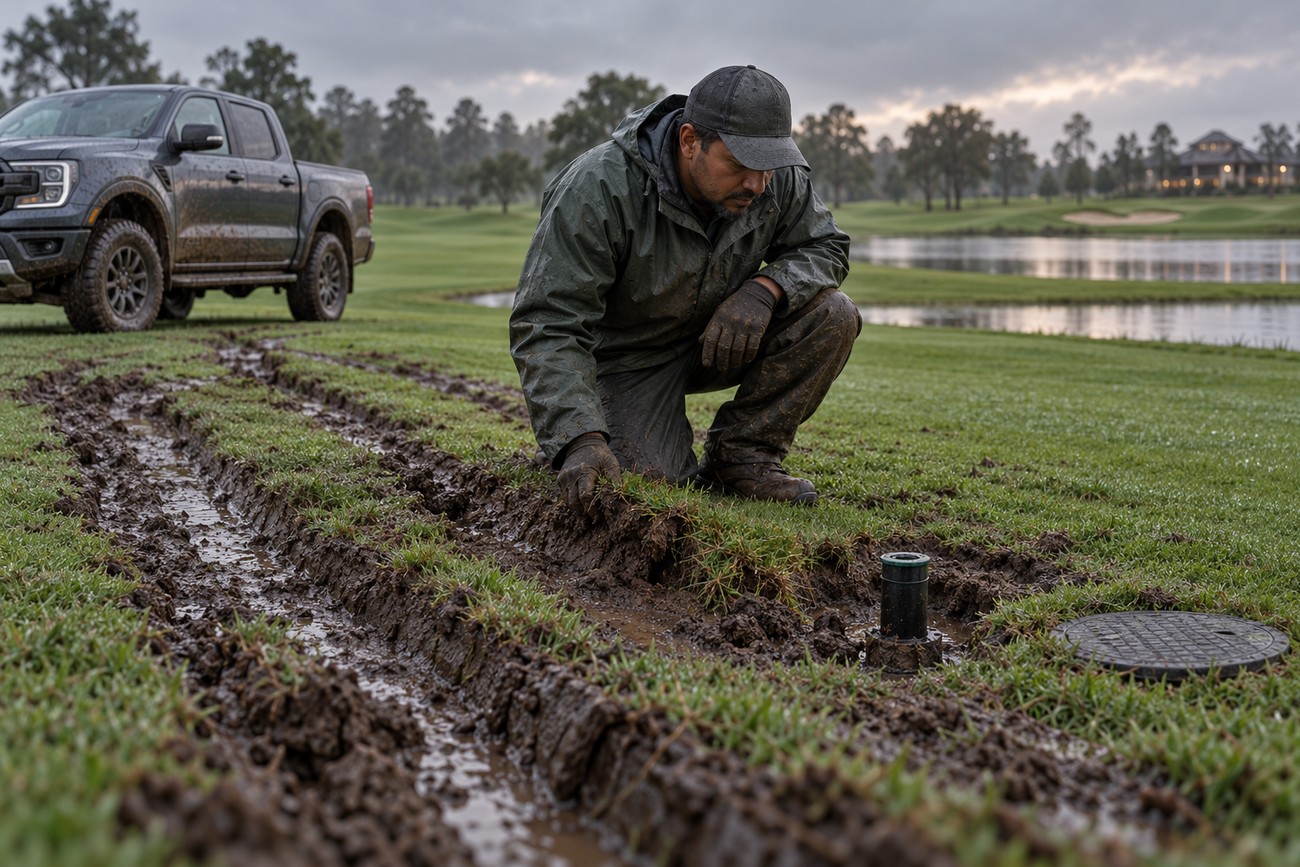
One unauthorized pass can create ruts that remain visible after the vehicle leaves. Pickup ruts may require weeks of restoration, including leveling, reseeding or replacing turf, and careful management of the affected area. Play may need to be redirected while the surface recovers.
The damage can extend below the grass. A tire or axle can strike drainage components, sprinkler heads, or plastic access covers, and a heavy vehicle can compact soil around buried systems. These failures may appear later, making the final repair cost harder to connect to the original entry.
Players add a separate safety concern. A moving pickup can cross a line of play, distract golfers with noise or movement, and limit the driver’s ability to see people hidden by terrain or vegetation. The Committee may close part or all of the course after dangerous vehicle behavior, affecting players, staff, and scheduled events.
Insurance may deny claims when vehicle entry is intentional or grossly negligent. The driver or organizer may then face repair charges directly, along with a club ban or wider reputational consequences among clubs in the region. Responsibility can also become more serious when people are exposed to vehicle movement, because the event may involve a safety threat rather than property damage alone.
If Access Is Approved: Plan the Route and Conditions
Treat approved access as a controlled service or media operation. Obtain written authorization before the vehicle arrives, confirm the driver and any spotter, and have the club inspect the route on the day. The route should be dry, stable, and limited to technical roads or specifically approved rough lines.
Plan the fewest possible turns, passes, and reversals. Exclude greens, tees, bunkers, fairways, young growth, repair areas, standing water, and visible or suspected infrastructure. Even golf carts should avoid standing water, repair zones, and young vegetation; a full-size pickup requires a wider margin of caution.
Route planners prioritize ground pressure, dryness, drainage covers, and the number of passes rather than choosing the firmest-looking line. A route that appears short can still be unsuitable if it concentrates load near a buried system or requires repeated turning.
Inspect bridges, path edges, gates, overhead clearance, and turning areas separately. A bridge or path rated for 2 t does not establish that the whole course can carry a pickup, and a published rating may reflect golf-cart traffic rather than the Ranger’s actual operating conditions. Stop the operation if the surface softens, water appears, visibility declines, players enter the area, or the vehicle begins to slip.
Follow applicable traffic laws and Ford’s operating guidance, monitor the surface continuously, and avoid driving modes or maneuvers that can damage the ground or cause loss of control. The club’s marshal or site representative should have authority to abort the activity immediately. If the approved route cannot be maintained safely, the vehicle should leave by the agreed route or remain off the course.
The Golf-Course PR Trap: Capability Is Not Permission
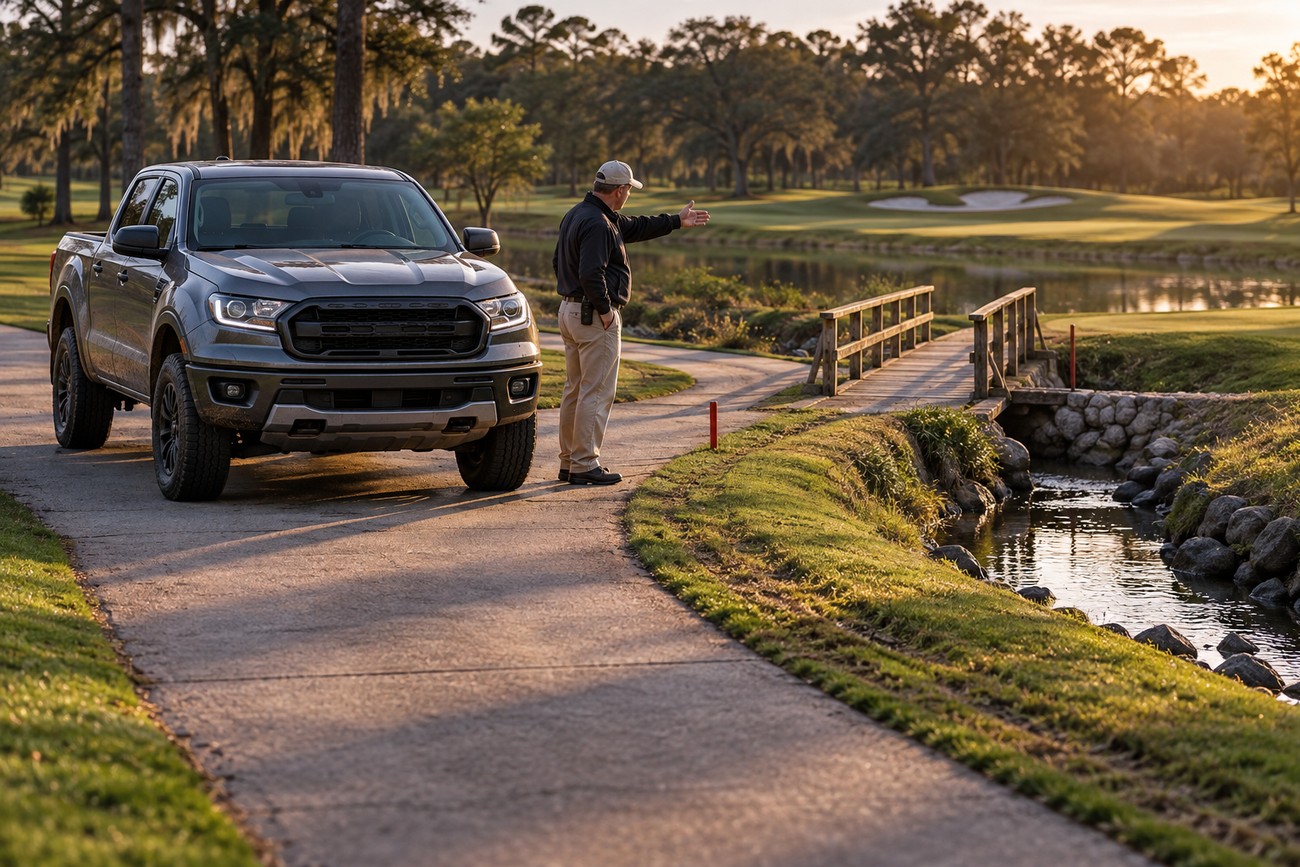
A capable 4×4 can cross ground that a golf course cannot afford to repair. Off-road performance describes traction, clearance, and control on suitable terrain; it says little about root-zone compression, turf recovery, drainage, or the protection of buried systems.
The 2 t bridge benchmark creates another common misunderstanding. It relates to golf-cart-oriented access and does not validate pickup use across the course. The bridge may be only one part of the route, while the approaches, grass edges, drainage structures, and surrounding turf remain vulnerable.
Glossy demonstrations also hide the costs that matter to course operators. Camera angles can omit shallow ruts, compacted soil, damaged roots, and stressed drainage. Recovery work may continue after filming, and promotional access can lead to repair costs, insurance disputes, member complaints, and conflict with the club.
Ground pressure is the key hidden variable. Safer promotional options include filming from approved technical roads, using specifically authorized rough lines, or using a golf cart for course movement while showing the Ranger on a suitable off-road site. These choices preserve the distinction between demonstrating vehicle capability and placing sports turf at risk.
Frequently asked questions
What years of Ford Ranger should I stay away from?
No Ford Ranger model year creates automatic permission to drive on a golf course. Selecting an older or newer model cannot resolve the access, turf, safety, or liability issues.
For lawful road or approved service use, assess the owner’s manual, vehicle condition, tire type and condition, load, braking system, and intended road use. A vehicle in sound condition with suitable tires may still be prohibited from course access, while a club-approved operation must follow the specific route and conditions set by the Committee.
Which SUV is best for carrying golf clubs?
The practical choice depends on cargo layout, hatch opening, protected storage, and the ability to secure clubs without damaging them. A vehicle that keeps bags dry and prevents them from moving during transport may be more useful than one selected for off-road clearance.
Golf-club carrying needs are separate from course access. Even a vehicle with ample cargo space and suitable road manners does not gain permission to drive on tees, fairways, greens, bunkers, or other playing surfaces.
What is the 90-degree rule for golf carts?
The 90-degree rule is a golf-cart routing practice. The cart stays on the path until it is level with the player’s ball, turns at roughly 90 degrees onto the turf, travels directly to the ball, and returns to the path by a similar route when practical.
Clubs apply the rule only under their stated conditions, and they may suspend it because of wet ground, repairs, young vegetation, or other protection measures. It does not authorize a Ford Ranger or any other full-size vehicle to cross playing surfaces.







