
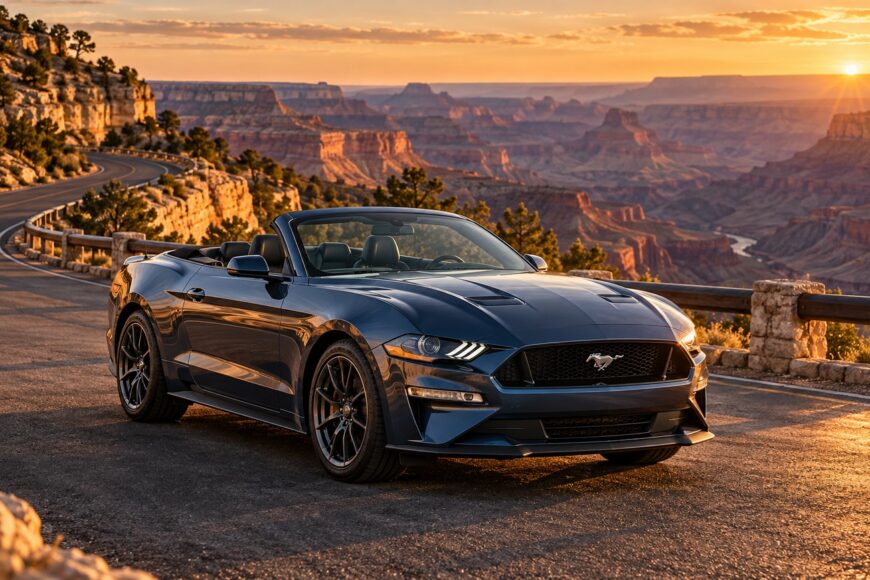
Arriving at the Grand Canyon in a Ford Mustang Convertible has an obvious appeal: the final approach can feel more connected to the landscape, especially on slower roads near viewpoints. The car adds a sense of occasion to a destination already built around changing light, open horizons, and long sightlines.
The practical choice is where the open roof genuinely improves the drive. On a scenic stretch at a moderate pace, it can make a short outing memorable. On a long highway transfer, however, wind noise, heat, loose luggage, and the Mustang’s smaller trunk may matter more than the convertible experience. Park access also depends on the season, so the best plan starts with the route and road status rather than the car’s image.
- Choose the drive before you choose the view
- Will the convertible fit the people and bags?
- Use the open roof where it improves the drive
- Know which South Rim roads you can actually drive
- Plan for heat, winter weather, and changing road status
- Build a canyon day around stops, not nonstop top-down miles
- Frequently asked questions
- What is the best month for a Mustang Convertible trip to the Grand Canyon?
- What parts of the Grand Canyon are off-limits to visitors?
- What is the best month to travel to the Grand Canyon?
- What is the most scenic route to the Grand Canyon?
- What part of the Grand Canyon is forbidden to go to?
Choose the drive before you choose the view
The right approach to the Grand Canyon depends on where your trip begins. A route from Phoenix, Las Vegas, Flagstaff, or another starting point will place different demands on the car, and no single approach road works as a universal recommendation. Treat the highway journey and the scenic driving inside the park as separate parts of the experience.
The South Rim is open year-round, although snow and ice can make roads hazardous and cause temporary closures. Once you arrive, Desert View Drive is generally accessible to ordinary vehicles year-round, subject to temporary closures such as those caused by snow or ice. It is therefore one of the clearest ways to combine a Mustang with a driveable park road, provided current conditions allow it.
Hermit Road requires a different decision. From March 1 through November 30, private vehicles generally cannot use it, so arriving in a convertible does not mean you can drive to its viewpoints. During that period, visitors normally park where directed and use the free shuttle; vehicles with qualifying disability permits are an exception.
Winter changes the arrangement rather than removing the choice altogether. From December through the end of February, Hermit Road is open to private vehicles, but shuttle service does not operate, and weather restrictions may apply. Neither road guarantees uninterrupted views: snow, ice, poor visibility, or an active closure can override the normal seasonal rule.
Will the convertible fit the people and bags?
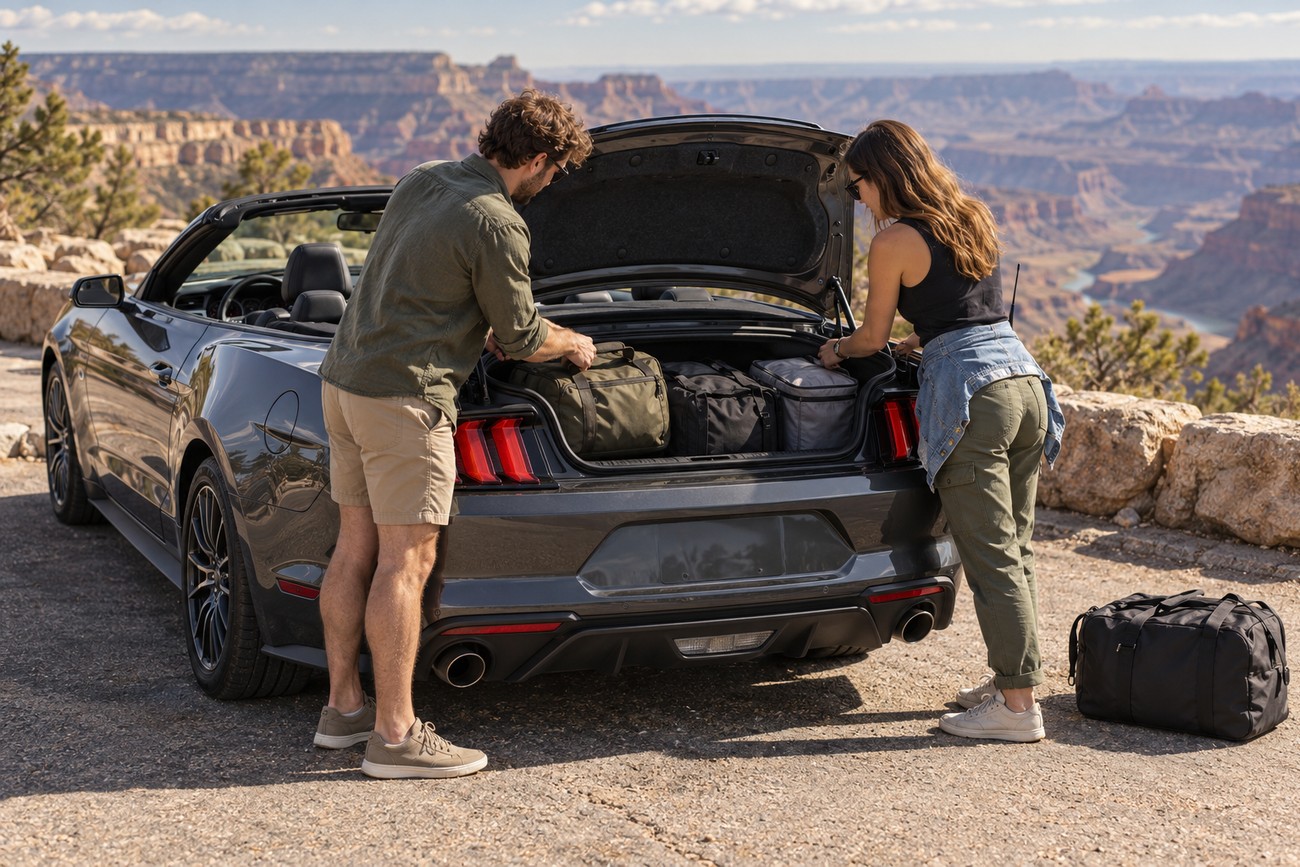
The 2026 Mustang Convertible has 10.3 cubic feet of trunk space. The 2026 Mustang Fastback has 13.3 cubic feet, so the difference is 3.0 cubic feet. That gap can decide whether a group can pack neatly or whether passengers must share limited cabin space with soft bags.
The passenger volume is 79.2 cubic feet, but that figure does not turn the rear seats into a comfortable place for adults on a long transfer. One discussion reports limited adult rear-seat comfort and strong turbulence for rear passengers from roughly 30 mph. That is a driver-reported impression, not an independently verified threshold or comparative test result. If adults will spend substantial time in the back, give them a realistic preview before committing to a full canyon trip.
Pack around the actual car rather than an assumed suitcase count. Place the bags you intend to take beside the vehicle, check their dimensions, and test whether the trunk closes without forcing the luggage into an awkward arrangement. If the roof mechanism affects how you load or access the trunk, rehearse that operation before departure; do not assume that lowering the roof changes the stated trunk volume.
A two-person trip with compact luggage is easier to manage than a family journey with rigid cases, camera gear, winter layers, and day packs. Keep items needed at viewpoints accessible, and avoid filling the passenger area with loose objects that can move during braking or become exposed when the roof is down. The Fastback is the more practical choice when luggage or rear-seat passengers are central to the trip.
Use the open roof where it improves the drive
The convertible works best when you choose the open roof for particular sections rather than treating it as the default setting. Short, slower stretches near scenic stops can make the air, sound, and scale of the landscape part of the experience. Long highway transfers are a different proposition, especially when traffic moves at typical speeds of 65–80 mph.
Drivers report substantial wind and noise at those speeds with the roof down. Conversation becomes harder, fatigue can build, and navigation or music may require more attention than expected. Heat adds another variable: under strong sun, an open cabin can become uncomfortable, particularly when the road offers little shade and the car is traveling slowly.
Carry water, use sun protection, and secure maps, clothing, and other light items before opening the roof. A flexible plan might keep the roof up for the main approach, lower it for a quiet scenic road or a brief viewpoint connection, and raise it again when the pace increases. Tolerance varies by passenger, so the driver’s enthusiasm should not determine everyone’s comfort.
Know which South Rim roads you can actually drive
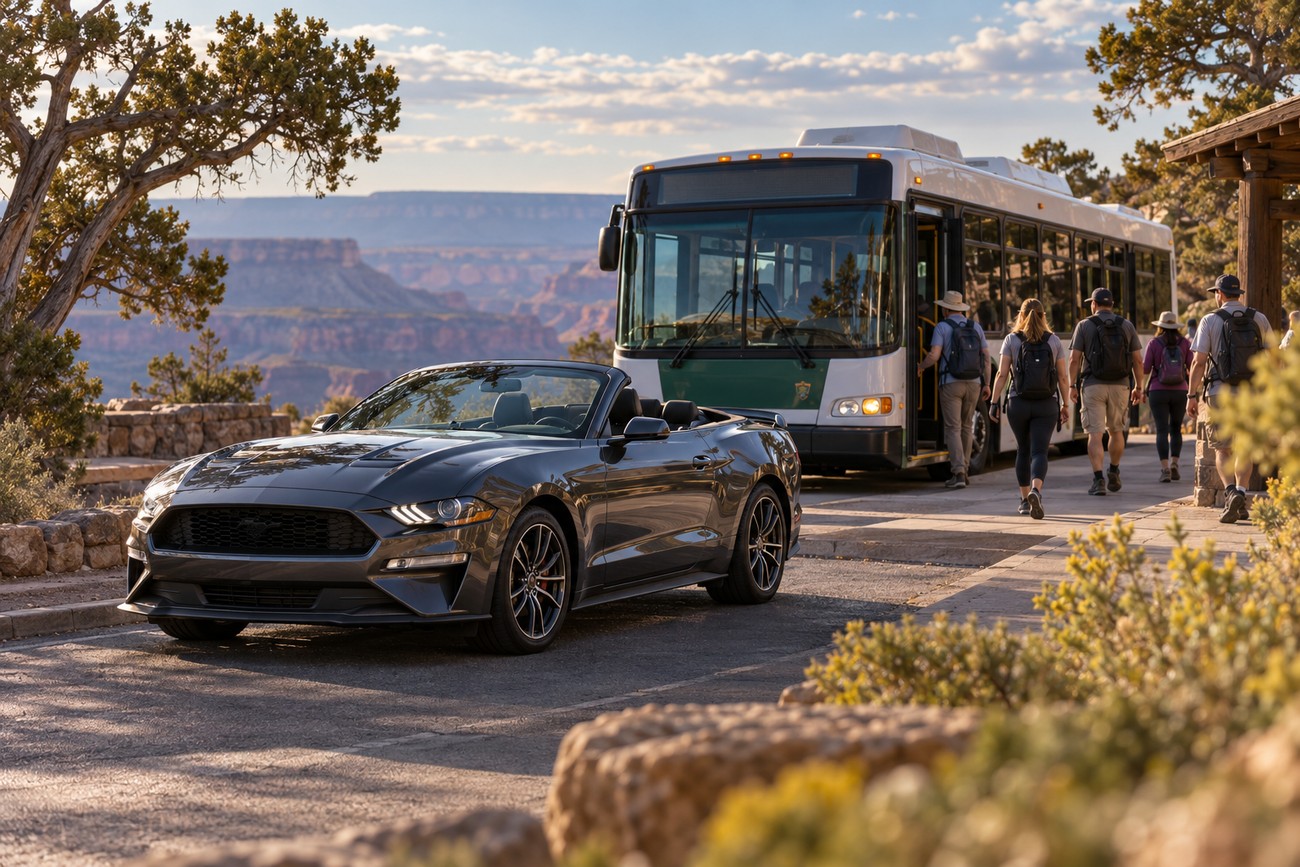
Hermit Road is the rule most likely to disrupt a Mustang-based itinerary. From March 1 through November 30, it is closed to private vehicles and served by a free shuttle. Unless the vehicle has a qualifying disability permit, plan to leave the Mustang in the designated area and take the shuttle rather than expecting to drive from overlook to overlook.
From December through the end of February, private vehicles may use Hermit Road, while shuttle service does not operate. That seasonal access can make a winter convertible trip more flexible in principle, but it does not create a weather exemption. Snow, ice, poor visibility, or a temporary park closure can still make the road unsuitable or unavailable.
Desert View Drive offers a more straightforward vehicle-based option. It is generally accessible to ordinary vehicles year-round, except during temporary closures such as those caused by snow or ice. The word “generally” matters: current notices take priority over a normal seasonal pattern.
Plan each stop as its own access point. Viewpoints can differ in parking, walking distance, traffic flow, and restrictions, so an assumption based on one overlook may fail at the next. A convertible is useful for moving between accessible scenic areas, but it does not provide access to roads closed to private vehicles.
Plan for heat, winter weather, and changing road status
The South Rim being open year-round means the destination remains part of the park’s operating plan; it does not promise clear pavement or comfortable convertible weather. Winter conditions can change quickly, with snow, ice, reduced visibility, and temporary road closures appearing after a forecast that looked manageable. A roof that is enjoyable in mild sun becomes irrelevant if the road itself is slippery.
Before leaving, check AZ 511, current NPS road alerts, and NPS webcams. The South Entrance webcam is especially useful because it can show snow or visibility changes that a general forecast may not communicate clearly. Check again near the park, since a morning road status may not describe conditions later in the day.
NPS uses stone screenings to improve traction rather than salt or chemical deicers. Screenings can help a vehicle find grip, but they do not melt ice or eliminate slippery pavement. Chains are generally not required, though they may be needed in snow, so winter drivers should understand the vehicle’s equipment and avoid treating the absence of salt as proof of normal traction.
The North Rim is a separate planning question. Highway 67 typically closes in winter, ending vehicle access to the North Rim until it reopens. The North and South Rims are therefore not interchangeable destinations for a winter road trip, even though the South Rim remains open year-round subject to weather-related restrictions.
Build a canyon day around stops, not nonstop top-down miles
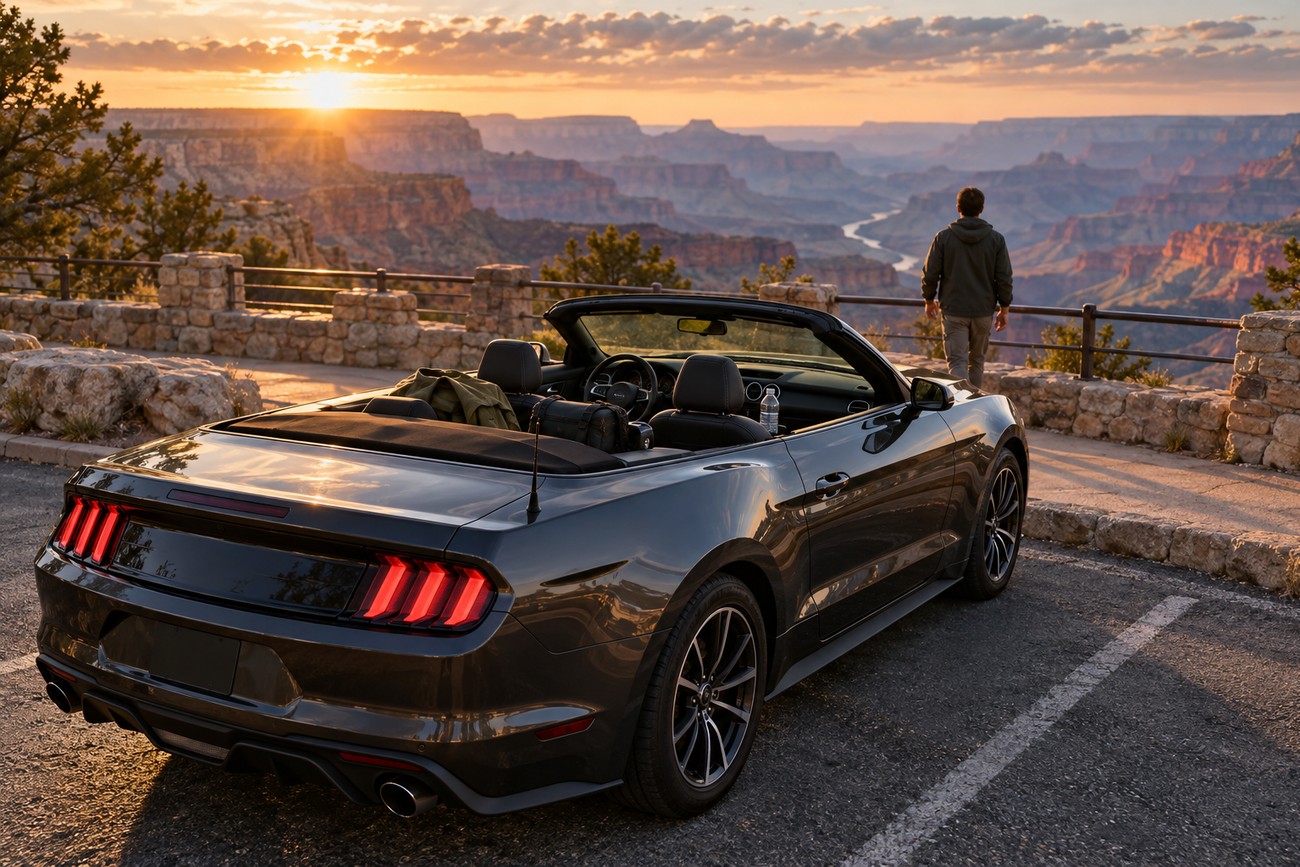
Start the day by checking road conditions, park alerts, and the webcam view. Use the Mustang comfortably on faster roads with the roof up, especially when traffic is moving at 65–80 mph, and save the roof-down experience for sections where the lower speed and scenery justify it. This approach keeps the convertible enjoyable instead of turning every mile into a test of noise and heat tolerance.
Before leaving the car, secure jackets, maps, camera accessories, and anything light enough to move in the wind. Keep water and sun protection easy to reach. Choose a scenic stretch that ordinary vehicles can currently access, then allow time for parking, walking, and looking at the canyon rather than measuring the day by the number of roof-down miles.
If the itinerary includes Hermit Road between March 1 and November 30, build in the free shuttle from the outset. The Mustang will not replace that service, apart from vehicles with qualifying disability permits. In winter, private-car access may be available from December through the end of February, but the absence of shuttle service and the possibility of weather restrictions require a different backup plan.
Extra time is more valuable than an aggressive schedule because conditions and access can change. A weather-dependent alternative, such as focusing on an accessible drive and nearby viewpoints, prevents one closure from spoiling the day. The Convertible is worth choosing for a small group, light luggage, and a flexible itinerary that values short scenic roof-down sections; passengers or bulky bags make the Fastback or another body style easier to live with, while an all-day open-roof expectation calls for a more flexible plan.
Frequently asked questions
The best time and route depend on the drive you want and the roads you can use. Hermit Road has seasonal private-vehicle restrictions, while weather can affect access elsewhere. Check current park notices before settling on an itinerary.
What is the best month for a Mustang Convertible trip to the Grand Canyon?
There is no single best month for every Mustang Convertible trip. Choose based on the balance you want between comfortable roof-down weather and Hermit Road access: from March 1 through November 30, private vehicles generally cannot use that road, while from December through the end of February private vehicles may use it if conditions permit, with no shuttle service.
Use the near-term forecast, AZ 511, NPS road alerts, and webcams before committing. A month that is pleasant for an open roof may still bring heat or wind on the approach, while a colder month can offer a different road arrangement but more uncertainty from snow and ice.
What parts of the Grand Canyon are off-limits to visitors?
Access restrictions usually apply to particular roads, overlooks, trails, facilities, or permit-controlled activities rather than to one entire rim being universally forbidden. Hermit Road’s private-vehicle restriction is a transport rule during its seasonal closure, not a statement that the whole area is off-limits to visitors.
Follow current NPS signs, barriers, notices, and permit requirements on the day of your visit. Do not infer that a closure at one overlook applies to every viewpoint, and do not bypass a barrier simply because another route in the park remains open.
What is the best month to travel to the Grand Canyon?
The best month depends on the purpose of the trip. Compare expected temperatures, snow and ice risk, road access, crowd conditions, and whether you want Hermit Road access by private vehicle or by shuttle. The South Rim is open year-round, but temporary weather restrictions can affect the practical value of any date.
For a convertible, make the final decision close to departure after checking the forecast and current road status. Comfortable temperatures alone do not guarantee that every scenic road or overlook will be available.
What is the most scenic route to the Grand Canyon?
There is no universally most scenic route because the answer depends on your starting point and which rim you intend to visit. For driveable scenery at the South Rim, Desert View Drive is a practical option when open, while Hermit Road requires the seasonal access plan described by the park.
Choose a route that leaves time for viewpoints and changing conditions rather than selecting one solely for maximum mileage. The most scenic road on a map may be unsuitable for a private Mustang during a seasonal vehicle restriction or temporary weather closure.
What part of the Grand Canyon is forbidden to go to?
No single South Rim area should be treated as permanently forbidden based on the Hermit Road rule. During the restricted season, private vehicles generally cannot use Hermit Road, but visitors can normally reach the area through the free shuttle, subject to current park notices and operating conditions.
Other locations may be closed by barriers, weather, maintenance, safety concerns, or permit requirements. The North Rim also has separate winter access conditions because Highway 67 typically closes, ending vehicle access until it reopens. Check current NPS information instead of assuming that one rim’s restriction applies to the entire canyon.







