
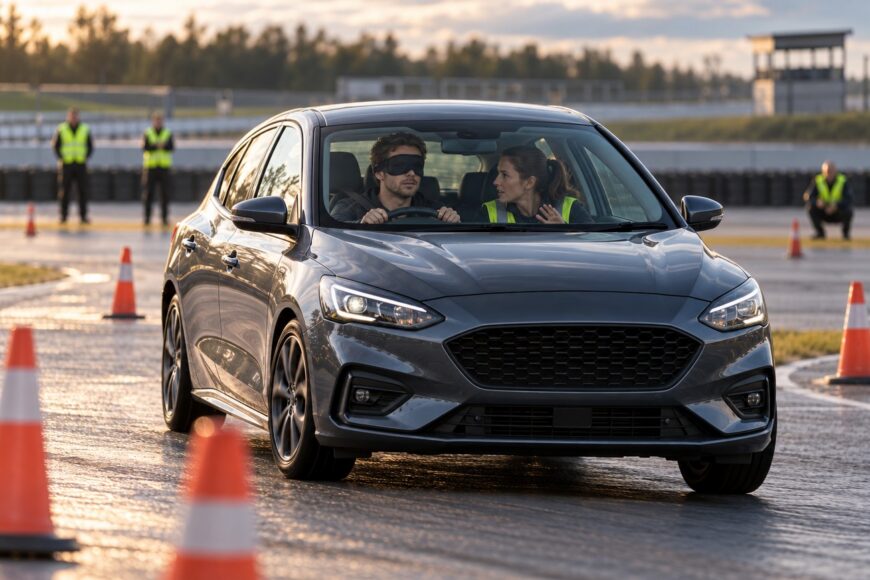
Can a navigator substitute for the driver’s vision? Voice instructions can describe a route, yet they cannot continuously judge lane position, clearance, road damage, pedestrians, or a vehicle’s changing attitude. A Ford Focus remains a fast-moving vehicle with enough mass to turn a small steering error into a serious collision.
A typical Ford Focus weighs approximately 1.2–1.5 tonnes, depending on generation and trim. Controlled demonstrations may look precise because they use a closed area, low speed, rehearsed commands, supervision, and contingency protection. Those conditions bear little resemblance to ordinary public-road driving.
Blindfold driving should therefore be treated as an unsafe stunt, not a repeatable road skill. A navigator may provide limited guidance, but voice navigation does not make deliberate loss of visual control safe or acceptable in normal traffic.
- What Blindfold Driving a Ford Focus Really Tests
- Why a Navigator Cannot Replace the Driver’s Eyes
- The Physics Behind the Risk
- Why Demonstration Videos Are Not Road Evidence
- Common Errors and the Focus’s Hidden Safety Limits
- What Ford Focus Driver Assistance Can—and Cannot—Do
- Frequently asked questions
- What year of Ford Focus should you stay away from?
- What is Ford’s blind-spot feature?
- What are some hidden features in a Ford Focus?
What Blindfold Driving a Ford Focus Really Tests
Driving depends on continuous visual feedback. The driver uses road edges, lane markings, nearby vehicles, shadows, signs, and obstacles to judge position and speed. Removing that information leaves sound and touch as partial signals, while the most important spatial information disappears.
Steering corrections that feel small inside the cabin can move the vehicle substantially across a lane. Without visual confirmation, the driver may not know whether the Focus is drifting, turning, correcting a previous error, or approaching an edge. This creates the feeling that the car has stopped responding to fine inputs and is “living its own life.”
A typical real-world reaction period is approximately 1–2 seconds. With visual control, that time can be used to recognize a hazard and choose a response; without it, the same interval becomes trajectory guessing. Near a kerb, cone, or obstacle, a positioning error of approximately 1–2 metres can be critical.
Why a Navigator Cannot Replace the Driver’s Eyes
A passenger or voice system can give a direction, yet it cannot supply a continuous visual survey of pedestrians, potholes, parked vehicles, road debris, or lateral clearance. A phrase such as “turn soon” may be too vague for a moving car, especially when the driver has already lost the lane reference.
Road and cabin noise can obscure spoken commands. The driver may ask for repetition, miss the next instruction, or receive it after the vehicle has already changed position. Small turns can trigger panic and abrupt braking, while an unclear instruction can leave the driver unsure whether to continue, correct, or stop.
The navigator also lacks direct access to the vehicle’s dynamics. A passenger cannot feel the driver’s steering effort, pedal control, tire grip, or the exact onset of a skid in the same way the driver can. Voice cues therefore cannot provide continuous control of the vehicle’s response.
The claim that voice navigation makes blindfold driving safe is unsupported by safety standards and ordinary driving practice. A navigator offers limited verbal or acoustic guidance; responsibility for the moving vehicle remains with the person operating it.
The Physics Behind the Risk

The Focus’s mass matters because a typical example weighs approximately 1.2–1.5 tonnes, depending on specification. Once moving, that mass carries momentum through steering corrections, braking, and changes in road grip. A delayed or incorrect response can therefore develop into a serious loss of control before the driver understands what is happening.
At 100 km/h, emergency stopping for a typical passenger car on dry asphalt is measured in tens of metres, not a couple of seconds. The driver must first identify the hazard, decide to brake, and then allow the vehicle and tires to do their work. Blindfold driving makes both the braking trigger and the available escape path uncertain.
Approximately 1–2 seconds of normal reaction time can cover a substantial distance before braking begins. Without visual input, that period is spent trying to infer the vehicle’s position from incomplete information. The result is a rapidly changing situation with fewer reliable options.
Low speed reduces energy, yet it does not remove the danger around people, kerb, cones, walls, or other fixed objects. At close range, an error of approximately 1–2 metres can determine whether the vehicle remains clear or makes contact.
Why Demonstration Videos Are Not Road Evidence
Professional or promotional demonstrations generally take place in controlled areas at low speeds. They may use a separate navigator or instructor, rehearsed or concise commands, supervision, favorable sound conditions, and protection against an expected mistake. These controls limit the number of variables that the driver must manage.
A public road adds unpredictable drivers, pedestrians, cyclists, drainage defects, changing surfaces, parked vehicles, and traffic signals. Noise also becomes less predictable, so a command that was clear on a quiet course may be missed in traffic. The driver has no dependable way to assess every developing hazard without vision.
Closed-course demonstrations can also be repeated until timing and commands are familiar. That preparation does not establish that the same behavior will work on another route or under different conditions. A successful clip demonstrates that a carefully managed event occurred; it does not prove repeatability or legality on public roads.
Ford Focus driver-assistance systems do not change this conclusion. They are assistance functions rather than autonomous driving, and they do not remove driver responsibility. A demonstration result cannot be generalized to ordinary road use.
Common Errors and the Focus’s Hidden Safety Limits
The most serious mistake is using enough speed to leave no time for correction. Other common failures include relying entirely on voice prompts, practicing on an ordinary road, and assuming that a memorized route will remain safe after conditions change. Route memory cannot replace continuous visual assessment of hazards and clearance.
Commands also fail when the driver and navigator have not agreed on short, unambiguous wording. Long explanations compete with road and cabin noise, while vague timing can cause the driver to turn too early, too late, or brake abruptly. Repeated steering corrections may then appear from outside as unstable wandering.
Standardized commands and a controlled audio environment matter because a lost visual reference is an immediate safety failure, not a signal to continue until orientation returns.
Voice guidance may lag behind the vehicle’s changing position and road situation. The navigator cannot see every obstacle, judge the exact lateral gap, or feel how the tires and steering are responding. The Ford Focus was not designed for blindfolded operation, so its normal controls and safety systems cannot be treated as a substitute for sight.
What Ford Focus Driver Assistance Can—and Cannot—Do
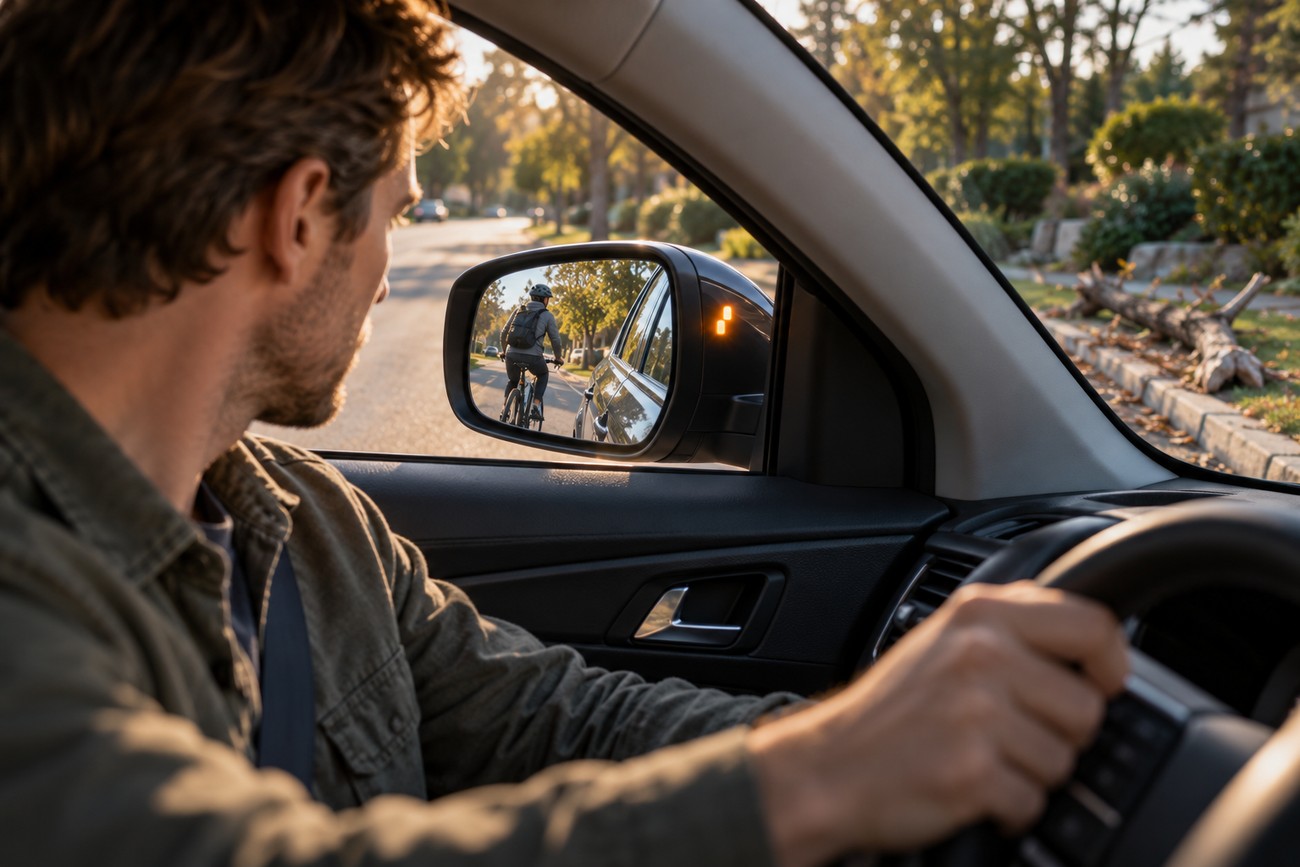
Ford Focus equipment varies by generation, market, engine, trim, and maintenance history. Depending on specification, a vehicle may offer functions such as blind-spot monitoring or other assistance features. Their presence should be verified against the vehicle’s equipment list and owner’s manual.
Blind-spot monitoring is generally a warning function that helps identify a vehicle in an area the driver may not see easily. It cannot provide a complete view of pedestrians, potholes, road edges, or every obstacle. Sensing range and behavior also depend on conditions and system design.
Some specifications may include additional steering or braking assistance, yet those functions remain conditional support. They can be limited by road markings, weather, sensor coverage, speed, or the type of hazard. Assistance does not turn a driver who sees nothing into a supervised autonomous system.
Factory safety systems are designed for an attentive driver who maintains visual control. They are not designed for deliberate blindfold operation, and driver responsibility remains with the person operating the vehicle.
Frequently asked questions
Ford Focus ownership questions often involve a specific generation and specification. Safety equipment, software behavior, reliability, and available settings can differ substantially between vehicles, so general advice should be checked against the individual car.
What year of Ford Focus should you stay away from?
There is no universally bad Ford Focus year without considering the generation, market, recalls, powertrain, service history, and inspection results. A poorly maintained example can be a worse purchase than a car from a generation with a mixed reputation but complete records and sound mechanical condition.
Check the vehicle identification details, recall status where applicable, maintenance documentation, warning lights, and an independent inspection. The specific car matters more than a blanket rule based only on model year.
What is Ford’s blind-spot feature?
Ford’s blind-spot feature is generally a monitoring and warning system that alerts the driver to a vehicle detected in a covered blind-spot area. Some Focus specifications may offer additional steering or braking assistance, while others may provide warning only.
Feature names, availability, detection behavior, and operating limits vary by market, generation, and trim. Use the owner’s manual and equipment list for the specific vehicle. The system cannot replace visual checks or provide a complete view of pedestrians, potholes, and other hazards.
What are some hidden features in a Ford Focus?
Potentially overlooked functions may include trim-specific settings, driver-information menus, lighting options, and other controls documented in the owner’s manual. Their availability depends on the vehicle’s generation, market, software, and equipment package.
Review the manual and the car’s equipment list rather than assuming every Focus has the same functions. A menu option or assistance setting should also be understood before use, especially where it affects warnings, driver attention, or vehicle behavior.







