
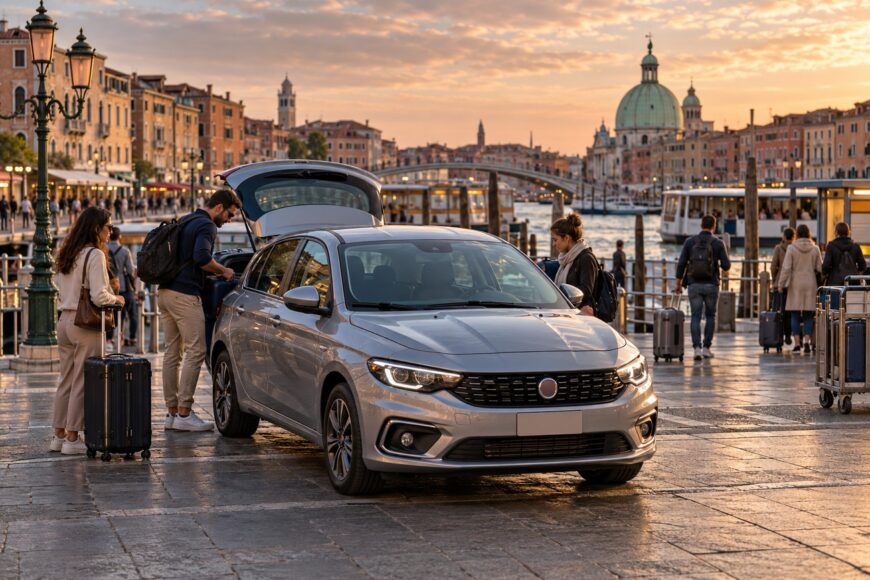
Reaching Venice by car does not mean reaching its historic center by car. A Fiat Tipo can take you across the road network toward the lagoon, yet the drivable part of the journey normally ends at a terminal parking area. From there, you continue on foot or by water transport, with bridges, steps, canals, and luggage shaping the final part of the trip.
The practical choice is usually between Piazzale Roma, the last road-access point before the historic center, and a mainland car park in Mestre. Parking cost, availability, the risk of arriving without a reservation, and the amount of luggage you need to move matter more than the Fiat Tipo’s size. A route planned as if the hotel were reachable by car can leave you with an expensive parking problem and a long walk.
- Where the Road Ends in Venice
- Where to Leave a Car When Driving to Venice
- Parking Cost, Availability, and the Booking Trap
- ZTL, Navigation, and the Mistakes That Create Fines
- What Happens After Parking: Bags, Bridges, and Boats
- Does the Fiat Tipo Fit—and What Problems Actually Matter?
- Frequently asked questions
- Why are ordinary cars banned from Venice’s historic center?
- What are some common problems with the Fiat Tipo?
Where the Road Ends in Venice
Ordinary cars cannot drive through Venice’s historic center. The city’s central areas are organized around canals, pedestrian routes, bridges, and water transport, so the road network finishes before the part most visitors mean by “Venice.” A normal rental or private car must be left in an authorized parking area.
Piazzale Roma is the last road-access point before Venice’s pedestrian and water-based historic center. It is connected to the mainland by road and functions as a transport interchange, which makes it the most direct place to leave a car when you want the shortest transfer into the city. From there, the onward journey is on foot or by water.
ZTL restrictions reinforce the physical boundary. A ZTL is a restricted-traffic zone where ordinary car entry is prohibited or limited, and the specific access rules must be checked before you drive toward the destination. A compact vehicle does not receive an exemption simply because it is easier to maneuver.
The common mistake is to treat the last few miles as an ordinary urban approach. Driving carefully, choosing a small car, or entering a hotel name into a navigation app does not create a legal route through the historic center. The correct plan ends with a confirmed parking space and a transfer plan.
Where to Leave a Car When Driving to Venice
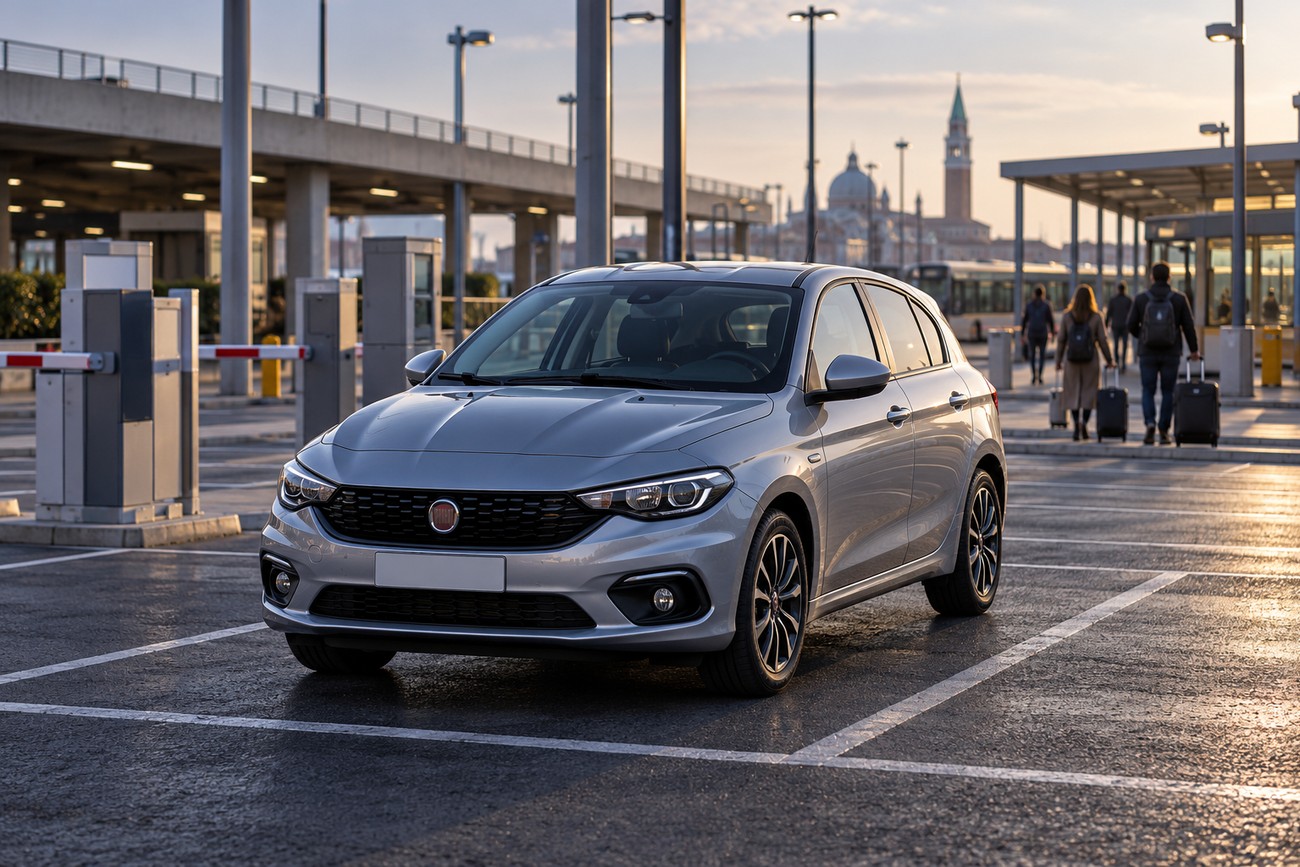
The closest practical option is parking near Piazzale Roma. It reduces the distance between the car and the historic center, which can matter after a long drive or when you are carrying cases. The trade-off is a higher likelihood of expensive tariffs, full facilities, and a stressful final approach through busy access roads.
Mestre offers a mainland parking strategy often marketed in connection with Venice. A car parked in Mestre is not parked in Venice’s historic center, so the booking must include the onward connection by public transport, taxi, or another permitted service. The address, transfer point, and late-arrival arrangements deserve the same attention as the parking reservation itself.
Choose between the two locations according to the whole transfer rather than the parking label. A cheaper mainland space may involve more handling of bags and an additional connection, while a central space may cost more yet reduce walking. For travelers with bulky luggage, mobility limitations, or a late arrival, the shortest transfer can justify a higher parking charge.
Listings can use “Venice” as a broad destination name even when the facility is in Mestre. Check the full street address and map position before paying. This small step prevents the common assumption that a booking described as Venice places the car beside the historic center.
Parking Cost, Availability, and the Booking Trap
Parking close to Piazzale Roma or Venice is reported at approximately €25–€45 per 24 hours, according to the supplied source. Treat that range as indicative because tariffs, dates, vehicle categories, and booking conditions can change. For a short visit, the parking charge can become a substantial part of the travel budget.
Central-area parking can be full, particularly when several arrivals coincide, and some facilities may require advance booking. Turning up without a reservation can mean circling through traffic, accepting a less suitable facility, or carrying luggage farther than expected. The financial saving from waiting can disappear quickly if the replacement space is inconvenient.
Free parking near the historic center is not confirmed by the supplied information. Paid organized parking is the dependable planning assumption, while any claim of a free space should be checked directly with the operator and against local restrictions. A space on a mainland street is also a different proposition from secure, authorized parking beside the road-access terminal.
Check the operator’s current tariff, opening hours, vehicle-height rules, cancellation terms, and arrival procedure before departure. Keep the reservation details accessible offline in case mobile coverage or roaming fails. If the car will remain overnight, remove luggage and visible electronics before leaving the vehicle.
ZTL, Navigation, and the Mistakes That Create Fines
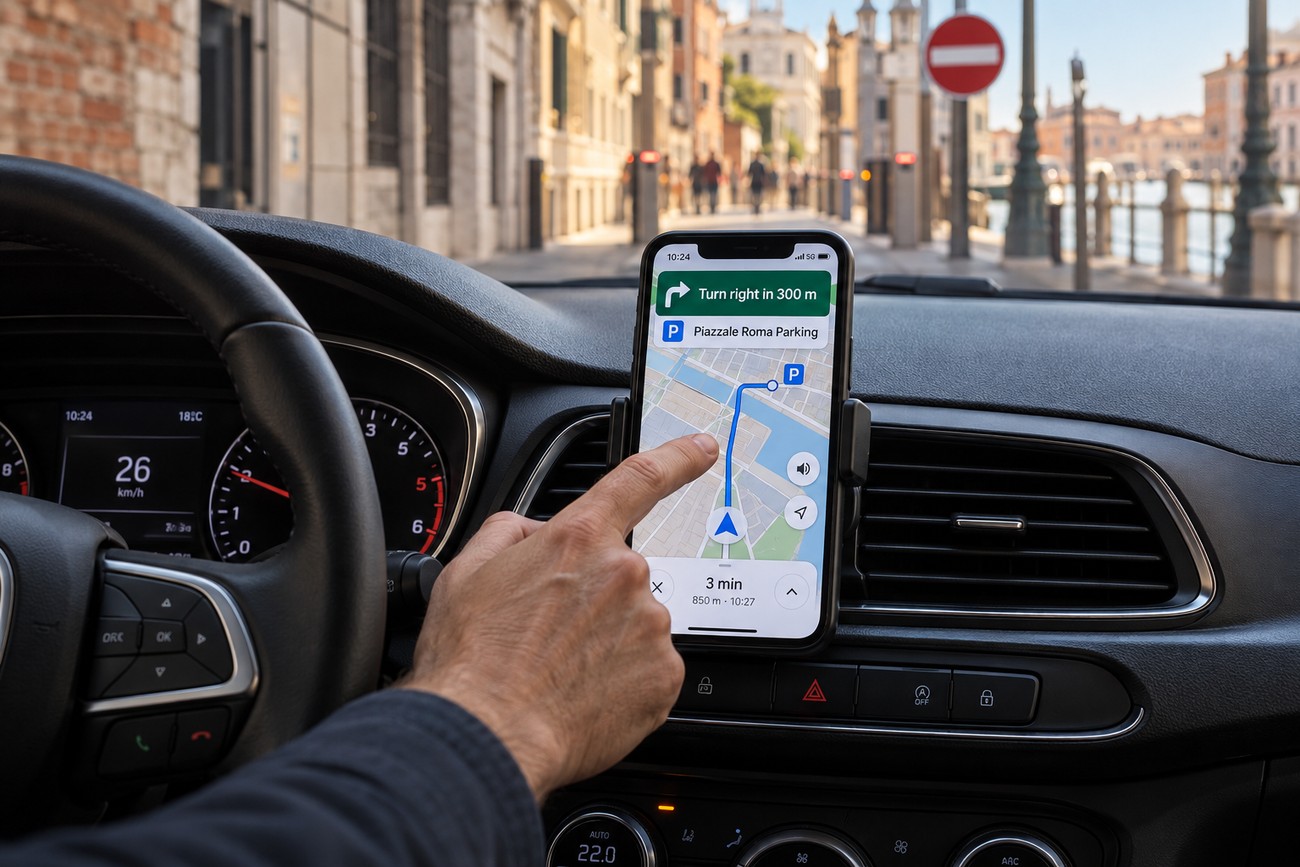
The approach to Venice can feel difficult because the final destination is controlled by local access rules rather than distance alone. ZTL areas restrict or prohibit ordinary car entry, and signs may matter more than the route suggested by a general navigation service. A standard sat-nav may calculate a road that is technically close to the hotel while ignoring the fact that the final street is inaccessible to a normal car.
Set the destination as the exact authorized car park, preferably using its full address and entrance instructions. Avoid routing to “Venice” as a generic destination or to a hotel in the historic center. Before the final approach, compare the route with the car park’s own access guidance and check whether the entrance is reached from the expected direction.
Enter the exact authorized car park address and read its access instructions before the final approach. A hotel name can be an appropriate pedestrian destination while being a poor legal driving destination.
Traffic around the access points can add pressure, especially when drivers are searching for an entrance while also watching signs and lane changes. Allow time to identify the correct facility rather than stopping in an unsuitable area to reorganize bags or bookings. If the reservation has a specific entrance, save its details before setting off.
A hotel in the historic center cannot provide a normal car drop-off route through the restricted area. Ask the accommodation in advance which parking facility and transfer point it recommends, then verify that advice against the current operator information. This avoids fines, unnecessary detours, and a final arrival with luggage at the wrong side of the city.
What Happens After Parking: Bags, Bridges, and Boats
Once the Fiat Tipo is parked, the journey changes character. You may walk directly toward the accommodation or use a vaporetto and other water transport, depending on the address, the amount of luggage, and the location of the nearest stop. The car does not continue to the hotel door.
Bridges and steps can make a short map distance physically demanding. Rolling suitcases need to be lifted over bridge steps, and a route that looks direct may include several crossings over canals. Travelers often underestimate this part because they measure the distance in meters while ignoring stairs, crowds, and the need to keep bags secure.
Water transport can reduce walking, although it introduces its own timetable and boarding logistics. Schedules and operating conditions may change, and a vaporetto ride is a transfer rather than a private vehicle journey. Check the route after parking and allow time to reach the stop with all your luggage.
Night water transport exists but is limited. Do not assume that a late arrival will be covered by the same service used during the day; confirm current options with the accommodation or transport operator. If your arrival is late, a closer parking location may be worth the additional cost because it reduces the number of connections and the amount of walking in unfamiliar streets.
Does the Fiat Tipo Fit—and What Problems Actually Matter?
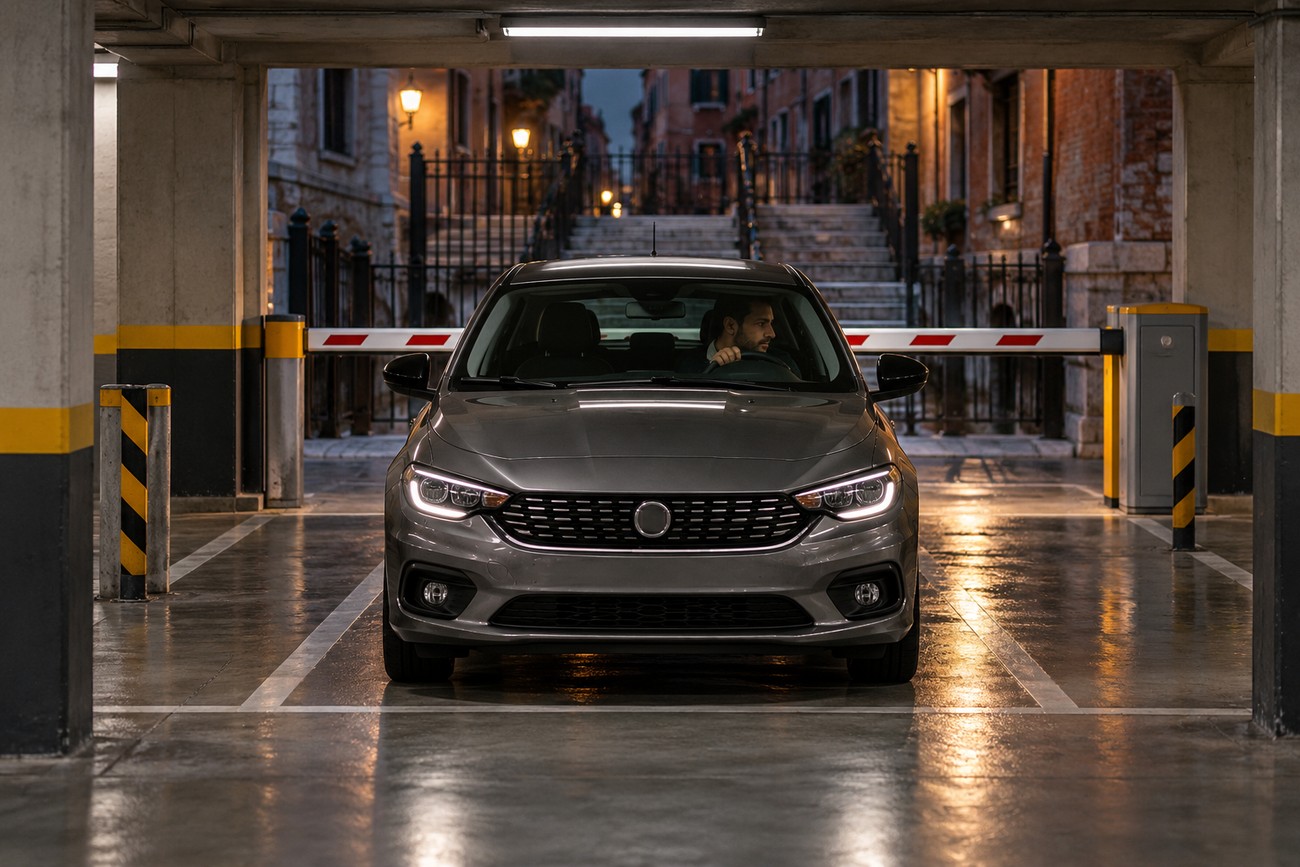
Across generations and body styles, the Fiat Tipo is approximately 3.96–4.58 m long, 1.70–1.82 m wide, and 1.0–1.4 t in mass. Those figures place it broadly within the range of ordinary European passenger cars. They matter for parking bays, turning space, and any height or width restriction at a facility.
The Fiat Tipo is not excluded because it is unusually large. The decisive issue is Venice’s access restriction: ordinary cars cannot drive through the historic center, regardless of whether the vehicle is a hatchback, sedan, or station wagon. Choosing the car for maneuverability can make parking easier, yet it cannot change where the road journey ends.
For this trip, the relevant checks concern the booked parking space, the car park entrance, navigation, and luggage handling. Confirm the vehicle category if you have a larger Tipo body style or a roof box, and check whether the facility has clearance limits. These details are more useful than searching for a model-specific solution to a city-access problem.
Do not leave luggage unattended in the car for a prolonged period, especially at peripheral parking areas where theft risk may be higher. Keep documents, electronics, and valuables with you, and place bags out of sight only when necessary during a brief stop. Once parked, take a photo of the level, bay, and exit route so that collecting the car later is less confusing.
Frequently asked questions
Why are ordinary cars banned from Venice’s historic center?
Ordinary cars cannot drive through the historic center because it is organized around canals, pedestrian routes, bridges, and water transport. Its central streets do not form a conventional road network, so ordinary vehicles stop at an access or parking area before the historic center.
The restriction is tied to the city’s physical layout as well as traffic control. Piazzale Roma marks the final road-access point for the historic-center journey, while mainland parking in Mestre requires a separate onward connection.
What are some common problems with the Fiat Tipo?
There is no Fiat Tipo problem in the supplied information that would specifically prevent a Venice trip. The practical concerns are ordinary ones: confirm that the car fits the booked parking bay, check the entrance clearance, plan the route to an authorized facility, and protect luggage while the car is parked.
Its approximate dimensions vary by generation and body style, so the rental specification should be checked if the vehicle has unusual equipment or a roof load. Those dimensions do not override Venice’s access restrictions; the car still ends its journey at the authorized parking area.







