
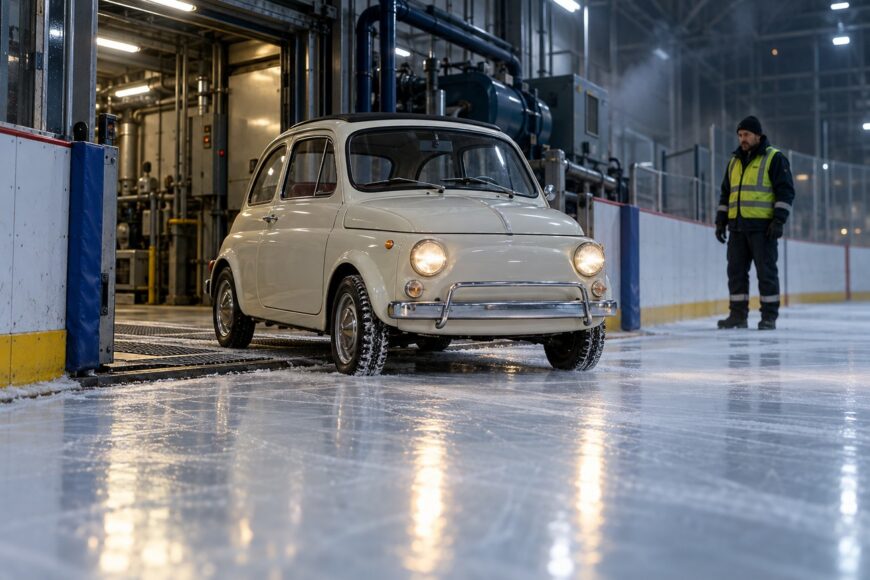
A Fiat 500 may move on an ice rink, but movement is not the same as controllable driving. Ice provides extremely low traction for acceleration, steering, and braking, so a small car can slide even when the driver uses gentle inputs and the electronic aids are operating normally.
The decision depends first on the venue, then on the car. You need the rink owner’s explicit permission, a plan to protect the ice, a controlled danger zone, suitable tires, and recovery arrangements. There is no verified safe maximum speed specifically for a Fiat 500 on rink ice, and no manufacturer’s electronic system can remove that uncertainty.
- Can a Fiat 500 Be Driven on an Ice Rink?
- Why the Fiat 500 Feels Unforgiving on Polished Ice
- Prepare the Fiat 500 Before It Reaches the Ice
- How to Drive the Fiat 500 on Ice
- The Mistakes That Turn a Demonstration Into a Crash
- Winter Tires, Studs, Chains, and Ice Protection
- Frequently asked questions
- Why do some people dislike Fiat 500s?
- What is the worst car to drive in snow?
Can a Fiat 500 Be Driven on an Ice Rink?
A Fiat 500 should enter an ice rink only with explicit permission from the owner or operator. A skating rink is a controlled private venue rather than an ordinary road, and the surface, barriers, drainage, refrigeration equipment, and surrounding areas may have rules that are invisible to a visiting driver.
The operator should confirm how the ice will be protected and whether the vehicle’s tires, wheels, and underbody are acceptable. Studs, chains, road debris, and tire contamination can damage the surface. Restrictions, fees, and operating limits vary by venue, and no universal public standard for admitting cars onto ice rinks was identified.
Spectators need to remain outside the danger zone, with physical barriers where appropriate. The organizer also needs an emergency and recovery plan covering a disabled car, a damaged barrier, loss of control, and access for staff or rescue equipment.
Insurance deserves written confirmation before the event. Ordinary vehicle insurance may not cover a controlled driving activity on private ice, while the venue may require additional liability protection. Even with permission, there is no verified safe maximum speed specifically for a Fiat 500 on rink ice.
Why the Fiat 500 Feels Unforgiving on Polished Ice
Ice provides extremely low traction for acceleration, cornering, and braking. Every control input consumes part of that limited grip, so sharp steering, sudden throttle, or a quick brake application can exceed the available margin before the driver has time to correct the slide.
Front-wheel drive can help the Fiat 500 move off because the front axle typically carries a greater static load. It does not prevent front-end understeer in a turn, and braking shifts weight forward while reducing the grip available to the rear axle. The result can be a car that feels secure in a straight line and then runs wide or rotates when the driver changes direction.
ABS prevents wheel lock and helps retain steering control, while ESC and TCS help manage stability and traction within the available grip. None of these systems can create grip. They may reduce the severity of a mistake, but they cannot make excessive speed or abrupt inputs safe.
One Fiat 500e owner reported rear-end sliding and wheelspin with light acceleration. That is a single vehicle-and-condition report, not a universal norm for every Fiat 500. It does, however, illustrate why a driver should establish the car’s response gradually rather than rely on the model’s size or dashboard warnings.
Prepare the Fiat 500 Before It Reaches the Ice
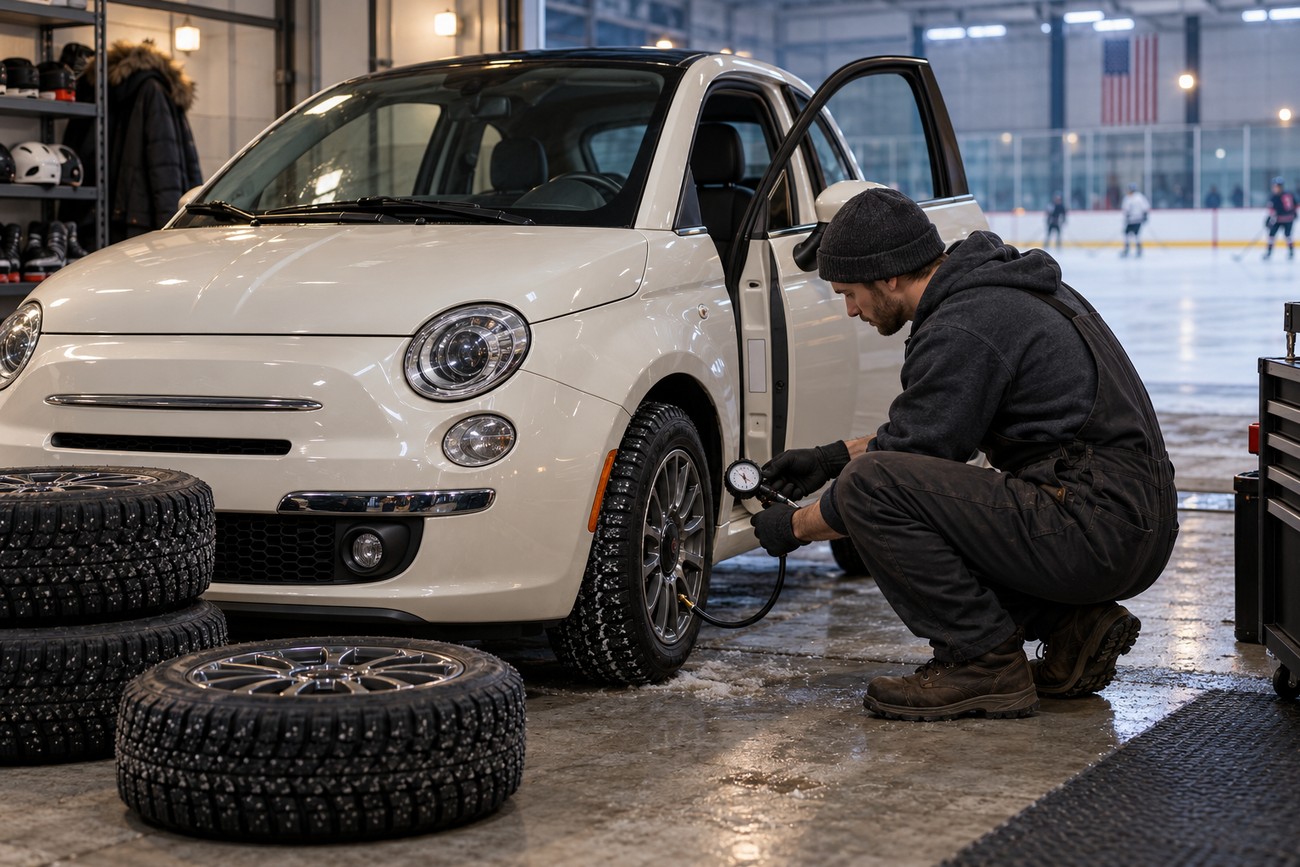
The Fiat 500 manual warns against using summer tires for snow and ice and recommends four matching winter tires. The complete set matters because different tire types or significantly different levels of grip can make the car’s response less predictable during braking and cornering.
Check tire pressure when the tires are cold, using the vehicle placard on the door pillar or door edge. The manual does not prescribe lowering tire pressure for ice. Changing pressure without a manufacturer-approved reason can alter handling and tire support without providing a reliable solution to the basic lack of grip.
Check the condition of the TPMS, tread, sidewalls, wheels, and suspension before arrival. A warning light, damaged tire, bent wheel, or worn component is a poor starting point for a surface where recovery space is limited. Remove loose objects from the cabin and confirm that the car’s battery, fuel, or charge level supports the planned activity and recovery route.
Standard road tires and ordinary wheels, suspension components, and bumpers are not designed for repeated slides or impacts with a rink barrier. A low-speed demonstration can still damage a rim, suspension part, tire, or bumper if the car reaches the edge sideways.
How to Drive the Fiat 500 on Ice
Begin at walking pace in a clear, closed section. Use tiny steering inputs, apply the throttle progressively, and leave generous space around the car. Build speed only after the Fiat 500 responds predictably in a straight line and through a very gentle change of direction.
Perform an initial braking test on a closed section with substantial space ahead and behind. Apply the brake continuously and firmly enough for ABS to operate if necessary; do not pump the pedal. ABS prevents wheel lock and helps retain steering control, but it does not guarantee a short stopping distance on ice.
Establish the car’s actual stopping response with a low-speed brake test before choosing a line or increasing pace. Tire branding and dashboard systems cannot substitute for measured space on the surface you are using.
Keep the car settled before turning. Brake in a straight line, release the pedal smoothly, and then use a modest steering angle. A sudden lift from the accelerator can change the balance of the car, while a sharp downshift can disturb the driven wheels.
The Fiat 500 manual warns against using a lower gear for extra braking on slippery surfaces because the driven wheels may begin to slide. Smooth throttle reduction is generally easier to manage than abrupt engine braking. If the car starts to understeer, reduce the steering demand and ease the throttle; if the rear moves, look where you want to go and make small corrections rather than adding a sudden steering input.
One owner considered speeds above approximately 50 km/h unsafe on clean ice, but that is an anecdotal judgment, not a validated or manufacturer-approved limit. Surface condition, tire specification, temperature, space, barriers, and driver skill can change the outcome substantially, so no speed should be presented as a factory-approved rink limit.
The Mistakes That Turn a Demonstration Into a Crash
Summer or mismatched tires are a basic preparation failure. The Fiat 500 manual recommends four matching winter tires for snow and ice, and using an inconsistent set can make braking and cornering behavior less predictable. The problem becomes harder to manage when the driver also assumes that a small car will naturally stop quickly.
Sharp inputs create the next failure mode. A sudden steering movement, throttle application, or brake application can exceed the available grip before ABS, ESC, or TCS has a useful opportunity to intervene. Those systems help manage stability and traction, but they cannot compensate for excessive speed or a control input that is too large for the surface.
ESC should not be switched off in advance as a general ice-driving tactic. The increased-wheel-slip mode is intended primarily for deep snow, sand, or gravel, where some wheelspin can help the vehicle move. It is not a universal setting for polished ice, where extra wheelspin usually consumes the limited traction available.
Surface type also matters. Fiat 500 owners report low ground clearance and underbody contact in deep snow, but that does not directly establish how the car behaves on smooth ice. Deep snow is a clearance and resistance problem; shallow or polished ice is primarily a traction and control problem. Entering without checking the ice condition, barriers, spectator positions, recovery arrangements, and insurance creates a venue risk before driving begins.
Winter Tires, Studs, Chains, and Ice Protection
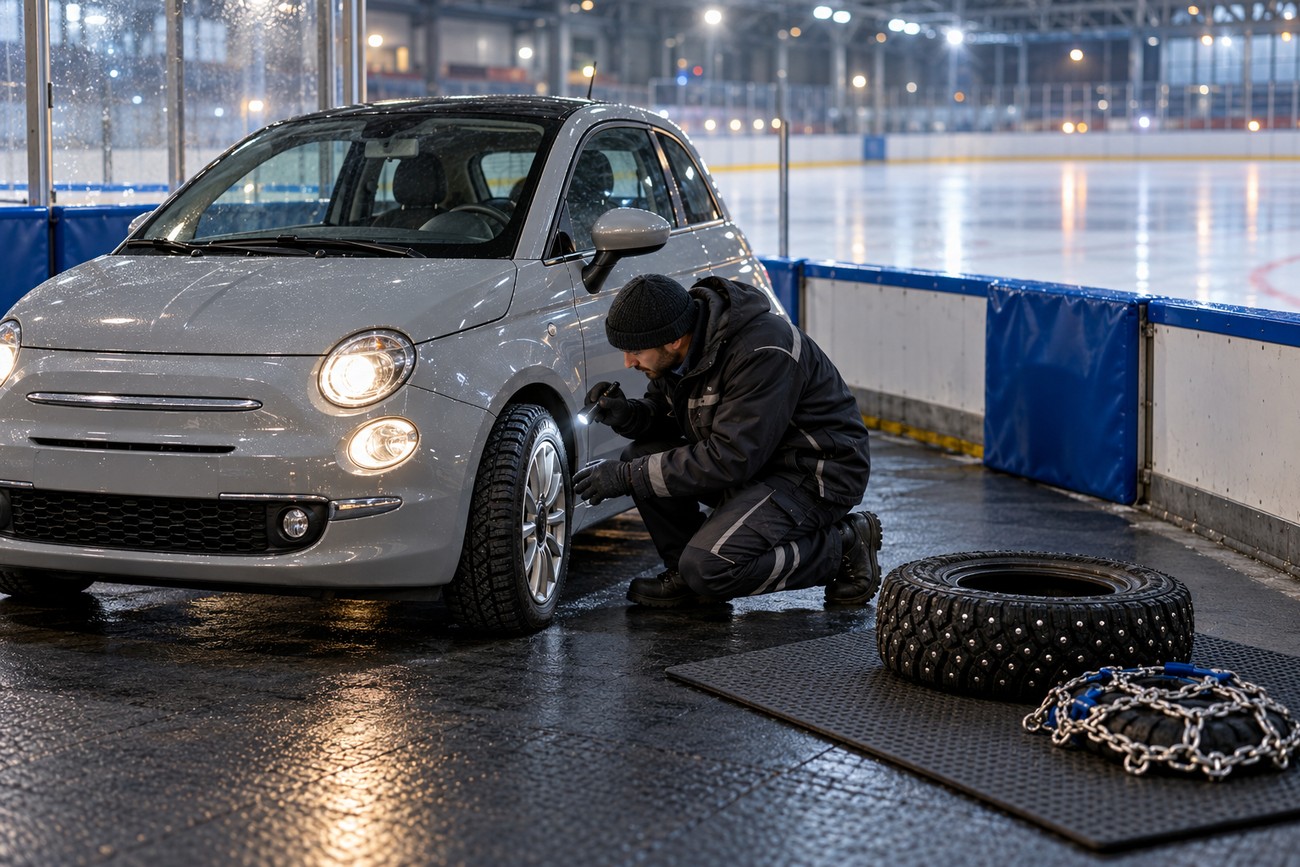
Winter tires can improve the grip available to a Fiat 500 in cold conditions, especially compared with summer tires. Their benefit remains limited on polished ice, where the braking margin can still be very short. A tire marketed as suitable for ice does not imply a safe high-speed limit on a rink.
Studded tires and chains may provide more mechanical bite in some conditions, but they can damage the ice and may be prohibited by the venue. The operator may also restrict particular tread designs, wheel materials, or vehicle weights to protect the surface and refrigeration system.
Vehicle traction and venue acceptability are separate decisions. A setup that helps the car move may be unacceptable to the rink, while a setup approved by the operator may still leave little stopping margin. Confirm the exact tire, chain, stud, speed, timing, surface-protection, and recovery rules in writing before arrival.
No confirmed universal tariffs or limits govern vehicle use on ice rinks. The absence of a standard makes direct communication essential, especially where the venue has no established procedure for cars. If the operator cannot explain how spectators, barriers, ice protection, and recovery will be managed, the activity is poorly controlled.
Frequently asked questions
Why do some people dislike Fiat 500s?
Some criticism concerns ownership compromises rather than winter traction. The compact cabin, limited cargo and passenger space, small-car ride, and restricted practicality may not suit people who prioritize comfort, carrying capacity, or long-distance stability.
Those opinions do not prove that the Fiat 500 performs badly on ice. Rink behavior depends on tires, surface condition, speed, inputs, and available space. General dislike of a small car should be kept separate from evidence about its behavior on polished ice.
What is the worst car to drive in snow?
There is no single universal worst car for snow. The more useful criteria are tire condition and type, ground clearance, the ability to maintain traction, electronic stability systems, weight distribution, and the driver’s control inputs.
A low-clearance Fiat 500 may struggle in deep snow because the underbody can contact packed snow, while that issue says little about behavior on a smooth ice rink. A vehicle with four suitable winter tires and careful inputs can be more manageable than a larger vehicle on poor tires or with an overconfident driver.







