
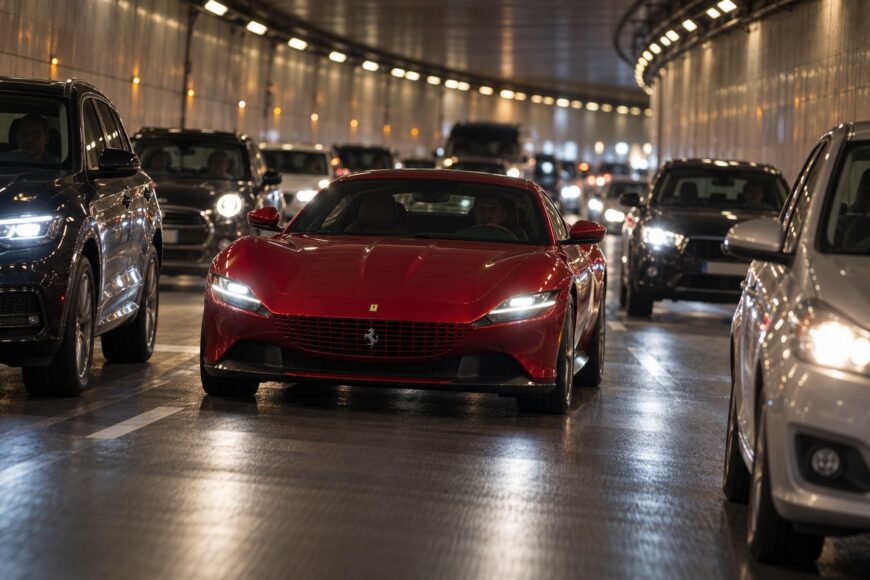
The cinematic version is easy to picture: a Ferrari Roma enters Monaco’s tunnel, its V8 filling the concrete space as the city briefly turns into a Grand Prix stage. The road-going reality is far more controlled. A 620-hp grand tourer is moving through public traffic, under a 50 km/h limit for passenger cars, with glare, lane discipline, pedestrians, and very little room for correction.
That gap between image and experience defines the drive. The Roma has a claimed top speed of over 320 km/h, while Formula 1 material places tunnel speeds at approximately 260–300 km/h in racing contexts. Those figures belong to a closed competition environment; they describe the mythology surrounding the location rather than a legal road journey through Monaco.
- The Monaco tunnel is not an F1 playground
- What the Ferrari Roma brings to the tunnel
- What the drive actually feels like
- The real challenge comes after the tunnel
- The mistakes that ruin the Ferrari Roma experience
- The F1 image versus a legal road drive
- Frequently asked questions
- What is Monaco’s legal blood-alcohol limit for drivers?
- Which car is known as the “poor man’s Ferrari”?
The Monaco tunnel is not an F1 playground
The tunnel’s reputation comes from the Monaco Grand Prix circuit, where the section forms part of a 3.340-km circuit with 19 turns; the race is run over 78 laps. Drivers approach it as one element in a highly controlled sequence, with a prepared car, a closed circuit, and conditions that differ fundamentally from city traffic. The visual setting remains the same, which is why the public-road experience can feel connected to the race even when the driving task is entirely different.
On ordinary roads, Monaco’s passenger-car speed limit is 50 km/h. That limit governs the tunnel as part of the public road network, regardless of how open or dramatic the road may appear. Traffic, road signs, lane positioning, and other users add further limits that a racing lap does not have.
The often-quoted 260–300 km/h figures describe racing contexts inside the Grand Prix environment. They should never be used as a guide to road driving, and they have no practical relationship to the legal speed available to a visitor in a Ferrari Roma. Treating them as comparable experiences encourages exactly the wrong reading of the tunnel.
The important sequence is what follows the tunnel: the racing layout leads toward sharp braking for the hairpin. On public roads, that becomes a reason for calm observation and adequate stopping distance. The tunnel is a famous setting, yet its road-going meaning is restraint rather than an invitation to reproduce a Grand Prix lap.
What the Ferrari Roma brings to the tunnel
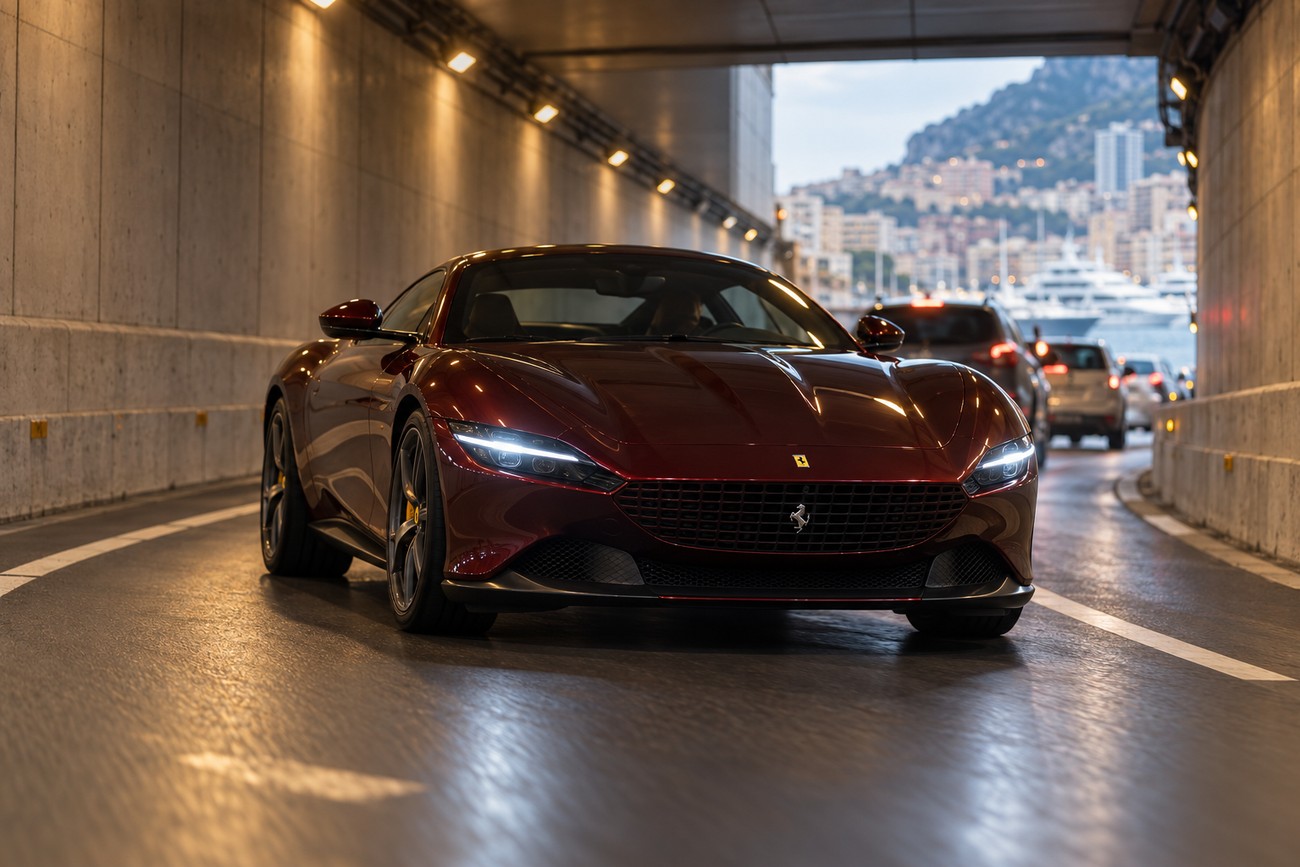
The Ferrari Roma is equipped with a 3.855-liter twin-turbo V8 producing 620 hp and 775 N·m of torque. An eight-speed DCT manages the power, and Ferrari quotes 0–100 km/h in 3.4 seconds, with a top speed of over 320 km/h. Those numbers explain the car’s effortless response, while also showing how little of its full performance Monaco’s public roads can use.
Its dimensions matter more in the city than the headline figures suggest. The Roma is 4656 mm long, 1974 mm wide, and has a 2670 mm wheelbase. In a narrow urban setting, that length and width influence positioning, corner entry, parking, and the psychological workload of passing barriers or other vehicles.
Published mass figures vary by source, from 1472 kg to 1664 kg. The range should remain qualified because specifications can reflect different equipment and measurement conventions. Either way, the car’s sense of scale affects how quickly it settles during direction changes and how much space the driver wants before braking.
That makes the Roma a fast grand tourer rather than a tiny city toy. Its front-mounted V8 delivers strong acceleration, but the useful qualities in Monaco are throttle resolution, visibility, steering accuracy, and composure. In dense traffic, a car that responds cleanly at low speed is more valuable than one that can reach a speed the road does not permit.
What the drive actually feels like
Inside the tunnel, the Roma’s engine and road noise become more prominent as sound reflects from the surrounding surfaces. The acoustic effect can make the car feel more dramatic, yet it also makes the sound harder to judge naturally. Exhaust note, tire noise, and reflected traffic sound arrive together, so volume is a poor indicator of speed or mechanical strain.
The lighting change creates a separate challenge. The tunnel is dark, and the exit leads into bright daylight with a sharp contrast that can briefly reduce visual comfort. A driver needs to preserve a stable line, read the road beyond the exit, and avoid treating the first clear patch of daylight as an opportunity for a sudden input.
Smooth throttle is especially informative before the tunnel exit: it leaves more attention for visual adaptation, traffic, and the road beyond the bright transition than a dramatic burst of engine noise ever could.
Traffic often removes the cinematic element altogether. A queue, a slower vehicle, or a constrained lane can turn the tunnel into a short exercise in spacing and concentration. The Roma still feels responsive, but its performance is expressed through quiet control rather than acceleration.
That is where Monaco can frustrate drivers expecting a constant supercar spectacle. The route may look spectacular from outside, while the person behind the wheel is managing glare, sound, narrow margins, and the behavior of surrounding vehicles. Smooth acceleration and braking suit the environment better than theatrical inputs.
The real challenge comes after the tunnel
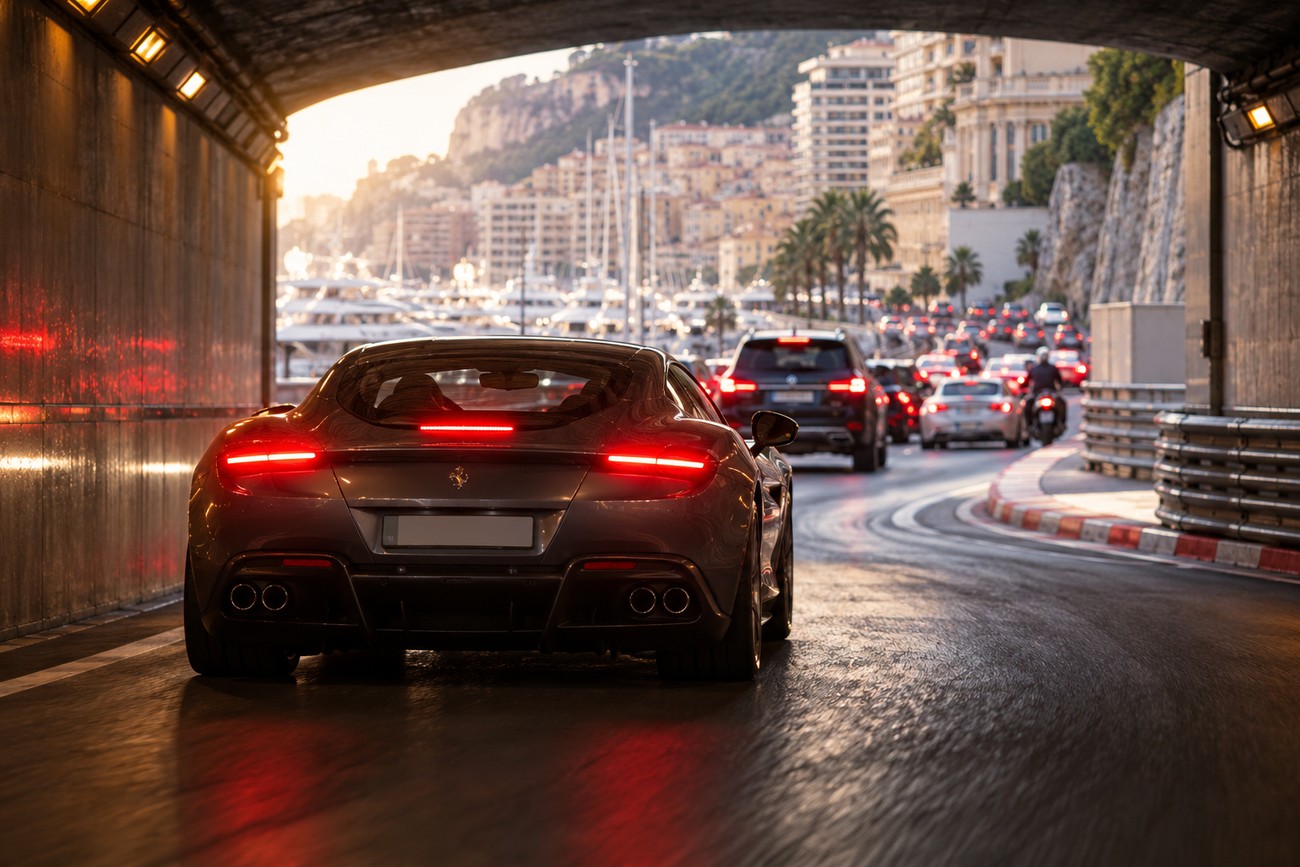
The tunnel should be understood as part of a sequence ending in sharp braking toward the hairpin. In racing, that transition is famous because the car moves from a fast enclosed section into a demanding braking zone. On public roads, the same geometry reinforces the need to anticipate what lies beyond the exit and to keep a usable stopping distance.
There is little margin for a late correction after the tunnel. Bright light can affect visual adaptation, traffic can occupy the expected path, and barriers leave limited space for recovery. The correct road-driving priority is a clear view, a settled car, and enough distance to respond without panic.
Tires, brakes, and operating temperature matter as much as the Roma’s 620 hp. Power is easy to notice; grip and braking consistency determine whether the car feels predictable when conditions change. A driver who focuses only on acceleration misses the systems that actually support control through a confined urban sequence.
The Roma’s front-mounted V8 and long wheelbase also create a different balance from a mid-engine Ferrari. That distinction can influence the way the car feels during turn-in, load transfer, and the exit from a bend. It is another reason to drive by the car’s settled responses rather than by expectations formed from racing videos.
The mistakes that ruin the Ferrari Roma experience
The first mistake is confusing the public route with the Grand Prix layout. Monaco’s 50 km/h road limit has no connection to racing speeds of approximately 260–300 km/h through the tunnel. The shared scenery creates the confusion; the legal setting, traffic, and available space do not.
A second mistake is treating the tunnel as an unrestricted speed zone. The enclosed acoustics can make modest acceleration sound dramatic, while the exit can compress the time available to process bright light and changing traffic. Noise can exaggerate the sensation without improving the driver’s information.
Braking reserves are also easy to overestimate. The Roma’s published mass range of 1472–1664 kg affects the feeling of lightness, and the car still needs suitable tires, brakes, temperature, and distance to stop predictably. A straight road after the tunnel does not guarantee a clear or safe braking environment.
The final error is treating a 4656-mm-long, 1974-mm-wide grand tourer like a small city car. Tight maneuvering demands more attention to clearances, lane placement, and the movement of surrounding traffic. Barriers, glare, noise, and congestion can make the visual drama of the route exceed the actual enjoyment of driving it.
The F1 image versus a legal road drive
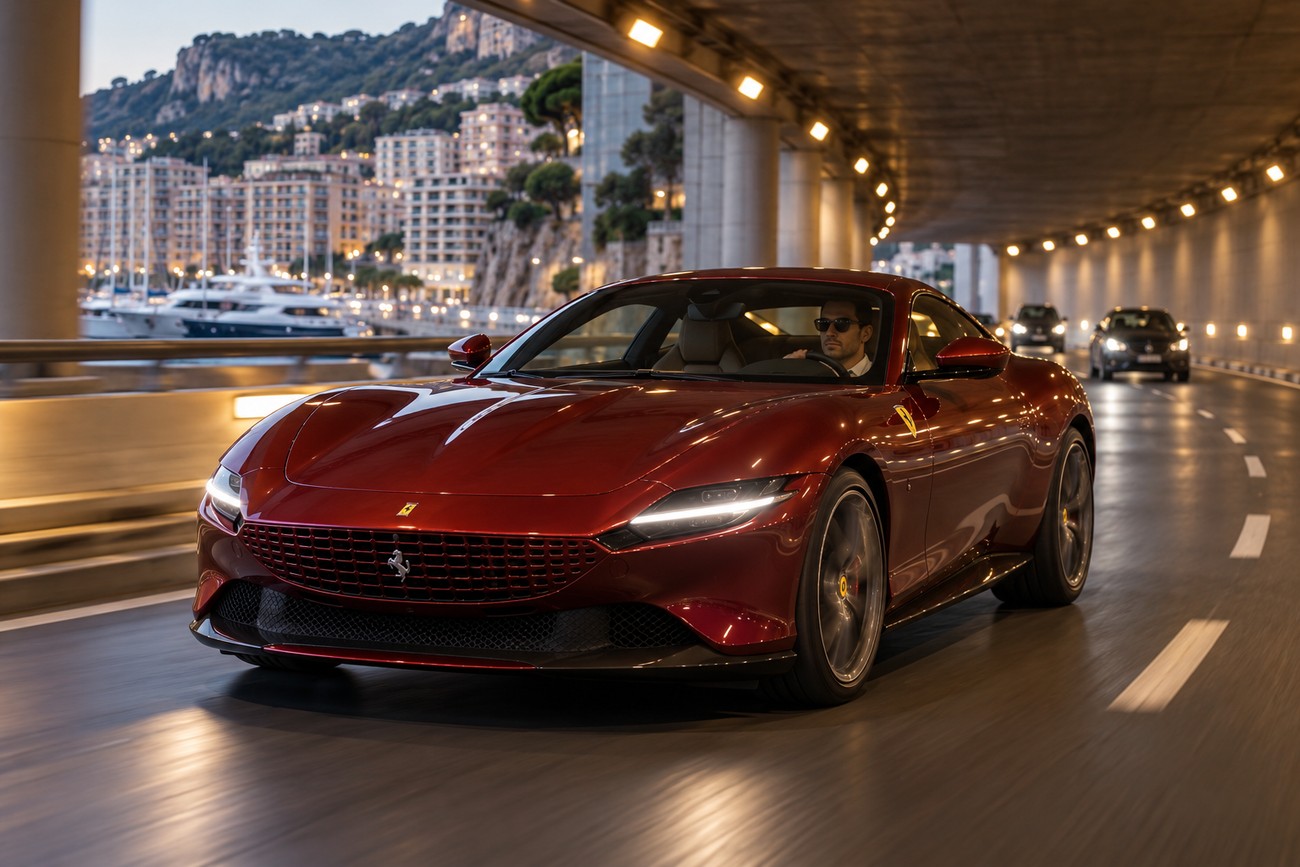
Monaco rewards precision and restraint more than maximum output. The Roma’s claimed top speed of over 320 km/h is a remarkable specification, yet that capability is largely unusable on Monaco’s public roads. Its value appears in the smoothness of its response, the reserve available for ordinary overtaking where legal and appropriate, and the composure of the car at controlled speeds.
The tunnel’s 260–300 km/h figures belong to racing contexts, supported by a closed circuit and a professional operating environment. They do not describe what a visitor should attempt in traffic. A legal road drive is measured by how accurately the driver reads the environment and maintains a comfortable margin.
The Roma can still feel special at 50 km/h. The V8’s character, the DCT’s clean response, and the car’s stable grand-tourer feel remain present without aggressive inputs. In Monaco, restraint lets those qualities come through more clearly than a forced attempt to imitate a racing lap.
A successful drive through the tunnel therefore ends with control intact and the car settled for what follows. The memorable part is the connection between the setting and the machine, handled with enough smoothness to respect the road. That is a more credible version of the Ferrari Roma experience than chasing a speed that belongs to another kind of driving.
Frequently asked questions
What is Monaco’s legal blood-alcohol limit for drivers?
Monaco’s stated permissible blood-alcohol level for drivers is 0.5 g/L. This applies to a public-road driving scenario, including a journey through the tunnel in a Ferrari Roma.
Performance cars require clear judgment, particularly where lighting changes, traffic, and limited road space increase the workload. The safest practical choice is to drive sober and avoid treating the legal threshold as a target.
Which car is known as the “poor man’s Ferrari”?
The Pontiac Fiero is commonly associated with the informal nickname “poor man’s Ferrari.” The phrase reflects its styling and the kit-car culture surrounding some Fieros, rather than a technical comparison with the Ferrari Roma.
The two cars occupy different engineering and performance categories. The nickname is a piece of automotive shorthand, not an assessment of the Roma’s front-mounted V8, dimensions, or road behavior.







