

A diesel Peugeot 308 can be legally used in Paris while being mechanically poorly suited to repeated short city trips. Access depends on the individual car’s Euro standard, first registration date, and Crit’Air classification, while ownership costs depend heavily on how often the engine can complete normal operating cycles.
Paris does not apply a blanket ban to every diesel 308. The Greater Paris ZFE restriction concerns the area inside the A86; the A86 itself is outside the perimeter. Before driving, check both the vehicle’s classification and the exact route, because staying on the ring road and entering central Paris are different journeys.
- Where and when Paris ZFE rules affect your drive
- Diesel Peugeot 308 Crit’Air classes and Paris access
- Check the sticker, exemptions, and paperwork before leaving
- What stop-start Paris driving does to a diesel 308
- Routes, parking, and the exceptions a legal car can still miss
- Is a diesel 308 the right choice for regular Paris driving?
- Frequently asked questions
- Where do you put AdBlue in a Peugeot 308?
- How many miles can a diesel Peugeot 308 last?
- What color is a diesel pump in France?
Where and when Paris ZFE rules affect your drive
The Greater Paris ZFE restriction covers the area inside the A86. The A86 itself is outside the perimeter, so a route that uses the ring road can remain outside the ZFE until it leaves the motorway and crosses into the area within the A86. A navigation app showing a route through Paris does not establish that the vehicle is allowed to make that crossing.
For passenger cars, the stated restriction applies on weekdays from 08:00 to 20:00, excluding public holidays. During those hours, Crit’Air 3, 4, 5, and unclassified vehicles are officially restricted inside the A86. Crit’Air 2 is not covered by that standing restriction.
The non-penalty transition for these ZFE restrictions runs through 31 December 2026. This means the restrictions remain in force even though the stated transition limits the application of penalties for the restricted-class rule during that period. It does not remove the need for a Crit’Air sticker or make every route unrestricted.
Other controls can still apply. Pollution episodes may bring temporary measures, and ordinary signs, bus lanes, access limits, parking rules, and road closures remain separate from the ZFE classification. Treat the transition as a temporary enforcement arrangement rather than evidence that the rules will remain unchanged after 2026.
Diesel Peugeot 308 Crit’Air classes and Paris access
These are practical guides for diesel 308s, not classifications assigned automatically to every car from a particular model year. Confirm the individual vehicle using its emissions standard and first registration date.
| Diesel 308 emissions standard | Typical Crit’Air class | Status inside the A86 during the stated hours | Verification needed |
|---|---|---|---|
| Euro 4 | Typically Crit’Air 3 | Officially restricted on weekdays, 08:00–20:00, excluding public holidays | Check the vehicle’s emissions standard, first registration date, and official classification |
| Euro 5 | Typically Crit’Air 2 | Not covered by the standing Crit’Air 3–5 and unclassified restriction | Confirm the individual vehicle’s official Crit’Air status |
| Euro 6 | Typically Crit’Air 2 | Not covered by the standing Crit’Air 3–5 and unclassified restriction | Confirm the individual vehicle’s official Crit’Air status |
Crit’Air applies to the specific vehicle, rather than to the Peugeot 308 name as a whole. Two 308s with similar body styles can have different access results if their engines, emissions standards, or first registration dates differ.
The current non-penalty transition does not make a restricted vehicle equivalent to Crit’Air 2. A Euro 4 diesel 308 typically falls into Crit’Air 3, which is officially restricted inside the A86 during the stated hours. Claims that every diesel 308 is banned, or that every Crit’Air 3 car is generally permitted, do not match the stated official position.
Check the sticker, exemptions, and paperwork before leaving

Start with the individual car. Check its emissions information, first registration date, and official Crit’Air classification rather than relying on the registration year or an online description of the 308 model range. This is especially important for imported cars and used vehicles whose documentation may be incomplete.
Arrange the Crit’Air sticker before travel and allow time for delivery. A Crit’Air sticker is required for driving in the low-emission zone, and lacking one does not make an otherwise restricted vehicle eligible. An order confirmation shows that an application was made; it does not necessarily replace the required sticker or other proof, so confirm the current documentation rules before departure.
If the vehicle is eligible, check the Paris ZFE Pass before using an exception. The pass can allow eligible vehicles up to 24 driving days per year, subject to the current eligibility conditions, application procedure, and required proof. Keep the approval or supporting documents available in the car where appropriate; an informal explanation at a roadside check is weaker than documented authorization.
The usual passenger-car fine cited for driving without the required authorization or sticker is €68, although application details vary by offense and enforcement period. The stated non-penalty transition for the ZFE restrictions runs through 31 December 2026, so drivers should avoid treating the present enforcement position as a permanent exemption.
What stop-start Paris driving does to a diesel 308
Repeated short trips and congestion increase the risk of incomplete DPF/FAP regeneration. The filter needs suitable operating conditions to burn accumulated soot, while a succession of cold starts, low speeds, and long idle periods gives the process little opportunity to finish. A 308 that spends most of its life crossing central Paris can therefore develop warning messages even if its quoted fuel economy looks attractive.
DPF or FAP issues are separate from AdBlue faults. Some BlueHDi 308s use an SCR system with AdBlue, and a fault in that system can trigger a countdown to a possible restart prohibition. A warning related to fluid level, emissions control, or the SCR system deserves prompt diagnosis because ignoring the countdown can leave the car unable to restart after the remaining allowance expires.
A clear dashboard at inspection is not enough. Stored DPF or SCR faults and the car’s regeneration history can reveal an interrupted problem before a warning returns, so a used-car check should include diagnostic data rather than relying only on the absence of warning lights.
Other components affect the same ownership calculation. The condition of the DPF, EGR system, turbocharger, and SCR equipment can outweigh the fuel saving shown in a brochure, particularly on a high-mileage used car. A warning that appears after city use should be diagnosed rather than simply cleared, because several systems can produce related symptoms.
Do not prescribe a fixed regeneration routine without knowing the car’s fault state and operating requirements. A proper diagnosis should establish whether the filter is loaded, whether regeneration has been interrupted, and whether an EGR, turbocharger, sensor, or SCR fault is involved. Regular longer journeys can suit a diesel better, but they do not repair an underlying emissions-system fault by themselves.
Routes, parking, and the exceptions a legal car can still miss
Plan the journey by boundary, not only by destination. The A86 itself is outside the stated ZFE perimeter, while the area inside it is subject to the restriction. A route that is legal on the ring road can become a restricted journey as soon as it enters the area within the A86.
Navigation services may not account for the vehicle’s Crit’Air class, the 08:00–20:00 weekday restriction hours, or an applicable exception. Check the route manually and use the vehicle’s actual classification when reviewing alternatives. A route that appears quickest may lead through a central street where the car’s access status or a local traffic rule creates a problem.
Central parking can change the economics of the trip. Garages may be costly or difficult to access, and the 308’s size can be awkward on narrow streets or in older underground car parks. Leaving the car outside the central area and continuing by public transportation may reduce both parking stress and exposure to restricted streets.
Crit’Air 2 does not exempt a driver from temporary pollution measures or other road restrictions. Check current notices before departure, particularly during an air-pollution episode, and keep any ZFE Pass or exemption documentation with the vehicle. The sticker confirms the classification; it does not override a temporary order or a local sign.
Is a diesel 308 the right choice for regular Paris driving?
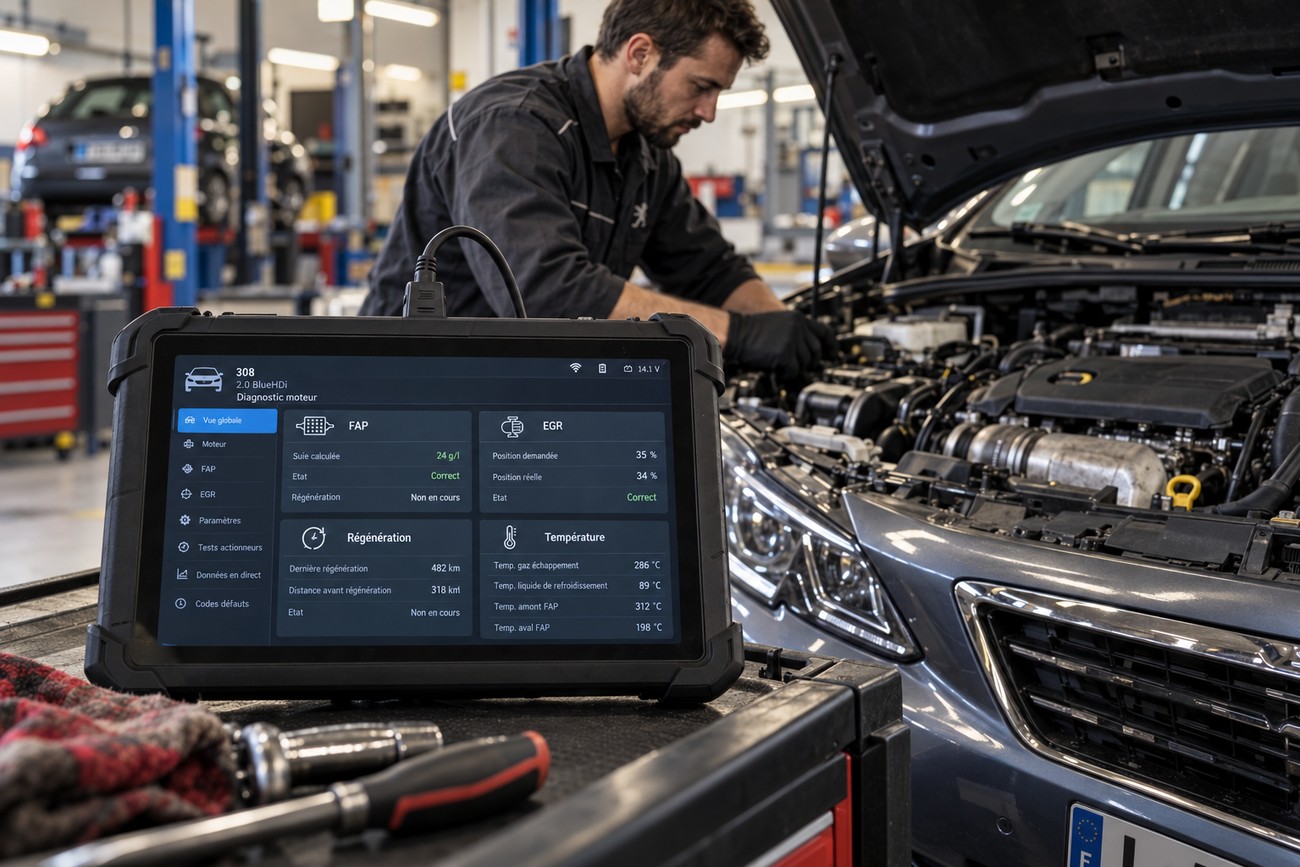
A diesel 308 can make sense for an owner who combines Paris visits with regular longer journeys. That pattern gives the engine more opportunity to reach normal temperature and complete emissions-system processes. Predominantly short trips through central Paris place greater weight on DPF/FAP, EGR, turbocharger, and SCR condition, making a petrol or hybrid car more practical for many drivers.
A used-car buyer should verify the individual car’s Crit’Air eligibility, VIN history, maintenance records, and diagnostic condition. Ask whether DPF regeneration has been interrupted, inspect for stored emissions faults, and check the BlueHDi SCR system where fitted. Model year and claimed fuel economy are useful background information, but they do not replace evidence about the car in front of you.
The common claim that all diesel 308s are banned in Paris is incorrect under the stated rules. Euro 5 and Euro 6 diesel 308s are typically Crit’Air 2, while a Euro 4 diesel 308 is typically Crit’Air 3. Official restrictions target Crit’Air 3, 4, 5, and unclassified vehicles inside the A86 during the stated hours.
A newer diesel is not automatically suitable either. The stated non-penalty transition runs through 31 December 2026, and later policy should not be assumed. Choose the car around your actual driving pattern, confirm its current access status, and budget for emissions-system maintenance rather than relying on the odometer or fuel consumption alone.
Frequently asked questions
Where do you put AdBlue in a Peugeot 308?
The AdBlue filler position varies by Peugeot 308 version, so use that vehicle’s handbook before opening any cap. Confirm the filler carefully and never add AdBlue to the diesel tank; the two fluids use separate systems, and a misfile can require professional draining and inspection.
How many miles can a diesel Peugeot 308 last?
There is no reliable mileage guarantee for a diesel Peugeot 308. Service records, correct oil and filter maintenance, driving pattern, and the condition of the DPF/FAP, EGR, turbocharger, and SCR equipment provide a better guide than an odometer promise.
A well-documented car used for suitable longer journeys may be a better purchase than a lower-mileage 308 that spent most of its life on short urban trips. Before buying, obtain a diagnostic scan and investigate stored faults, warning history, and gaps in maintenance records.
What color is a diesel pump in France?
Pump colors are not a dependable way to identify diesel in France. Read the written fuel label, confirm that it matches the fuel requirement in the Peugeot’s handbook or filler flap, and check the label before inserting the nozzle.







