
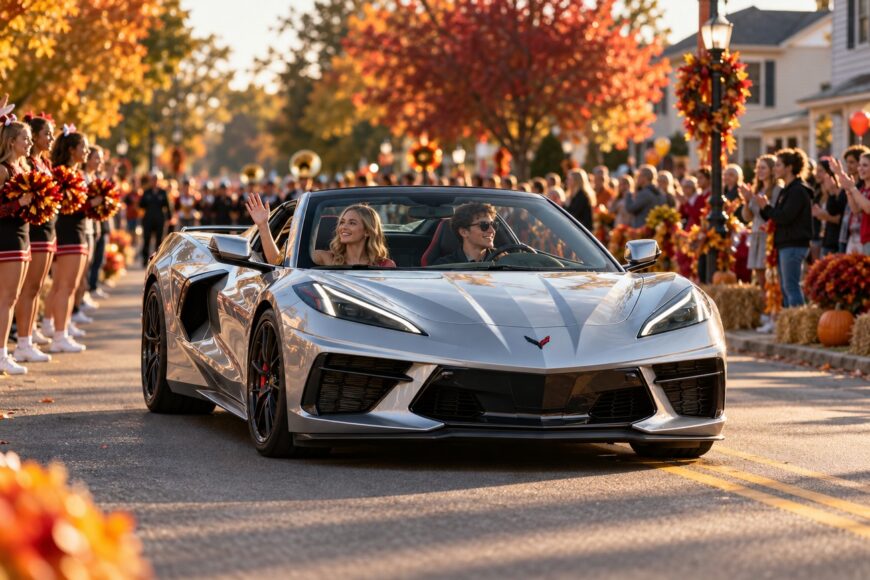
A Corvette makes a memorable entrance at a homecoming parade. Yet the job is a slow, even procession, often over pavement whose bumps and joints matter to a low car. Smooth starts, predictable stops, and room for nearby walkers matter more than acceleration.
The C8’s low seating position, two-seat cabin, sports-oriented chassis, and limited clearance shape the whole appearance, from passenger pickup to the final turn. If the plan involves someone standing to wave, settle that question before choosing the car: an open roof does not turn a standard Corvette into a parade platform.
- Is a Corvette C8 Right for a Homecoming Parade?
- Prepare the Corvette and Check the Parade Route
- How to Drive a Corvette Smoothly at Parade Speed
- Common Mistakes and When to Choose Another Car
- Frequently asked questions
- How should you decorate a Corvette for a homecoming parade?
- How do you drive a car in a parade?
- What car is the poor man’s Corvette?
- What is a funny nickname for a Corvette?
- How do you decorate a car for a homecoming parade?
Is a Corvette C8 Right for a Homecoming Parade?
The C8 Stingray is a two-seat, mid-engine sports car with an eight-speed dual-clutch transmission. Typical figures are about 490–497 hp and 630–637 Nm, though some sources list about 482 hp depending on market or version. Its reported 0–100 km/h time ranges from about 2.9–3.5 seconds, and its top speed from about 296–312 km/h. None of those numbers tells you how settled it will feel in a procession.
A suitable parade car needs to move smoothly at very low speed, give its occupants easy access, and leave the driver a clear view of escorts and pedestrians. The Corvette’s low seat and sports-oriented chassis can make each of those tasks less forgiving. Its appearance also draws attention, which may suit a celebratory arrival but can distract from a more formal ceremony.
Keep both occupants seated while the car moves. The standard C8 has no purpose-built parade platform or standard handrails for a standing passenger, and its roof opening is no substitute. If the homecoming plan requires a person to stand and wave, choose a vehicle prepared for that role rather than improvising inside the Corvette.
Prepare the Corvette and Check the Parade Route
Walk or drive the route before the event, including the staging area and exit. Look for ramps, pavement seams, speed bumps, slopes, curb approaches, and tight turns. Note where passengers will get in and out, where the line may stop, and whether the driver can take a wide enough path around a raised edge.
The C8 Stingray measures approximately 4630 × 1933 × 1234 mm and has a curb weight of about 1527–1530 kg. Its low nose and body deserve particular attention at transitions onto streets or temporary staging areas. A route that looks clear from a standing viewpoint may still put the front end close to a pavement joint.
Rehearse at the intended ceremonial pace; roughly 5–15 km/h is useful planning context, not a vehicle specification. Include the actual pickup and exit points, because a low seat can make repeated entry awkward, especially with formal clothing. With only two seats, arrange separate transport for additional people and any decorations, papers, or bulky accessories that will not fit in the car’s storage compartments.
How to Drive a Corvette Smoothly at Parade Speed
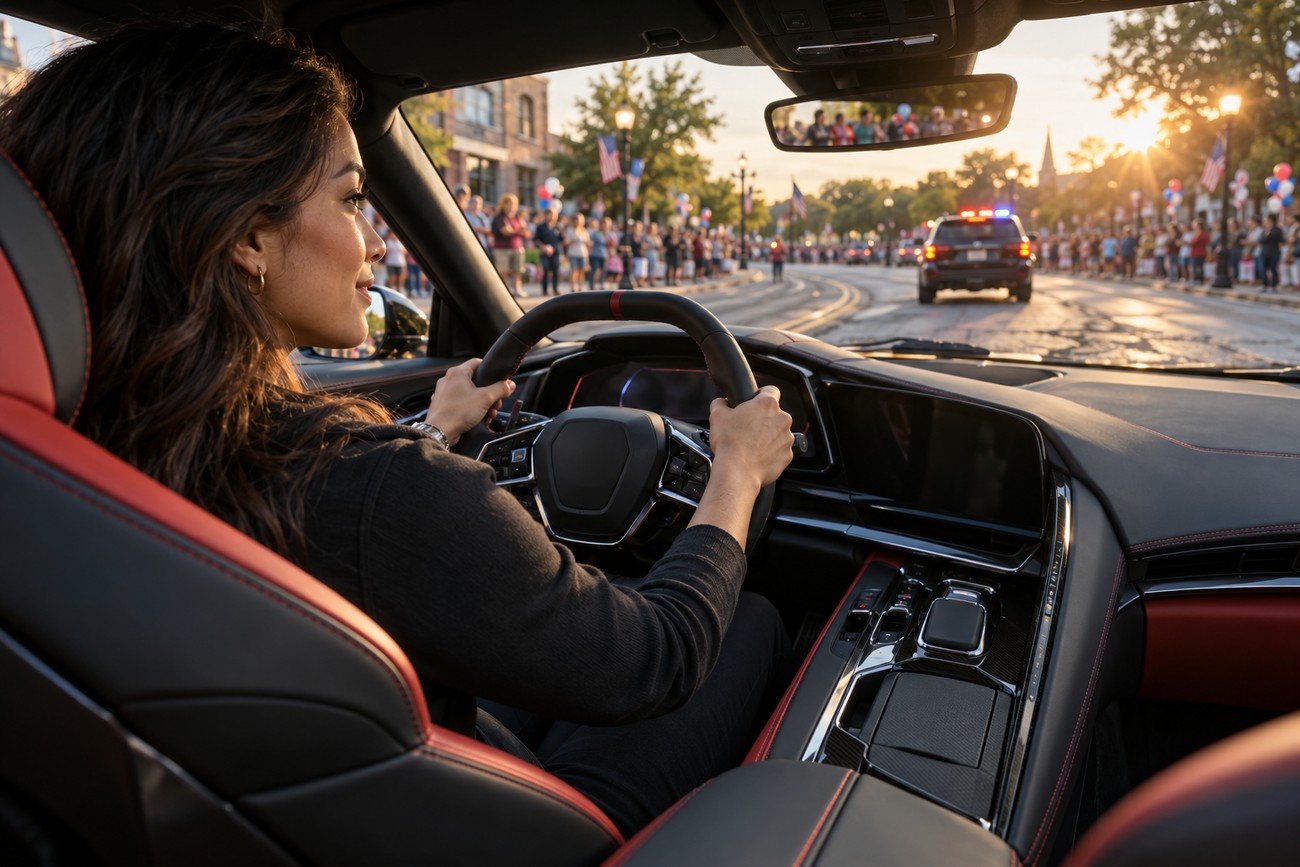
Use small, progressive throttle inputs and leave a generous gap to the vehicle ahead. That space lets you ease off early instead of alternating between acceleration and braking. Begin slowing before a bend or crowd pinch point, then steer steadily so occupants do not sway from side to side.
Choose the calmest suitable vehicle settings and avoid a performance-oriented mode that sharpens responses or increases exhaust noise. The sports-oriented suspension can transmit bumps noticeably during a slow crawl. Cross unavoidable uneven pavement gently, without a sudden throttle input as the car settles.
Keep your eyes moving between the route ahead, mirrors, escorts, and pedestrians near the car’s low sides. In a tight formation, ask an organizer where the car should pause if the procession stalls, then make each stop gradual. Do not use the Corvette’s acceleration potential as part of the show; a brief burst can close a carefully maintained gap before anyone nearby expects it.
Common Mistakes and When to Choose Another Car
Power and visual drama do not establish parade suitability. A convertible roof also does not supply a secure place to stand or hold on. Treat a request for a standing rider as a vehicle-selection issue, rather than a decoration or seating problem to solve at the staging line.
Another mistake is checking the main street while overlooking access to it. A steep entrance, rough holding area, or curbside pickup can cause more trouble than the procession itself. Minor contact is worth avoiding: Corvette body panels and other specialty components can make parade damage costly.
A C8 can work for a controlled, seated appearance on a suitable route that has been rehearsed. Choose a larger, smoother, easier-to-enter vehicle if the ceremony calls for standing, frequent passenger changes, several occupants, or rough access roads. That decision protects the schedule as well as the car and its passengers.
Frequently asked questions
The questions below cover decorations, procession driving, and Corvette nicknames. Keep decorations clear of the driver’s view and moving parts. On the route, follow the organizer’s signals and leave room for nearby walkers.
How should you decorate a Corvette for a homecoming parade?
Use lightweight, removable decorations and secure them so they cannot flap loose or reach moving parts. Keep the driver’s sightlines, lights, mirrors, license plate, doors, vents, and exhaust area clear. Check the attachments after a short rehearsal, and remove anything that shifts or leaves adhesive residue.
How do you drive a car in a parade?
Follow the organizer’s route and signals, keep a steady gap, and stop smoothly when the procession pauses. Before moving off, confirm that nearby walkers and escorts are clear; never assume they can hear the car or predict its path. Agree on a simple signal with the organizer for a mechanical problem or an unexpected passenger need.
What car is the poor man’s Corvette?
There is no single official answer. The Opel GT is sometimes given that informal nickname because its styling recalls an earlier Corvette, though people also apply the phrase to other less expensive sports cars. It does not indicate that any of them offers the same parade access or passenger arrangement as a Corvette.
What is a funny nickname for a Corvette?
“Vettezilla” is a playful nickname for a Corvette, especially one arriving with bold homecoming decorations. Keep any nickname on a removable sign or in the event program rather than placing lettering across the windshield or lights.
How do you decorate a car for a homecoming parade?
Start with the event’s theme, then choose a few lightweight signs or ribbons that remain readable at walking pace. Secure them away from the driver’s view, lights, doors, wheels, and exhaust, and test the car’s full steering and door movement before entering the lineup. A simple, stable display is easier to manage during repeated stops than a large display that needs constant adjustment.







