
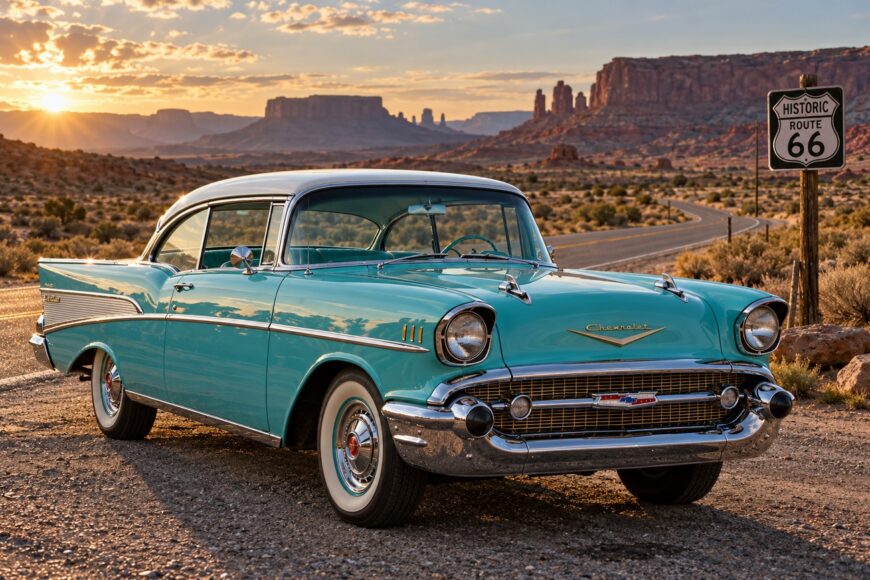
A 1955–1957 Chevy Bel Air beside a Route 66 sign looks entirely at home: bright trim, broad glass, and a road built into American motoring lore. Behind the photograph is a less forgiving journey. Heat, heavy traffic, long gaps between services, and repeated stops ask more of an old car than a gentle drive to a local show.
A Bel Air can make the trip today, but its condition and the route you choose matter more than its period appeal. A sound car still brings longer braking distances, less crash protection, more noise, and closer attention to fuel and temperature than a modern vehicle. The rewarding version of this drive leaves room for inspections, shorter days, and a change of plan when either the road or the car demands it.
- Can a Chevy Bel Air Handle Route 66 Today?
- What Route 66 Is Actually Like Today
- Prepare the Bel Air Before the Trip
- The Hard Parts of Driving a 1950s Bel Air
- Plan the Drive Around the Car, Not the Map
- What Makes the Trip Worth It—and What It Costs in Comfort
- Frequently asked questions
- What is the best car to drive Route 66 in?
- What is Route 66 like today?
- What is the scariest part of Route 66?
- What is the most famous stop on Route 66?
Can a Chevy Bel Air Handle Route 66 Today?
Yes, a carefully prepared Chevy Bel Air can travel Route 66 today. Chevrolet built the Bel Air from 1950–1975, and the 1955–1957 cars have the strongest visual association with the route. Their appeal is easy to understand from the driver’s seat as well as the sidewalk, but a successful long-distance drive depends on mechanical condition rather than model-year prestige.
A period Bel Air usually has drum brakes, with braking performance weaker than a modern car’s. Electrical equipment may be 6-volt or early 12-volt, depending on year and market; a 1955–1957 car should be assessed for what is actually fitted, including any later changes. Old wiring, tired charging components, and marginal cooling can turn an otherwise pleasant car into one that struggles after a slow, hot afternoon.
Show condition is a poor substitute for road condition. Fresh paint says little about brake hydraulics, a radiator’s ability to shed heat, or whether the engine restarts after a fuel stop. The car that has repeatedly completed substantial drives, with faults found and corrected along the way, offers a more credible starting point than one described as “ready to drive anywhere” on the strength of its appearance.
Owners seeking more dependable travel often consider improvements to braking, cooling, and ignition while keeping the car’s period look. Others prefer to retain factory equipment and accept slower progress, more frequent checks, and a narrower margin for error. Either approach can be legitimate if the itinerary reflects the car in front of you; neither makes a stock 1950s Bel Air a carefree modern touring car.
What Route 66 Is Actually Like Today
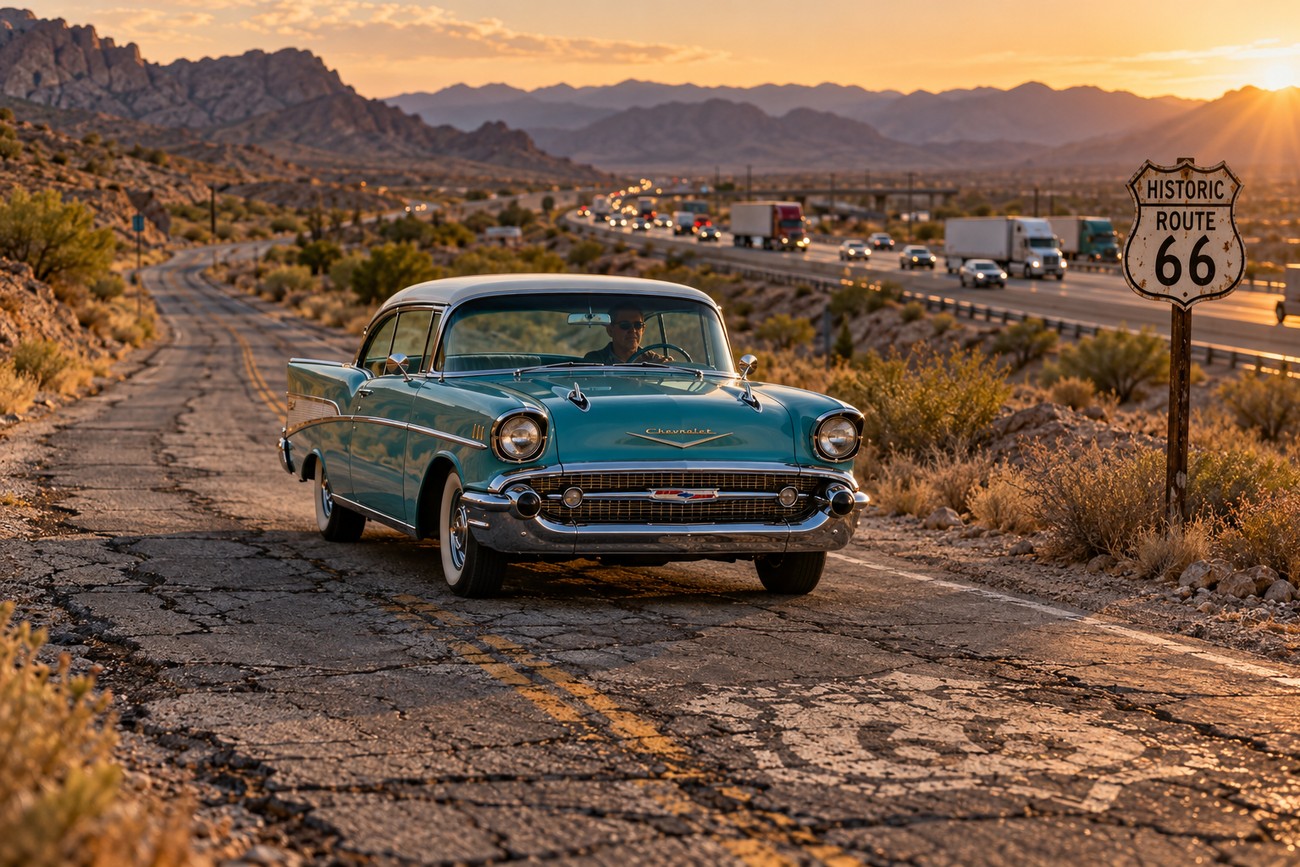
Route 66 is no longer a single continuous official roadway. A present-day drive combines surviving historic sections, local roads, and I-40, with changes of alignment and occasional gaps where the old road cannot be followed. That matters in a Bel Air because each transition can replace a quiet stretch with freeway traffic or send you through a town full of lights and slow turns.
Historic pavement varies. Some sections reward a relaxed pace; others have uneven surfaces, awkward entrances, or local detours that demand more steering and braking than their photographs suggest. A softly sprung, low-slung car deserves a cautious approach to rough patches, particularly when it carries luggage and a full-size spare. If a section looks unsuitable, taking a sound alternative protects the car without invalidating the trip.
Towns also reshape the day. Low speed limits and frequent stops keep the engine working while reducing airflow through the radiator, just when afternoon heat is highest. A map distance that looks modest may involve slow navigation, photo stops, fuel, and time spent letting the car cool. Build the schedule around those interruptions rather than trying to recover lost time at highway speed.
The empty stretches deserve equal respect. A minor fault near a town may mean a short delay; the same fault far from services can become a recovery problem. Keep an alternative route in mind, know where fuel and help are available before leaving a populated area, and avoid committing to an isolated historic segment simply because it appears on a vintage map.
Prepare the Bel Air Before the Trip
Begin with a roadworthiness inspection, not a cosmetic checklist. Have the brakes checked for hydraulic leaks, sound hoses and lines, correct adjustment, and predictable stopping; inspect steering and suspension for wear that could make rough pavement or evasive maneuvers difficult. Check tire condition as well as pressure, and confirm the spare can actually be fitted with the tools carried in the car.
Cooling, ignition, charging, wiring, and fuel delivery deserve the same attention. Inspect the radiator, fan operation, belts, and hoses, then check the battery and charging system under real operating conditions rather than assuming that a successful cold start proves them sound. On a carbureted car, examine the fuel system for leaks and heat-related trouble before a hot roadside stop exposes a weakness.
Look beneath the attractive surfaces. Inspect floors, frame rails, and the trunk for hidden corrosion; structural rust can cost more to put right than visible cosmetic damage and may undermine the case for a long drive. A pre-purchase inspection is especially valuable if a seller presents shiny paint and a brief demonstration drive as evidence that the car is trip-ready.
Discreet improvements can make a Bel Air easier to use without changing what people see at the curb. Disc brakes, electronic ignition, and a more effective radiator are options to assess with a competent specialist, with installation quality and the rest of the system considered together. Check whether the car has seat belts and head restraints rather than assuming it does: older cars may lack them, and their crash protection remains materially below modern standards even after mechanical upgrades.
Finish preparation with a meaningful test trip that includes highway running, town traffic, fuel stops, and a restart after the engine is fully warm. Carry a full-size spare, suitable belts and hoses, ignition parts, and the means to use them, but treat the test as a chance to learn what this particular car needs. Repeated small faults close to home are a reason to postpone departure, not an acceptable forecast for a remote stretch of the route.
The Hard Parts of Driving a 1950s Bel Air
Driving a 1950s Bel Air well takes anticipation. Usually fitted with drum brakes, a period car has weaker braking performance than a modern car, and confidence can fall further on a descent or in dense traffic. Leave generous space, enter downhill sections at a manageable speed, and resist the pressure to follow a modern vehicle at a modern following distance.
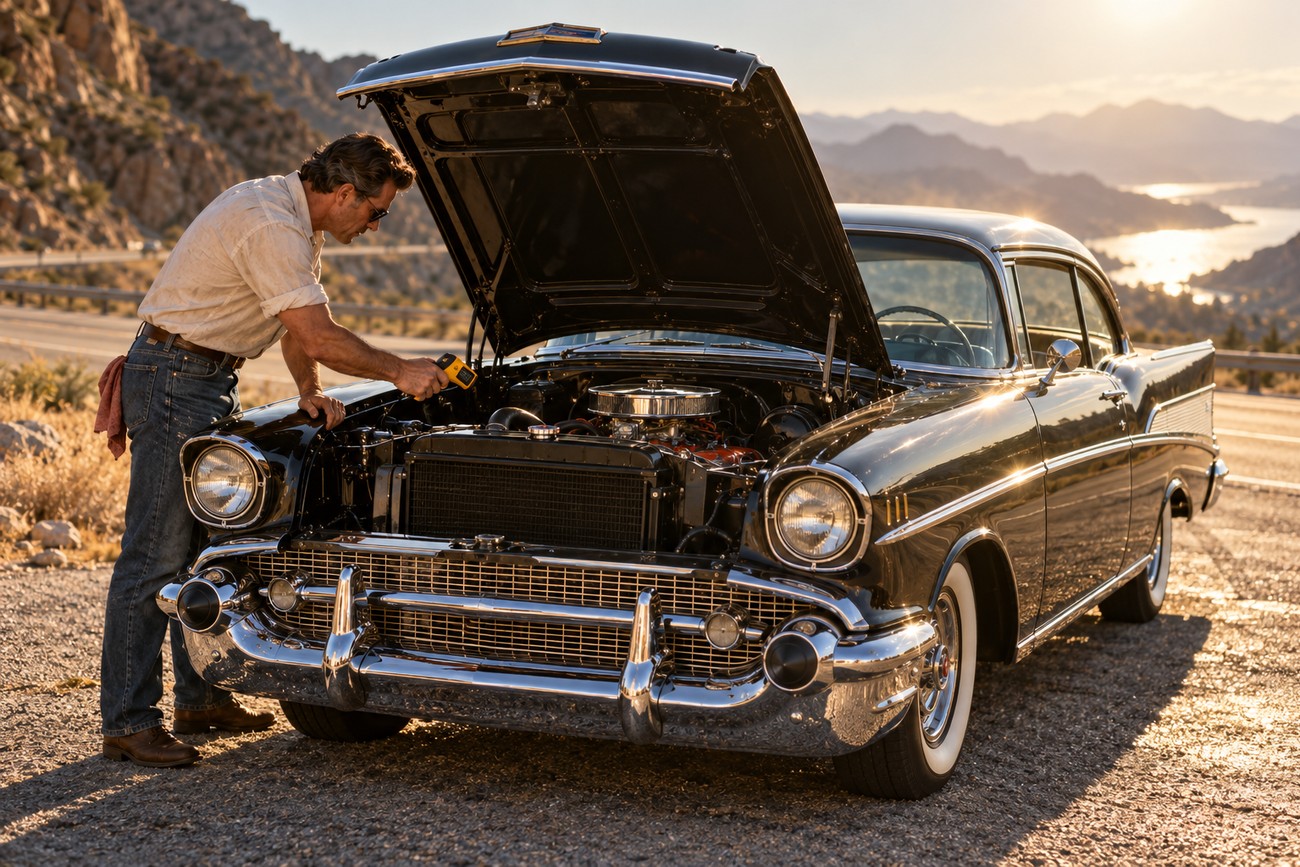
Heat is often the more persistent test. Slow town traffic reduces cooling airflow, while hot conditions can bring overheating, vapor lock, and difficult hot starts in a carbureted V8. More engine power will do little to help a car that cannot manage its temperature at low speed. Watch the gauges, notice changes in how the engine runs, and choose a safe place to stop before a rising temperature becomes a roadside failure.
A hard restart after a hot fuel stop does not automatically point to a weak starter or battery. Before departure, check cooling performance and fuel-line condition and routing; heat soak or vapor lock may be the cause, and replacing electrical parts without diagnosing it can leave the fault untouched.
Highway driving brings a different strain. A healthy classic V8 can still feel less comfortable keeping pace with modern traffic, especially among trucks or during overtakes, and the car’s brakes and steering set limits beyond the engine’s ability to accelerate. Use I-40 where it solves a route gap, then leave it when a calmer road is available and suitable. There is no prize for holding a speed that makes every lane change tense.
Comfort affects judgment, too. Noise, vibration, limited climate control, and sustained attention to the car can make a drive beyond a few hours tiring, particularly in heat. Plan fuel and rest stops before fatigue dictates them, and let passengers say when the day has been long enough. A restored interior may be a pleasant place to sit while still offering little of the insulation or climate control expected in a newer car.
Plan the Drive Around the Car, Not the Map
Divide the itinerary into days the Bel Air can complete without pressure to make up time. Morning and evening driving reduce heat, traffic, and carburetor stress, while a shaded stop during the hottest part of the day gives both people and machinery a break. Leave space for a slower historic section, an unexpected detour, or a workshop visit instead of booking every arrival tightly.
Make fuel and recovery plans before entering a long empty stretch. Confirm where the next dependable fuel stop is, keep the full-size spare accessible, and carry belts, hoses, and ignition parts suited to the car. Modern gasoline and high ambient temperatures can make a carbureted system less stable; a car that runs cleanly on a cool morning still needs to prove itself after a hot stop.
Tires require more planning than simply finding a matching tread pattern. Confirm the fitted size, load rating, and availability along the route, and establish whether the wheels and tires use tubes or are compatible with tubeless fitment. An uncommon setup can make a puncture difficult to resolve quickly even when a tire shop is nearby. Know the car’s exact requirements before asking that shop for help.
Check registration, insurance, inspection, and emissions requirements relevant to the vehicle and your journey before setting out; rules vary by state and county. For a car arriving from another jurisdiction, verify what applies rather than assuming every local test applies to visiting vehicles or that historic registration permits every kind of use. Save route alternatives and recovery contacts where you can reach them without a signal, and treat an I-40 connection as a practical tool when the historic road is closed or unsuitable.
What Makes the Trip Worth It—and What It Costs in Comfort
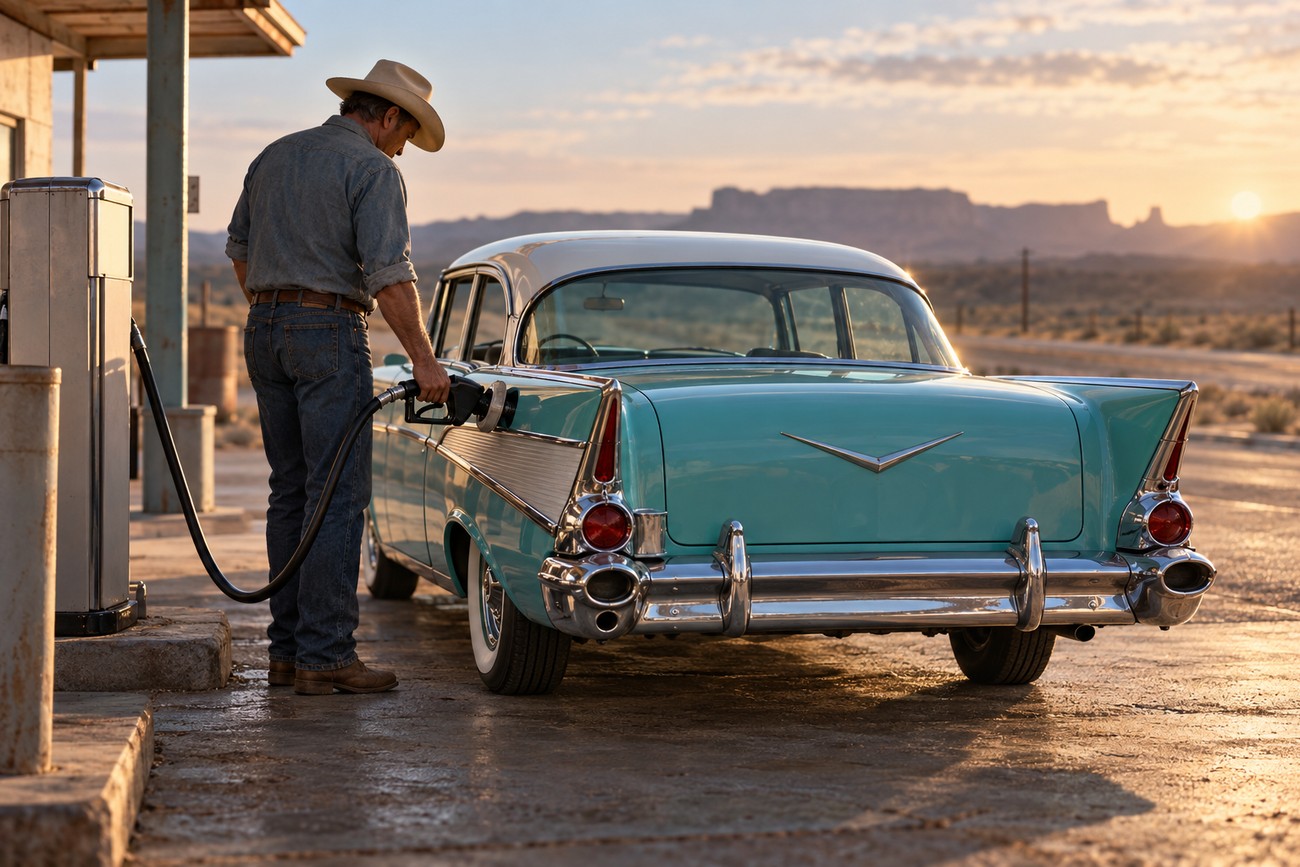
The 1955–1957 Bel Air gives Route 66 a visual connection that a newer car cannot reproduce. Its view through the windshield, distinctive shape at a roadside stop, and unhurried response make the drive feel different from ordinary highway travel. Morning or evening light also makes a better time for photographs while sparing the car some heat and traffic.
That character carries a cost beyond fuel. A restored Bel Air still calls for more fuel stops, temperature monitoring, and service planning than a modern car; a less sorted example may add downtime. Parts are broadly available, but a needed component may not be on a local shelf, and reproduction quality varies. Budget time for diagnosing and fitting parts as well as buying them.
Small, unobtrusive changes can deliver substantial gains. Better braking, reliable ignition, and effective cooling matter each time traffic stops or a descent begins, even though none draws the attention that paint and chrome do. They cannot give the car modern crash protection or erase noise and fatigue, so judge the result by how confidently it completes ordinary driving tasks, not by how little its engine bay appears to have changed.
Choose the vehicle that matches the journey you want to manage. A mostly original Bel Air suits a slower, flexible trip for someone willing to accept its limitations; a discreetly upgraded example offers a broader margin while retaining much of the period experience. A modern car, or a modern support vehicle traveling with the classic, makes sense when predictable long-distance progress and comfort take priority. The best choice is the one you can prepare, drive, and recover responsibly.
Frequently asked questions
The right vehicle and itinerary depend on the experience you want and the delays you can accommodate. These decisions are easiest to make before an isolated road or a hot afternoon makes them urgent.
What is the best car to drive Route 66 in?
There is no universal best car for Route 66. A modern car offers the strongest combination of comfort and predictable travel, while a stock classic delivers authenticity with greater demands on the driver and less safety margin. A discreetly upgraded Bel Air sits between them: it keeps the period setting while improving selected systems, although it still needs more attention than a newer vehicle.
Consider repairability along your intended route, not simply whether parts exist online. If losing a day to a fault would spoil the trip, choose the more predictable car or arrange support. If the Bel Air itself is the purpose of the journey, allow time and money for it to set the pace.
What is Route 66 like today?
Route 66 today is a collection of historic sections joined by local roads and highways, including I-40, rather than one uninterrupted road. Build the itinerary state by state and check current access, closures, and detours before each driving day. Historic signs and printed maps are useful guidance, but neither guarantees that the next stretch remains open or suitable for an old car.
Keep an accessible alternative for each planned historic segment. That lets you leave a rough or closed section without improvising a long detour while the Bel Air is hot, low on fuel, or surrounded by faster traffic.
What is the scariest part of Route 66?
For a driver in an old Bel Air, becoming immobile far from services can be more unsettling than any particular landmark or road. Before an isolated segment, identify the next fuel stop, a safe place to pull off if possible, and a recovery contact able to deal with the car. Tell someone your intended route and allow for areas where phone service may be unreliable.
Know what you will do if the engine overheats or refuses to restart, and avoid pushing on to preserve a schedule. A full-size spare and a few appropriate parts help only when you can use them safely or have arranged help that can reach you.
What is the most famous stop on Route 66?
No single stop is the definitive answer; Route 66 has many widely photographed landmarks, and fame alone is a poor reason to take a Bel Air down an awkward road. Choose stops by checking current opening status, road access, parking, and whether you can leave the car safely without a long idle or a hot restart in traffic.
An iconic site reached in the cooler part of the day, with straightforward parking and time to let the car rest, may be a better stop than a more recognizable one reached at peak heat. Check the practical details shortly before arrival, since access and operating hours can change.







