
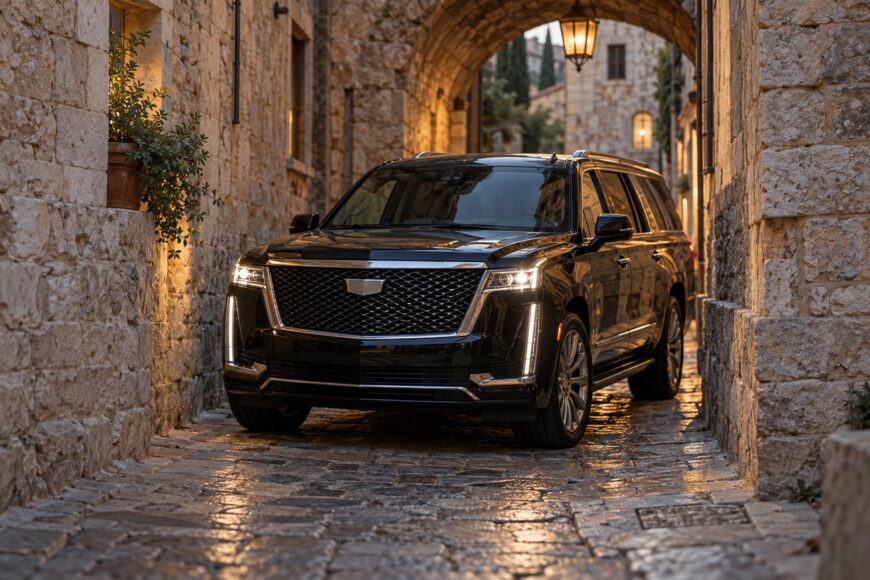
A full-size Cadillac Escalade can look out of place on a medieval street before it even reaches the first difficult corner. The Escalade ESV is about 5.76 m long, about 2.06 m wide without mirrors, and about 1.94 m high. Those dimensions leave little margin around gates, parked cars, projecting walls, and short-sightline junctions.
The problem involves more than simple width. Turning geometry, mirror clearance, stone surfaces, access rules, and the availability of a safe escape route all determine whether the drive is practical. A route may appear open on a map and still fail at a tight corner or controlled entrance, so the decision depends on the specific vehicle, the exact route, and local restrictions.
- Why an Escalade Feels Oversized in a Medieval Center
- The Real Choke Points: Mirrors, Corners, and Turning Geometry
- What Cobblestones, Slopes, and Weight Change
- Access Rules Are Part of the Route
- A Lower-Risk Way to Plan and Drive the Route
- Common Myths and the Practical Verdict
- Frequently asked questions
- What year should you avoid when buying a Cadillac Escalade for this kind of driving?
- Who usually drives Cadillac Escalades, and does that matter in a medieval city?
- What year should you avoid a Cadillac Escalade?
- Who usually drives Escalades?
Why an Escalade Feels Oversized in a Medieval Center
The Escalade ESV’s dimensions are closer to those of a large touring vehicle than a typical city car. At about 5.76 m long, it occupies substantial space before the driver begins a turn, and its width of about 2.06 m excludes the mirrors. Its height of about 1.94 m also matters around low gateways, covered passages, and older structures with uneven approaches.
Medieval streets rarely provide consistent lanes with generous sightlines. Their width can change around a building corner, a gate, a parked vehicle, or a small square. A passage that looks acceptable on the approach may narrow precisely where the vehicle needs room to swing.
The Escalade’s large turning radius makes tight 90-degree turns and dead ends difficult. If the street does not allow a full arc, the driver may need several corrections, a reverse maneuver, or a different route. Those options become harder when walls, pedestrians, bollards, and other vehicles occupy the available space.
Ordinary urban-SUV assumptions therefore become unreliable. A vehicle that feels manageable on a modern city street can feel oversize where the road has irregular edges, no shoulders, and little room to recover from a poor entry angle.
The Real Choke Points: Mirrors, Corners, and Turning Geometry
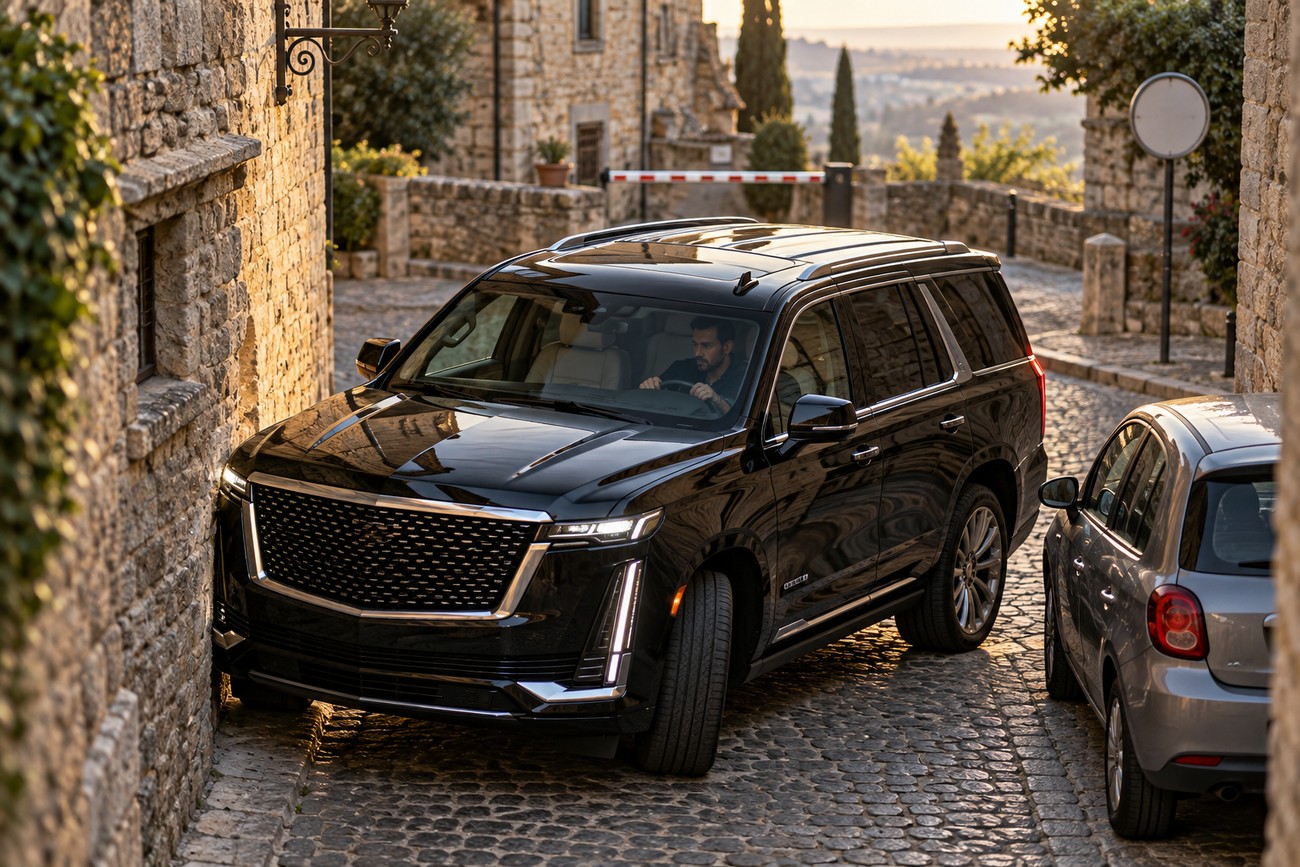
The most common mistake is checking whether the main body appears to fit between two walls. That only tests a straight section. Mirrors and the front end may become the main clearance problem, especially where the road bends around a projecting corner or a fixed bollard.
A vehicle can pass through the apparent width of a lane and still fail at the corner. The front outside corner follows a different path from the inside front wheel, while the rear of the vehicle swings through the turn. Parked cars reduce that space further, and a large turning radius becomes especially restrictive when the street offers no full arc.
The outside mirror and the front-corner sweep deserve priority through a turn. A visible gap between walls says little if the mirror or front corner reaches the wall before the wheels complete the maneuver.
Use a slow approach that preserves the option to stop before the narrowing begins. If the vehicle cannot make the turn without relying on uncertain clearance, continuing forward can convert a manageable route-planning error into body damage, a blocked street, or a difficult reverse.
Finding an alternative early is usually the safer decision. A wider approach, a permitted loading area, or a route with a credible turnaround can save time and reduce the risk of contact with stonework, signs, bollards, or parked vehicles.
What Cobblestones, Slopes, and Weight Change
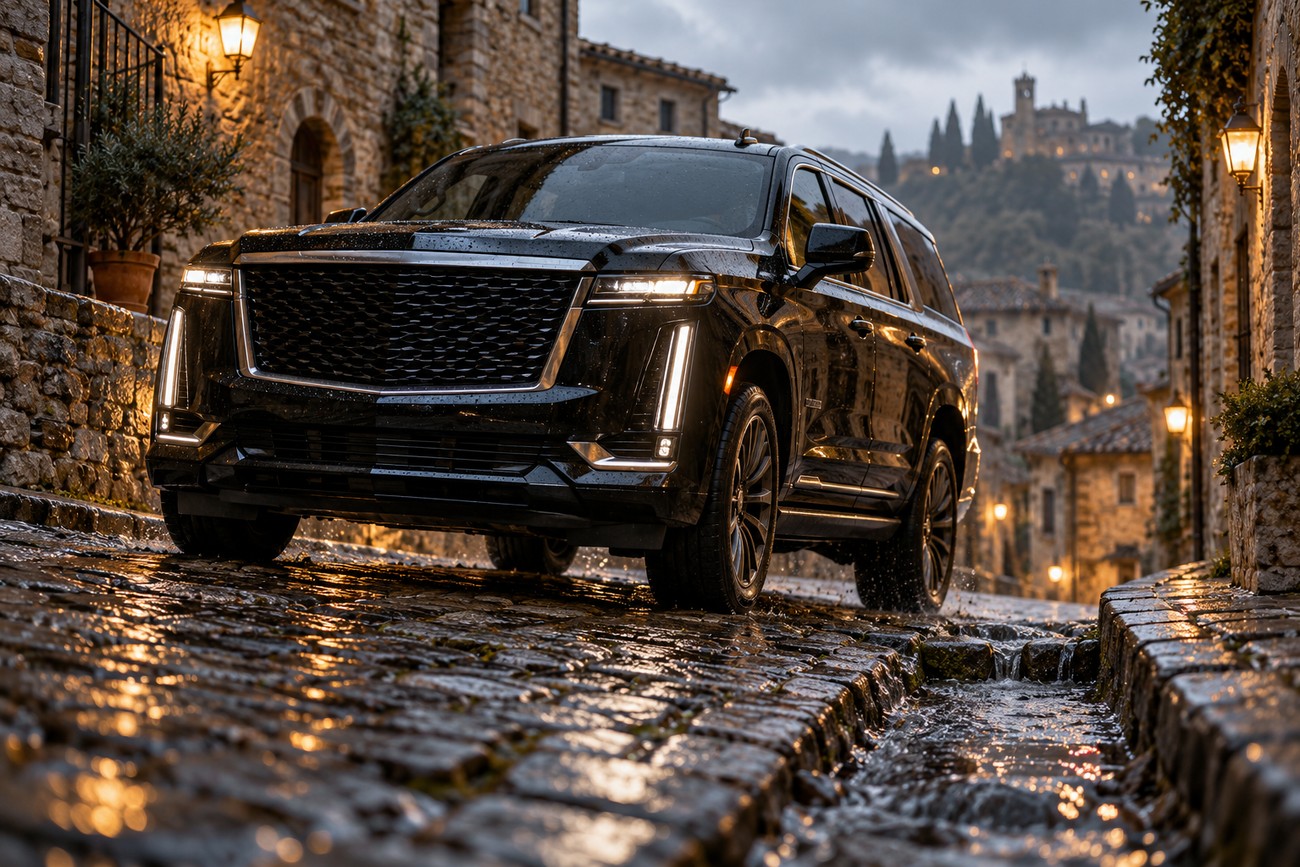
A typical Escalade weighs about 2.7–2.9 t in curb condition. On uneven stone, that mass increases the loads carried by the suspension, tires, and brakes, while also increasing the consequences of abrupt steering, acceleration, or braking.
Cobblestones can create vibration and reduce the consistency of tire contact, particularly where the surface is worn, wet, or laid over uneven ground. A crossfall, drainage channel, or sunken section can make the vehicle feel less settled during a low-speed maneuver. Wet stone also increases the possibility of traction loss during steering or braking.
Modern Escalade ground clearance is roughly 20+ cm, which helps with some uneven surfaces. It does not eliminate contact with steps, curbs, sills, bumpers, drainage channels, or broken road geometry. A central part of the underbody may clear an obstacle while a sill or bumper corner still strikes it.
Drive at walking pace where conditions require it, and keep steering, throttle, and braking smooth. Turning the wheel sharply while applying power or braking hard on uneven stone can increase sliding and impact loads. Extra care is also needed on slopes, where the vehicle’s weight makes a small loss of traction more difficult to arrest.
Access Rules Are Part of the Route
Physical access is only one part of the decision. Historic centers may restrict heavy, wide, commercial, or unauthorized vehicles, with rules based on vehicle type, width, height, total weight, or axle load.
Entry may be limited to residents, services, taxis, special vehicles, or permit holders. Bollards, gates, one-way controls, and weight restrictions can apply even where the street looks physically wide enough. A resident or service exception does not automatically extend to a visitor driving a large SUV.
Navigation software may miss local, temporary, physical, or permit-dependent restrictions. It can also fail to represent a removable bollard, a controlled gate, or a route that is technically open only at certain times. Treat the navigation route as a starting point for verification rather than proof of authorization.
Check the official local access information before entering the historic area. If the rules are unclear, park outside the restricted zone and use a suitable local transport option or obtain the required permission. This avoids potential fines, towing, disputes over access, and damage to protected paving.
A Lower-Risk Way to Plan and Drive the Route
Begin with access rules, then assess the route itself. Confirm whether the vehicle is permitted and look for restrictions involving width, height, weight, axle load, or permits. A legal route can still be mechanically unsuitable, so both questions need separate answers.
Inspect satellite and panoramic imagery before departure. Look for arches, bollards, narrowed sections, one-way lanes, projecting building corners, drainage channels, and places where a turn or reverse maneuver might be possible. Pay particular attention to the final approach, since the most restrictive point may be several turns after the main road.
Plan an alternative before entering any route with no credible turnaround. If the street narrows ahead and reversing would require a long, blind maneuver, stop while the vehicle still has room to change direction. Trying to force a passage increases the risk of damage, obstruction, and legal complications.
On stone, use smooth steering, gentle throttle, and progressive braking. Allow extra clearance around the mirrors and front corners, and avoid turning at speed or applying power with the steering at full lock. If the surface is wet, sloped, or visibly broken, reduce the maneuver’s complexity by choosing a wider route whenever possible.
The safest decision point is before the vehicle enters the choke point. Once the mirrors are close to walls and the rear path is difficult to observe, the driver has fewer useful options, and a small misjudgment can affect both the vehicle and the surrounding historic fabric.
Common Myths and the Practical Verdict
High ground clearance does not make an Escalade naturally suited to medieval streets. It may help over some uneven surfaces while leaving mirror clearance, front-corner sweep, turning radius, and access restrictions unchanged.
Passing a straight width check does not prove that the full turning path is safe. Corners, parked vehicles, projecting walls, and the rear swing can remove the space required for a turn. The critical measurement is the complete path through the maneuver, not the widest-looking section of road.
Cobblestones are more than rough pavement for a heavy vehicle. Uneven or wet stone can increase vibration, reduce low-speed traction, and raise loads on the suspension, tires, brakes, and paving itself. Smooth inputs and careful route selection matter as much as ground clearance.
Navigation also does not always know the rules. An Escalade may work on selected approaches and permitted roads, especially where the route has adequate width and a reliable exit. A medieval center should be treated as a constrained route environment rather than a normal urban drive.
Frequently asked questions
Suitability depends on three separate factors: the condition and equipment of the vehicle, the geometry and surface of the route, and the local access rules. No single model year or driver profile can answer all three.
What year should you avoid when buying a Cadillac Escalade for this kind of driving?
No single model year can be declared unsuitable from route geometry alone. A newer or older Escalade may still be a poor choice for a particular medieval route if its dimensions, mirror position, tires, condition, or equipment do not suit the access and maneuvering demands.
Before purchase, check the specific vehicle’s tires, suspension condition, braking system, cameras, sensors, and available clearance information. Those checks help establish whether the vehicle is prepared for low-speed work on uneven surfaces, although they cannot make a restricted or physically impossible route suitable.
Who usually drives Cadillac Escalades, and does that matter in a medieval city?
Escalades are commonly used by families, business travelers, private chauffeurs, and drivers who need substantial passenger or cargo space. That background says little about whether a particular historic route is suitable.
Familiarity with a large vehicle can improve positioning and mirror awareness, yet it does not replace permission checks, route inspection, or low-speed judgment. A confident driver still needs a credible turnaround and enough space for the entire vehicle path.
What year should you avoid a Cadillac Escalade?
There is no universal year to avoid solely because the destination has medieval streets. The practical choice depends on the exact route and the condition of the individual Escalade, including its tires, suspension, brakes, and maneuvering equipment.
A vehicle in good condition may still be unsuitable for a narrow, restricted lane. Conversely, a permitted wider approach may be manageable if its geometry and surface are verified in advance.
Who usually drives Escalades?
Escalades are typically chosen by people who value a large cabin, passenger capacity, cargo space, or a substantial towing and touring vehicle. They may be private owners, families, executive users, or chauffeured-transport customers.
Those use profiles do not determine medieval-street suitability. The decisive factors remain the driver’s low-speed control, the vehicle’s condition and equipment, the route’s turning geometry, and the access rules in force.







