
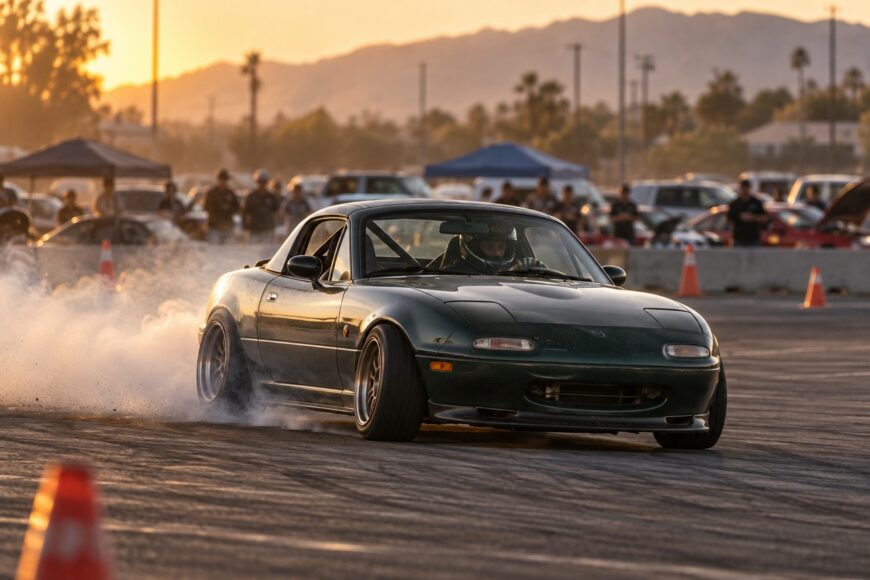
The Mazda Miata combines a light, balanced chassis with limited torque, especially when dry asphalt and wide, high-grip rear tires absorb the available power. That makes the car responsive and approachable for learning weight transfer, yet it can struggle to hold a long angle once engine speed falls.
The sensible choice is to learn car control in a mostly stock, well-maintained car rather than spend money compensating for poor preparation. Event rules, vehicle condition, surface, tires, and cooling matter more than the Miata badge. A healthy car can teach useful skills, but it will not guarantee effortless smoke or long, sustained drifts.
- Why a Miata Can Be Easy to Learn in but Hard to Drift
- Choose and Inspect the Right Miata Before the Event
- Pass Tech and Make the Convertible Track-Appropriate
- Set Up Tires, Alignment, and Steering Without Creating New Problems
- Learn the Event in Short, Repeatable Drills
- Manage Heat, Wear, and the Gaps Between Runs
- Common Miata Drift Mistakes and Expensive Fixes
- Frequently asked questions
- What year should you avoid when buying a Mazda Miata for drifting?
- Why are Miatas hard to drift on dry asphalt?
- Why are Miatas hard to drift?
Why a Miata Can Be Easy to Learn in but Hard to Drift
The MX-5 is a front-engine, rear-wheel-drive car with a short wheelbase and low mass. Late manual-transmission generations weigh approximately 1,060–1,065 kg, so changes in throttle, braking, and steering produce clear reactions. That communication helps a beginner understand how load moves between the four tires.
The same compact dimensions demand precision. A short wheelbase can make the car rotate quickly, leaving less time to correct an excessive entry. Moderate power also means that a small loss of engine speed can end the slide, especially when the rear tires are wide and designed for high grip.
The ND 2.0 produces 181 hp and 205 N·m, which is useful in a light road car but limited for a stable, sustained angle on dry asphalt with sticky rear tires. Earlier cars have less output: the NA 1.8 makes approximately 142 hp, while the NC 2.0 makes approximately 166 hp. Their lighter, simpler feel can still suit practice, particularly on a lower-grip surface.
Marketing claims that describe every Miata as an ideal drift car leave out this trade-off. Low weight and a short wheelbase make basic car control accessible, while limited torque reduces the margin for maintaining wheelspin. The car can be an excellent training platform without being an effortless high-speed drift machine.
Choose and Inspect the Right Miata Before the Event
“Miata” describes several generations, engines, differentials, and conditions. Start with the actual example in front of you. Check for rust, signs of previous track damage, bent suspension or chassis components, leaks, and repairs that suggest the car has already had a hard life.
Confirm the engine output and drivetrain specification before assuming the car will behave like another owner’s car. LSD availability and condition depend on the specific year and trim. An open differential may spin one rear wheel and make consistent drifting difficult, while a worn limited-slip differential may no longer provide the behavior you expect.
Inspect the clutch, driveshaft, axles, CV joints, differential, wheel bearings, and gearbox for noise, play, or slipping. Check the engine-oil level and condition, cooling system, hoses, radiator area, brakes, ball joints, tie-rod ends, and dampers. A road test that feels acceptable can still conceal a problem that appears after repeated heat and load.
A supposedly stock car deserves the same skepticism as a modified one. Previous owners may have returned a track car to standard parts while leaving hidden overheating, a tired LSD, worn bushings, or damage from earlier use. A pre-event inspection by someone familiar with the model can cost less than solving a failure at the venue.
Pass Tech and Make the Convertible Track-Appropriate
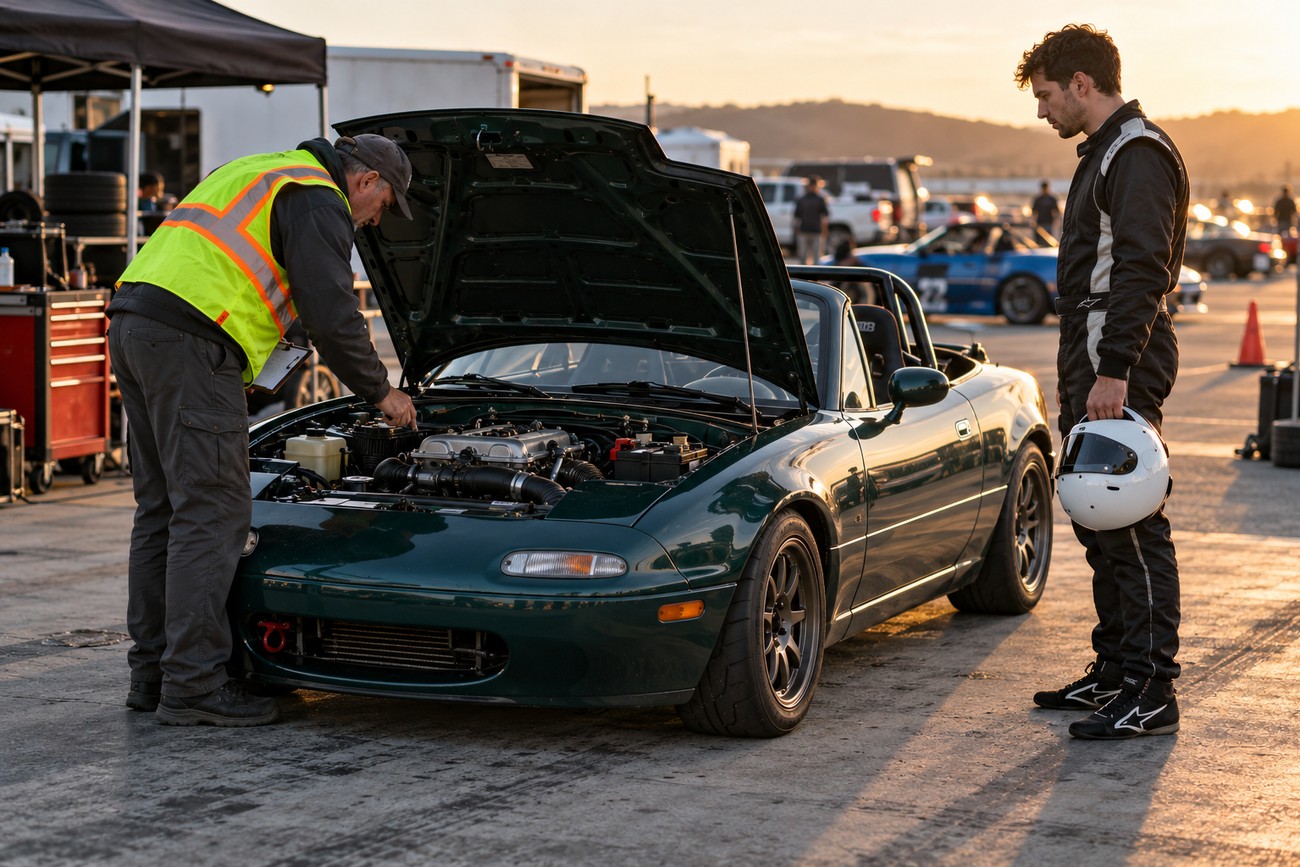
Grassroots events do not share one universal rulebook. The organizer sets requirements for technical inspection, helmet approval, belts, noise, insurance, tow points, and sometimes wheel coverage. Read the event instructions before buying parts or traveling, then ask the organizer about anything the written rules leave unclear.
Check the car’s brakes, steering, suspension attachments, battery security, fluid leaks, tire condition, and wheel fasteners. Make sure the tow points work with the recovery equipment likely to be used. A minor mechanical failure can end the day quickly, so plan how the car will leave the site if it cannot drive home.
Seat-back hoops do not automatically make a convertible safe or compliant for drifting. The organizer may require a full roll bar or cage compatible with the helmet, seat position, and vehicle geometry. Verify helmet clearance with the seat adjusted as you will use it, and confirm that the protection structure does not create a dangerous contact point.
Bring the required equipment, including the correct helmet, appropriate clothing, tools, spare fluids, and a way to monitor the car between runs. Closed wheels, a working tow point, and a realistic evacuation plan may matter more on the day than a small engine modification.
Set Up Tires, Alignment, and Steering Without Creating New Problems
Tires determine how much torque the car needs to initiate and maintain wheelspin. Excessively wide, high-grip rear tires can overwhelm stock power on dry asphalt, forcing the driver to use more aggressive inputs. Lower-grip rear tires reduce the torque required for wheelspin, yet they also reduce braking and control margins.
Do not copy another car’s tire pressure and expect the same result. Adjust pressure using tread temperature, wear pattern, and rear-axle behavior. A tire that feels easy to spin in the first run may overheat or become unstable later, while excessive pressure reduction can overload the sidewall and increase the chance of losing the bead.
Alignment should preserve predictable contact with the ground across steering and suspension movement. Large steering angles usually require steering modifications and careful checks for tire, wheel, liner, brake, and suspension clearance. Test the full range of motion while the car is loaded as it will be at the event.
Spacers, excessive lowering, and very stiff bushes can sharpen response while making the car nervous on an uneven surface. They can also accelerate wear and create clearance problems. Solve basic tire choice, alignment, and maintenance issues before chasing maximum steering angle.
Learn the Event in Short, Repeatable Drills
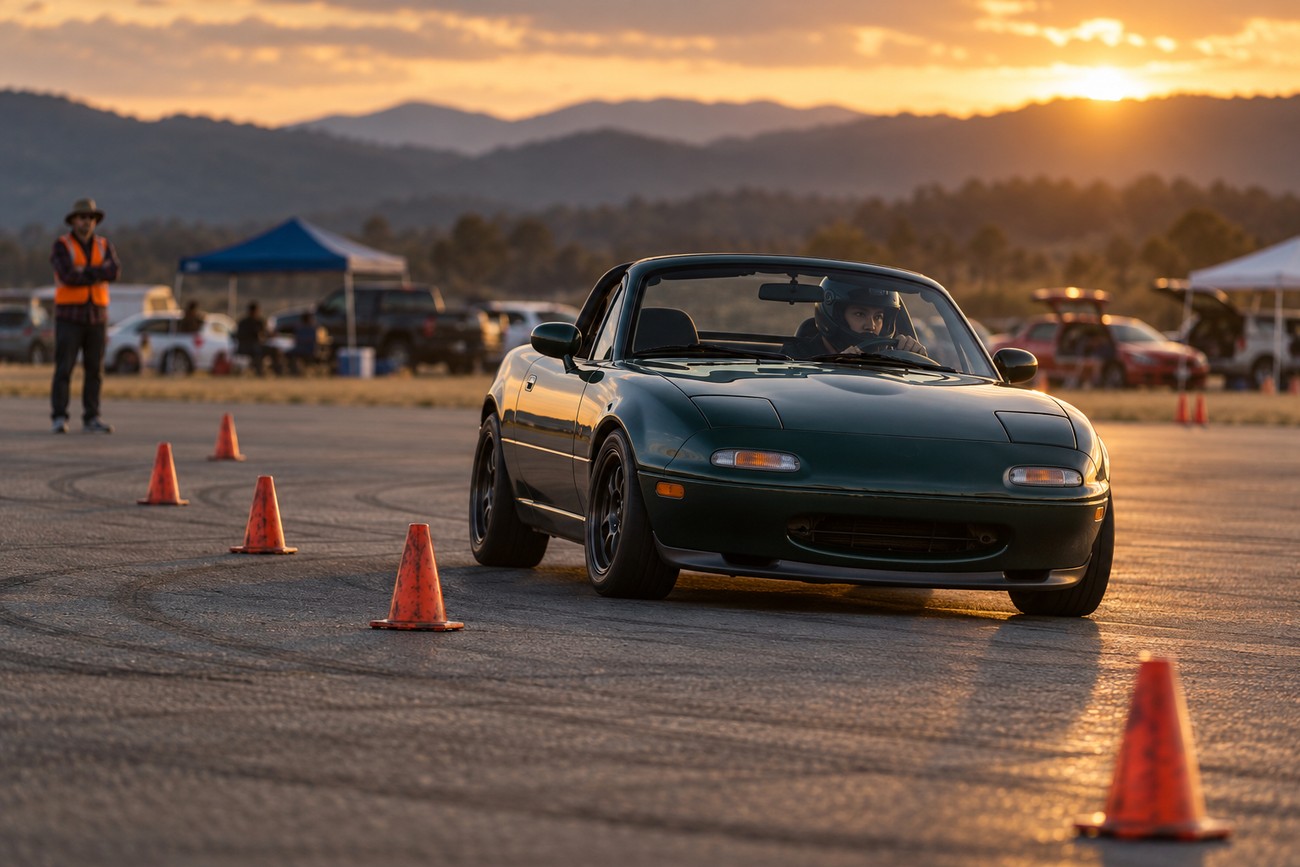
Begin at low speed on a controlled, appropriate surface. Practice braking, throttle release, steering input, and weight transfer until the car’s response becomes predictable. This builds the timing needed for a slide without making a high-speed handbrake entry the first lesson.
Use one short exercise or linked section and repeat it with deliberate changes. Learn where to slow down, where the surface changes, and where the car can cool. A short sequence performed consistently teaches more than an ambitious route driven at the limit with no time to diagnose mistakes.
Grass or wet ground can reduce tire load or grip, which may make initial wheelspin easier. Grip can change abruptly, especially where pavement meets grass. Dropping wheels onto grass can tug the car or alter its balance without warning, so treat the edge of the course as a hazard rather than an escape route.
Throttle control remains central. Too much throttle can widen the line or spin the car, while too little allows the rear tires to regain grip and ends the slide. Keep the exercises within the organizer’s run area, leave room for correction, and stop when the car or driver loses consistency.
Manage Heat, Wear, and the Gaps Between Runs
Several runs can raise engine-oil and coolant temperatures, even when each individual attempt is short. Factory road-car testing and normal road use do not equal uninterrupted drifting. Repeated wheelspin also loads the clutch, axles, CV joints, differential, cooling system, and oil system.
Rear tires disappear quickly, and used tires with unknown history can behave unpredictably as they heat up. A tire that seems acceptable during the first attempt may lose stability later. Watch for unusual vibration, tread separation, cords, sidewall damage, or a change in the car’s balance.
Check wheel torque, leaks, tire temperatures, brake heat, fluid levels, and new vibrations before chasing another attempt. A short inspection often identifies the failure that would otherwise appear at speed.
Use the gaps between runs for cooling and inspection rather than treating them as wasted time. Check wheel fasteners, fluid levels, visible leaks, brake condition, tire wear, and steering response. If the car develops a new noise, vibration, smell, or temperature trend, report it and stop until the cause is understood.
Common Miata Drift Mistakes and Expensive Fixes
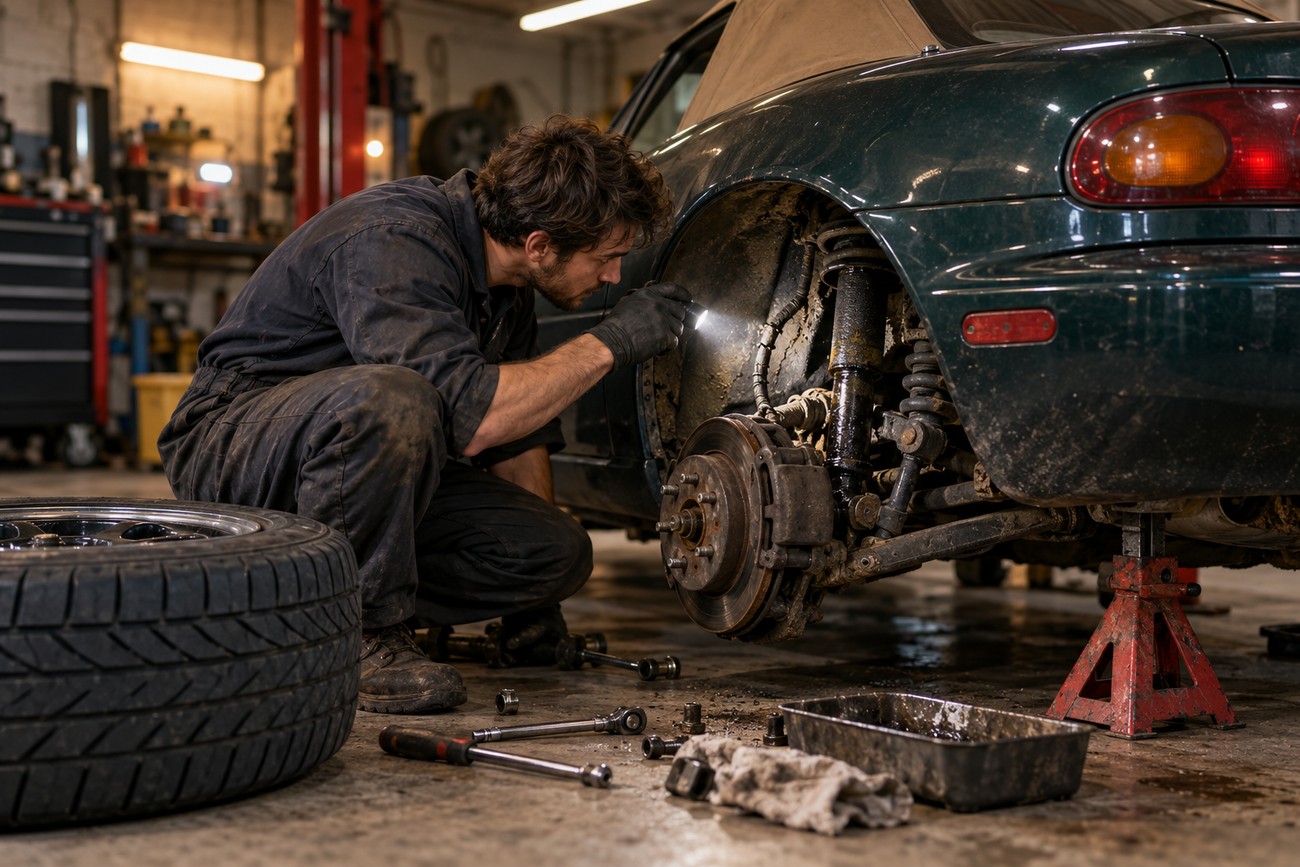
Arriving with old brake hoses, worn joints, leaking dampers, or an unknown oil level turns a driving day into a reliability test. These faults can end an event before a major crash occurs. Repair the basic systems first, and confirm that the car can stop, steer, and recover from load changes repeatedly.
Another common mistake is fitting very sticky rear tires and compensating for the lost wheelspin with more violent inputs. Confirm the differential before changing tires or planning technique. An open differential may spin one rear wheel instead of producing consistent two-wheel drive, while an LSD with unknown condition may need inspection before use.
A turbo kit is not required for learning or for lower-grip surfaces. Turbocharging adds demands on cooling, clutch capacity, tuning, and budget. More power can expose weaknesses in the differential, axles, CV joints, and oil system before it solves the original problem.
Extreme lowering, aggressive angle hardware, spacers, and stiff suspension parts can also become substitutes for maintenance and technique. Each modification needs clearance checks, suitable geometry, and a reason tied to the actual surface and tires. Follow the organizer’s rules for safety equipment, noise, tow points, and vehicle preparation before spending on performance parts.
Frequently asked questions
What year should you avoid when buying a Mazda Miata for drifting?
There is no universal avoid-year verdict from the available facts. Prioritize rust, maintenance history, differential specification, and evidence of previous track damage over the model year alone.
A well-maintained car with the right drivetrain can be a better purchase than a newer example with overheating, worn suspension, a tired LSD, or hidden chassis damage. Inspect the specific car, verify its equipment, and budget for repairs before judging its suitability.
Why are Miatas hard to drift on dry asphalt?
Dry asphalt can provide more rear-tire grip than the engine can overcome, particularly with wide, high-grip tires. Once engine speed drops, available torque may no longer sustain wheelspin, so the car straightens or regains traction.
The Miata’s low mass and short wheelbase make weight transfer easy to feel, which helps learning. Those same traits do not create additional torque. A lower-grip surface can make practice easier, while abrupt surface transitions still require caution.
Why are Miatas hard to drift?
Miatas are hard to drift when rear-tire grip exceeds the torque available at the wheels. This is most noticeable on dry, high-grip surfaces, where a light car may need more sustained wheelspin than its engine can provide.
They become easier to manage when the tires, surface, differential, and setup match the car’s output. That does not remove the need for controlled practice, cooling breaks, suitable rollover protection, and compliance with the organizer’s requirements.







