
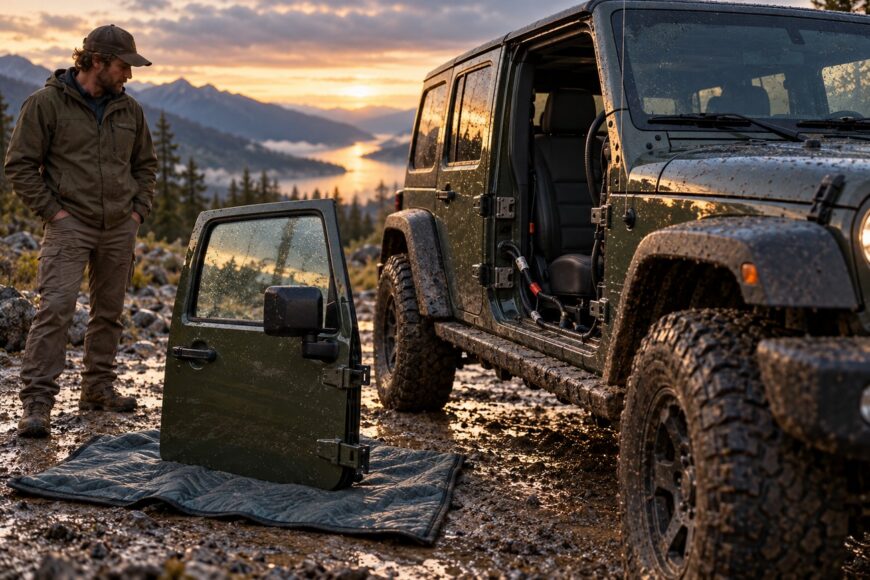
A Wrangler door coming loose or falling off on a trail is an immediate safety problem, even if the vehicle can still move. First, distinguish a door you intentionally removed from one that detached because a hinge, retaining pin, latch, or mounting point failed. Mud, vibration, strained wiring, and misalignment can turn a quick roadside refit into a door that looks closed but is not securely locked.
Keep the Jeep stationary until the loose door and exposed wiring are protected. Inspect the hardware before deciding whether to reattach the door, recover the vehicle, or arrange a replacement. A roadside repair is reasonable only when the hinge, latch, retaining hardware, mounting surfaces, and connectors are sound and the door reaches its final locking position.
- First: Secure the Jeep and the Door
- Inspect the Hinge, Pins, Latch, and Wiring Before Reattaching
- How to Reattach a Wrangler Door Without Creating a New Problem
- Why a Jeep Wrangler Door Can Come Loose on the Trail
- Can You Drive After a Wrangler Door Comes Off?
- What the Door-Safety Standards Actually Tell You
- 2026 Wrangler Pins, Door Assemblies, and Replacement Reality
- Frequently asked questions
- How should I store Jeep Wrangler doors after removing them?
- What year Jeep Wrangler should I avoid?
- How to reattach Jeep doors?
- Why do Jeep doors come off?
First: Secure the Jeep and the Door
Stop on stable ground, apply the parking brake, and keep people clear of the door’s travel path. A detached door can be heavy enough to damage its edges, mirrors, hinges, or wiring if it drops. Support it on a clean surface or move it carefully to a protected location rather than dragging it behind the Jeep.
Disconnect or protect exposed power-window, lock, and speaker wiring before moving the door. Do not pull on a harness to free the door, and do not allow connectors to hang against sharp metal. A hurried removal or refit can damage terminals and wiring even when the bodywork appears undamaged.
Check whether the door can reach the final locking position. Wrangler doors, like other hinged vehicle doors covered by the referenced M1/N rules, can have an intermediate locking position and a final locking position. Visual closure alone does not prove final locking, so a door that is merely caught on the latch is not ready for normal driving.
Do not drive normally if a hinge, latch, retaining pin, or mounting surface is bent, cracked, loose, or missing hardware. Uncertain locking, visible structural damage, or damaged wiring warrants stopping and considering recovery. Do not force a damaged mechanism into place; that can turn a repairable assembly into a replacement job.
Inspect the Hinge, Pins, Latch, and Wiring Before Reattaching
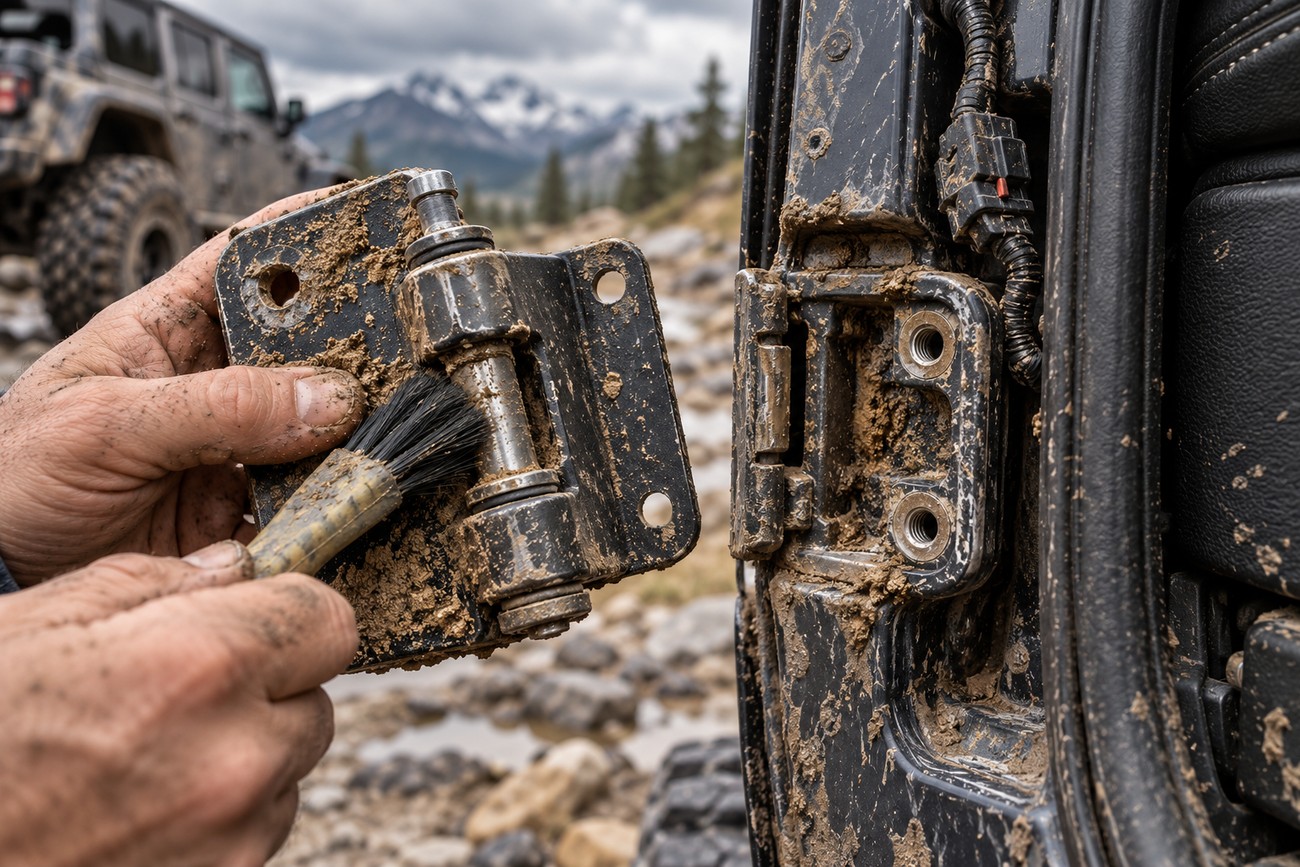
Start with the hinge and mounting area. Look for bent metal, cracks, elongated mounting holes, missing washers or retainers, fresh impact marks, and paint rubbed away around the hinge or latch. Check both the door side and the body side, because a sound-looking door can still be attached to a damaged mounting surface.
Remove loose mud and sand from the hinges, pins, and retaining mechanism before testing movement. Off-road contamination can contribute to seized hinges and tight or difficult retaining mechanisms, especially after water crossings or sandy trails. Clean first; forcing a contaminated pin can damage the pin, retainer, or surrounding metal.
Adjusting a door before cleaning and unloading the hinge often creates a temporary alignment that later becomes a rattle or failed latch. Retained washers, clear alignment marks, and protected connectors prevent a quick trail fix from becoming a recurring fault.
Operate the latch carefully and inspect the striker for rubbing, deformation, or unusual witness marks. Check the connectors for pulled wires, cracked housings, bent terminals, or water and grit contamination. Repeated removal and installation increases the opportunity for connector, wiring, and mounting damage.
Some damage appears only after the Jeep has dried out and been driven again. Owner-reported symptoms after wet or sandy trail use include door play, squeaks, rattles, rubbing, and poor closing. Treat those symptoms as inspection findings rather than harmless noise, particularly if they appeared after the door was removed or struck an obstacle.
How to Reattach a Wrangler Door Without Creating a New Problem
Use a controlled refit on level ground with the door supported at its weight-bearing points. Clean the mating surfaces, hinges, pins, latch, and retainers first. When possible, mark hinge and washer positions before removal; losing those reference positions can produce sagging, rubbing, and poor closure during reinstallation.
Reconnect the wiring before final positioning when the model’s layout requires it, and keep the harness clear of the hinge and latch. Align the door vertically without forcing the hinges into place. Install the retaining hardware fully, secure the retainer, and check that the door sits evenly against its seals and adjacent body panels.
After installation, close the door with controlled pressure and verify final locking. Check the latch from inside and outside, then inspect the gaps, hinge movement, window operation, lock operation, and speaker connection where equipped. A door that closes with a heavy slam, rubs, or springs back needs adjustment or repair before the Jeep returns to the trail.
For a 2026 Wrangler, the stated removal sequence is to open the door, release the retainer, raise the pin, disconnect the power-window and speaker connectors, and lift the door vertically. Follow the model-year-specific procedure rather than applying an older habit. A damaged hinge, pin, latch, connector, or mounting point is a stop condition for roadside reattachment.
Why a Jeep Wrangler Door Can Come Loose on the Trail
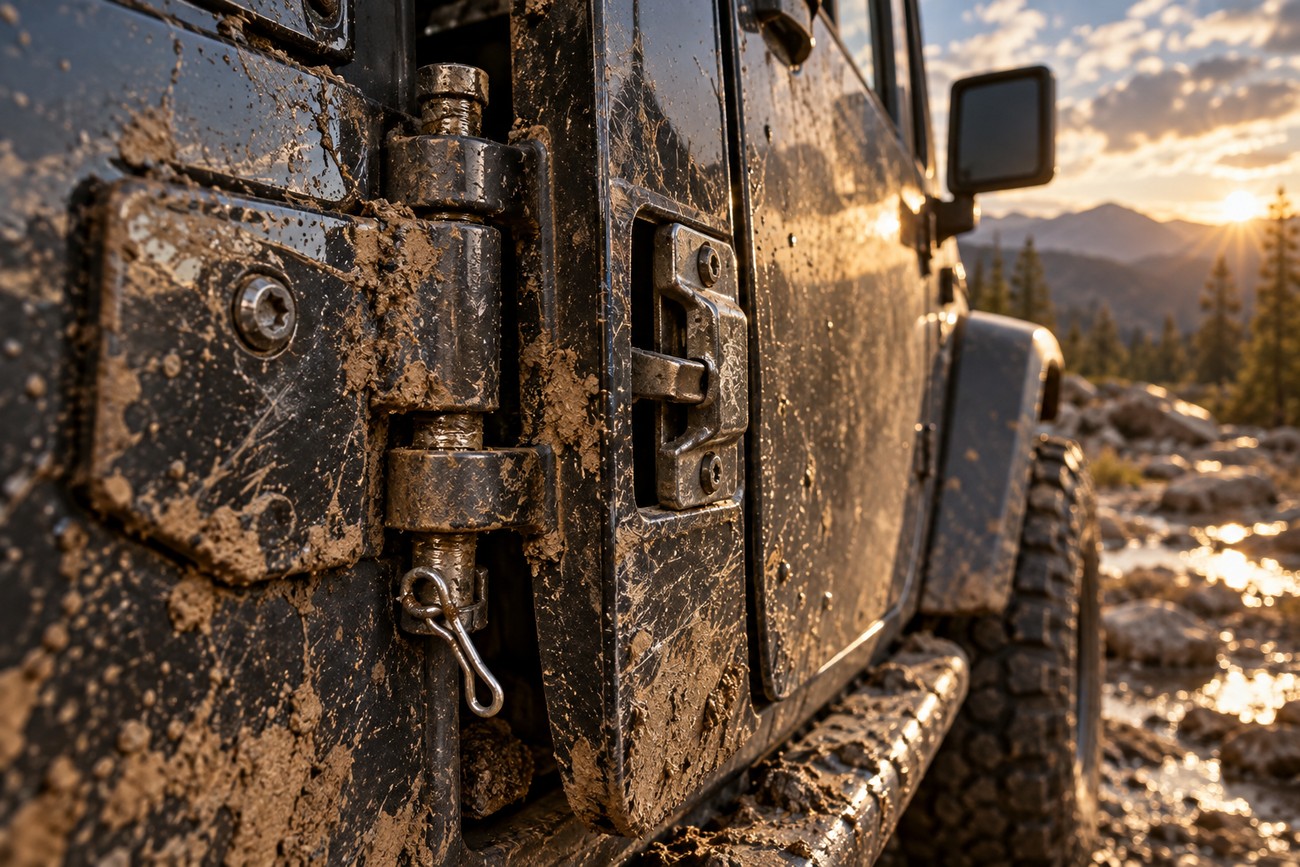
Wrangler doors are designed to be removable, but removable does not mean maintenance-free. Correct alignment, clean hardware, complete retainers, and final locking remain essential after every removal and installation. Trail vibration can expose looseness that was not obvious in the driveway.
Mud and sand can restrict hinge or pin movement, while repeated handling can wear or damage retainers, washers, connectors, and mounting surfaces. A seized hinge may make the installer apply excessive force, and a misaligned door may appear latched while remaining in the intermediate locking position. Loose or missing hardware increases the risk further.
Owner-reported trail complaints include seized hinges, difficult retaining pins, door play, rattles, squeaks, poor closing, and damaged connectors. These are reported issues, not a universal failure rate or proof that a particular Wrangler model year is inherently unsafe. The vehicle’s maintenance, removal history, impact damage, and hardware condition matter more than a simple year-based assumption.
The practical failure pattern is often cumulative: contamination creates resistance, resistance encourages force, force damages a retainer or connector, and misalignment prevents final locking. A door that has only been caught by the first latch position can then become loose under vibration. Treat the locking position and hardware condition as separate checks.
Can You Drive After a Wrangler Door Comes Off?
Drive only after confirming final locking and sound hardware. Road rules and equipment requirements vary by jurisdiction, so local law may also determine whether driving without a door is permitted.
| Trail-side condition | What it may indicate | Immediate action | Drive or recover? |
|---|---|---|---|
| Door is correctly aligned, fully supported, and confirmed in the final locking position | Normal refit may have been successful | Check latch, retainers, wiring, gaps, and operation again before moving | Cautious continuation only after verification and where local rules allow it |
| Door appears closed, but lock engagement is uncertain | Intermediate locking position, misalignment, or latch contamination | Stop and inspect; do not rely on appearance or a light push | Do not continue normally until final locking is confirmed |
| Hinge, pin, latch, or mounting point is bent, cracked, loose, or missing hardware | Structural or retaining damage | Keep the door supported and avoid forcing the mechanism | Recover or tow unless a qualified repair makes the assembly sound |
| Wiring is exposed, torn, pulled, or trapped | Connector or harness damage and possible further electrical damage | Protect and isolate the wiring before moving the door | Stop and inspect; recovery is prudent if the wiring cannot be secured safely |
| Door cannot be supported or reinstalled securely | Unsafe load, missing hardware, or damage beyond a field adjustment | Secure the vehicle and door separately | Recover or tow |
What the Door-Safety Standards Actually Tell You
The referenced ECE/GOST rules for side doors on M1/N vehicle categories provide a useful safety benchmark. They distinguish an intermediate locking position from a final locking position, which explains why a door can look closed without being fully secured. The standards are a test reference, not proof that a trail-side repair has passed certification.
For hinged doors, the referenced test applies a 300 N force, and the mechanism must not open in either the intermediate or final locking position during that test. This does not give a field technician a simple pass/fail procedure with a hand tool. It does show why relying on visual closure or a light latch click is inadequate.
Referenced retaining-device tests include loads of approximately 1111 daN longitudinally and 889 daN laterally. Those figures describe controlled strength testing of the retaining system, rather than a force you should try to reproduce on the trail. Damaged, loose, or contaminated hardware should be inspected and repaired instead of being tested by driving over rough ground.
An aftermarket component described as reinforced or heavy-duty is not automatically proven to meet equivalent strength requirements. Compatibility with a Wrangler may confirm fit, while saying nothing about durability under severe off-road loads. Ask for documented testing and installation requirements where the part affects door retention or another safety-related mounting point.
2026 Wrangler Pins, Door Assemblies, and Replacement Reality
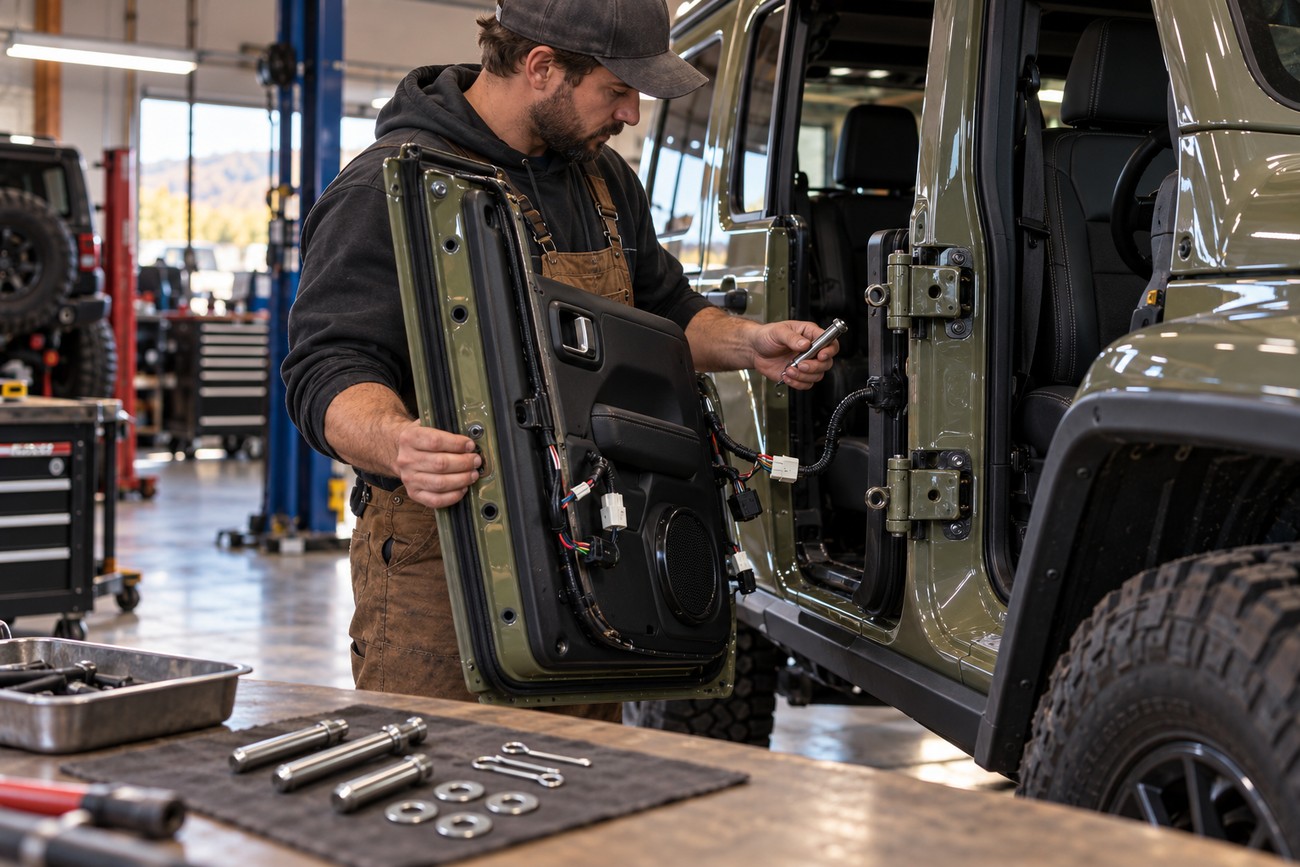
The brief identifies new retaining pins as standard on two-door and four-door 2026 Wrangler versions. That change does not by itself indicate that the incident was caused by the new hardware. It does mean that model-year-specific instructions matter, because the interface and removal sequence may differ from what an owner remembers on an earlier Wrangler.
For the 2026 procedure described here, open the door, release the retainer, raise the pin, disconnect the power-window and speaker connectors, and lift the door vertically. The electrical connections remain part of the job even though the retaining-pin design changes the mechanical interface. Skipping that step can damage connectors or wiring.
Replacement pricing and labor estimates can be misleading if “door” means only the outer assembly. A replacement door assembly may be supplied with hinges but without interior panels and mirrors. Confirm the contents, transfer parts, paint requirements, wiring, glass, latch hardware, and trim before treating the assembly as ready to install.
Separate door hardware and rear-door accessory products are available, but compatibility does not prove durability under severe off-road loads. Check the intended load path, mounting surface, fasteners, and manufacturer documentation. A part that fits the vehicle can still be unsuitable for repeated impacts, vibration, or heavy equipment.
Frequently asked questions
The questions below address door storage, model-year selection, reattachment, and common causes of door detachment. They also reinforce the distinction between a door that looks closed and one that has reached the final locking position.
Inspect the hardware, wiring, and mounting surfaces whenever symptoms appear after trail use or door removal. Follow the model-year-specific procedure before attempting another refit.
How should I store Jeep Wrangler doors after removing them?
Store each door upright on a padded support that carries the lower structure rather than the mirror, latch, or hinge. Keep the door from leaning on its mirror and avoid stacking doors, since pressure can bend hardware or scratch painted surfaces.
Protect the electrical connectors with clean covers or bags, keep them away from damp floors, and secure the door against tipping. A dedicated rack or padded stand is safer than placing a door flat where its mirrors, trim, or hinges carry the load.
What year Jeep Wrangler should I avoid?
The available information does not support a blanket “avoid” model year. Condition, maintenance, door-removal history, collision or trail damage, retaining hardware, hinges, latches, and wiring are more useful buying checks than year alone.
Inspect a prospective Wrangler with the doors installed and, where appropriate, removed according to its model-year procedure. Look for play, poor closing, rubbing, damaged connectors, missing hardware, and evidence of repeated forced removal before deciding.
How to reattach Jeep doors?
Clean the hinges and mating surfaces, support the door, align it vertically, reconnect the required wiring, install and secure the retaining hardware, and close the door carefully. Confirm final locking, even gaps, latch operation, and the absence of rubbing before driving.
Do not reattach the door roadside if a hinge, pin, latch, connector, or mounting point is damaged. The correct model-year procedure takes priority, especially on 2026 Wranglers with the retaining-pin sequence described above.
Why do Jeep doors come off?
A Wrangler door may come off intentionally because the vehicle uses a removable-door design, or unintentionally because vibration, contamination, misalignment, worn or missing retaining hardware, hinge damage, latch problems, or a failed mounting point prevents secure retention.
Owner-reported symptoms such as door play, rattles, squeaks, difficult pins, and poor closing can appear after wet or sandy trail use. These symptoms require inspection because a door caught in an intermediate locking position is not equivalent to one in the final locking position.







