
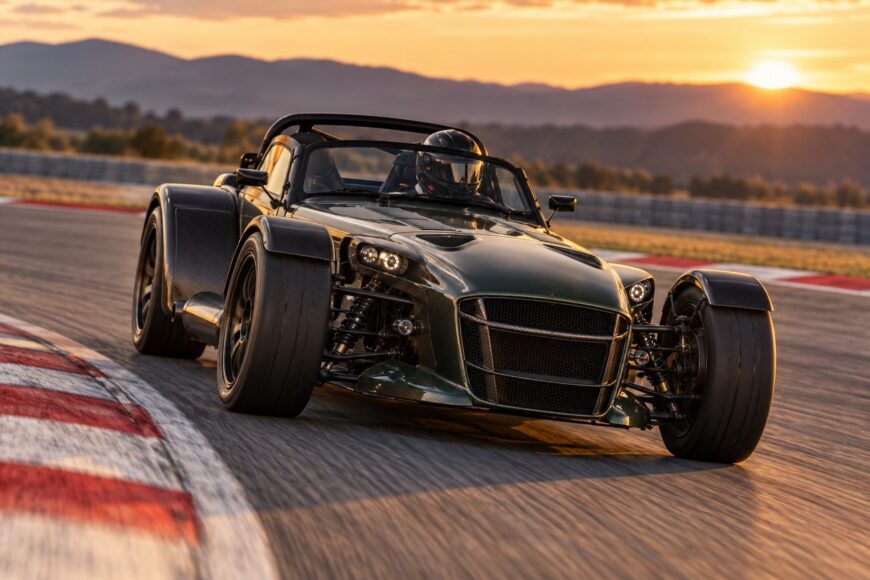
The Donkervoort D8 GTO delivers supercar acceleration in a package scarcely larger than its occupants. Its turbocharged five-cylinder engine has little mass to move, and the driver works through a manual gearbox with few layers of insulation. On a quick road or circuit, it feels closer to a road-legal race car than a relaxed weekend cruiser.
Even its weight needs a careful reading: the often-quoted figure under 700 kg describes an advertised dry car, while a fueled car with a driver weighs more. That distinction matters, though it does little to blunt the D8 GTO’s pace. The more important question is whether its demands—noise, physical effort, and constant attention—sound like the point of ownership or a reason to walk away.
- What the Donkervoort D8 GTO Actually Is
- Performance Numbers That Explain the Hype
- Why It Feels More Like a Race Car Than a Roadster
- Making the D8 GTO Work on Track
- Ownership Costs, Service, and the Hidden Trade-Offs
- Everyday Practicality and the Right Buyer
- Frequently asked questions
- What is the price of a Donkervoort F22?
- Why do Donkervoort D8 GTO weight figures differ so much?
- What should buyers inspect on a used D8 GTO?
- How should an owner plan fuel for a D8 GTO road trip?
What the Donkervoort D8 GTO Actually Is
The D8 GTO is a compact, rear-wheel-drive roadster built around a tubular and composite chassis. Its long bonnet and exposed-wheel stance suggest an old-school sports car, but the powertrain is a modern Audi 2.5 TFSI turbocharged inline-five gasoline engine. This combination gives the car its defining character: immediate responses from a light chassis, followed by a forceful surge of turbocharged power.
Every D8 GTO retains a manual transmission. The JD70 and its derivatives use a five-speed Tremec gearbox, putting the driver directly in charge of a car with an unusually high power-to-weight ratio. There is no need to treat the manual shift as a quaint detail; managing torque, traction, and gear choice is central to driving it well.
Early D8 GTO versions produced approximately 340–380 hp. Output rose to as much as 421 hp in the JD70 and 440+ hp in recent Individual Series cars. Those figures describe a family of versions rather than one fixed specification, so a comparison or used-car listing should identify the particular car.
Its place in the market is equally specific. The D8 GTO offers substantial speed and road legality, yet it makes few of the comfort concessions expected of a luxury supercar. A buyer drawn mainly to exotic looks may find that the steering, seating position, and sheer workload define the experience more than the badge or acceleration figure.
Performance Numbers That Explain the Hype

Base D8 GTO dry or advertised mass is approximately 680–695 kg; marketing commonly presents the car as under 700 kg. That is a meaningful engineering achievement, provided the measurement is understood. Approximately 732–807 kg with fluids, fuel, and a driver is a more relevant range for a car heading onto a road or circuit, depending on configuration and measurement method.
Road versions deliver approximately 480–650 hp per tonne, with the result depending on version and the weight basis used. Light mass helps the engine accelerate the car, while also giving the brakes and tires less weight to manage. A power-to-weight claim is most useful when both the power output and the weighing method appear beside it.
The official 0–100 km/h time is 2.8 seconds for the base GTO and 2.7 seconds for the JD70 and JD70 R. Top speed varies from approximately 270 to 286 km/h by version. These are formidable figures for an open car with a manual gearbox, although a standing-start result says little about how much precision is needed once the road turns or traction deteriorates.
On track, the modest footprint and strong engine make speed accumulate quickly between corners. That changes the driver’s task: braking points arrive sooner than the car’s size might suggest, and a small throttle input can have a large effect on rear-tire load. The numbers explain the excitement; they do not describe an easy car to exploit.
Why It Feels More Like a Race Car Than a Roadster
The D8 GTO passes on more of the road surface, engine noise, and mechanical activity than a conventional sports car. Firm suspension, cabin heat, and sustained noise can turn an ordinary journey into work. Drivers who value feedback may welcome the clarity on a smooth circuit, then discover how tiring the same intensity becomes on a rough public road.
Accommodation is tight, and getting in or out requires commitment. Taller drivers should check their position while wearing a helmet: the roll structure and windscreen frame can restrict head clearance. A short, comfortable test drive without track equipment is no substitute for confirming that the intended driver fits safely in the intended setup.
Owners describe feeling physically and mentally drained after only a few fast track sessions. That fatigue deserves respect because the car’s grip window can feel narrow, especially as conditions change. In rain or cold weather, available grip and confidence can fall sharply; an aggressive input that felt manageable on a warm, dry lap may produce a much quicker response from the rear axle.
Its passive-safety concept and limited electronic assistance also warrant a clear-eyed comparison with a modern coupe. The D8 GTO’s lightweight, exposed architecture offers a different margin of protection from a contemporary mass-produced performance car. On public roads, leaving room for surface changes and other traffic is more useful than trying to reproduce a dry-track pace.
Making the D8 GTO Work on Track

A productive track day begins before the first fast lap. Tire and brake temperatures need to build before their performance is judged, and pressures should be checked as the tires warm. Attacking immediately on cold rubber can make an otherwise capable chassis feel vague under braking and abrupt at corner exit.
Seating position matters as much as enthusiasm. Sitting deep, close enough to operate the pedals cleanly, and secured by a firm belt or appropriate harness helps the driver make measured inputs rather than brace against the cockpit. Any restraint and seating arrangement should suit the car’s installation and the event’s requirements.
Treat the opening laps as a baseline test: establish tire and brake temperature, confirm hot pressures, and settle the seating position before chasing lap time. Cold-grip behavior is a poor basis for blaming the chassis.
The D8 GTO responds strongly to setup. Tire pressure, alignment, and ride height can materially change its behavior, so a setting that works at one circuit may be unhelpful at another. Fuel load matters too: moving between a full and near-empty tank changes the mass the car carries and can make its balance feel different to an attentive driver.
Tire choice should match the car, conditions, and intended use. Unsuitable road tires may give away much of the expected grip and feedback, while track-focused rubber can be difficult to trust when cold or wet. Uneven roads add another problem: suspension bottoming or a sudden loss of traction can make the car feel nervous even when its smooth-track setup is sound.
Ownership Costs, Service, and the Hidden Trade-Offs
The Audi-derived engine does not make the whole car as straightforward to maintain as an Audi TT RS. The Donkervoort’s installation, chassis systems, and low-volume components require specialist familiarity. Outside the Netherlands, finding competent service and obtaining particular parts may take planning rather than a routine booking at a nearby workshop.
Fuel quality is another practical constraint. Owners of high-output versions may need 98-octane fuel or higher, particularly when traveling outside Western Europe. Before a long journey, check the requirement for the individual car and the fuel available along the route; a familiar engine family does not guarantee that any convenient pump will suit its calibration.
Insurance can require patience. A rare model gives an insurer fewer comparable cars for valuation, and damage to scarce body or chassis parts can complicate a repair estimate. Seeking a suitable policy before purchase is wiser than discovering after delivery that the agreed valuation, repair route, or track-use terms do not meet your needs.
Low mass does not promise low consumable bills. Strong torque, high cornering loads, and the speeds reached between bends can consume tires and brakes quickly during track use. Budgeting against an ordinary lightweight roadster may therefore be misleading, particularly if frequent circuit days are the reason for buying the car.
Regular inspection of suspension components, fasteners, and turbo-related systems is important when a car is driven hard. Keep evidence of that work as well as routine servicing: it helps a specialist assess condition and gives a future buyer more confidence. Resale may still take time, because the pool of people seeking such a focused roadster is narrow.
Everyday Practicality and the Right Buyer

The base D8 GTO is approximately 3,740 mm long and 1,850 mm wide; the JD70 is approximately 3,836 mm long, with a wheelbase of about 2,350 mm. Its short length helps in a garage or tight parking space, though its width and low driving position still call for care. Compact exterior dimensions also do not translate into a generous cockpit.
Approximately 250 liters of luggage space and a 48-liter fuel tank give the car more touring potential than its track-focused appearance suggests. Some versions also use a turbo engine adapted to current European emissions requirements. Neither feature removes the need to plan around fuel availability, weather, and the effort of spending hours in the cabin.
The best match is a committed driver who enjoys a manual car, accepts setup work, and has access to roads or track days where its responses can be used responsibly. Quiet early sessions with little traffic leave more space to learn how grip changes as the tires and surface warm. That is a more rewarding prospect than treating every outing as a maximum-attack run.
Someone seeking a comfortable exotic for occasional weekends should drive one long enough to encounter ordinary roads, heat, noise, and the awkward entry and exit. The D8 GTO’s focus is a virtue when the process of driving is the reward. It becomes a liability if effortless speed and relaxed travel are the priorities.
Frequently asked questions
These distinctions matter most when comparing listings, inspecting a used car, or planning a journey. Confirm details against the specification and condition of the individual vehicle rather than assuming every D8 GTO is alike.
What is the price of a Donkervoort F22?
The F22 is a separate Donkervoort model, so its price does not establish the value of a D8 GTO. F22 pricing depends on market, specification, and availability; obtain a current factory quote or check a verified listing in the relevant market rather than relying on an old headline figure.
Why do Donkervoort D8 GTO weight figures differ so much?
They describe different weighing conditions. Approximately 680–695 kg refers to base dry or advertised mass, commonly presented as under 700 kg. Approximately 732–807 kg with fluids, fuel, and a driver reflects a car prepared for actual use, with the result varying by configuration and measurement method. Ask what was included before comparing two quoted weights.
What should buyers inspect on a used D8 GTO?
Arrange an inspection that covers the tubular chassis and composite components, suspension and fasteners, turbo-related systems, and clutch behavior. Check tire age as well as tread, assess brake wear, and look for records of regular specialist maintenance. Evidence of track use is less informative than the quality of preparation, inspection, and repairs that accompanied it.
How should an owner plan fuel for a D8 GTO road trip?
Check the individual car’s required fuel grade, then identify suitable stations along the route before departure. Owners may need 98-octane fuel or higher, especially away from Western Europe, where availability can be less predictable. The 48-liter tank makes this a route-planning matter rather than something to leave until the next convenient stop.







