
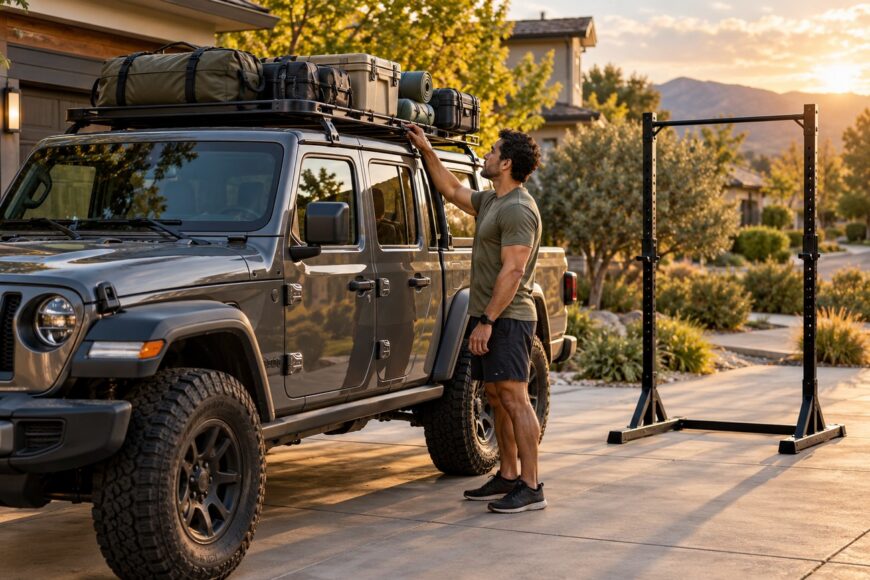
A pull-up bar on a parked Jeep Gladiator can look like an easy way to train outdoors. The question is whether the bar, rack, roof, and mounts are approved to support a person hanging and moving from one point.
A cargo rating cannot answer that question on its own. It describes a specified way of carrying gear, while a pull-up concentrates force at the gripped bar and repeats it with every movement.
- Can you do pull-ups on a Gladiator roof rack?
- Why the mounting point matters more than the rack’s appearance
- Small warning signs that can point to costly repairs
- A safer way to train beside your Gladiator
- Frequently asked questions
- How much weight can a Jeep Gladiator roof hold?
- What is the lawsuit against the Jeep Gladiator?
- Where is the Easter egg on a Jeep Gladiator?
- What year should you stay away from when buying a Jeep Gladiator?
Can you do pull-ups on a Gladiator roof rack?
Do not assume a Gladiator roof rack is safe for pull-ups unless the complete rack-and-mount setup is explicitly approved for that use. A rack can hold substantial camping cargo and still have no approval for a person hanging from a crossbar. Check the instructions for the exact rack, mounts, roof, and vehicle configuration rather than relying on how solid the installation feels.
A static cargo rating applies to stationary cargo under the manufacturer’s specified loading conditions. It does not establish approval for concentrated, repeated human loads. Gear spread across a platform loads it differently from a grip near one joint, especially when the person changes direction during each repetition.
There is no sound way to turn a cargo rating into a safe body-weight limit for pull-ups. The gripped bar may be strong while its connection, a rack foot, a vehicle mount, or the supporting roof assembly is less suited to the task. Every part of that load path has to be suitable for the intended use.
Why the mounting point matters more than the rack’s appearance
Force travels from your hands into the crossbar, through its joints and rack feet, then into the mounts and the vehicle structure beneath them. A thick-looking bar only shows you the first part of that path. Fasteners, brackets, and attachment points can receive concentrated loads even when the wider rack barely moves.
Swinging, repeated movement, and an off-center grip can impose loads unlike evenly distributed cargo. An off-center grip also twists the rack, so one side may carry a different load from the other. Keeping the vehicle parked removes road motion; it does not remove the movement created by the exercise.
A roof- or hardtop-mounted rack sends load into its roof or hardtop attachments. A system supported independently by the bed or chassis has a different load path, which may avoid loading those roof mounts. That difference is worth checking, but it does not mean every crossbar on a bed- or chassis-supported system is approved for exercise.
Before considering any setup, identify what supports the gripped bar, including any brackets shared with cargo accessories. The bar, joints, feet, mounts, and supporting structure must all be suitable for a hanging, moving person. A claim about carrying gear is no substitute for stated use conditions.
Small warning signs that can point to costly repairs
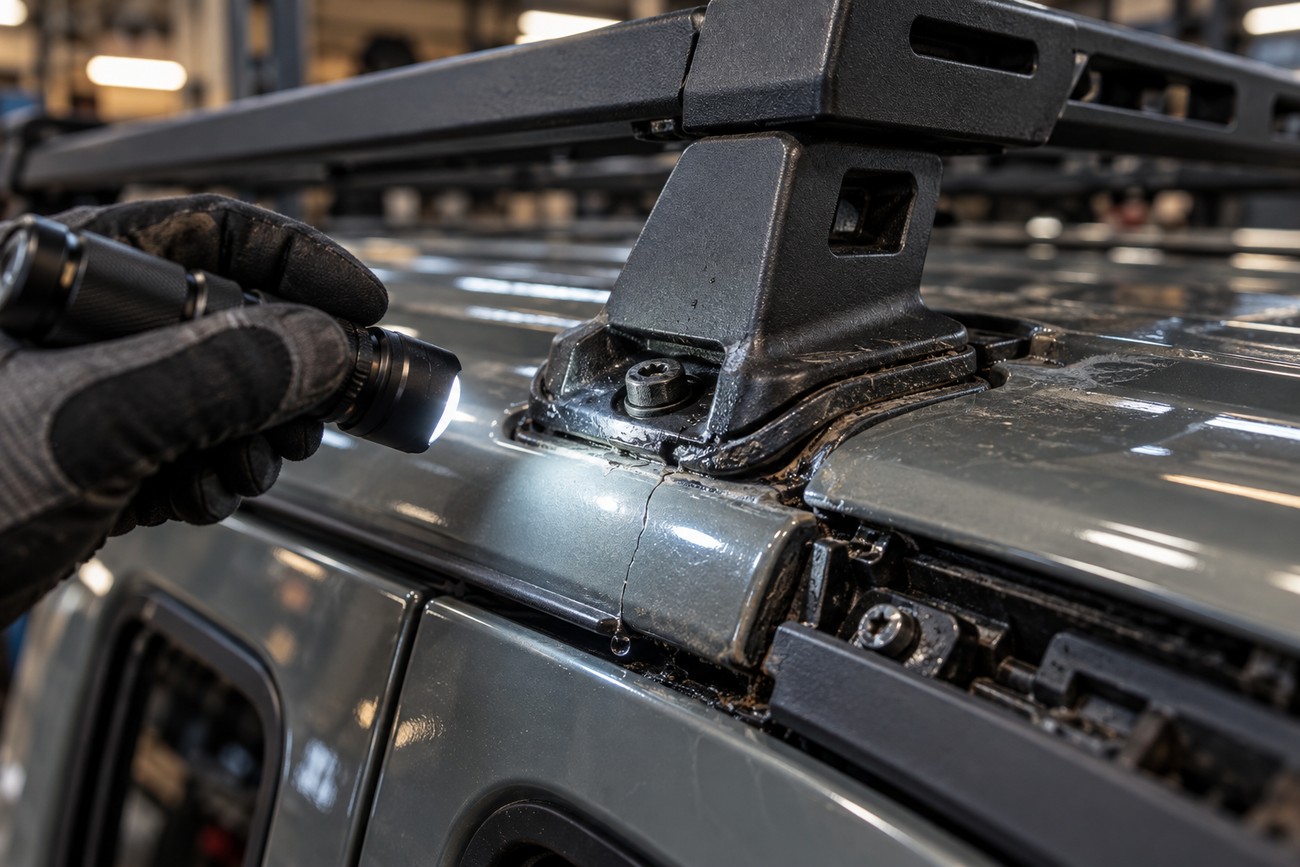
New movement, creaks, loosened fasteners, or disturbed seals call for stopping exercise and inspecting the installation. Cracked finish around a mount, a small change in how a foot sits, or water entering near an attachment point deserves the same response. Continuing to hang from the bar to “see if it holds” adds load before the cause is known.
Damage is not always visible from above. A mount can shift beneath a rack foot, while trim or seals hide what is happening at the attachment point. Investigating a damaged mount may require trim removal; repairs can also involve sealing or bodywork, depending on where the movement occurred.
Reports of deformed racks or damaged attachment points show possible outcomes, not a failure rate for every Gladiator rack. If an inspection finds damage, document the condition and follow the rack maker’s and vehicle maker’s guidance before repairs. Damage linked to exercise may affect a specific warranty claim; a dead hang does not automatically cancel all vehicle coverage.
A safer way to train beside your Gladiator
A freestanding pull-up station keeps exercise loads off the vehicle. If you want a bar attached to a vehicle-supported structure, choose one with mounting instructions that explicitly cover human loading for the full arrangement. A bed- or chassis-supported rack still needs that approval for its bar, connections, and supports.
Read both the rack and vehicle instructions for the exact configuration. If the intended use is unclear, seek written confirmation that identifies the bar, rack, mounts, and vehicle setup. When that approval is absent, use another training station rather than treating a cargo specification as permission.
A brief, gentle hang is not a test of how an installation will respond to repeated pull-ups. Neither tighter bolts nor homemade reinforcement validates the complete load path; changing one connection may simply move stress elsewhere. The practical decision is to train on equipment designed and approved for the exercise.
Frequently asked questions
How much weight can a Jeep Gladiator roof hold?
There is no universal limit for every Gladiator roof and rack setup. Check the vehicle documentation and the instructions for your exact roof, rack, and mounting configuration, then observe the lowest applicable cargo limit. That limit is not a rating for a person hanging from the rack or doing pull-ups.
What is the lawsuit against the Jeep Gladiator?
There is no single lawsuit by that name. Lawsuits involving the Gladiator have included allegations about defects such as overheating manual-transmission clutches. The claims and vehicles covered depend on the specific case; an allegation is not a finding that every Gladiator has the defect.
Where is the Easter egg on a Jeep Gladiator?
One commonly spotted Gladiator Easter egg is a tiny pair of flip-flops molded into the windshield cowl near the wipers. Details can vary by model year and trim, so inspect that area if you cannot see it at first glance.
What year should you stay away from when buying a Jeep Gladiator?
There is no model year that every buyer must avoid. The 2020 model year, the first, is often singled out for closer scrutiny, but service history, condition, and whether a specific vehicle has outstanding recalls matter more than the year alone. Check the VIN and arrange a pre-purchase inspection.







