
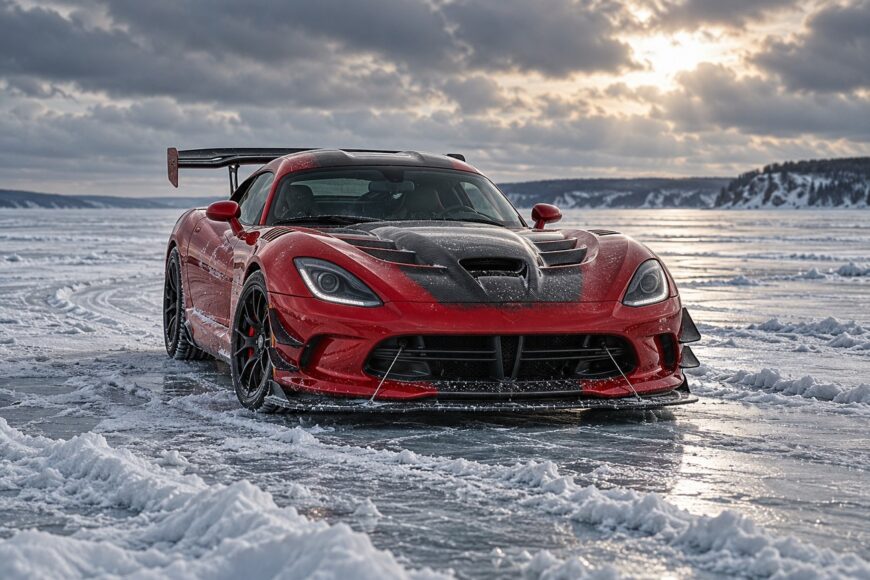
A low-slung Dodge Viper ACR against the white expanse of frozen Lake Superior makes a striking picture. The car was built to generate grip on pavement; the lake offers shifting ice, snow, ruts, and cracks instead. Its splitter sits close to a surface that can change shape within a few feet, while its rear tires must turn substantial V10 torque into motion where traction is scarce.
The useful question is whether an ACR can be operated there under controlled conditions, rather than whether it can produce a dramatic drift. Tires, verified ice quality, weather, restrained driver inputs, legal access, and a credible recovery plan govern that decision. Horsepower and road-car top speed tell you little about whether the next stretch of ice will support the car or let it stop.
- Dodge Viper ACR on Ice: The Real Mismatch
- Why the ACR Is So Unforgiving on Frozen Water
- Lake Superior Ice Is Not a Racetrack
- Tires, Studs, and the Setup That Changes the Equation
- How to Drive It Without Treating Ice Like Asphalt
- Hidden Failure Points: Ground Clearance, Brakes, Cold, and Corrosion
- Logistics, Rules, and a Recovery Plan
- Viral Drift Videos vs a Defensible Decision
- Frequently asked questions
- What is the most sought-after Dodge Viper?
- Why did so many people crash Dodge Vipers?
- What is the top speed of the Dodge Viper ACR without the limiter?
- How can you verify that a Dodge Viper ACR still has its original driver aids and tire setup?
Dodge Viper ACR on Ice: The Real Mismatch
The 2016 Dodge Viper ACR, VX I generation, is a rear-wheel-drive track car with more than 600 hp and a top speed above 280 km/h. Its aerodynamics, stiff suspension, and track-focused tires make sense where the pavement is predictable. On natural lake ice, those same choices leave little tolerance for ridges, frozen ruts, or an abrupt loss of grip.
There is an important distinction between ice racing and driving onto a lake because it looks frozen. A prepared event can inspect a defined course, control access, specify tires, monitor conditions, and keep recovery equipment available. Casual access provides none of those safeguards merely because another vehicle has crossed the surface.
Even on rally-style studded tires, experienced drivers rarely exceed 120–140 km/h on frozen lakes. That observation is a warning about usable grip and stopping distance, not a target speed. A car capable of far more on pavement cannot carry its road-course braking points or cornering expectations onto ice.
An ACR can be used in a professionally managed ice event if the surface, equipment, and operation are suitable. On factory tires or unverified Lake Superior ice, the sensible verdict is no-go. The difference lies in preparation and control of the site, not in a driver’s willingness to take a risk.
Why the ACR Is So Unforgiving on Frozen Water
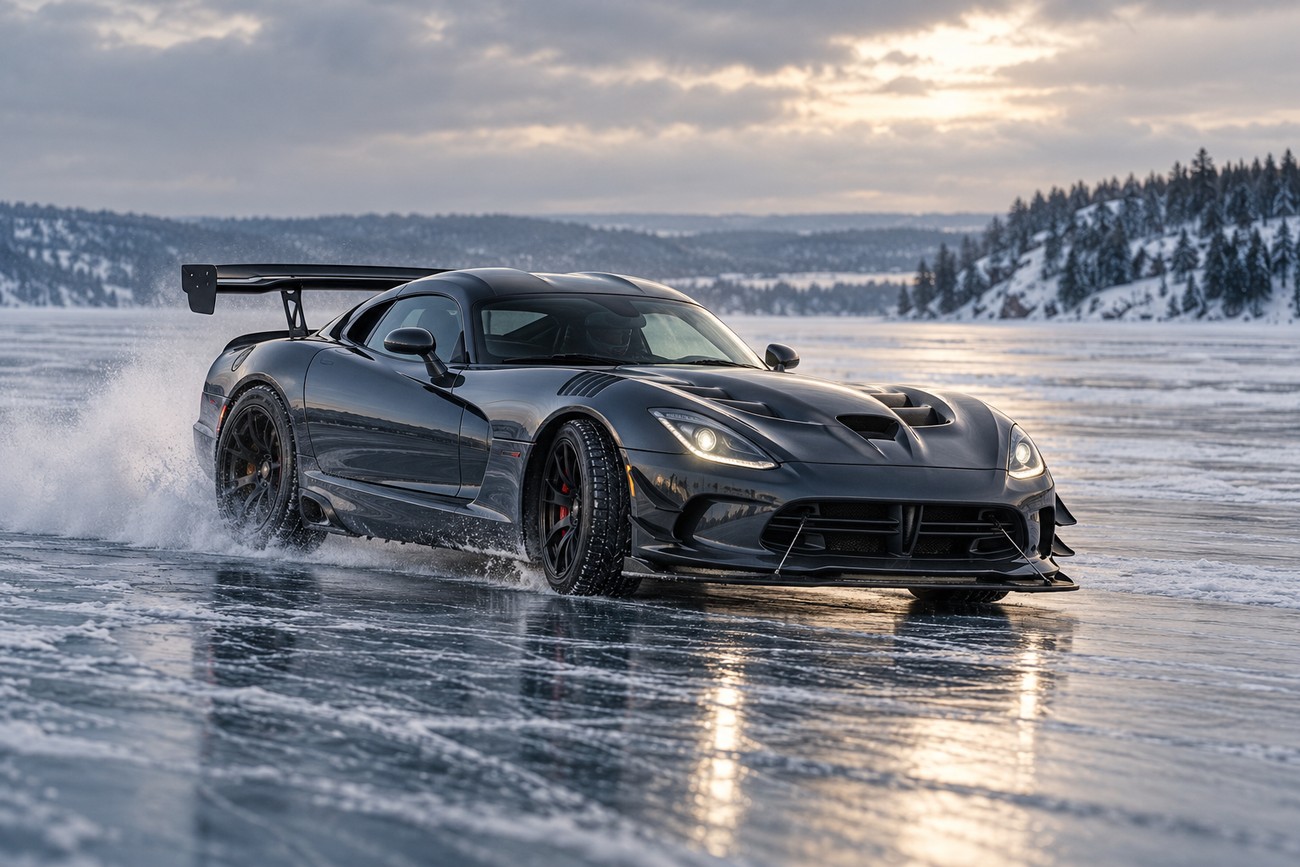
At approximately 1,530–1,550 kg, the ACR is not a light toy that can be redirected without consequence. Its approximately 49/51 front/rear weight distribution puts slightly more load over the driven wheels, which can help them find purchase when accelerating gently. Once the rear tires slide, however, the car’s mass and momentum make a correction more demanding.
The V10 delivers substantial torque through an aggressive limited-slip differential. On low-grip ice, a small throttle change can overwhelm both rear tires and turn modest yaw into a spin. Lifting abruptly or making a large steering correction can then upset the car again, especially as grip changes between bare ice and snow-covered patches.
Rear-wheel drive by itself does not make a car uncontrollable. Tire bite, differential behavior, throttle response, speed, and driver inputs all matter. The ACR combines high torque with a chassis tuned for responsive track driving, so the margin between a useful correction and an excessive one becomes narrow on ice.
Driver-aid claims deserve care here: a 2016 Viper ACR has no electronic stability control. Any other driver aids, available settings, and modifications must be checked on the particular car. The absence of stability control means there is no electronic backup to help manage a slide, and no system can create traction where the tires have almost none.
Lake Superior Ice Is Not a Racetrack
Lake Superior does not freeze into a uniform sheet. Ice thickness can vary along a proposed route, while pressure cracks, open-water leads, and under-ice currents create hazards that may be hard to identify from the driver’s seat. A thickness reading at the shoreline says little about an area farther out or near moving water.
Approximately 8–12 inches (20–30 cm) of homogeneous, clear ice is sometimes cited as a light-vehicle guideline, subject to local verification. It is not a guarantee for this car, this route, or a particular maneuver. Ice containing snow, slush, cracks, or poorer-quality layers cannot be judged by a single total-thickness figure.
Snow buildup also changes what the driver experiences. Slush can conceal weak areas and impede the tires; frozen pickup ruts can tug at the steering or strike the underbody. Heaves may present hard, raised edges to a low splitter. The result can feel less like a smooth skating rink than an uneven winter trail with no forgiving shoulder.
Wind adds another variable on an exposed lake. A crosswind can shift the car’s line just as the tires encounter a change in grip, forcing a correction the surface may not support. Wind also moves snow, covering visual clues to ruts and cracks after a route has been inspected.
Repeated high-speed passes along the same line should not be treated as proof that the ice is sound. Moving vehicles load the ice dynamically, and cracks or local damage can develop as conditions change. A managed course needs continuing assessment; an average lake report cannot certify every wheel track for the rest of the day.
Tires, Studs, and the Setup That Changes the Equation
The factory ACR package uses Kumho Ecsta V720 or similar track-focused semi-slicks with minimal tread. Those tires are not intended for snow or ice use. Their broad contact patches, including rear tire widths up to 355 mm, are useful on suitable pavement but cannot cut through snow or reliably bite polished ice.
A wider tire is not automatically a better ice tire. Narrower tires with deep ice-racing studs generally provide more useful bite than wide, smooth track tires, provided the wheels, brakes, clearances, and event rules allow the setup. Studs still have limits in slush, ruts, and changing ice, and their use may be restricted locally.
Before pursuing speed, confirm that the chosen studded wheel clears the brakes and bodywork throughout suspension and steering travel. Then inspect splitter clearance over the course’s actual ridges: tire grip is little help if the front aero package hits the surface.
The ACR’s low front splitter and stiff suspension make ride height a practical constraint, not a cosmetic detail. A frozen rut or ice heave can damage the splitter or underbody before the driver has a chance to react. Altering the setup for clearance also changes how the car behaves, so it calls for competent inspection rather than an improvised adjustment beside the lake.
How to Drive It Without Treating Ice Like Asphalt
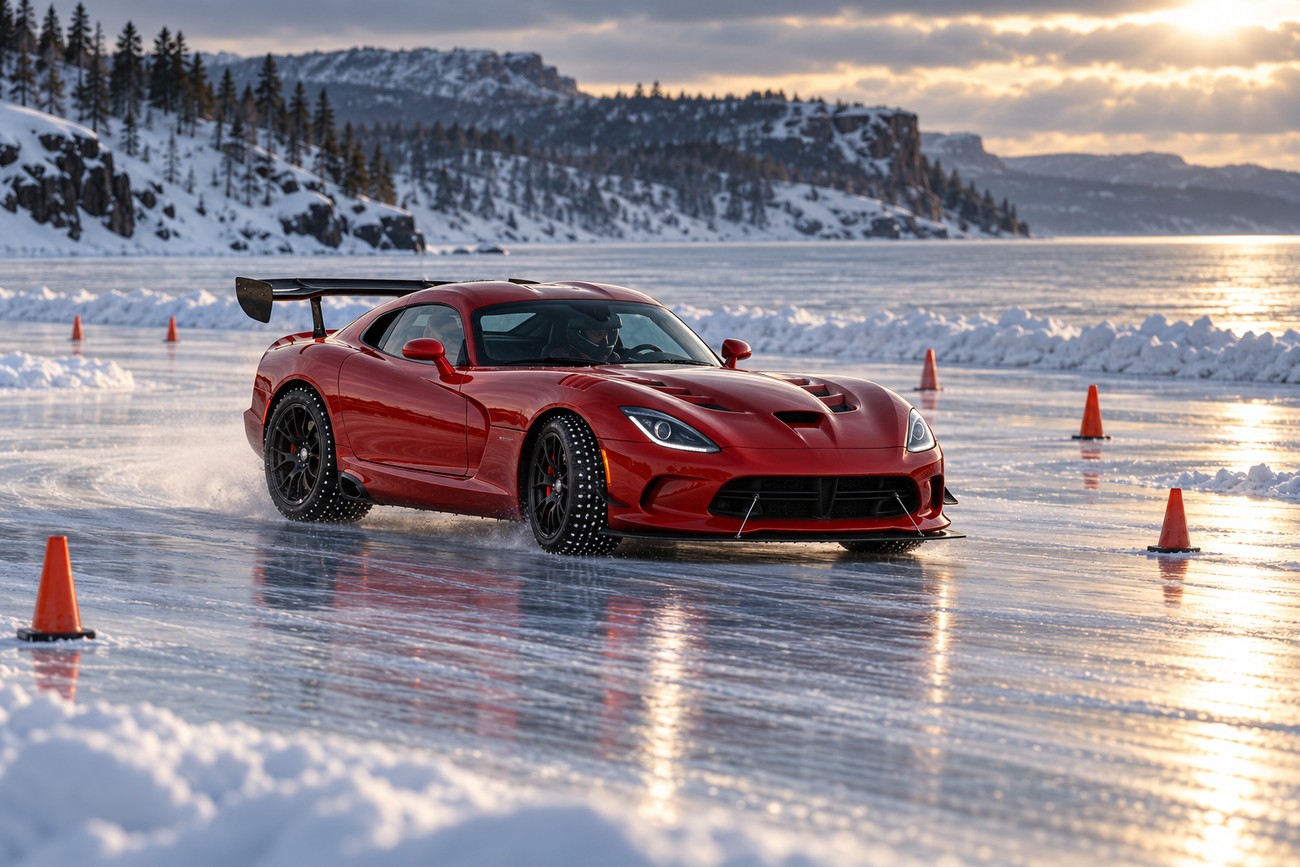
Suitable tires and verified ice come before technique. On untreated ice, aggressive throttle can produce an immediate spin, and no steering trick will restore grip that the tires cannot generate. The first driving objective in a controlled event is to leave enough room and time for the car to respond slowly.
Throttle should be applied progressively, with steering kept measured and braking begun early and gently. Late braking and sharp track-style inputs demand traction the surface may not offer. If the rear begins to rotate, a hurried lift or large countersteer can be as disruptive as the input that started the slide.
The driver also needs to look beyond the next patch of visible ice. A line that works on a clear section may lead straight into slush or frozen ruts, where braking and steering response change. Large margins around course boundaries, other vehicles, and known weak areas matter more than placing the car precisely at a corner’s edge.
Crosswinds deserve particular attention during a run, rather than only during the morning weather check. A gust may require a steering correction just as the rear tires pass onto lower-grip ice. If wind, drifting snow, or visibility makes the inspected route difficult to read, slowing or stopping the session is the controlled response.
These are principles for a supervised setting, not instructions for trying the stunt on an open lake. Even with rally-style studs, practical ice speeds remain far below the ACR’s road-car top speed. Unsuitable tires or uncertain ice turn a driving problem into an exposure and recovery problem that skill cannot solve.
Hidden Failure Points: Ground Clearance, Brakes, Cold, and Corrosion
A dramatic clip rarely shows what happened to the underside afterward. The stiff suspension can send sharp impacts from frozen ruts directly through the chassis, while a low splitter may catch a ridge that a taller winter vehicle clears. Damage can include loose aero parts or compromised components that warrant inspection before another run.
Cold braking hardware needs equal attention. Track-oriented pads, and some high-performance brake setups, may behave differently before reaching their intended operating temperature; ice then lengthens stopping distances further because tire grip is limited. The driver should establish how the particular car brakes under the event’s conditions rather than borrow a pavement braking point.
Starting the V10 in severe cold is another preparation issue. Track oil viscosities may be too thick for dependable starting at approximately -20°C and below without careful preparation and reference to the car’s approved specifications. Battery condition, fluids, and warm-up procedures belong in the pre-event check, not in troubleshooting after the car has been unloaded onto the ice.
Inside the Viper, little sound isolation means ice and ruts can be unusually audible. Noise alone does not diagnose weak ice, but it can distract a driver from assessing the car’s response. Lake Superior is freshwater; the corrosion concern is primarily road salt and de-icing chemicals, combined with trapped moisture and slush around the exhaust, suspension, and brakes. Washing and inspecting those areas after the event reduces the chance that a short outing causes lasting damage.
Logistics, Rules, and a Recovery Plan
Access must be confirmed for the exact location and date. Rules differ across Great Lakes jurisdictions and managed events: permission, registration, speed limits, vehicle spacing, or closures may apply. A photograph of vehicles on the ice is not evidence that the route is currently open or that an ACR may use it.
Ice reports help identify where to investigate, but they do not replace measurements along the intended route. Local organizers or qualified ice-safety personnel should verify thickness and quality with an auger or equivalent method, paying attention to cracks, inlets, and changing conditions. Vehicles also need appropriate spacing so a group does not concentrate loads in one area.
Weather checks extend beyond air temperature. Wind, new snow, visibility, and recent changes in temperature can alter access and conceal hazards during the event. Communications should work at the site, and someone away from the course should know the plan and how to contact local emergency resources.
Recovery must be arranged before a vehicle becomes stuck, breaks through, or is damaged on a ridge. Confirm what the event crew can extract, where equipment can approach safely, and what the insurance policy actually covers for ice use and recovery. An ordinary tow truck or roadside-assistance promise should not be assumed to apply on a frozen lake.
Enclosed transport can spare the ACR a separate winter-road journey on unsuitable tires through snow and road salt. It also gives the team a way to remove a damaged or undriveable car without trying to drive it home. If legal access, measured ice, communications, and recovery cannot all be established, the outing should not proceed.
Viral Drift Videos vs a Defensible Decision
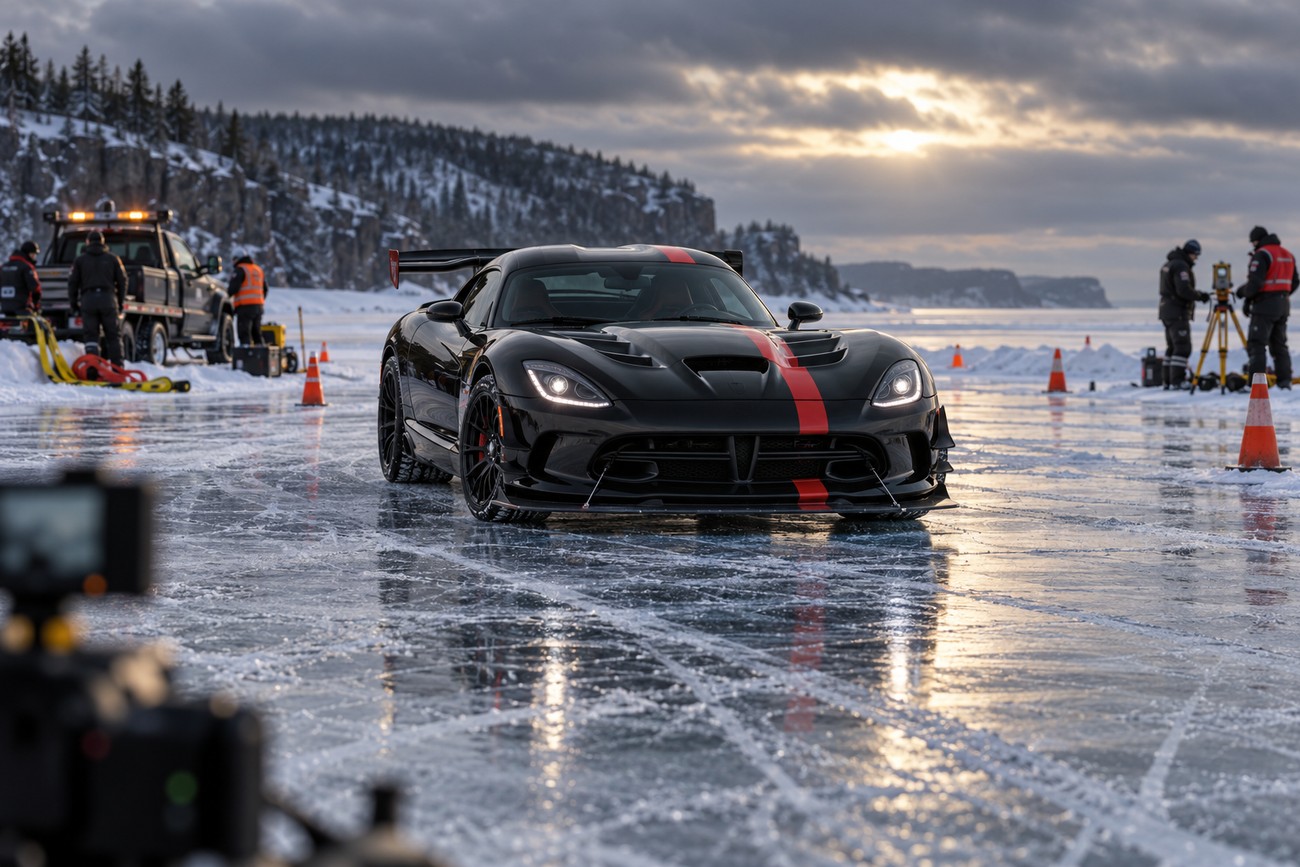
Video compresses preparation into a few seconds of motion. A prepared-ice demonstration may involve specialized studded tires, an inspected surface, controlled vehicle spacing, and a recovery crew outside the frame. Without those details, footage cannot show whether the same maneuver would be viable on another part of Lake Superior.
Ice rated for vehicles is a conditional guideline, not certification for every route or aggressive maneuver. Rear-wheel drive and high power do not produce controllable grip without appropriate tires and disciplined inputs. Wide track semi-slicks likewise offer no inherent advantage over narrower studded tires on ice.
The defensible decision is therefore site-specific. A legally permitted, professionally prepared and repeatedly assessed course, a correctly equipped and inspected car, suitable weather, and an established support and recovery plan can make an ACR ice run a controlled experiment. Remove any of those conditions, and the spectacle is no longer a sound reason to drive.
Frequently asked questions
Collector value, equipment checks, and quoted performance figures can affect how an owner evaluates the risk. They are separate from the lake’s condition, but they help prevent assumptions about a particular Viper from becoming part of the driving plan.
What is the most sought-after Dodge Viper?
There is no single most sought-after Viper across all collectors. Preferences differ between early road-going cars, later special editions, low-mileage examples, and track-focused models such as the ACR. Originality, documented history, condition, and specification often matter as much as the badge.
A desirable collector car can also be a poor candidate for winter use. Ice-event preparation may require different wheels and tires, while salt exposure and splitter damage can make preserving a rare or unusually original ACR harder.
Why did so many people crash Dodge Vipers?
The Viper’s crash reputation reflects a demanding combination of strong power delivery, responsive handling, and limited tolerance for careless inputs, especially in earlier cars with fewer driver aids. Cold or unsuitable tires and an inexperienced driver can compound those traits. The reputation should not be read as a verified crash-rate comparison with other sports cars.
Model year matters. Driver aids changed over the Viper’s production life, so a story about an early car should not be applied uncritically to a 2016 ACR. Even in a later car, electronics cannot overcome tires that have almost no grip on ice.
What is the top speed of the Dodge Viper ACR without the limiter?
The 2016 Dodge Viper ACR’s quoted road-car top speed is above 280 km/h, but a precise “without the limiter” figure cannot be inferred by removing a single setting. Aerodynamic configuration, gearing, tire specification, available power, and test conditions all affect the result.
For an ice event, that distinction has little operational value. The useful speed is the one at which the car can still be steered and stopped within a verified course, with room for changing grip and an aborted run.
How can you verify that a Dodge Viper ACR still has its original driver aids and tire setup?
Start with the car’s model year, equipment records, and owner documentation, then inspect the actual vehicle. Confirm the stability-control system and its settings, check for electronic or drivetrain modifications, and have any warning lights or faults assessed before use. Do not infer the installed equipment from another Viper’s specification.
Read the tire sidewalls for model, size, and date markings, then inspect tread condition and look for changes to wheels or suspension. Factory-style track tires remain unsuitable for ice even if they are new; an event-specific tire setup also needs checks for brake clearance, body clearance, and compliance with local rules.







