
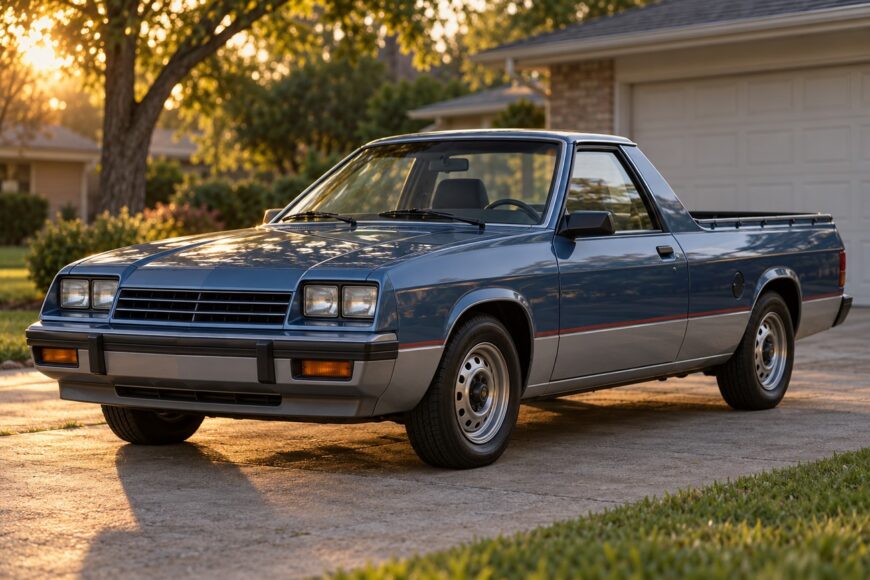
A car-sized pickup has an appeal that a full-size truck cannot quite match: it is easier to place on a narrow road, and its open bed can carry awkward loads that will not fit in a hatchback. The Dodge Rampage added a striking promise of utility to that formula, including a published payload claim of roughly half a ton.
Its limits matter as much as its appeal. The Rampage drives its front wheels and carries its bed within a unibody, so it should not be treated like a conventional body-on-frame work truck. For a buyer, the useful questions are what the bed can actually hold, how the vehicle behaves with a load, and whether four decades have left its structure and safety systems fit for use.
- A pickup built from a front-drive car
- Engine, transmissions, and model-year traps
- What fits in the bed—and what the half-ton claim misses
- How it drives, and why fuel-economy claims diverge
- Inspect the structure and safety systems before the engine
- Finding parts without assuming they fit
- Frequently asked questions
- How much is a Dodge Rampage worth?
- What paperwork should I request when buying a Rampage?
- How should I budget to revive a Rampage that has been parked for years?
A pickup built from a front-drive car
Sold for the 1982–1984 model years, the Dodge Rampage used Chrysler’s front-wheel-drive L-body platform. The Dodge Omni, Plymouth Horizon, and Dodge Charger are related L-body vehicles. That family connection helps explain the Rampage’s compact proportions and gives owners a starting point when researching parts, though shared ancestry does not guarantee that a particular component fits.
The cargo bed is integrated into a unibody rather than mounted on a separate pickup frame. This arrangement helped keep the vehicle light, but the bed floor, sides, and underlying structure work together as part of the body. Damage around the cargo area therefore deserves more attention than a dent in a removable truck bed might receive.
In use, the layout suits modest, well-secured loads and ordinary driving better than repeated heavy hauling. Front-wheel drive can be useful on a lightly loaded vehicle, yet it does not turn the Rampage into a tow vehicle or make its advertised payload a target to reach on every trip. Its small footprint is the attraction; the condition of the whole body determines how much of its original utility remains.
Engine, transmissions, and model-year traps
The Rampage’s stated engine is Chrysler’s 2.2-liter inline-four, with reported output of roughly 84–99 hp depending on year and version. That is enough to explain the vehicle’s everyday character: it was designed to move a light pickup, not to deliver effortless acceleration with a full bed. A smooth-running example is encouraging, but its performance should be judged on a drive rather than inferred from a horsepower figure.
Transmission choices included an early four-speed manual, a later five-speed manual, and a three-speed TorqueFlite A404 automatic. Check the gearbox in the actual vehicle before ordering parts or comparing two advertisements. A later five-speed is a distinct configuration; an early four-speed truck should not be described as though it has the same equipment.
Engine identification needs similar care. References to VW engines in early L-body relatives do not establish that Dodge sold a factory VW-powered Rampage. If a truck has an unfamiliar engine or altered fittings, document what is installed rather than assuming it is standard.
Even vehicles with the Chrysler 2.2-liter engine can differ in accessories, mountings, wiring, and other peripheral equipment. Record the model year, engine details, and transmission before buying a replacement component. “Fits an L-body” is a useful lead for further checking, not a complete fitment description.
What fits in the bed—and what the half-ton claim misses
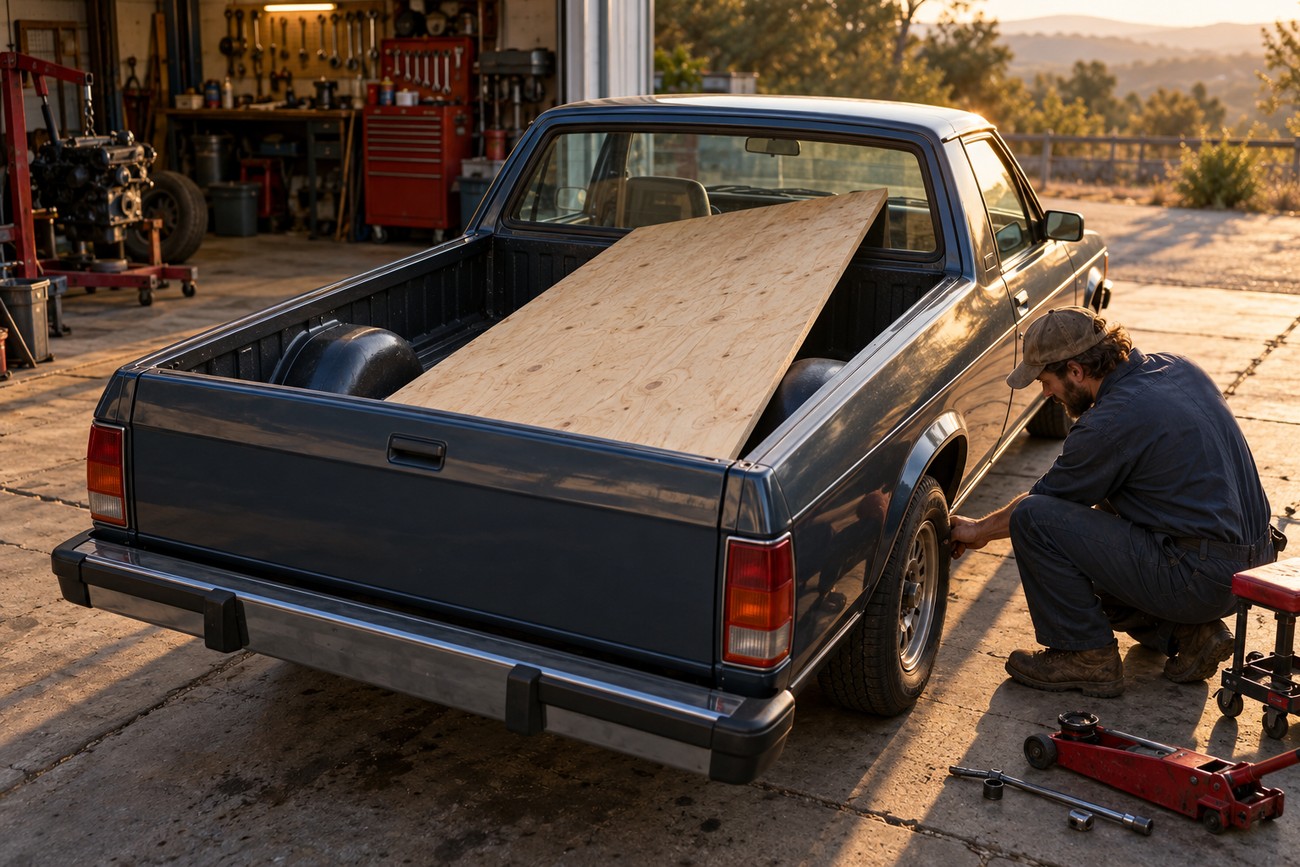
With the tailgate closed, the bed measures approximately 62 × 52 inches. Its most consequential dimension is the 41.8 inches between the wheel arches: a 4×8-foot sheet will not lie flat on the bed floor. Length alone can make the cargo area look more accommodating than it is, especially when a load needs a level, supported base.
Published payload figures differ, with sources giving both 1,000 lb and 1,145 lb. Neither figure is a safe-load assessment for a particular aged Rampage. Tires, brakes, springs, and structural condition all matter before a load goes aboard; a decades-old truck should not be worked to an advertising claim simply because it once met a period specification.
The rear suspension uses leaf springs, a tubular axle beam, and diagonally mounted shock absorbers. Those parts help the compact body carry cargo, but tired springs or damaged mounting areas change how the truck sits and responds under load. Check for uneven ride height and examine the supporting structure rather than judging capacity by how much space remains in the bed.
Reported towing capacity is about 750 lb, a reminder that payload and towing are separate limits. A load in the bed and a trailer each affect braking, stability, and acceleration in different ways. The Rampage makes sense for light-duty jobs whose weight and shape suit its dimensions; the “half-ton” description should not be read as a promise of broad work-truck capability.
How it drives, and why fuel-economy claims diverge
Low weight and front-wheel drive give the Rampage a car-like starting point, though a pickup body and rear leaf springs affect its responses. Owner reports describe slow acceleration, middling handling, and inconsistent build quality. Individual condition now matters greatly, so a test drive should reveal how one truck tracks, brakes, shifts, and responds over uneven pavement.
A reported 0–60 mph time of approximately 16 seconds sets realistic expectations. With cargo aboard, leave more room to join traffic or pass, and avoid treating a short gap as an invitation to accelerate through it. A hesitation under power may also point to a fault rather than simply being part of the model’s leisurely performance.
Published fuel-economy figures conflict: historical material gives 25/40 mpg, while other secondary accounts cite about 21/29 mpg. Without matching the model year, transmission, and test method, those pairs cannot be combined into one reliable rating. Neither is a sound promise for a truck whose tune, tires, fuel system, and mechanical condition may have changed considerably.
During a drive, pay attention to repeatable behavior rather than one brief impression. Check starting from cold if possible, then see whether the engine runs consistently after warming up and whether the vehicle remains composed during ordinary braking. That tells you more about the example for sale than selecting the most appealing period economy figure.
Inspect the structure and safety systems before the engine
Begin a pre-purchase inspection at the bed floor, bed sides, underside, and rear-suspension mounting points. Look for corrosion, poorly finished repairs, and damage hidden beneath coatings or cargo liners. Because the bed is part of the load-bearing unibody, a problem in this area can reach beyond the appearance of the cargo compartment.
Assess repairs by looking at their surrounding metal and, where possible, asking for photographs of the work in progress. Fresh finish alone cannot show what was removed or how sound the remaining structure is. If mounting areas cannot be inspected adequately, treat that uncertainty as part of the purchase decision.
Next, check fuel and vacuum hoses, brake lines, wiring, seals, tires, and brakes. Rubber can deteriorate without an obvious external split, while old lines and electrical connections may fail after a vehicle returns to regular use. A running engine establishes only that it runs; it does not establish that the truck can stop safely or deliver fuel without leaks.
Some owners report intermittent electrical faults and fuel-system sensitivity, with particular attention needed on vehicles equipped with fuel injection. These are condition-dependent risks, not defects guaranteed on every Rampage. The engine and transmission are often regarded as more durable than the hoses, wiring, sensors, and fittings around them, making careful recommissioning more valuable than a quick start-up.
Finding parts without assuming they fit
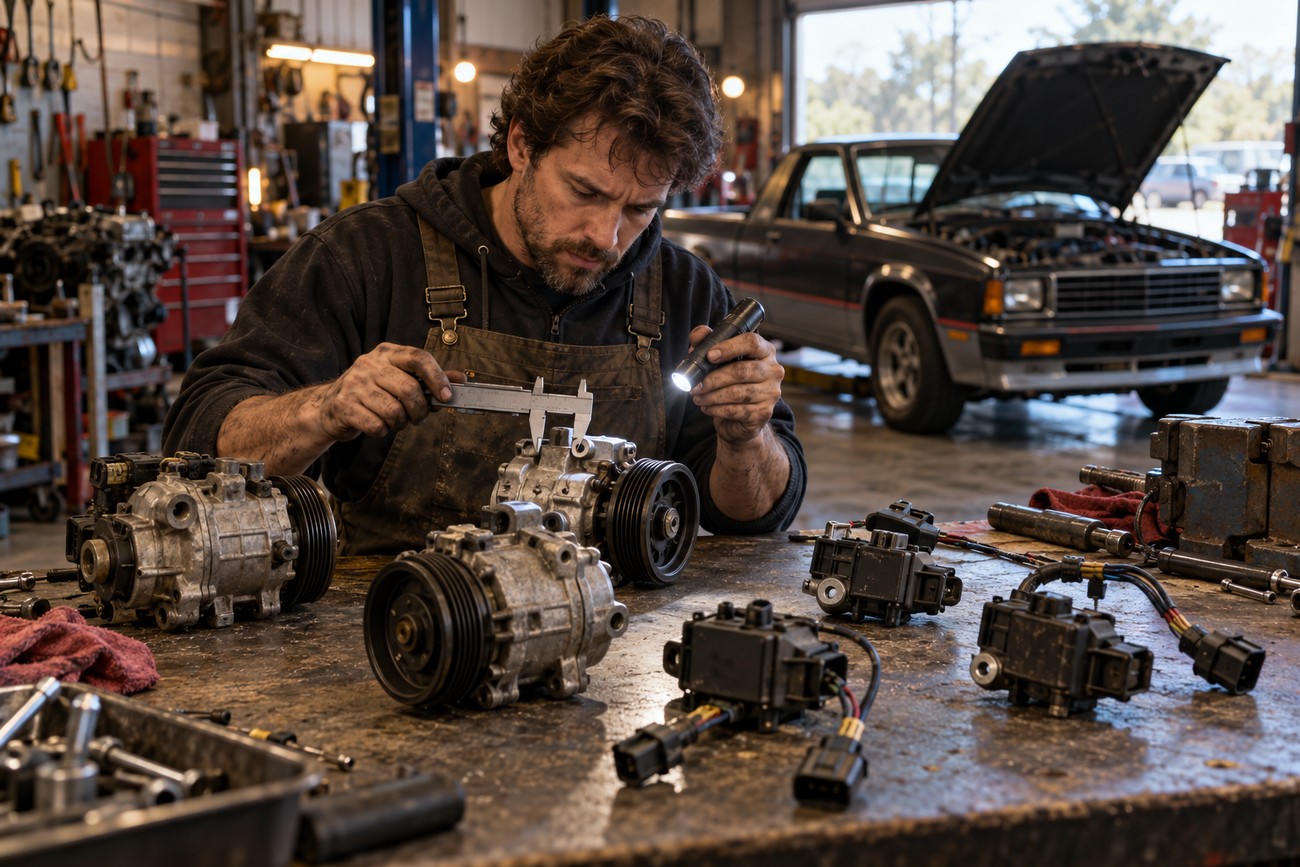
The Dodge Omni, Plymouth Horizon, and Dodge Charger can provide useful leads when searching for Rampage parts. Shared L-body origins, however, do not guarantee direct interchange. A listing for a related car is a reason to compare the component closely, particularly when the part involves the engine’s peripheral equipment or the electrical system.
Before ordering, match the Rampage’s model year, engine, and transmission, then check mounting points, connections, and the details of the part being replaced. Photos and identification numbers from the vehicle can help resolve uncertainty where a catalog groups several L-body models together. Confirming fit before purchase is less disruptive than discovering a mismatch midway through a repair.
Put documented maintenance and safety work ahead of speculative upgrades. Sound brake and fuel systems, dependable wiring, and a structurally secure body determine whether the truck can be enjoyed at all. This is especially important when buying a vehicle advertised as a running project: “runs” may describe only a small part of the work left to do.
Claims about modern or turbocharged engine swaps warrant restraint. A reported installation does not establish a simple bolt-in conversion, and changes to the drivetrain, supporting systems, or brakes may be necessary. Evaluate a modified truck by the quality and documentation of the completed work rather than by the name of its replacement engine.
Frequently asked questions
Buying a Rampage involves questions that specifications alone cannot settle. Value depends on the individual vehicle, while records can help distinguish completed repairs from claims in an advertisement. A truck that has sat unused also needs a return-to-road plan before it needs cosmetic attention.
How much is a Dodge Rampage worth?
Use recent completed sales of comparable vehicles as a starting point, then adjust your assessment for structural condition, originality, and documented repairs. Compare actual sales rather than asking prices, and give particular weight to evidence of sound bed and suspension mounting areas. Without a verified current market range, a single price quoted for every Rampage would be misleading.
What paperwork should I request when buying a Rampage?
Request the ownership document required in your location and check that the vehicle’s identity matches it. Ask for receipts and, ideally, photographs that substantiate claimed structural repairs or work on the brakes, fuel system, and wiring. Those records help you identify what was done and what still needs inspection; they do not replace an examination of the truck itself.
How should I budget to revive a Rampage that has been parked for years?
Budget in stages rather than starting with paint or trim. First allow for a thorough inspection and transport if the truck cannot safely be driven; then prioritize structural findings, tires, brakes, fuel and vacuum lines, wiring, and other safety-critical work. Only after it runs, stops, and drives reliably does a cosmetic budget become meaningful. The cost depends on what that first inspection reveals.







