
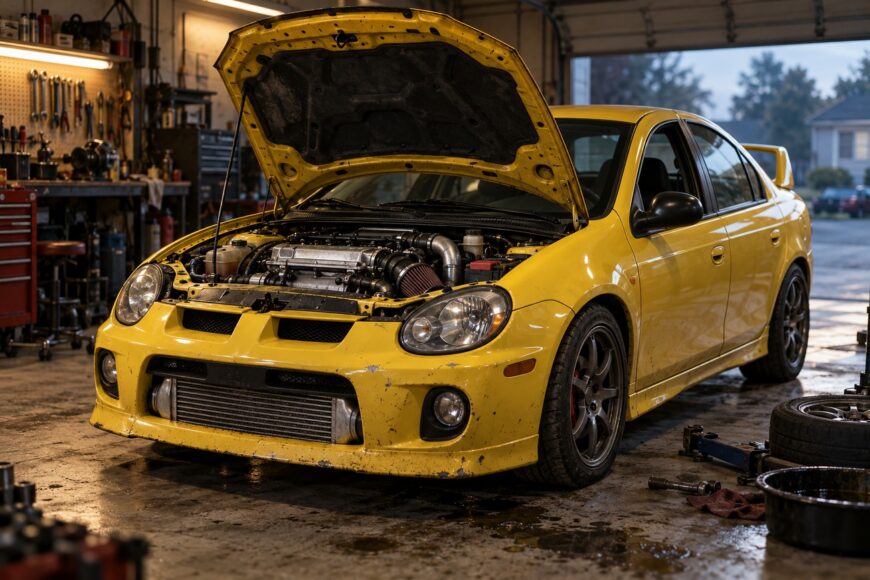
The Dodge Neon SRT-4 made turbo performance feel attainable. It put a strong four-cylinder engine and a manual gearbox in a compact sedan, giving drivers straight-line pace and a platform they could modify without starting with an exotic car.
That appeal has a catch for anyone shopping today. The front tires must handle both steering and turbocharged torque, while decades of launches, added boost, and previous-owner work can leave expensive problems behind. The SRT-4 became a tuner favorite because it responded to attention; finding one that still deserves more power takes a closer look.
- What Made the Neon SRT-4 Different
- How Fast Was It in the Real World?
- Why Tuners Loved the SRT-4
- The Traction and Heat Behind the Hype
- Upgrades That Help Before a Bigger Turbo
- Buying a Used SRT-4 Without Inheriting Someone Else’s Build
- Frequently asked questions
- How much horsepower can a stock SRT-4 handle?
- Who is the best Mopar tuner for an SRT-4?
- What should you do first after buying an SRT-4?
What Made the Neon SRT-4 Different
Produced from 2003 to 2005, the Dodge Neon SRT-4 paired front-wheel drive with a five-speed manual transmission. Its factory engine was an intercooled, turbocharged 2.4-liter inline-four. That combination gave an otherwise familiar compact-sedan shape an unusually forceful character.
Published factory output needs a year attached to it. Early cars are cited at 215 hp and 332 Nm, while sources often cite 230 hp and 333 Nm for 2004. Those figures should not be applied indiscriminately to every year or market, particularly when a used car may have been recalibrated.
The engine’s torque is central to the car’s personality. A short burst of acceleration can feel more dramatic than the sedan’s appearance suggests, and the manual gearbox keeps the driver involved. The same torque also asks a great deal of the front tires, setting up the trade-off that defines both the standard car and many modified examples.
How Fast Was It in the Real World?
The quickest published figures make a strong case for the SRT-4, though they are not interchangeable. Some tests report 0–100 km/h in approximately 5.1–5.5 seconds; some listings give figures as high as 6.7 seconds. Test methods, launch grip, and vehicle condition all affect what ends up on the clock.
Quarter-mile figures cited for the car include approximately 15.1 seconds and a trap speed around 107 mph. They convey its straight-line appeal, rather than a result every surviving SRT-4 will reproduce. A tired clutch or poor traction can spoil a launch even if the engine still pulls hard once the car is moving.
Published curb-weight figures also vary, from approximately 1,300 to 1,356 kg. The range matters less to a buyer than the condition of the particular car, but it is another reason to treat a single catalog number cautiously. For a useful comparison, look at the test, the car’s specification, and whether the result came from a healthy standard example.
Why Tuners Loved the SRT-4
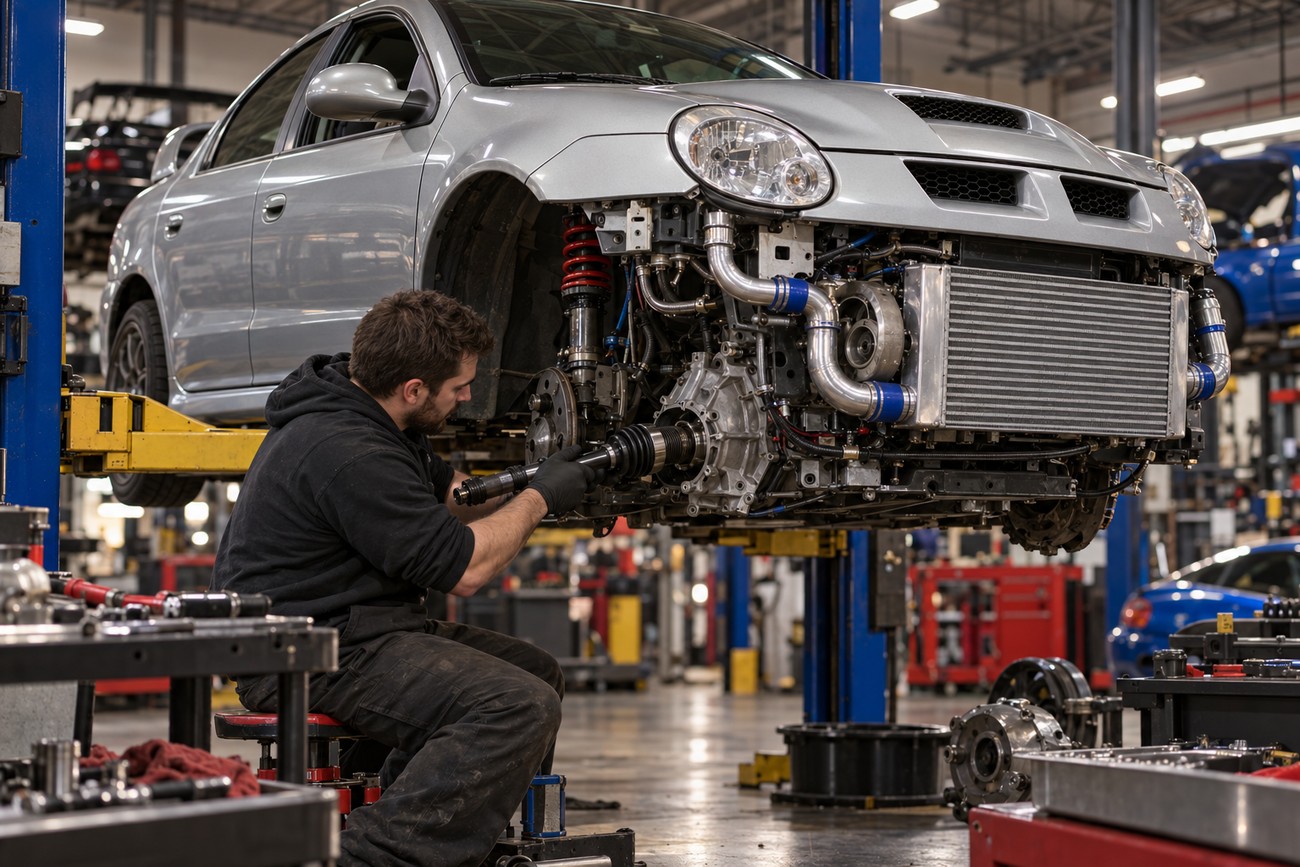
The SRT-4 offered an accessible entry into turbo tuning: an intercooled engine, a manual transmission, and a compact car that already felt eager under acceleration. Owners could work toward a car suited to hard straight-line pulls, which helped give the model a life well beyond its brief production run.
That culture also blurred the line between what an SRT-4 can be built to produce and what an untouched car can withstand. One documented project describes a setup intended for more than 450 hp with upgraded axles. It illustrates the supporting work involved; it is neither a factory rating nor a safe-power threshold for other cars.
Power claims need their measurement stated, too. Factory horsepower is an engine-output rating, while wheel horsepower is measured at the driven wheels. A modified-car claim expressed in wheel horsepower cannot be compared directly with the factory figure as though both were taken at the same point.
For the driver, usable acceleration is the more revealing goal. Additional output can make a front-drive car harder to launch cleanly or keep straight under power. A build that preserves grip and repeats its performance may be more satisfying than one tuned around a peak number it rarely puts to the road.
The Traction and Heat Behind the Hype
Wheelspin is a practical limit in the SRT-4, especially from a standing start. Owners also report torque steer as drive forces tug at the steering under hard acceleration. Road surface, tires, and vehicle condition change the severity, so another owner’s clean run does not predict yours.
Repeated hard acceleration presents a different problem: heat. As temperatures build, performance can become less consistent from one run to the next. A car that feels strong on its first pull may tell a different story after sustained use, making cooling-system condition and a sound calibration more valuable than an impressive initial burst.
Everyday comfort carries its own compromise. Owners describe the standard suspension as firm and noisy, particularly on poor roads. On a short drive, that can add to the car’s urgent feel; over a rough commute, the impacts and noise may become tiring. Worn suspension parts can make it difficult to distinguish the intended firmness from problems that need repair.
Upgrades That Help Before a Bigger Turbo
Start with the parts that let the car use the power it has. Suitable tires, a sound suspension, a healthy clutch, and effective cooling make acceleration more repeatable. They also give you a clearer baseline before deciding whether the engine needs further work.
Higher boost increases demands throughout the car. The gearbox, clutch, CV joints, fuel system, and calibration all need assessment alongside the engine. Replacing the turbo alone can simply shift the weak point elsewhere, particularly on a car with unknown wear or an undocumented tune.
If the goal is greater output, match the fuel supply and calibration to the hardware and intended use. Leave room in the budget to correct faults found along the way. A large-turbo power claim describes a particular build and result; it does not show that an otherwise stock SRT-4 will deliver that power reliably.
Buying a Used SRT-4 Without Inheriting Someone Else’s Build
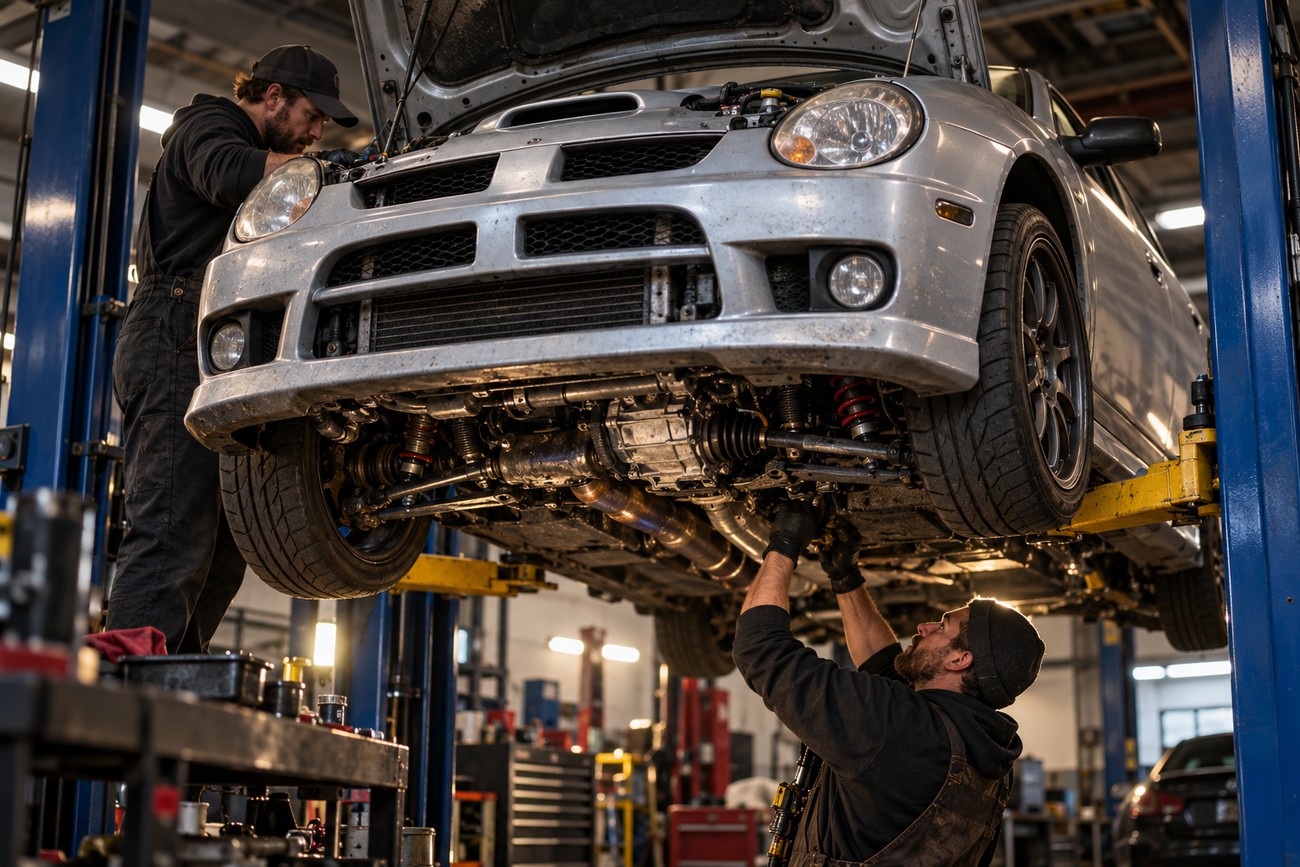
Begin with the modification history. Ask what hardware is installed, who calibrated the car, and whether earlier parts or records remain. An unknown tune is more consequential than a cosmetic change: it makes current behavior harder to interpret and can conceal a history of heat or drivetrain stress.
Next, assess how the car puts power down. Check the transmission, differential, axles, and clutch for signs of trouble, then examine the cooling system before treating a strong test drive as proof of health. Brakes and suspension deserve the same attention; restoring neglected fundamentals can absorb money intended for upgrades.
Age adds another layer to every 2003–2005 example. Wiring, seals, and rubber components may need work regardless of whether the engine remains standard. Two cars with similar paint and advertised power can differ sharply beneath the surface because of maintenance, previous tuning, and the quality of repairs.
Keep part of the purchase budget for a mechanical baseline rather than spending it all to secure the car. Records and a careful inspection cannot eliminate uncertainty, but they help separate a documented project from an accumulation of unexplained parts. The better buy is the example whose condition you can establish, even if its headline power is modest.
Frequently asked questions
For a used SRT-4, the most useful answers depend on the car’s condition and intended use. Factory figures describe the model; tuning and maintenance decisions belong to the individual example.
How much horsepower can a stock SRT-4 handle?
There is no defensible universal safe number. “Stock” might mean factory engine internals while the clutch, fuel system, or axles have changed, or it might mean the entire drivetrain is untouched. A brief dyno result also says less about durability than repeatable hard use. Condition, calibration, fuel, cooling, and intended use all matter before a power target makes sense.
Who is the best Mopar tuner for an SRT-4?
Choose on evidence rather than a single name. Ask about SRT-4-specific calibration work, the fuel the proposed setup requires, and whether the tuner will review logs and mechanical condition before changing boost. Someone willing to identify a fault and postpone tuning is a better fit than someone who promises a number without examining the car.
What should you do first after buying an SRT-4?
Establish your own baseline before hard driving. Document the installed parts and current calibration, address overdue fluids and wear items, and verify that the engine, cooling system, and drivetrain are healthy. Even a thorough pre-purchase inspection cannot replace learning exactly what you now own and putting its maintenance on a known footing.







