
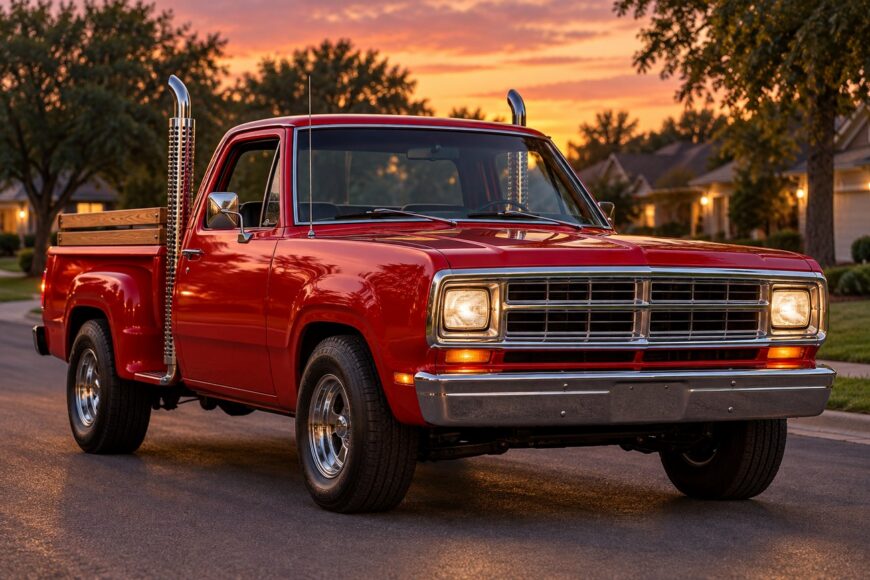
The Dodge Li’l Red Express was loud, conspicuous, and unmistakably a pickup in corners. Yet in 1978, it became one of the quickest American production trucks in selected magazine tests. Its “fastest” reputation grew from that achievement, then stretched well beyond what the evidence supports.
That distinction matters if you are considering one now. The Li’l Red Express deserves to be celebrated as a clever period performance package, with engineering beneath its red paint and chrome stacks. It also deserves to be examined as an aging, limited-production collector truck whose rust, missing parts, and previous modifications can cost far more than its appearance suggests.
- Why the 1978 Dodge Li’l Red Express Became So Fast
- What Dodge Changed Beyond the Red Paint
- 1978 vs. 1979: Power, Certification, and Test Results
- How Fast Was It Really—and Was It Faster Than a Corvette?
- The Ownership Reality: Fuel, Heat, Noise, and Truck Handling
- Buying an Authentic Li’l Red Express Without Paying for a Clone
- Frequently asked questions
- How much horsepower did the 1978 Dodge Li’l Red Express have?
- Was the Li’l Red Express faster than a Corvette?
- What was the fastest production vehicle in 1978?
- Why do sources disagree about Li’l Red Express horsepower and speed?
Why the 1978 Dodge Li’l Red Express Became So Fast
Dodge offered the Li’l Red Express as a special package for the 1978 and 1979 model years, based on its D/W-series pickup family. It arrived when emissions rules and fuel-economy pressures had changed expectations for American performance vehicles. Against that backdrop, a full-size pickup capable of brisk acceleration made an impression that its paintwork alone could not explain.
Period magazine results commonly place the truck at approximately 0–60 mph in 8–9 seconds and approximately 16 seconds for the quarter mile, depending on the test and the truck’s condition. Those figures made it one of the quickest American production pickups or trucks in selected late-1970s tests. They were magazine measurements, however, rather than guaranteed results for every truck Dodge built.
The headline needs its category attached. “Fastest truck” describes a comparison among production pickups or trucks in particular tests; it does not make the Li’l Red Express the fastest production vehicle across all classes in 1978. Road surface, launch, weather, and the vehicles chosen for comparison could all change the order.
Its impact also came from the combination. Dodge put useful performance hardware into a recognizable special package at a time when few pickups were presented this way. The result felt startling for a truck, even though its chassis and driving position still belonged to the pickup world.
What Dodge Changed Beyond the Red Paint
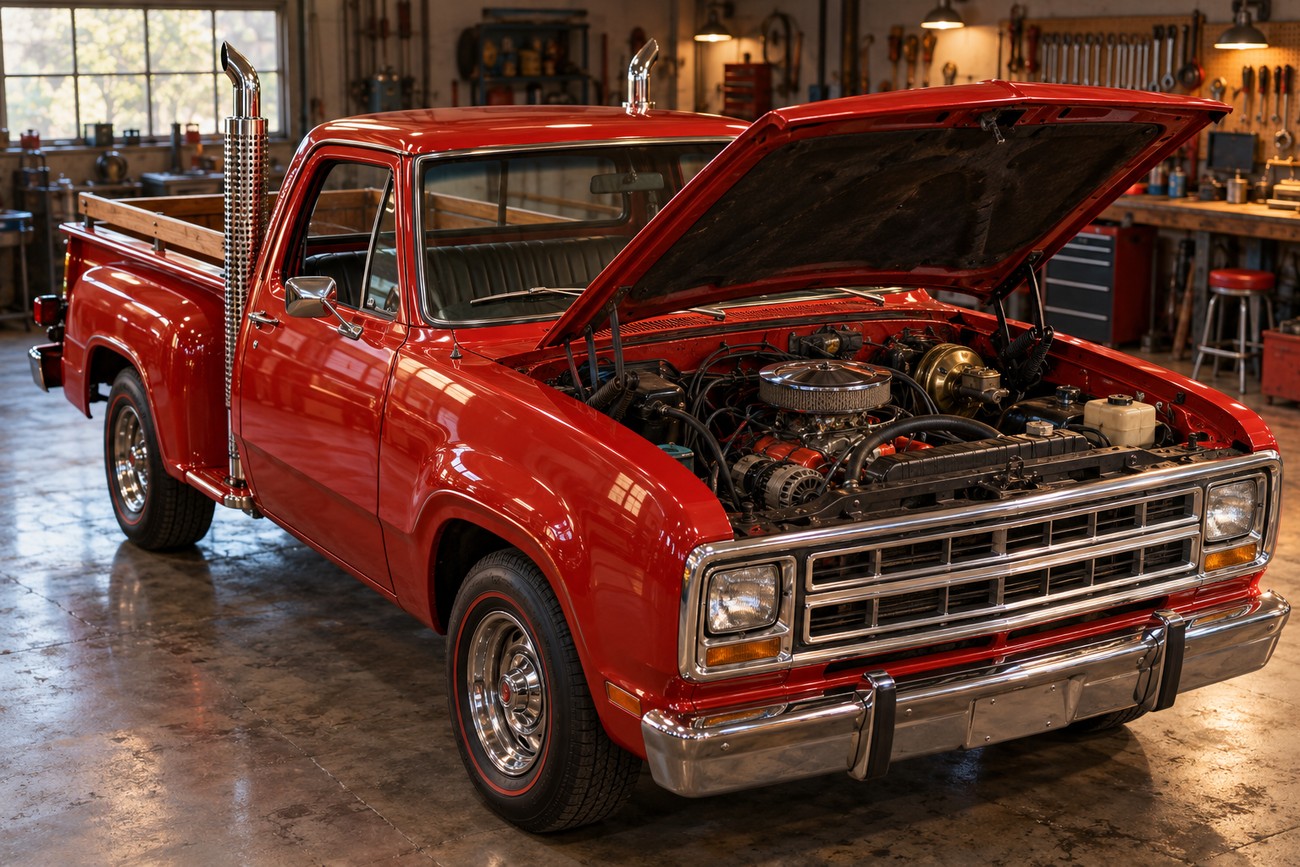
The commonly specified 1978 Li’l Red Express used a 360 cid V8 with a four-barrel carburetor, rated at 225 hp SAE net. That figure is central to the 1978 truck’s reputation, but the engine was only part of the package. Dodge’s approach was to combine components and certification choices to produce a quicker pickup, rather than rely on one exotic, unique motor.
The vertical chrome stacks behind the cab were factory package components with a functional role in the exhaust system. They gave the truck its signature silhouette while shaping its performance character. A later owner-installed set of stacks may look convincing from across a parking lot without reproducing the factory system.
Early versions did not use a catalytic converter because of the period’s special passenger-car/truck certification situation. That distinction helped the original performance package, but it should not be treated as a blanket exemption for an owner today. Emissions and inspection requirements depend on where a surviving truck is registered.
For a collector, the distinction between factory engineering and later modification is consequential. Replacement exhaust routing, a changed air intake, or engine alterations may affect drivability and originality in different ways. Attractive paint cannot establish that the components responsible for the truck’s period identity are still present.
1978 vs. 1979: Power, Certification, and Test Results
The two model years share the special-package concept, but their published figures should be read with the year and source attached.
| Model year | Engine and published power | Package and certification context | Why reported results differ |
|---|---|---|---|
| 1978 | Commonly specified 360 cid V8 with a four-barrel carburetor; 225 hp SAE net. | Li’l Red Express special package based on the Dodge D/W-series pickup family. Early versions did not use a catalytic converter under the period’s special passenger-car/truck certification situation. | Market and certification details, source methodology, test conditions, and the condition of an individual truck can affect comparisons. |
| 1979 | 360 cid V8; 195 hp SAE net in some factory specifications. | Li’l Red Express remained a special package based on the Dodge D/W-series pickup family. Equipment and certification details should be checked against the particular truck. | Model-year and market differences, certification, SAE measurement standards cited by sources, test methods, and vehicle condition can lead to conflicting published numbers. |
The 225 hp and 195 hp figures should not be silently blended into a single specification for every Li’l Red Express. Nor does a lower published 1979 figure, by itself, identify every mechanical or regulatory change behind it. A buyer needs documentation for the model year and vehicle being evaluated.
Acceleration figures require similar care. A period magazine tested a particular truck on a particular day, whereas a surviving example may have different tires, tuning, exhaust components, or engine condition. Published power and measured speed answer related but separate questions.
How Fast Was It Really—and Was It Faster Than a Corvette?
Approximately 0–60 mph in 8–9 seconds and a quarter mile in approximately 16 seconds describe the Li’l Red Express’s commonly reported period-test performance, with variation by test and condition. For a late-1970s production pickup, that was striking pace. It remains a range, not a factory promise that every example can meet today.
The Corvette comparison is plausible only when the particular vehicles and acceleration test are specified. A well-running truck could embarrass some contemporary sports cars over a measured sprint. That does not establish that it outran every Corvette, or that it had comparable braking, cornering, or sustained high-speed ability.
Launch conditions matter especially in this rear-wheel-drive pickup. Traction can change the opening seconds of a run, and a test that favors the truck in one distance may produce a different impression over another. Comparing an old, modified Li’l Red Express with a published period result introduces another variable.
The defensible claim is narrower and more interesting than the myth: Dodge built one of the quickest American production pickups or trucks seen in selected late-1970s magazine tests. It was not the fastest production vehicle across all classes in 1978. Keeping those statements separate preserves the achievement without asking the truck to be something it was not.
The Ownership Reality: Fuel, Heat, Noise, and Truck Handling
The performance comes with substantial fuel consumption, even by the standards of period V8 pickups. Regular use can therefore feel costly long before a major repair is needed. Anyone planning long drives should judge the truck as an old, powerful pickup rather than assume its acceleration came with economical cruising.
Traffic exposes a different weakness. Overheating complaints on aging examples often point toward a neglected cooling system, so an inspection should include its condition and how the truck behaves after it reaches operating temperature. A short drive on an open road may never reveal a problem that appears while idling.
The stack-style exhaust supplies much of the theater, along with noise and vibration that can become tiring over distance. Its nonstandard layout can also make access to some service points more awkward. Before buying, listen to the truck at steady cruising speed as well as during acceleration; a dramatic short test drive tells only part of the story.
Rear-wheel drive and a high center of gravity make traction sensitive on hard launches and wet roads. Braking, steering precision, and body control remain closer to an older truck than a modern performance vehicle. Its ability to gather speed deserves respect precisely because its chassis does not shed or redirect that speed with modern composure.
Age magnifies these traits. A sound example can be enjoyable on an appropriate road, while worn components or poor tires make the same truck feel unsettled. Sensible ownership means assessing the complete vehicle, not using an engine-power figure as a proxy for mechanical health.
Buying an Authentic Li’l Red Express Without Paying for a Clone
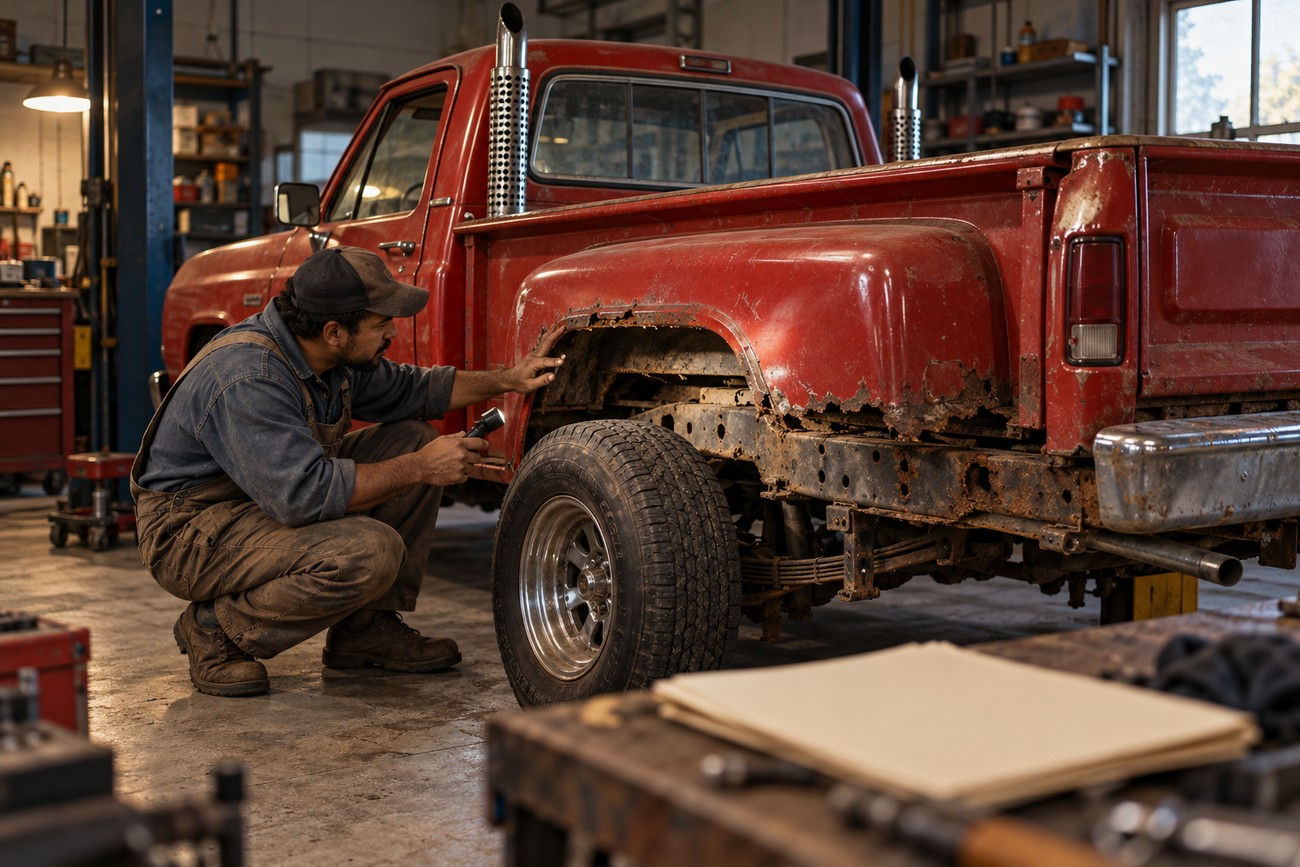
Start with identification and documented history, then compare the truck’s equipment with the claimed model year. An ordinary D-series pickup can be painted red and fitted with stacks, and a carefully finished replica may be persuasive in photographs. Ask for the vehicle’s identifiers and supporting records before assigning it genuine special-package value.
Inspect the structure before judging the shine. Frame rust, cab-floor corrosion, and damage around the rear fenders can outweigh an impressive paint job, particularly where fresh finishes hide old repairs. Original panels with visible, assessable wear may be a safer basis for restoration than a glossy body with uncertain metal beneath it.
Check the stack mounts and exhaust routing alongside the package-specific trim, then inspect behind apparently clean panels. Agreement between visible details and underlying metal is more persuasive than paint and badges alone.
Examine the original exhaust and air-intake components, badges, paint details, wheels, stack mounts, and other factory equipment as a group. Many surviving trucks have acquired engine, exhaust, or suspension changes, and missing package pieces can be expensive or difficult to source. A modified truck may still be enjoyable, but its price should reflect what it is rather than an unverified claim of originality.
Finally, distinguish restoration quality from preservation. New trim and fresh paint can make an example easier to admire, yet neither proves that its original panels or package hardware survived. For a limited-production collector truck, documented identity, sound metal, and minimal undocumented intervention often provide a firmer foundation than cosmetic perfection.
Frequently asked questions
The Li’l Red Express’s reputation is easiest to assess when horsepower ratings, acceleration tests, and vehicle classes are kept separate. These distinctions also help when comparing a period article with the condition of a truck for sale.
How much horsepower did the 1978 Dodge Li’l Red Express have?
The commonly specified 1978 truck was rated at 225 hp SAE net from its 360 cid V8 with a four-barrel carburetor. That is the figure to use for the 1978 model-year specification; some 1979 factory specifications instead list the 360 V8 at 195 hp SAE net. A listing that applies one number to both years is oversimplifying the record.
Was the Li’l Red Express faster than a Corvette?
It could be quicker than some contemporary sports cars in a specific period acceleration comparison, but “faster than a Corvette” is too broad without naming the vehicles and test. A standing-start result says little about cornering, braking, or every Corvette configuration. It also should not be transferred automatically from a tested truck to a surviving example decades later.
What was the fastest production vehicle in 1978?
The Li’l Red Express should not be named the fastest production vehicle of 1978. Its defensible distinction is as one of the quickest American production pickups or trucks in selected late-1970s magazine tests. An all-vehicle claim requires a defined measure of speed and a comparison across vehicle classes; the truck-specific results do not establish it.
Why do sources disagree about Li’l Red Express horsepower and speed?
Sources may refer to different model years, markets, certification details, or SAE measurement standards and reporting methods. Published acceleration also changes with test procedure, conditions, and the state of the vehicle tested. When assessing an individual truck, match the specification to its year and documentation, then treat any period road-test time as a benchmark rather than a guarantee.







