
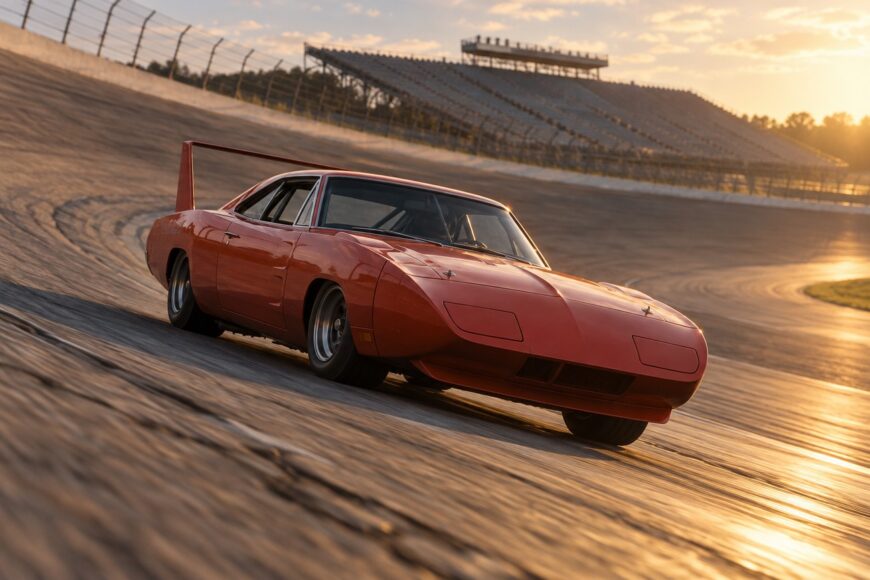
The Dodge Charger Daytona crossed NASCAR’s 200-mph threshold at Talladega, not at Daytona International Speedway. That geographical detail matters because the achievement belongs to a qualifying lap at Talladega Superspeedway, where Buddy Baker drove a NASCAR-prepared Daytona on March 24, 1970.
It also matters what “first” means. Baker’s run was the officially recognized NASCAR stock-car qualifying milestone, rather than a race result or the first vehicle of any kind to reach 200 mph. The road-going Charger Daytona shared the aerodynamic idea and lineage, but it was a homologation car, not the same machine in preparation, setup, or demonstrated speed.
- The Talladega lap that made NASCAR history
- Why Dodge built the Daytona
- What the nose and towering wing actually did
- The engineering beyond the bodywork
- A road Daytona was not a 200-mph race car
- Was the Daytona banned from NASCAR?
- Frequently asked questions
- What was the first car to go 200 mph anywhere?
- How can you tell a factory-built Daytona from a clone?
- What was the first car to exceed 200 mph in NASCAR?
- How fast was the Dodge Daytona in NASCAR?
The Talladega lap that made NASCAR history
Buddy Baker exceeded 200 mph in a Dodge Charger Daytona during qualifying at Talladega Superspeedway on March 24, 1970. The run came before the race, so the record concerns a qualifying speed rather than a race lap or race average.
That distinction gives the achievement its proper scope. Baker’s Daytona became the first stock car to exceed 200 mph in an officially recognized NASCAR qualifying context. It was not the first racing machine, production-derived vehicle, or automobile of any kind to pass that threshold.
Published accounts disagree over the exact decimal figure. Some cite 200.447 mph, while other historical accounts and reconstructions give approximately 200.096–200.3 mph. The defensible historical statement is that Baker exceeded 200 mph at Talladega; choosing one disputed decimal as definitive adds precision the surviving record does not securely support.
Crossing the threshold gave the Dodge program a clear technical and marketing victory. NASCAR stock cars had been approaching that speed as superspeedway development advanced. Baker’s lap demonstrated what carefully prepared aerodynamics, power, gearing, and oval testing could achieve together.
Why Dodge built the Daytona
The Charger Daytona debuted in NASCAR in 1969 as an evolution of the Charger 500. Dodge developed it for superspeedways such as Daytona and Talladega, where small aerodynamic losses accumulated over long, high-speed laps and where a car had to remain manageable in traffic.
The Charger 500 addressed some of the standard Charger’s high-speed weaknesses, especially airflow around the rear window. Engineers then pursued a more radical solution: a long nose to reduce drag and a high rear wing to control the car’s behavior at speed. The package attacked the competitive problem directly rather than treating the road body as sufficient for oval racing.
NASCAR’s homologation system linked the race car to a production obligation. Dodge built more than 500 road-going 1969 Daytonas to satisfy the period’s 500-car minimum for eligibility. Those cars made the aerodynamic concept available through dealerships, while the NASCAR machines received race-specific preparation, suspension work, engine development, and setup.
That separation is important for collectors and historians. A road Daytona proved that Dodge had produced the required design in quantity, but it did not establish that every production example had the capability or balance of Baker’s race car. Homologation established eligibility; competition exposed the advantage.
What the nose and towering wing actually did
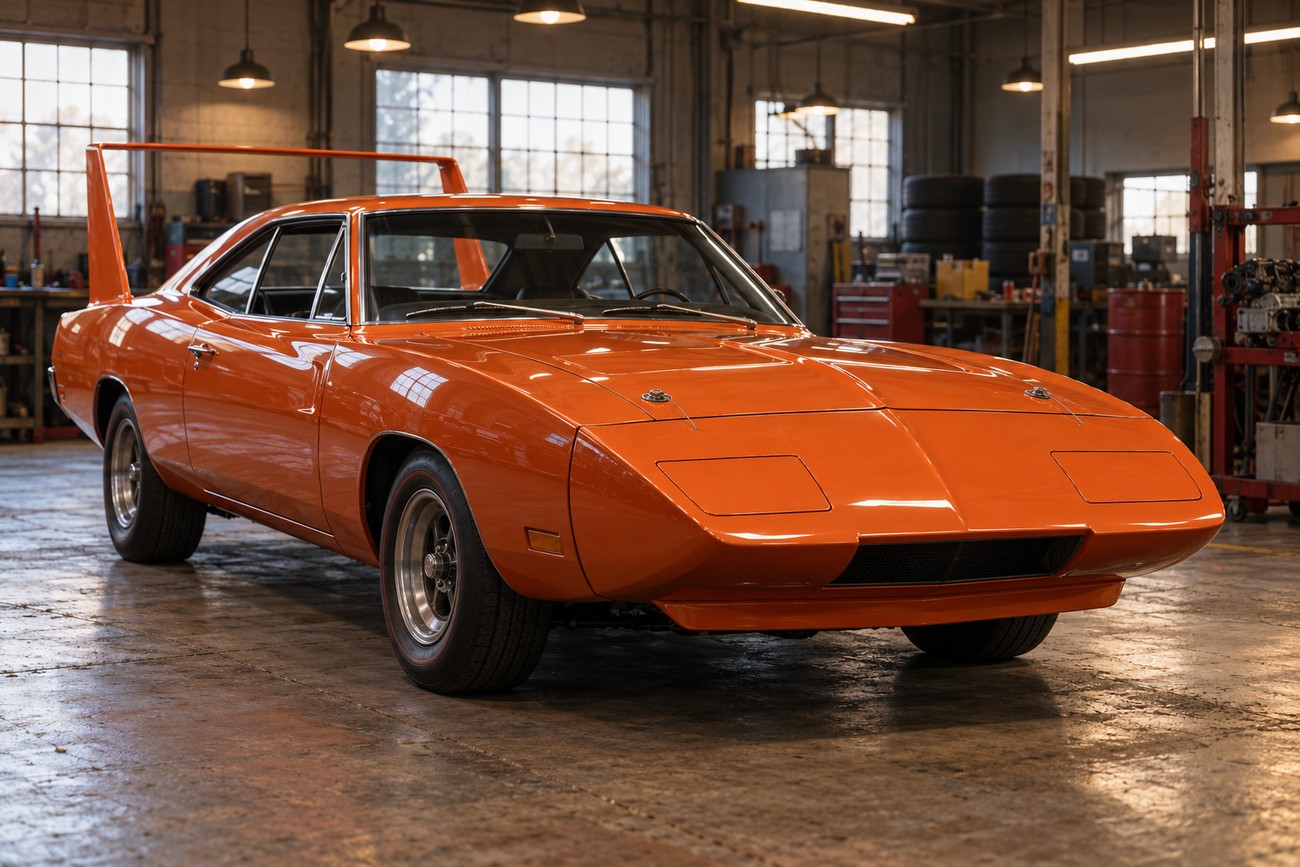
The Daytona’s nose cone extended approximately 18–19 inches ahead of the Charger’s normal front end. Its purpose was to manage the air arriving at the front of the car, reducing drag and helping the body move through the dense airflow of a superspeedway.
The rear wing stood approximately 23–24 inches high. Its unusual height allowed it to work in cleaner airflow above turbulence created by the roof and rear bodywork. That positioning helped provide stability and usable rear-end control at the speeds reached on Daytona-style ovals, especially when cars ran close together.
Stability was the central engineering goal. A fast stock car in a drafting pack encounters disturbed air, changing loads, and small steering corrections, so outright top speed alone is an incomplete measure. The wing and nose were designed to make high-speed oval performance more predictable while preserving the low drag required for a competitive lap.
On ordinary roads, the package offers little comparable benefit. At lower speeds, the aerodynamic surfaces are less influential, while the long nose, tall wing, and restricted rearward view remain present. The design was optimized for a specialized operating environment, and it should not be treated as a universal handling or safety upgrade.
The engineering beyond the bodywork
A wing could not produce Baker’s lap by itself. Daytona-related V8s included the 426 Hemi and 440, and estimates for prepared racing-engine output run around 575–600+ horsepower. Those figures describe period racing-engine estimates, not a verified dyno result for Baker’s specific engine.
Power had to reach the track through suitable gearing. Talladega required a combination that kept the engine in its useful range while limiting unnecessary drag and avoiding a gearing choice that left acceleration weak in the draft. Carburetor setup, fuel delivery, and engine behavior under sustained high-speed load mattered just as much as the nominal horsepower figure.
Testing converted those parts into a functioning race car. The team had to understand how the Daytona behaved in clean air and traffic, then refine its setup for Talladega’s long straights and sustained cornering loads. That preparation explains why a race-prepared Daytona should never be judged from road-car specifications alone.
A road Daytona was not a 200-mph race car
More than 500 road-going Daytonas were produced for homologation, but their purpose was legal eligibility and public sale. A NASCAR Daytona carried race-prepared power, gearing, suspension, tires, safety equipment, and aerodynamic tuning. Treating a surviving road car as a direct equivalent of Baker’s machine creates a serious technical and historical error.
The road version also has practical compromises. The tall wing and unusual rear glass produce poor rearward visibility, while the oval-focused aerodynamic package contributes little at normal road speeds. On a road car with aged tires, original suspension, or poorly chosen modifications, the famous appearance does not guarantee stable behavior at high speed.
Original noses, wings, brackets, and associated hardware can be scarce and costly. Corrosion in original panels adds further difficulty, and restoration work that looks correct from a distance may still contain reproduction parts or altered mounting points. A modern engine installed without matching upgrades to the brakes, suspension, and tires can increase risk rather than improve the car’s real-world capability.
The collector market adds another problem: convincing clones exist. An ordinary Charger can receive Daytona-style bodywork and appear authentic in photographs, while its identity and construction history tell a different story. Provenance, condition, and the quality of the restoration matter more than a seller’s claim that the car is automatically an investment because it is associated with the 200-mph milestone.
Was the Daytona banned from NASCAR?
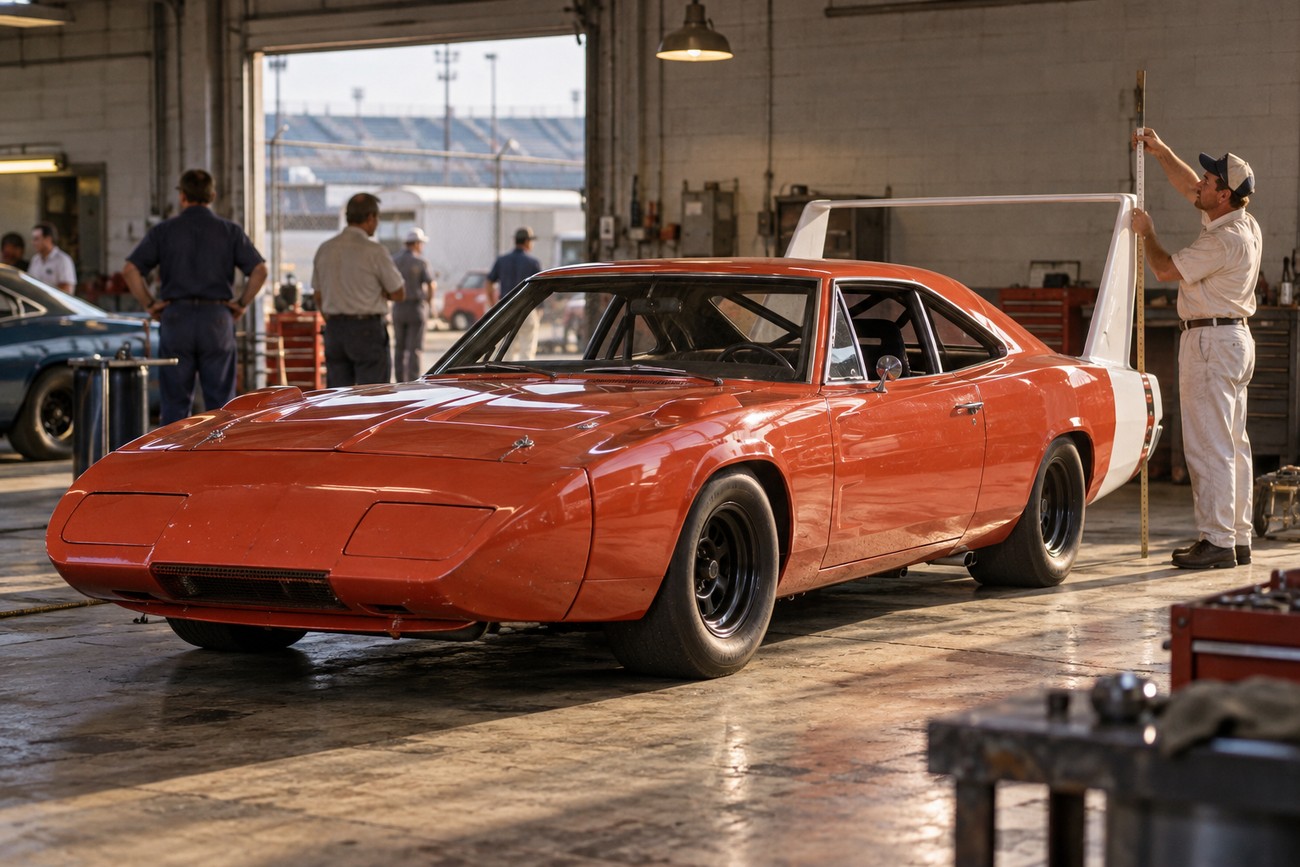
“Banned” is a convenient summary, though it oversimplifies what happened. NASCAR changed rules affecting engine displacement and aerodynamic equipment, reducing the advantage held by the wing cars rather than ending their story through one blanket prohibition.
The Charger Daytona and Plymouth Superbird represented the most aggressive stock-car aerodynamic designs of their period. Their performance forced NASCAR and manufacturers to reconsider how much advantage could come from special noses, extended wings, and large-scale body modifications.
As restrictions tightened, the engineering path that had made the wing cars so effective became less valuable in the top division. The Daytona’s competitive window therefore closed through changing technical rules and eligibility conditions. Its decline was a regulatory and technical process, not proof that the car had suddenly become incapable of speed.
The record remains significant because it marks a recognized NASCAR stock-car qualifying threshold at Talladega. It does not prove that wing cars were unbeatable, universally safer, or equally effective on every circuit. Their success depended on a particular combination of oval geometry, airflow, power, gearing, and team preparation.
Frequently asked questions
The meaning of “first” depends on the vehicle class and how speed was measured. Baker’s NASCAR qualifying milestone is distinct from earlier 200-mph achievements in other classes. The answers below also address Daytona authenticity and the difference between race-car and road-car speed.
What was the first car to go 200 mph anywhere?
There is no single answer without defining the vehicle class and the method of measurement. Land-speed cars, racing machines, and other specialized vehicles reached 200 mph before Baker’s NASCAR achievement. Baker’s distinction is narrower and better documented: he exceeded 200 mph in a Dodge Charger Daytona during qualifying at Talladega, making it the officially recognized NASCAR stock-car milestone.
How can you tell a factory-built Daytona from a clone?
Start with the VIN and supporting production history, then have a marque specialist examine the body and aerodynamic parts. The nose, wing, mounting structure, body details, and surviving documentation should agree with one another; a Daytona appearance kit alone proves very little.
Original aero components and hardware may be scarce, and reproduction parts can require hand-fitting or differ in geometry. A professional inspection is especially valuable before purchase because visual similarity can conceal a converted Charger, mixed original and reproduction components, or incomplete provenance.
What was the first car to exceed 200 mph in NASCAR?
The first officially recognized NASCAR stock car to exceed 200 mph was Buddy Baker’s Dodge Charger Daytona during qualifying at Talladega Superspeedway on March 24, 1970. The milestone was a qualifying speed, not a race-lap result.
How fast was the Dodge Daytona in NASCAR?
Baker’s qualifying run exceeded 200 mph. Published accounts give different exact figures, including 200.447 mph and approximately 200.096–200.3 mph, so “over 200 mph” is the most reliable formulation. The result applies to a prepared NASCAR race car and should not be transferred directly to a standard road-going Daytona.







