
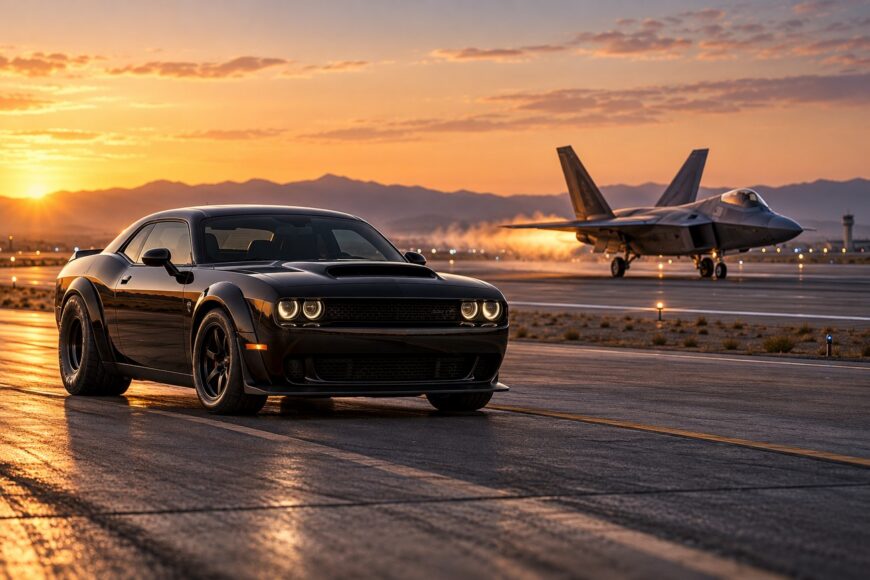
A Dodge Challenger SRT Demon 170 launching alongside a fighter jet makes compelling footage: one stays planted on a drag strip, while the other gathers speed toward liftoff. The spectacle also hides the central problem. They do not necessarily share a starting condition, a surface, an operating limit, or even a useful definition of “winning.”
Dodge claims 0–60 mph in 1.66 seconds, under the manufacturer’s stated performance conditions, and an 8.91-second quarter mile as its factory drag-strip result. Those numbers depend on a high-ethanol fuel setup and careful launch preparation. A jet’s result depends on the aircraft, its takeoff procedure, and the runway and weather; neither vehicle can be assigned a fair advantage until the race is defined.
- The Race Is Only Fair After You Define the Start
- What the Demon 170’s Headline Numbers Really Require
- Why a Fighter Jet May Look Slow—and Still Change the Result
- Demon 170 vs. Fighter Jet: What the Race Actually Measures
- The Hidden Variables Behind Viral Winner Claims
- Frequently asked questions
- Why is the Dodge Demon 170 banned from drag racing?
- What is faster, a Demon 170 or a Trackhawk?
- Why do fighter-jet race videos use a runway instead of a drag strip?
The Race Is Only Fair After You Define the Start
A standing-start drag race measures how quickly the Demon can turn engine output into motion through its rear tires. A fighter jet in this kind of demonstration normally begins a runway roll or takeoff run, which may involve taxiing into position, holding on the brakes, or entering the measured course already moving. Those choices change the timing before either machine’s acceleration is considered.
Distance changes the comparison too. A short course places enormous weight on the car’s initial grip; a longer course gives sustained aircraft thrust more room to matter. A rolling start can remove much of the Demon’s specialized launch advantage, while a runway that must also accommodate takeoff and stopping imposes constraints absent from a drag-strip timing slip.
Aircraft mass, thrust, engine mode, wheel braking, runway condition, available length, temperature, and wind all affect the run. A lighter aircraft using a different engine setting is a different competitor, even if both are called “fighter jets.” Comparing a jet’s thrust figure directly with the car’s horsepower adds no clarity: thrust is a force, while horsepower measures power.
What the Demon 170’s Headline Numbers Really Require
The Demon 170’s factory claims are 0–60 mph in 1.66 seconds, under the manufacturer’s stated performance conditions, and an 8.91-second quarter mile as the factory drag-strip result under those conditions. They describe a prepared run, not a promise for an ordinary stretch of pavement. Reproducing them calls for E85 or a high-ethanol fuel setup, suitable tires, a prepared drag surface, and the correct launch settings.
Its equipment is designed to make those conditions usable. Line lock assists tire preparation; the transbrake, drag mode, and traction-control calibration help manage the launch and power delivery. The driver still has to put the setup together correctly. Lower ethanol content reduces output and acceleration, so fuel availability can prevent a headline-performance attempt before the car reaches the line.
On ordinary pavement, uncontrolled wheelspin can make the car feel far less dramatic than its advertised time suggests. Owner and independent results are often slower than 8.91 seconds because fuel, tires, track preparation, temperature, surface grip, and launch technique vary. That spread does not erase the factory result; it defines the conditions under which the result is meaningful.
Why a Fighter Jet May Look Slow—and Still Change the Result
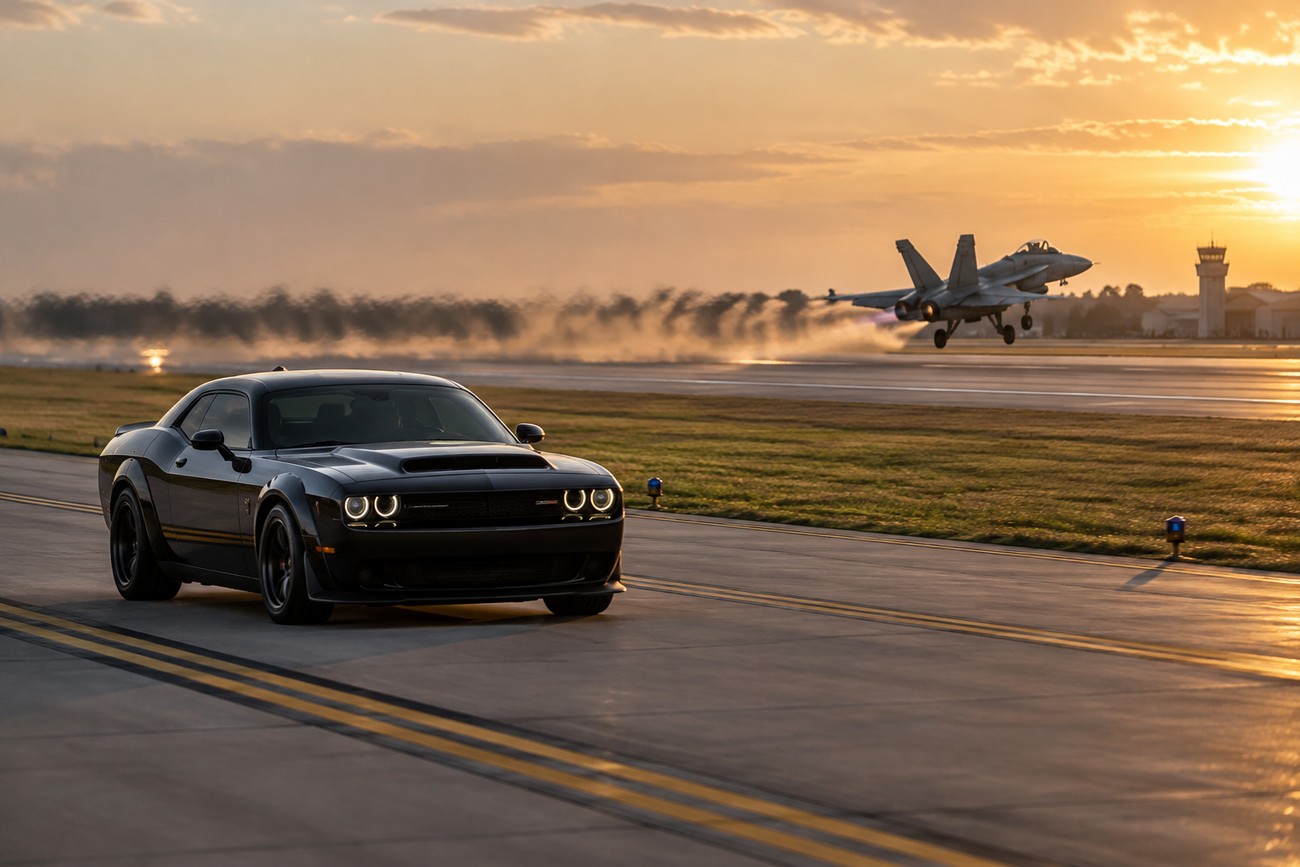
A jet can appear to hesitate beside a hard-launching car because its runway run serves a different purpose. The pilot follows a takeoff profile governed by safe takeoff speed, relevant V-speeds, runway length, and aircraft procedures. The aim is a safe departure, not the lowest elapsed time over a drag-strip distance.
Acceleration also changes with aircraft mass, air density, temperature, wind, runway condition, and engine operating limits. An aircraft carrying a different load or using a different permitted engine mode cannot be represented by one generic “fighter-jet” time. Even wheel braking and the point at which a timed run begins can alter what a video appears to show.
Once airborne, the aircraft has left the car’s performance metric behind. A frame showing the jet passing the Demon does not, by itself, establish a comparable quarter-mile result. Likewise, converting jet thrust into an automotive horsepower figure cannot settle the contest: the quantities describe different things, and useful acceleration still depends on the complete vehicle and its conditions.
Demon 170 vs. Fighter Jet: What the Race Actually Measures
The useful comparison is between defined runs, with the same timing points and a clearly stated finish condition.
| Factor | Dodge Challenger SRT Demon 170 | Fighter jet |
|---|---|---|
| Start condition | Stationary drag-strip launch for its reference times | Specified runway roll or takeoff procedure; a rolling entry must be identified |
| Propulsion | Engine power delivered through the drivetrain and rear tires | Jet-engine thrust; available acceleration depends on aircraft and engine mode |
| Traction | Prepared tires and surface are critical at launch | Wheels support the runway run; engine thrust provides propulsion |
| Principal limits | Grip, launch calibration, gearing, and power delivery | Mass, runway and weather conditions, takeoff procedures, and engine limits |
| Fuel or energy requirement | E85 or a high-ethanol fuel setup for headline performance | Aircraft-approved fuel and a specified operating configuration |
| Meaningful metric | 0–60 mph in 1.66 seconds under the manufacturer’s stated performance conditions; 8.91-second factory drag-strip quarter mile under the stated conditions | Measured time over the same defined course, or aircraft-specific takeoff performance; no universal fighter-jet result |
In a short standing-start contest, the Demon’s early result depends heavily on consistent traction and power delivery through the first 60 feet. Peak horsepower alone cannot rescue a launch spent spinning the tires. That is why its preparation matters as much as the number on a specification sheet.
A longer run or a rolling entry changes what is being rewarded. Sustained thrust may become more important, while the car loses some of the advantage its drag setup creates at the line. That is a possible outcome for a specified aircraft and course, not a rule for every fighter jet.
A credible result would name the aircraft, its mass and engine mode, the runway, the weather, and the starting procedure. It would also identify where timing starts and ends. Without those details, a dramatic finish is evidence of what happened in one demonstration, not a transferable performance ranking.
The Hidden Variables Behind Viral Winner Claims
For the Demon, the least visible variables often decide the first moments. Cold or unsuitable tires, ordinary pavement, incorrect fuel, poor launch calibration, and wheelspin all move a run away from its factory conditions. The 8.91-second quarter mile is a factory drag-strip result, not an everyday-road expectation.
Aircraft footage can conceal a different set of constraints. The jet may be following a safety-limited takeoff procedure, while an edited clip obscures whether it crossed the start line from rest or already rolling. Runway length and stopping or takeoff requirements also shape the demonstration in ways a car-only drag race does not.
More horsepower does not automatically win the launch: traction, mass, gearing, and controlled power delivery determine how effectively the car accelerates. Jet thrust cannot be substituted for a horsepower number to settle the argument, either. Claims that a jet loses from rest but wins after a particular distance require a named aircraft and test conditions; there is no universal crossover point.
The conditional verdict is straightforward. On a prepared short course with a true standing start, a properly fueled and launched Demon 170 is built to be formidable. Change the aircraft, distance, start, runway, or weather, and the result may change with them. The only defensible winner is the one measured under a stated set of rules.
Frequently asked questions
These questions concern event rules and vehicle roles as well as acceleration figures. A sanctioned drag race, an aircraft demonstration, and an informal video operate under different requirements.
Why is the Dodge Demon 170 banned from drag racing?
There is no single universal ban on the Demon 170. Organized events set safety and equipment requirements through their sanctioning bodies, and a car capable of unusually quick runs may need additional compliance before it can compete at a given event. Eligibility depends on the event’s rules and the vehicle’s configuration, rather than its badge alone.
What is faster, a Demon 170 or a Trackhawk?
For a prepared straight-line drag run, the Demon 170 is the more specialized machine. The Trackhawk is a high-performance SUV with different priorities, including utility, traction, and all-weather versatility. A useful comparison should specify the surface and conditions; the Demon’s factory drag-strip claim should not be treated as a guaranteed result on ordinary pavement.
Why do fighter-jet race videos use a runway instead of a drag strip?
An aircraft needs runway space for its operating procedures, potential takeoff, and the safe handling of an aborted run; a drag strip is not designed for that task. Moving the contest to a runway therefore changes more than the backdrop. Its length, surface, starting procedure, and available stopping distance become part of the result, making the footage a demonstration unless both competitors are timed under clearly defined rules.







