
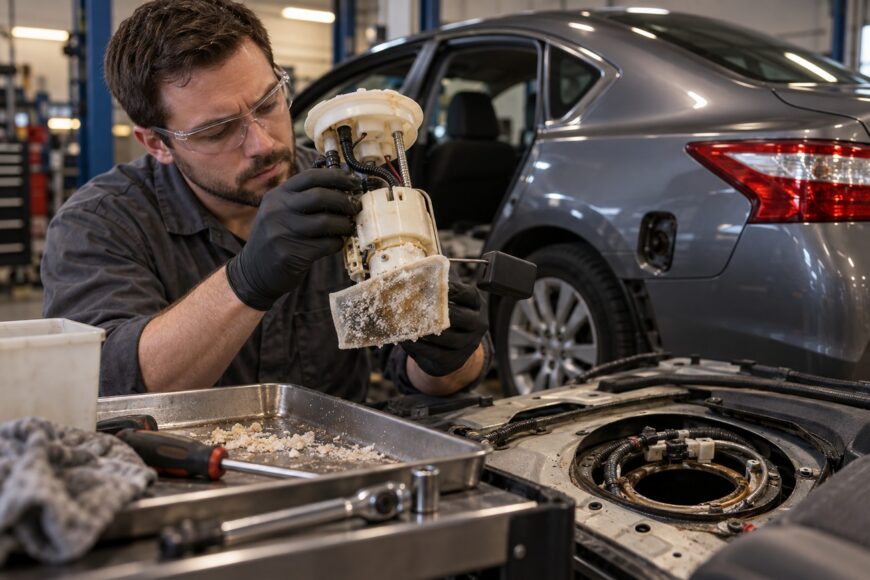
An Altima that starts and stalls, jerks under acceleration, or suddenly shows Check Engine symptoms after suspected tampering is concerning. The popular story that sugar melts an engine is misleading: sugar is poorly soluble in gasoline and generally settles as crystals or residue rather than becoming a syrup-like fuel mixture.
The practical risk is a restricted or contaminated fuel-delivery system. If contamination is reasonably suspected, avoid starting or repeatedly testing the car, because the fuel pump can move debris farther into the filtration system, fuel rail, and injectors. Water, poor-quality gasoline, rust, stale-fuel sediment, and a failing pump can create similar symptoms, so the fuel system needs evidence-based testing before you drive or replace ignition parts.
- What Sugar Actually Does in a Nissan Altima’s Gas Tank
- Symptoms That Can Point to Contaminated Fuel
- What to Do Before You Start the Car Again
- How a Nissan Altima Fuel-Contamination Diagnosis Works
- Why Draining the Tank May Not Be Enough
- Sugar-in-the-Tank Myths That Lead to the Wrong Repair
- Frequently asked questions
- How will I know if someone put sugar in my gas tank?
- What would happen if you put sugar in a car’s gas tank?
What Sugar Actually Does in a Nissan Altima’s Gas Tank
Sugar does not normally dissolve into gasoline as an ordinary fuel component. Because it is poorly soluble in hydrocarbon fuel, it tends to settle as crystals or residue in the tank. It does not become a sweet syrup that flows evenly through the engine.
The main hazard is mechanical contamination. Settled material can reach the pump pickup or strainer, restrict the fuel pump, obstruct filtration, and contribute to problems farther along the fuel lines, fuel rail, or injectors. The resulting fuel-pressure problem can prevent the engine from receiving the volume of gasoline it needs.
Modern Altima models use electronic fuel injection, so restricted delivery can produce hard starting, lean symptoms, misfires, hesitation, or unstable operation. These effects come from insufficient or inconsistent fuel supply. Sugar is not chemically burning through the engine or directly melting internal engine parts.
The timing can also mislead an owner. Material may remain settled until the vehicle moves, the fuel level changes, or the pump draws from the affected area. A car that ran normally before parking may develop symptoms after the next start or during acceleration, even though the contamination was already present.
Symptoms That Can Point to Contaminated Fuel

A contaminated Altima may start and stall after a few seconds, crank for longer than usual, hesitate under acceleration, surge, or develop an unstable idle. Misfires and Check Engine warnings can appear when fuel delivery becomes too restricted for the engine control system to maintain the expected mixture.
These symptoms establish a possible fuel-delivery problem, not the identity of the material in the tank. A failing fuel pump can produce nearly the same pattern, especially if pressure falls under load. Water, rust, stale-fuel sediment, and poor-quality gasoline can also cause rough running or repeated stalling.
Fuel color and odor are unreliable ways to confirm sugar. A residue may look like ordinary sediment, while water and corrosion products can appear equally suspicious in a drained sample. Confirmation requires a physical fuel sample and inspection of relevant fuel-system components.
That distinction matters before replacing spark plugs, ignition coils, or oxygen sensors. Those parts may be affected by engine problems, but they may not be the original cause. Testing fuel pressure and examining the sample can prevent an ignition-system repair from masking an unresolved supply restriction.
What to Do Before You Start the Car Again
If contamination is reasonably suspected, do not start the Altima or repeatedly test the engine. Each test can run the pump and draw settled material into the pump strainer, filtration components, fuel lines, fuel rail, and injectors. Arrange an inspection or suitable transport instead of driving the vehicle to a repair facility.
Adding fresh gasoline may dilute some liquid contamination, but it does not remove residue from the tank or clean material already caught at the pickup. A quick drain-and-refill can therefore leave the underlying restriction in place. The same caution applies to fuel additives marketed as universal cleaners.
Replacing spark plugs or coils before checking fuel delivery can lead to the wrong repair. Those components may be functioning correctly while the engine is receiving inadequate fuel. A technician should first establish whether the problem is fuel contamination, low pressure, or another fault that only resembles contamination.
If the car has already been driven after the suspected event, avoid further trips until the system is checked. Continued operation can worsen a partial restriction and may place additional load on a fuel pump that is already struggling to maintain pressure.
How a Nissan Altima Fuel-Contamination Diagnosis Works
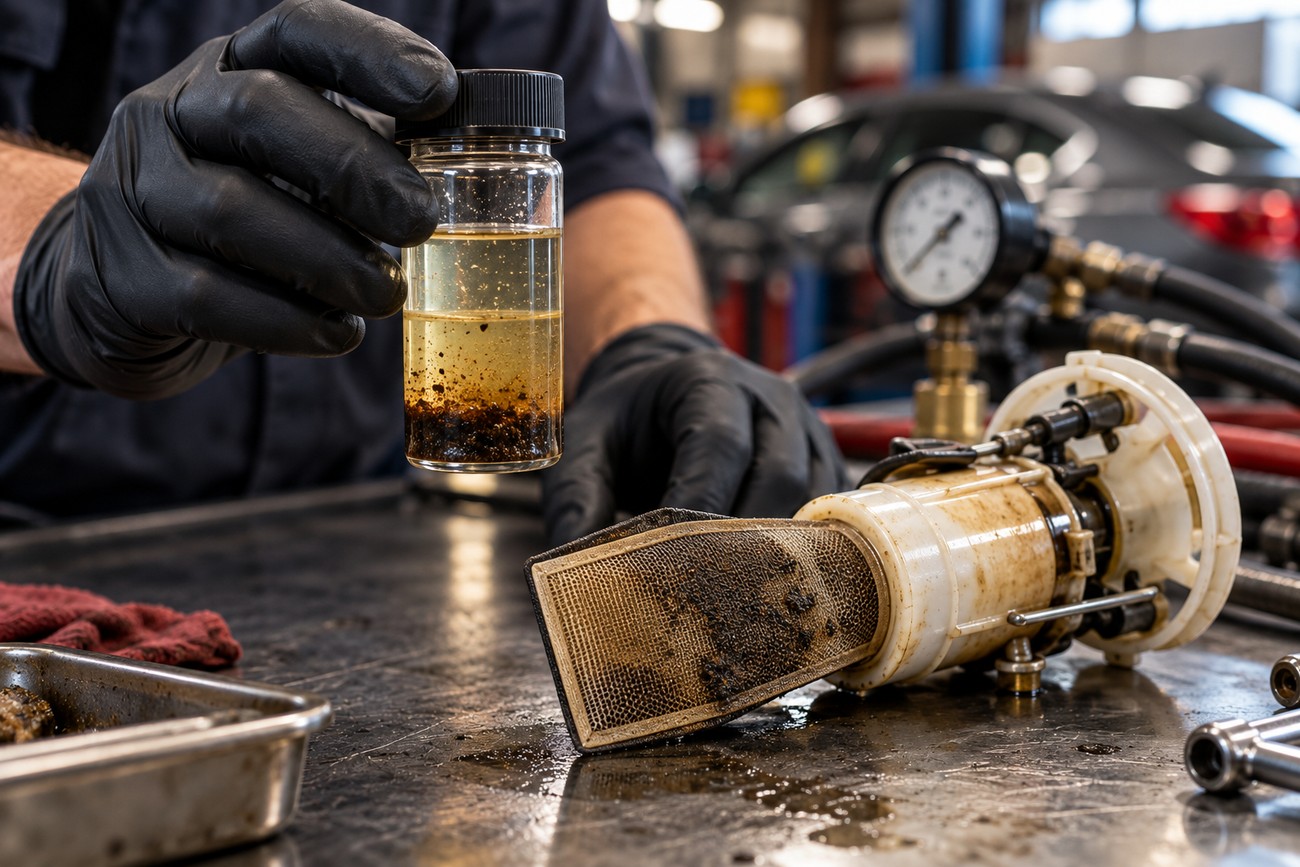
A sensible diagnosis begins with a fuel sample taken safely from the appropriate part of the system. The sample is examined for water, visible particles, unusual sediment, and other evidence of contamination. Symptoms alone cannot identify sugar or distinguish it reliably from rust, stale fuel, or poor-quality gasoline.
The technician then inspects the tank-side filtration and pump strainer, looking for restriction or residue. Fuel pressure is measured against the applicable vehicle specification, including how pressure behaves during starting and under operating conditions. A low reading can result from a restricted strainer, a failing pump, or another supply-side problem.
Measured fuel pressure should be compared with contamination evidence before the pump module is condemned. A clogged strainer and a failing pump can produce nearly identical symptoms, but they do not require the same repair decision.
Injectors are assessed when evidence shows that contamination has moved downstream. Depending on the findings, the repair may involve cleaning, additional component testing, or replacement of damaged parts. Access to the Altima fuel module may require more disassembly than an owner expects, which can increase labor and repair complexity.
Service procedures generally address contaminated fuel as a system condition rather than treating sugar as a routine standalone Altima fault. A vehicle scan may reveal lean or misfire-related codes, but those codes do not prove what entered the tank. Physical inspection remains the deciding evidence.
Why Draining the Tank May Not Be Enough
Draining removes the liquid fuel, but it may leave particles in the tank, around the pump pickup, or inside filtration components. Residue can also remain in fuel lines and reach the fuel rail or injectors after the tank has been emptied. The system therefore may need inspection and cleaning beyond simply installing fresh gasoline.
A restricted strainer can reduce pump inlet flow and make the pump work under unfavorable conditions. If contamination has damaged the pump or obstructed the module, cleaning alone may not restore reliable pressure. Severe cases can require replacement of the fuel pump or the pump module, but that decision should follow inspection rather than a blanket assumption.
Water creates an additional complication. If water entered along with the suspected sugar contamination, symptoms and fuel-system damage can appear faster and become more serious. Prolonged sitting with water or contaminated fuel can also contribute to corrosion of affected components.
Quick-cleaner claims deserve caution when material has reached the pump or injectors. An additive cannot reliably remove a physical restriction from a strainer or repair a pump that has been damaged. The proper repair scope depends on where contamination is found and whether pressure and injector operation recover after cleaning.
Even after a successful repair, the complete fuel-delivery path should be checked before the vehicle returns to normal use. Otherwise, particles left in a line or injector can cause a second round of symptoms and make the original repair appear unsuccessful.
Sugar-in-the-Tank Myths That Lead to the Wrong Repair

The claim that sugar dissolves in gasoline and caramelizes inside the engine is not supported by sugar’s poor solubility in hydrocarbon fuel. The realistic concern is restriction or contamination of the fuel-delivery system, not sugar chemically burning through the engine.
A car that still drives is not necessarily clear of danger. Partial restriction can allow normal operation at light load while causing hesitation, lean symptoms, or stalling when fuel demand rises. Continuing to drive may move more debris through the system or overwork the pump.
Fuel color and smell cannot reliably identify sugar. Water, rust, old-fuel sediment, and poor-quality gasoline can look or smell unusual as well. A physical sample, component inspection, and fuel-pressure test provide stronger evidence than visual suspicion.
Draining and refilling is also not an automatic cure. Material can remain near the pickup, in the filtration system, or downstream in the injectors. Testing the complete fuel-delivery path is a safer basis for deciding whether cleaning is enough or whether a pump or module needs replacement.
Frequently asked questions
The symptoms of contaminated fuel overlap with several ordinary Altima faults. The answers below separate suspicion from confirmation and focus on the decisions that protect the fuel-delivery system.
How will I know if someone put sugar in my gas tank?
You cannot confirm sugar from symptoms alone. Starting and stalling, hesitation, misfires, unstable idle, and Check Engine warnings indicate a possible fuel-delivery problem, but they can also result from water, rust, stale fuel, poor-quality gasoline, or a failing fuel pump.
Confirmation requires examining a physical fuel sample and inspecting residue or restriction in the tank-side components. The pump strainer, filtration, fuel pressure, and injectors should be assessed as indicated by the findings. Color and odor alone are not reliable evidence.
What would happen if you put sugar in a car’s gas tank?
Because sugar is poorly soluble in gasoline, it generally settles rather than forming a uniform mixture. Vehicle movement or pump operation can disturb the material and draw it toward the pickup, where it may restrict fuel flow.
The result can be reduced fuel pressure, hard starting, starting and stalling, hesitation, or misfires. The material does not automatically destroy the engine; the main concern is contamination and restriction across the fuel-delivery path.







