
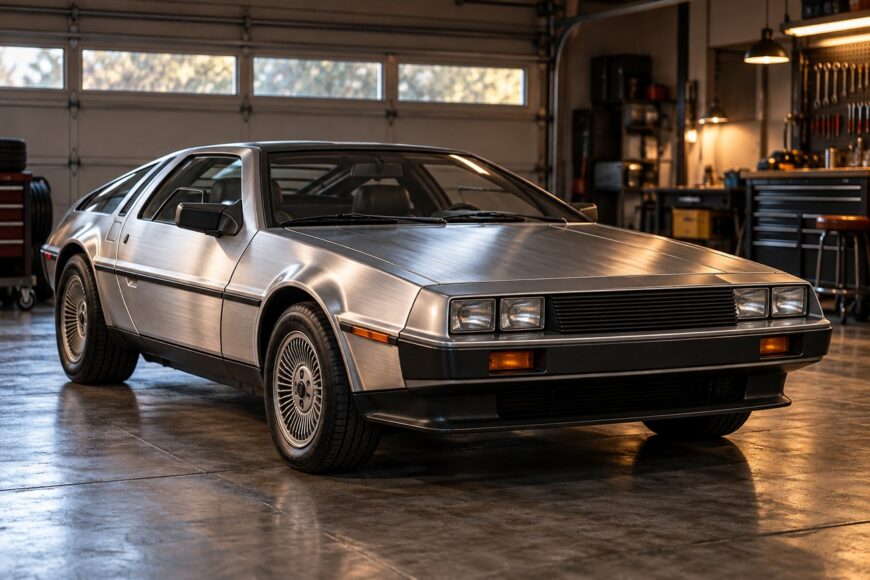
The DeLorean DMC-12 is recognizable because its body was left exposed: brushed stainless steel gives the car a hard, industrial surface that changes with the light, while the gullwing doors turn entry into part of the design. Those features are closely linked to the car’s identity, yet both create ownership demands that ordinary painted sports cars avoid.
Stainless panels show scratches, contamination, and poor repairs clearly. The doors save considerable side space, although they need substantial clearance above the roof and depend on a heavily loaded mechanical system. Understanding those compromises makes the DMC-12 easier to inspect, maintain, and use safely. This is an engineering and ownership explanation rather than a general buying guide.
- Why the DMC-12’s Stainless Body Is More Than a Styling Trick
- How the DeLorean Gullwing Doors Actually Work
- The Gullwing Advantage—and Its Overhead Cost
- Cleaning Brushed Stainless Steel Without Ruining the Grain
- Scratches, Dents, and Corrosion You Cannot See at First Glance
- Common DeLorean Door and Stainless-Steel Myths
- Frequently asked questions
- Was the DeLorean body stainless steel or aluminum?
- What is the average price of a DeLorean DMC-12?
- What is the cheapest car with gullwing doors?
- What kind of doors did the DeLorean have?
Why the DMC-12’s Stainless Body Is More Than a Styling Trick
The visible body panels are brushed austenitic SAE 304 stainless steel. They were normally left unpainted and without clear coat, so the directional brushed grain is the car’s actual exterior finish. Light reflects along that grain, giving the DMC-12 its familiar silver appearance without a conventional paint film.
That skin is attached to a composite or fiberglass underbody. The stainless panels are therefore not an independent load-bearing frame, and a straight-looking exterior does not automatically prove that the structure beneath it is sound. Damage around panel mounts, attachments, or the composite foundation can remain hidden until the car is examined from below or partly disassembled.
SAE 304 resists ordinary atmospheric corrosion well, which explains why many panels remain presentable decades later. “Stainless” describes corrosion resistance rather than total immunity. Iron contamination, harsh chemicals, abrasive damage, and corrosion in nearby steel components can still create visible or structural problems.
How the DeLorean Gullwing Doors Actually Work
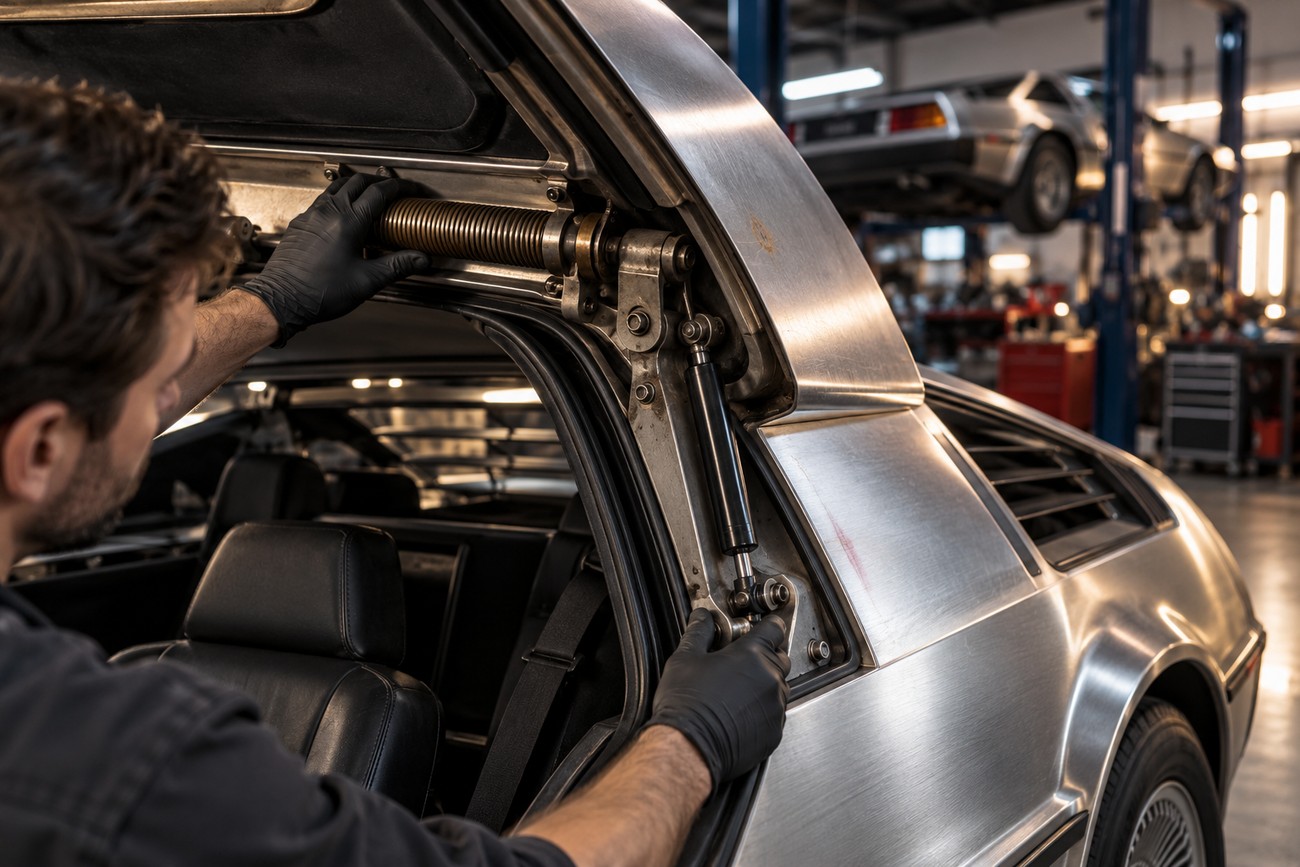
The DMC-12 uses heavy gullwing doors hinged at the roof sides. Their weight is balanced principally by torsion bars, which store and release energy as the doors move. Gas-filled struts assist movement, smooth the action, and help retain the doors at their end positions.
This distinction matters because a tired gas strut is only one possible cause of poor door behavior. Torsion-bar adjustment, hinge condition, mounting points, and door alignment all affect the force required to open the door and the confidence with which it stays open.
Replacing gas struts alone may leave a heavy door unsafe if the torsion-bar adjustment, hinges, or mounts are already compromised. The complete movement of the door should be assessed before one component is blamed.
Stored energy makes torsion-bar work a specialist operation. Incorrect removal, installation, or adjustment can release force suddenly, so the correct procedure and tools matter. A door that drops, twists, or feels sharply uneven deserves inspection before repeated use, since the mass of the door magnifies a fault in the mechanism.
The Gullwing Advantage—and Its Overhead Cost
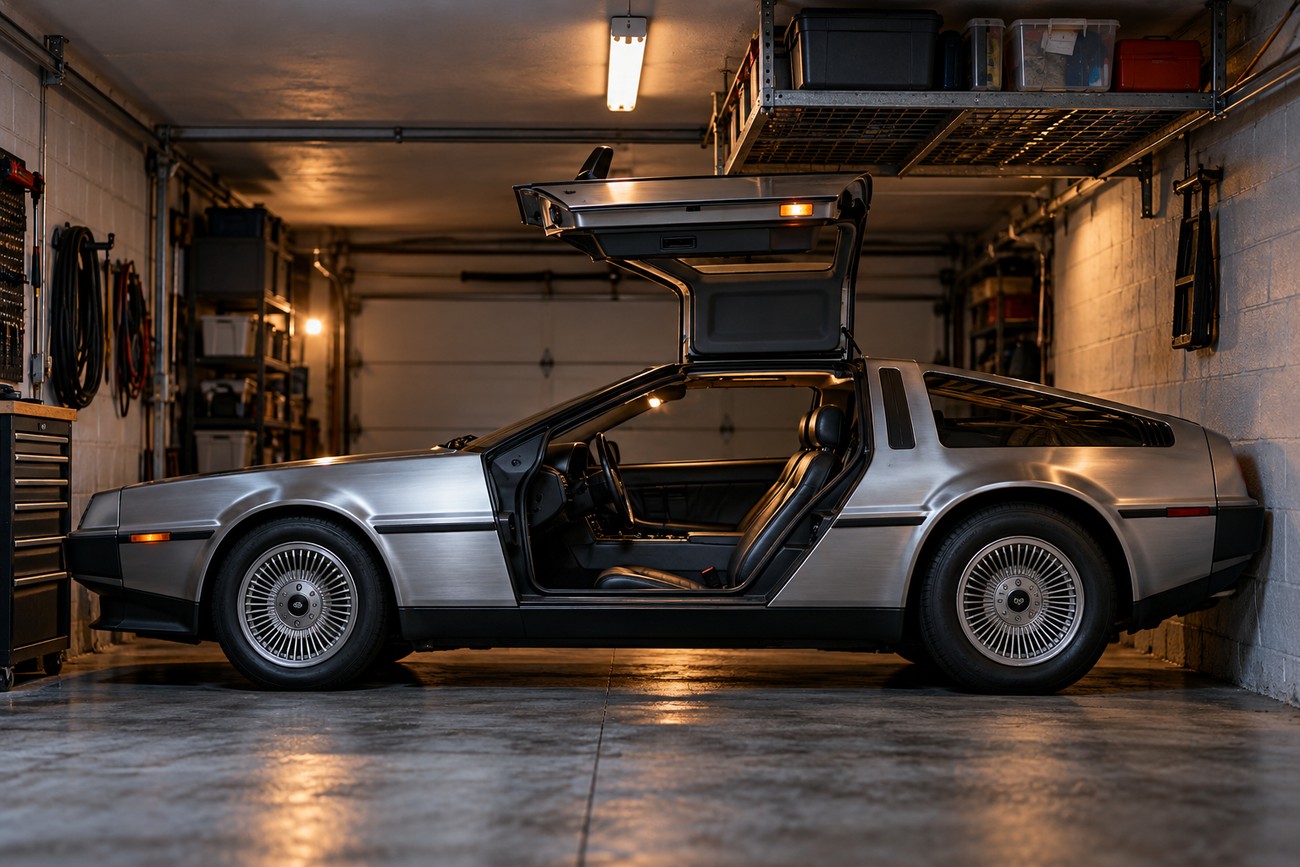
A gullwing door opens upward rather than swinging through a wide arc beside the car. When fully open, it projects approximately 11 inches beyond the side contour, so the DMC-12 can require less lateral clearance than a conventional side-hinged door. That helps in a narrow parking bay, provided the surrounding walls and vehicles leave enough room to stand beside the car.
The trade-off is height. The vehicle measures approximately 44.9 inches high with the doors closed and approximately 77.2 inches with a door fully open. A garage ceiling, suspended light, storage rack, or door opener can therefore become a collision hazard even when the floor space appears generous.
Checking only the width of a garage is a common mistake. Measure the available height at the actual door position, and account for anything hanging below the ceiling. A weak gas strut or incorrect torsion adjustment adds another risk because a heavy door may fail to stay open or move unexpectedly while someone is entering.
Cleaning Brushed Stainless Steel Without Ruining the Grain
The owner’s manual permits washing with warm water and a low-foaming detergent. This is a deliberately restrained routine: remove loose dirt first, wash without aggressive scrubbing, and rinse away residue before it dries. The objective is to clean the surface while preserving the factory direction of the brushed grain.
For tar and grease, the manual identifies gasoline or mineral spirits. Such solvents require sensible ventilation, suitable containers, and careful handling around seals, trim, ignition sources, and other materials. Test a small inconspicuous area when the condition of a coating, replacement panel, or previous repair is uncertain.
Light marks may sometimes be corrected by working with the original grain, although a local repair that crosses the grain can be more visible than the scratch itself. Steel wool and metallic abrasives are best avoided: they can leave visible damage and may introduce iron particles that later produce rust-colored contamination on the stainless surface.
Scratches, Dents, and Corrosion You Cannot See at First Glance
A shallow surface mark and a deep dent require different decisions. The former may respond to controlled texture correction, while a creased or stretched panel can exceed what ordinary dent work can restore. Painting over the damage also changes the character of the car and does not recreate the original brushed finish.
Serious panel repair requires equipment and a process capable of reproducing the directional texture. The replacement material, shaping method, and final brushing pattern all affect the result. A technically straight panel can still look wrong if its grain runs at a different angle or has a different density from the surrounding panels.
Rust-colored spots on the exterior do not always mean that the 304 panel itself has deeply corroded. Iron particles can become embedded in the surface and oxidize, creating staining that resembles ordinary rust. Removing the contamination without leaving a new cross-grain mark calls for more care than simply polishing the area until it shines.
The stainless skin also says little about concealed steel parts. Subframes, fasteners, brake components, and other hidden steel elements can corrode while the outer panels remain visually convincing. Inspection should therefore include the underside, mounting points, door hardware, and the condition of the composite underbody and its attachments.
Common DeLorean Door and Stainless-Steel Myths
The first myth is that stainless steel cannot rust. SAE 304 is corrosion-resistant, yet iron contamination, chemicals, and abrasive damage can stain or mark it, while surrounding steel parts remain vulnerable to corrosion. The exterior material reduces one class of problem; it does not remove the need for inspection.
The second myth gives gas struts responsibility for the whole door. Torsion bars provide the principal compensation for door mass, while gas-filled struts assist movement and help retain the door at its end positions. Replacing struts without checking torsion adjustment, hinges, and mounts can leave the underlying fault untouched.
Gullwing doors also do not eliminate clearance planning. They reduce lateral clearance needs, but a fully open door raises overall height to approximately 77.2 inches and can strike overhead equipment. Likewise, every scratch is not a job for an abrasive pad: correction must preserve the original directional grain, and deep damage may require professional texture reproduction or panel replacement.
Door operation belongs on the regular maintenance checklist. The owner’s manual treats it as a recurring maintenance check rather than a one-time inspection after purchase. Changes in opening effort, movement, alignment, or the ability to remain open are useful warnings that the complete system needs assessment.
Frequently asked questions
The DMC-12’s signature features often produce simple answers that conceal important distinctions. These points separate the visible skin from the hidden structure, and the advertised design from the cost of keeping it usable.
Was the DeLorean body stainless steel or aluminum?
The visible exterior panels were brushed SAE 304 stainless steel, not aluminum. They were normally unpainted and without clear coat, which is why the directional grain remains visible as the car’s finish.
The outer skin should not be confused with the body structure. Stainless panels were attached to a composite or fiberglass underbody, so assessing the car requires attention to both the visible panels and the condition of the foundation, mounts, and concealed steel components.
What is the average price of a DeLorean DMC-12?
There is no reliable single average price without current, source-specific market data. Value varies with condition, originality, documented history, panel quality, and the state of the doors and hidden structure.
A car with attractive stainless panels may still need substantial work in its door system, subframe, or composite attachments. Conversely, a car with cosmetic marks may be mechanically more useful. Comparing the inspection evidence and repair requirements is more informative than treating one market figure as a universal guide.
What is the cheapest car with gullwing doors?
There is no stable universal answer based only on the lowest purchase price. A low-priced gullwing car may need door hardware, structural repairs, specialized panel work, or other corrections before it is safe and practical to use.
Judge the total project instead: inspect the hinges, mounts, balancing system, door retention, body condition, and available parts or expertise. The cheapest listing can become the more expensive choice when essential repairs are hidden behind an appealing exterior.
What kind of doors did the DeLorean have?
The DeLorean had heavy gullwing doors. They are hinged along the roof sides and rise upward, unlike conventional side-hinged doors, which pivot outward from vertical hinges.
That arrangement is also distinct from scissor doors, which pivot upward around hinges near the front edge of the door. The DMC-12’s roof-side hinge layout explains both its limited lateral projection and its demanding overhead clearance.







